Monday, February 18, 2013

The Early Medieval Countryside

by Carol McGrath

A knowledge of landscapes can be of use to the historical author to create a faithful atmosphere and background for a novel set in, for instance, the medieval period. There are various helpful writings to help us piece together a picture of the medieval English countryside.  Domesday Book is an obvious starting point. Scribed in 1086 it was a planned record of land tenure and a first census. It gives us a view of the medieval manor and a sense of the countryside as well as towns. It does sometimes omit taxable things such as ship yards but it does include woods which were, in fact, not taxable. Since it records changes from just before the Conquest of 1066 it is possible to get a sense of a demesne typical of a particular region. I consider it an invaluable resource.


Page for Warickshie in the Domesday Book


So what was the medieval countryside like? Regions of England are of great antiquity. County and parish boundaries were often determined a thousand years ago. Landscapes clearly vary. There is a difference between ancient countryside and planned countryside. Both existed in medieval England. Ancient countryside historically contained perhaps a modest extent at most of open fields, but it had ancient hedges,small woods and much heathland. It contained non-woodland trees such as oak, ash, alder, birch and many ponds. Planned countryside however had a strong tradition of open-field farming beginning early on and lasting until the Enclosure Act period. Hedges were modern, woods absent, large heaths rare and there was little bracken or broom. Trees were non-woodland thorns and elders. There were few ponds and interestingly the Normans, as did the Romans, drained fen-land.

A Victorian vision of the medieval wild wood


Further historical evidence of the medieval English countryside lies in plant debris ranging from tree trunks to bud scales. Pollen analysis tells us much about the wild wood in the past.


Anglo-Saxon Charters clothe an archaeological record with vivid detail and describe what specific pieces of the countryside looked like. They show the conveyance of a piece of land usually in Latin. The charter would contain a sermon, the name of the premises, the nature of the transaction, a list of witnesses and a curse, a horrible curse on anyone who would subvert the title. The charter contained details of land management and common rights. Now this bit is my personal favourite concerning land charters. They would have what is termed a perambulation. This would describe, usually this time in old English, the piece of land's boundaries proceeding from point to point in a sun wise direction. From AD 600-1080 there are 840 perambulations that describe landmarks that enclose an area. For example, a grey apple tree marked a boundary of Crowhurst near Hastings, close to the 1066 battlefield at Senlac. Charters are useful for the researcher because they portray the England of 100-200 years before the Domesday Book. I used both Domesday and charters in my research for The Handfasted Wife. They point to features such as trees, linear features such as hedges, streams and hills. And it is interesting to remark here that the word forest was not used until later. When it was used it meant a region where a king has the right to keep deer. Usually a place to keep deer was referred to as a park in the eleventh century.

Hares abounded but rabbits were introduced after 1066.


And so by 1250 woods covered only a few per cent of England. They had definite names, boundaries, and acreages, and they were private property that were extensively managed. They were permanent.

For further information I suggest The History of the Countryside by Oliver Rackham and seeking out Anglo-Saxon Calendars and of course The Domesday Book.

Carol McGrath, author of The Handfasted Wife, a story of Edith Swanneck, King Harold's common-law wife, to be published May 2013 by Accent Press. 

Rescued by a Duke, by Ruth J. Hartman

Ruth J. Hartman is giving away an ecopy of her novel Rescued by a Duke. You can read more about the book HERE, and you will be prompted to return to enter by commenting on this post. Please be sure to leave your contact information.

Sunday, February 17, 2013

Strawberry Hill House - a neo-Gothick castle which heralded in an architectural revolution.

By Mike Rendell

In 2010 a remarkable house, situated south west of London, emerged from its chrysalis of scaffolding and protective cladding and was revealed in all its original glory: Strawberry Hill House. It has been likened to a wedding cake on account of its beautiful white exterior finish called ‘harling’ (a lime and pebble stucco render). It may be decorated like icing, but to me it is altogether lighter - more like a confection made of whipped cream! It really is a masterpiece and its resurrection is all the more remarkable because by the end of the Twentieth Century the place was in a terribly dilapidated state. Three cheers for English Heritage and the Lottery Fund, who between them raised the majority of the nine million pounds needed to restore the building which kicked off the neo-Gothic movement!

I cannot claim that I am enamoured with what Victorian Gothic became (think of the heavy, over-ornate architecture of the Houses of Parliament) but I have to say that its Georgian precursor of Strawberry Hill Gothic (as the style became known) is astonishingly delicate, vibrant – and fun!
The style is down to the vision and verve of Horace Walpole, who bought what was an eighty-year old villa near the banks of the River Thames, at Twickenham, in 1747. The previous owner was a well-known shopkeeper who sold toys and trinkets by the name of Mrs Chevenix, and Horace Walpole described his purchase as "a little plaything that I got out of Mrs Chevenix's shop and is the prettiest bauble you ever saw." Over the next fifty years he transformed it into a Gothic fantasy - into what he whimsically described as "the castle I am building of my ancestors".


Walpole used it as his summer residence. In those days it was half a day’s ride from the centre of London, eleven miles away. It was not in a particularly fashionable area, but Walpole created a wondrous creation to impress and amuse his friends – and to house his astonishing collection of books, paintings, furniture, coins and historical artifacts.
He could hardly have come from a better-connected family: his father Robert was the first British Prime Minister, and Robert had built his rather solid ancestral home in Palladian style at Houghton Hall in Norfolk. Horace was the youngest son and he did what was expected of him: he went to Eton, then went up to Cambridge, failed to take his final examinations, and then set off on the Grand Tour for a couple of years. He returned in 1741 and immediately entered Parliament, but his main interest seems to have been the acquisition of paintings and artworks. Strawberry Hill was his chance to showcase the collection; he had some 4000 items including drawings by Holbein, paintings by Sir Joshua Reynolds, Renaissance armour, and objets d’art. The architectural symmetry so favoured by contemporary architects disappeared out the window, to be replaced by crenellations, gothic window frames, Tudor turrets, Jacobean chimneys and details from his imagination. Horace Walpole never intended it to be built to last – he himself doubted if it would remain more than ten years after his lifetime. Why? Because it was jerry-built, a piece of froth, a sham. Where others used plasterwork Walpole used papier mache, but to what effect! The interiors were stunning, and it is thanks to a brilliant restoration programme that they have been put back to their former glory. In all there are 25 show rooms which have been meticulously restored on the ground and first floors. Most significantly, all the cement render has been hacked off and the exterior put back to its white stucco finery.

Horace Walpole was a remarkable man - an effete, an aesthete, a dilettante, a collector and an innovator. He died in 1797 at the age of eighty.
Of course it is a shame that none of the contents remain. In an act of cultural desecration the contents were sold off separately in 1843, although the V&A were able to track down nearly three hundred of these items in a major exhibition in 2010.
Outside, Walpole’s pride and joy was his lime tree grove, and this is now being replanted. As Walpole wrote in 1753 “it is an open grove through which you see a field which is bounded by a serpentine wood of all kind of trees and flowering shrubs and flowers”. Nothing much can be done about the fact that the fields have been replaced with modern housing, but hopefully the gardens will soon prove to be a magnificent setting for this extraordinary creation, one which triggered off the architectural movement which dominated the ensuing century. Strawberry Hill house is at 268 Waldegrave Road, Twickenham, TW1 4ST and is administered by the Strawberry Hill Trust. The house has been closed for the winter, with a re-opening date of 3rd March 2013. The trust website is here, and I am grateful to them for the use of all the images used in this post (apart from the John Giles Eccardt portrait of Horace Walpole from 1754, which is shown courtesy of the National Portrait Gallery).

Mike is author of a book on life in Georgian England entitled The Journal of a Georgian Gentleman, available on Amazon or from Mike direct on info@mikerendell.com He writes a regular blog on all-things-Georgian here.

Saturday, February 16, 2013

London was Home to Henry James and John Singer Sargent

by Mary F. Burns

I grew up in love with England. Even before the Beatles showed up on the scene, I’d been reading about King Arthur and the Knights of the Round Table, and I longed to visit Camelot and Stonehenge and the Tower of London. Mary Stewart’s deep and imaginative rendering of the Arthurian legend through the eyes of Merlin—from young boy to ancient spirit of the woods—was a constant inspiration and delight. In college, I read Jane Austen for the first time, and I also fell deeply in love with Henry James—probably the most prominent American to love England so much he ultimately became a citizen of that country on 26 July 1915, about six months before he died, as a declaration of loyalty to his adopted country and in protest against America's refusal to enter the war. James lived in London for many years, was a member of the Reform Club (which I visited in 1993—they were finally allowing ladies in for luncheon), and settled in Rye, at Lamb House, which is a National Trust property.

In 1999, I came across the paintings of John Singer Sargent at a huge exhibition in Washington, D.C. and found that he was another American who lived most of his life in Europe and especially in England, after 1884 until his death in 1925. I was overwhelmed by his stunning, enormous portraits, and vowed I would write a novel about him. While conducting research about Sargent, I discovered that he not only knew Henry James, but also that James was an active patron of the young painter, and was very influential in persuading him to leave Paris and come to live in London. I had no trouble imagining why these men preferred England (or Europe) to America. James’s novels are the quintessential exploration of the differences between the Old and the New Worlds, usually as seen through the eyes of a fresh, young, innocent American who comes upon the landscape of the tired, cynical and sinful Europeans who both misunderstand and underestimate the newcomer. But it’s clear that James nonetheless admires those very cynics, those inveterate, experienced sinners, and is convinced there is much to learn from them, and knowledge to be gained that one simply cannot get in the United States. (Just read The Ambassadors!) Sargent, on the other hand, was actually born in Florence, Italy—his parents were the ex-patriates, especially his mother, who vastly preferred Europe to American, and rarely went back home to Boston, despite her husband's longing to do so.

Sargent spoke five languages, was a talented musician and obviously a brilliant artist. He settled in Paris after his art training, when he was in his early twenties, and he intended to stay there—but scandalous circumstances in 1884 made it impossible for him to earn a living in Paris, so he fled to London and was assisted by Henry James and other friends in making himself known to potential clients. He eventually rented a studio on Tite Street in Chelsea, just north of the River Thames. In the late 19th century, Tite Street was a favored and fashionable location for people of an artistic and literary disposition. Sargent’s residence was at No. 31 and his studio at No. 33, formerly the studio of James McNeill Whistler. Other famous people who lived at Tite Street at the time were Oscar Wilde and Edwin Austin Abbey.

In a way similar to the experience of the Impressionists in Paris, whose paintings were rejected so thoroughly by the academic Salon held every year that they started their own gallery (helped by wealthy friends) to exhibit their “plein air” paintings, the upstart artists in London were enormously assisted by the opening of the Grosvenor Gallery in 1877 by Sir Coutts Lindsay and his wife Blanche (née Rothschild). Initially, the Grosvenor was a showcase for the works of the Pre-Raphaelite painters—such as Edward Burne-Jones, William Holman Hunt, John Everett Millais, Dante Gabriel Rossetti, and Walter Crane, whose paintings were not approved by the Royal Academy of Art for its annual exhibition. Unlike both the Royal Academy and especially the French Salon, the Grosvenor approached art exhibitions in a completely new way, placing several works by an artist in the same room, arranged with ample space and natural lighting to help the viewer appreciate the works as part of a whole style or way of painting.

In 1877, a famous incident occurred there when the art critic John Ruskin visited the gallery, where an exhibition of paintings by Whistler was on display. Ruskin's savage review of Whistler's work led to a long-drawn-out libel case between the two men. Sadly, although Whistler won the case, the judge awarded him a mere farthing in damages, leaving the American artist bankrupt and bitter. But the case made the gallery famous as the home of the Aesthetic movement, which was satirized in Gilbert and Sullivan’s musical Patience, a play about the folly of chasing fads, which includes the line, “A pallid and thin young man, A haggard and lank young man, A greenery-yallery, Grosvenor Gallery, Foot-in-the-grave young man!”

Henry James wrote essays on art criticism for both London and New York magazines, and frequently attended the Grosvenor Gallery, where in 1882, Sargent exhibited three Venetian studies, of which James spoke highly. A large and brilliant portrait by Sargent titled “Dr. Pozzi at Home” was exhibited the same year at the Royal Academy—James referred to it as “splendid” and, comparing it to two portraits of Cardinals (Manning by Watts, and Newman by Millais), wrote that “Sargent’s flamboyant physician out-Richelieus the English Cardinals, and is simply magnificent.” An English friend of Sargent’s, Violet Paget (whose pen name was Vernon Lee), wrote to a friend about this portrait: “I went to the Academy, poor stuff for the most part, but John’s red picture, tho’ less fine than his Paris portrait, magnificent, of an insolent kind of magnificence, more or less kicking other peoples pictures to bits.”

As in Paris, Sargent was able to straddle both the accepted and the new worlds of art in London, too. He became so in demand by the London aristocracy and wealthy merchant class that his popularity was depicted in a cartoon by the famous Max Beerbohm, showing wealthy female clients lined up at his door, and Sargent peering warily out the window at them. By the early 1900’s, Sargent was thoroughly tired of portraiture, and as he’d earned vast amounts of money in the previous decades, he spent more time painting landscapes, or more “impressionistic” figures in landscapes. A great way to take a look at hundreds of Sargent paintings is visit the online site www.jssgallery.org .

John Singer Sargent died on April 14, 1925, and is buried in Brookwood Cemetery, Surrey. Henry James died on February 28, 1916, and is buried in Cambridge Cemetery, Cambridge, Massachusetts.

A little about me:

Mary Burns lives in San Francisco with her husband Stu. She is a member of and reviewer for the Historical Novel Society, and she is on the planning board for the North American HNS Conference to be held in St. Petersburg, Florida in mid-June, 2013. Her novel Portraits of an Artist, about John Singer Sargent, is available online and in bookstores from Sand Hill Review Press (ISBN: 9781937818128). Please visit her blog at www.portraitsofanartist.blogspot.com, on her Facebook Author Page, or at Goodreads.


N.B.—A Giveaway of a copy of Portraits of an Artist will be posted on this blog for the week of February 25th.

Friday, February 15, 2013

Mysteries and Secrets: Queen Victoria, her physician Sir James Reid, and John Brown


by Stephanie Cowell

The story behind the genesis of this biography of the Victorian physician Sir James Reid who died in 1923 is almost as fascinating as the story itself.  The physician’s grandson inherited Sir James’ home of Ellon Castle in Aberdeenshire.  And his wife, on a cleaning spree one day, peered into a dark cupboard. Among the dusty albums was a large cash box containing forty small pocket diaries written in neat tiny handwriting which proved to be a meticulous daily account of Sir James’ life as he worked with his most famous royal patient and her family.  Michaela Reid read the diaries and pored through the dusty scrap albums to write her biography ASK SIR JAMES.  But she was never able to study the medical diaries and something called the Green Memo Book because they were burned for the sake of discretion by Sir James’ son.

What secrets did those ashes contain? 

The Queen and John Brown
James Reid, Queen Victoria's Scottish personal physician for the last 20 years of her life, became her intimate friend and counselor as well and steered her through many muddles and crises. He lived daily with her extraordinary extended family, seeing the more human, humble, and lonely side of the widow. So possessive was she of him that when he married her lady-in-waiting, she hardly allowed him the time to do so. When she knighted him, she first noticed his bald spot. He may have earned the bald spot in service to her.

James Reid knew her well, and likely knew the truth about her relationship to her Scottish servant, the burly, earthy and whiskey-drinking John Brown to whom she became close in her widowhood. Was the real truth committed to the fire to conceal it? Sir James was as a discreet a man as he was a gifted physician.

Sir James Reid
 
When Edward VII became King he gave Reid the task of retrieving letters about John Brown for which the King was being blackmailed. They were letters written by Victoria, over three hundred of them which Reid called “most compromising.”

In January 1901 when Victoria died, the care of the body was Reid’s until the coffin was sealed. He adhered to the burial instructions and placed in the coffin many mementos from her family and friends. Among them was “the plain gold wedding ring which had belonged to the mother of my dear valued servant and friend J. Brown which I have worn constantly since his death, a coloured profile Photograph in a leather case of my faithful friend J. Brown, his gift to me—with some of his hair laid with it…” Reid wrapped these things in paper and covered them with Queen Alexandra's flowers so that they could not be seen by the family.

John Brown

 A rumor remains that John Brown married his sovereign secretly who bore him one to three children. The Queen's daughters joked that Brown was "Mama's lover” and the Earl of Derby noted in his diary that Brown and Victoria slept in adjoining rooms. But surely the Queen would not have taken a lover or remarried while she had her late husband Albert’s hot shaving water brought in each day of the more than forty years of her widowhood!

Victoria needed a strong man on whom she could depend. There are many kinds of love. This was an unusual relationship, to be sure, so beautifully portrayed in the film Mrs. Brown.

A letter from the Queen was discovered in the Suffolk Record Office by Bendor Grosvenor, a PhD student at the University of East Anglia, while writing a thesis on Disraeli's government. It is address to Lord Cranbrook who was Victoria’s close friend and compared the loss of John Brown to the loss of her husband Albert. Brown had died suddenly and the Queen poured out her grief without restraint.

Though many secrets are revealed in this fascinating biography, the most personal of them we can only guess. The deepest privacy of the old Queen was kept forever by her faithful physician-in-ordinary.

Billy Connolly and Judi Dench in MRS. BROWN


Historical novelist Stephanie Cowell writes about English history and historic people in the arts. She is the author of Nicholas Cooke, The Physician of London, The Players: a novel of the young Shakespeare, Marrying Mozart (which debuted as an opera/play in NYC this past December) and Claude & Camille: a novel of Monet. She is the recipient of the American Book Award. Her work has been translated into nine languages. Her website is http://www.stephaniecowell.com

Thursday, February 14, 2013

The First Female Pioneers of Aviation

by Diana Jackson

Everyone has heard of Amy Johnson and Amelia Earhart, pioneers in aviation in the 1930’s, but during my research I have discovered many women whose endeavours matched those male counterparts of their era as far back as 1910. Their daring to venture in what was seen as a man’s world accomplished much more than their achievements in flying alone, although these were certainly remarkable. They also designed clothes, opened factories, begun flying schools and fought prejudice at many levels. They were not, as I had imagined, all rich young ladies with plenty of time on their hands, but women who dared to be different.

Harriet Quimby 1875 – 1912 ‘The Green Eyed Beauty’

Background and inspiration to fly ~ Harriet Quimby came from a poor American family, but by working herself up from journalism and theatrical writing she became a competent and successful screenwriter for the silent movies of her time. It was after attending the Belmont Park Air Tournament on Long Island that she decided she must learn to fly.

Aviation achievements ~ In 1911 she gained her pilots licence and became the first female American to gain an Aero Club of America Certificate. As many pilots of her day, Harriet gained experience and a way to fund her ambitions by participating in several air shows, but her main achievement was in April 1912 to be the first woman pilot to fly across the English Channel.
Death ~ Unfortunately she met her early death as a passenger in a two-seater Bleriot, only three months later in July 1912.
Notable difference ~ Harriet was also noted for her beauty and her dignified manner, but her other notable legacy was that she designed a suitable style of dress for women pilots of her day. She was known for her purple satin one piece flight suit which converted into pants (trousers) when flying but to a skirt when out of the aeroplane so that she did not offend the dress expectations of her era.

Katherine Stinson 1891 – 1997 ‘The Flying Schoolgirl’

Background and inspiration to fly ~ Katherine Stinson originally took up flying to save up to travel to Europe to study music, but she was a naturally gifted flier and soon became quite famous for her daring feats. She gained her pilots licence in 1912 and a year later participated at exhibition flights.

Aviation achievements ~ It is claimed by some that Katherine was the first woman to perform a loop and to fly solo at night, but she was certainly the first woman to be authorised to carry mail and to do pre flight inspections on her aeroplane.
Noteable difference ~ Her other claim to fame was that she invented night skywriting, amazing her audiences worldwide. Not being allowed to participate as a pilot in WW1 Katherine, as many of her counterparts, raised money for the Red Cross through exhibiting her daring feats.

Death ~ Unlike many of her fellow female fliers Katherine defied an early death and lived to an amazing age of 106!

Ruth Bancroft Law 1887 – 1970 ‘Ruth Law’s Flying Circus’

Background and inspiration to fly ~ A student at a private academy in New Haven CT, Ruth Law saw her first plane in the sky and fell in love with the idea of flying.

Aviation achievements ~ She gained her pilots licence in 1912 and set the non-stop cross country record from Chicago to New York. It is also claimed that she was the first woman to do a loop the loop and to fly at night.

During WW1 she formed ‘Ruth Law’s Flying Circus’ to raise money for the Red Cross where cars raced aeroplanes and she flew through fireworks.

Noteable difference ~ Due to her determination to contribute in a more substantial way to the war effort she was dismayed at the army’s rejection of her application to fly for them, but finally they allowed her to wear an NCO uniform whilst raising money for their cause. The first lady ever to do so.

The New York Governor chose Law to illuminate the Statue of Liberty which she circled three times with flares on the tips of her wings and a banner with the word ‘liberty’ on the fuselage.

It is strangely her husband who decided enough was enough, and put a stop to Law’s flying antics, by writing her notice of retirement in the newspaper in 1922!

Death ~Ruth Law died at the good age of 83 years.

Hilda Beatrice Hewlett 1864 – 1943

Background and inspiration to fly ~ Born into a wealthy but large family, she was educated at Kensington Art School in wood carving, metalwork and sewing, all skills she used later in life. She married Maurice Hewlett, a successful novelist and poet, and through him Hilda became interested in motorcars, becoming a passenger and mechanic to a female racing driver, Miss Hind.

In 1909 she became a friend of an engineer Gustave Blondeau, through whom she gained an interested in aviation and began to save up to buy an aeroplane. She travelled to France where she worked alongside the men building her aeroplane, where she called herself Mrs Grace Bird.

Aviation achievements ~ They returned with the aeroplane, called The Blue Bird, and set up a flying school at Brooklands where Hilda learned to fly. At 47 years old Hilda is the first English woman to gain a pilot’s licence in 1911. Alongside their flying school, where incidentally Tommy Sopwith also learnt to fly, they began making aeroplanes.

Noteable difference ~ In 1912 she moved to Leagrave in Bedfordshire where she set up her own aeroplane factory where women were trained to build planes for The Great War. By 1918 they employed 300 men and 300 women. (Even her sewing skills came into use here in sewing the fabric on the wings of the planes.) Later, she was the first woman passenger to make the 11 day through flight from England and New Zealand and she was also involved in an airline.

Death ~ Hilda Hewlett died at 79yrs.

Bessie Coleman 1892 – 1926 ‘Queen Bess’


Background and inspiration to fly ~ One of a family of thirteen children of a sharecropper Bessie had to walk four miles to school each day, where she excelled in mathematics. In 1915 she worked at a barber’s shop as a manicurist which is where she heard stories of pilots arriving home from WW1.

Aviation achievements ~ She dreamed of learning to fly but even black US airmen wouldn’t train her so, undeterred, she learnt French and headed to Paris. In 1921 she became the first African American to obtain her international aviation licence. Still unable to make a living flying in the USA, or to find anyone willing to train her as a stunt pilot, she returned to France gaining instruction there and in Germany too, by a pilot at the Fokker Corporation.

On returning to the US she appeared in air displays and became known as “The world’s greatest woman flier.”

“I decided blacks should not have to experience the difficulties I had faced, so I decided to open a flying school and teach other black women to fly,” Bessie was noted saying.

Death ~ Unfortunately she did not live long enough to fulfil this dream because in 1926 a plane she flew in with William Will crashed and both died.

Noteable difference ~ It was after her death that she made the impact she’d hoped for in life, when Bessie Coleman Aero Clubs sprang up throughout America.

Diana Jackson writes historical fiction and has brought out two books in the Riduna series, ‘Riduna’ and ‘Ancasta Guide me Swiftly Home’ based mainly in the Channel Islands, including Alderney and Guernse,y and back on the mainland in Southampton, between 1865 and 1920. The second sees early flight, especially of flying boats, through the eyes of the characters living in Woolston, but no women pilots unfortunately. Diana hopes to redress this balance in the third book in the series.

This is the first in Diana Jackson’s Weekend Blog Tour
You can find details and more of her ‘Muse, Reviews and News’ on her blog.


The Road Beneath Me and The Locket

Jessica Blair is giving away two books, The Road Beneath Me and The Locket. You can read more about these books HERE. You will be prompted to return to this page to enter the drawing. Please be sure to leave your contact information.

Wednesday, February 13, 2013

Sedgemoor - England's last battle, by Tim Vicary


The last pitched land battle in England happened at Sedgemoor, just outside Bridgwater in Somerset, in 1685. And if hadn’t been for a man with a pistol, and an unexpected ditch, it might have ended quite differently.

Earl of Feversham
The two generals on either side were Louis Duras, the Earl of Feversham, and James Scott, Duke of Monmouth. In June 1685 Monmouth had landed with three ships at Lyme Regis, in Dorset, where he recruited an army mostly composed of Protestant West Country cloth workers and artisans, with whose aid he hoped to depose his Catholic uncle, King James II. The army of Louis Duras, and his second in command John Churchill (later the Duke of Marlborough), consisted entirely of professional soldiers. Their job was to crush Monmouth’s rebellion as quickly as they could.


In the three weeks between 11th June, when he landed, and 1st July, the date of the battle of Sedgemoor, Monmouth had done his best to equip and train his part-time soldiers. They were well armed with the latest up-to-date flintlock muskets, shiploads of which he had brought from Holland. Some pikeman had eighteen foot pikes, others had scythe blades tacked to long poles. And to their credit they had already fought two small battles, at Bridport and Philips Norton, in neither of which they had been defeated.

Monmouth’s main problem, however, was his lack of trained cavalry horses. When he landed, he was convinced that many English gentlemen and old friends from his army days – including John Churchill – would ride in to join him, bringing skilled horsemen with him. But very few did. And so his cavalry, led by his friend Ford, Lord Grey, had to make do with such horses as they could beg or steal. Not surprisingly, at their first battle in the crowded streets of Bridport, these animals panicked and bolted, carrying their riders with them. The same problem would bedevil Monmouth at Sedgemoor.


Monmouth's men moved fast. On 21st June they were in Taunton, where Monmouth was proclaimed King. On 25th June they were outside the walls of Bristol, the second city in England. But then, instead of attacking, they retreated, trudging back towards Bridgwater which they had passed on their journey east. It seemed Monmouth had lost the initiative, suffered a fatal lack of
confidence when the promised cavalry did not arrive.

But then, in Bridgwater, he regained his courage. Standing on top of St Mary's church tower by the city walls, he could see the royal army settling down to camp on the flat marshy ground of the Somerset Levels, about five miles away. As the sun set, a mist began to rise, hiding everything from view.  And his scouts brought him hope, in the shape of a local countryman, who knew the moorland outside the town intimately.

‘I can bring you to them, my lord,’ he said. (or something very similar) ‘If your men are quiet, and don’t speak, I can bring you right into the enemy camp before anyone knows you’re there.’

To Monmouth it seemed a risk worth taking. ‘Who dares, wins,’ he might have thought to himself, as he ordered the army to prepare.  Boots and horses’ hooves were muffled with rags, buckles secured so they would not clink. And then shortly before midnight, the town gates were opened and the army filed out – a long line of men, mostly on foot, following the countryman’s lead.

It was dark, and the mist was higher than a man’s head. To avoid getting lost, men held onto their friends, sometimes clutching the jacket of the man in front. There was a scarey moment when they all had to stop, listening to the hooves of a royalist cavalry patrol crossing the road in front of them. But nothing happened, and the line of silent soldiers trudged on, first north, then turning south-east towards the enemy’s camp.


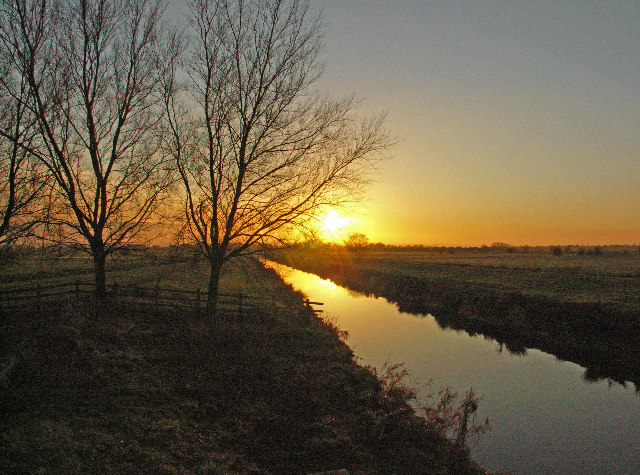
And then they came to a ford. The Somerset Levels are a wide, flat marshy area, only a few feet above sea level, drained by a network of ditches called ‘rhines’, some five feet across, some wider and deeper, like small canals or rivers. Their guide knew the best places to cross, he had assured Monmouth of that. But to some men – and horses – water can be frightening, especially at night, when it’s black, and of an unknown depth. And it was while they were crossing a ford, within a few hundred yards of the enemy camp – you can imagine the hesitations, the urgent whispers, the officer’s orders not to splash or curse or fall over, not to make a noise of any sort –that a pistol went off.

Was it an accident, or treachery? At the time, the man who fired claimed, of course, that it was an accident, and it may well have been. But much later, when he was on trial in front of Judge Jeffreys, Captain Hucker claimed he’d done it on purpose, to warn the royal troops. Jeffreys, to his credit, despised this excuse. ‘First you betray your King, then you betray your fellows,’ he said. 'There is no mercy for such as you.’ When he was sent back to prison, his fellows nearly lynched him.

Whatever the reason, the pistol shot awoke Feversham’s sentries. As Monmouth’s men waded through the ford, they heard shouts in the darkness ahead of them, and drums calling men to arms, rat-a–tat-tat! But they still had a chance.  The enemy was alarmed, confused, and only a short distance ahead; their surprise had almost worked.  And they had been practicing their drill for three weeks now, as if their lives depended on it – which they did. So under their officers’ shouted orders – no need for silence now – they deployed into lines; musket men in the middle, pikemen to right and left – and advanced to where the light of camp fires and slow match was becoming clearer in the mist.

The enemy were in a state of shock and panic – they still weren’t ready. Whereas Monmouth’s men had been visualizing this moment all evening, ever since they left the town. And unlike Feversham’s men, they had modern flintlock muskets, which they had fired in anger several times already.

But then, as they advanced towards the enemy, they saw the rhine.


It wasn't as wide or deep as the river Rhine in Germany, of course not, but it might was well have been. Right there between themselves and the men they were about to attack there was another unexpected drainage ditch. No-one had warned them about this. It was full of black water maybe fifteen yard wide, and who knows how deep? Their officers urged them to cross it, some going down into the water themselves, but somehow, the thought of wading across that black unknown depth while the enemy soldiers stood on the far bank firing down into them was just … too much.

They couldn’t do it.

And so, instead, they stood on their own bank and fired back.  They fired well, for a while, their new flintlock muskets performing as well or better than the matchlocks of their enemy. But the element of surprise was gone; and with it, all their advantage.

Feversham’s men, now they were awake, had two deadly advantages. Firstly, their cavalry. Monmouth’s cavalry had no more success than the infantry at crossing the rhine. They tried to urge their half-trained farm horses into the water and failed. They searched for a ford but had no idea where it was. So they trotted up and down uselessly in the darkness, until Feversham’s cavalry – who’d found the ford in daylight – rode across and chased them away.

canister of grapeshot
The other advantage was artillery. Monmouth had dragged a few small field guns through the mist and darkness to the battlefield, but Feversham had far more. That was why it had been vital for Monmouth’s men to cross the rhine and get into the enemy camp straight away: so that they could capture the enemy guns and either spike them or turn them against their own men. But instead, here they were, still standing on their own side of the rhine, a sitting target for enemy’ field guns. Guns loaded with grapeshot, which could tear through a file of soldiers, killing five or ten men at a time.

And so they lost. They stood there until they could take it no more, and then they fled, some running, some marching grimly down the road to Bridgwater. Monmouth fled on horseback, to be found hiding a field a few days later. The last battle on English soil had been won and lost.

But if Captain Hucker hadn't fired that pistol, and Monmouth's men had dared to cross the rhine – who knows? History can turn on very small moments. 

****
Tim Vicary's novel of the rebellion, The Monmouth Summer, is available as paperback and ebook on Amazon US and Amazon UK. See also his website and blog