On the Treatment of Nervous Disorders
by Maria Grace
 The early 19th century saw an epidemic rise in nervous disorders. Thought to be maladies of affluence and sophistication, doctors, surgeons and apothecaries rushed in to provide relief to a suffering and often monied clientele, so much so that after doctors started taking nervous disorders seriously, everyone seemed to be taking medication for them, outdoing each other with exaggerated symptoms and buying an array of medical equipment to deal with them. How strangely 21st century it all sounds.
Doctors did not agree as to the cause of nervous conditions. Some, like Tennet, argued the stomach was at core of the disorder. Others, including Buchan believed the causes more complex. Indolence and other things that relaxed or weakened the body like drinking tea, frequent bleeding or purging could lead to nervous disorders. While those things which hurt digestion could contribute to the problem, unfavorable postures of the body and intense application to study were equally likely to cause difficulties.
The symptoms of nervous disorders were often thought to begin in the stomach, considered the center of the nervous system. These symptoms might be accompanied by difficulty breathing; violent palpitations of the heart, sudden flushes or a sense of cold in various parts of the body, pains throughout the body, variable pulse, fits of crying and convulsive laughing, poor sleep and night-mares.
Progression of the disease would bring headaches, body cramps, mental disturbances including terror, sadness, weak memory and failure of judgment.
Treatments for Nervous conditions
In many ways, the recommended treatments for nervous disorders were quite progressive. They included a multipronged approach that included diet, exercise, and adjustments of daily routine as well as medication.
Since digestive troubles were considered a large contributor to nervous disorders, careful attention to diet was a major part of treatment. “Persons afflicted with nervous diseases ought never to fast long. Their food should be solid and nourishing, but of easy digestion. Fat meats, and heavy sauces, are hurtful. All excess should be carefully avoided. …Wine and water is a very proper drink at meals: but if wine sours on the stomach, or the patient is much troubled with wind, brandy and water will answer better…All weak and warm liquors are hurtful, as tea, coffee, punch, &c. People may find a temporary relief in the use of these, but they always increase the malady, as they weaken the stomach and hurt digestion.” (Buchan)

“A change of place, and the sight of new objects, by diverting the mind, has a great tendency to remove these complaints. For this reason a long journey, or a voyage, is of much more advantage than riding short journeys near home. Long sea voyages have an excellent effect; and to those who can afford to take them, and have sufficient resolution, we would by all means recommend this course.” (Buchan)
Patients were also advised to avoid great fires and seek cool dry air to brace and invigorate the body, though chills were to be avoided. Regular cold baths as well as frequently rubbing the body with a special brush, or a coarse linen cloth should be incorporated into the patient’s routine. Further, “they ought likewise to be diverted, and to be kept as easy and cheerful as possible. There is not anything which hurts the nervous system, or weakens the digestive powers, more than fear, grief, or anxiety.” (Buchan)
Though not seen as actual cures, a number of medicines might be recommended to render the patient’s life more comfortable. Mild purgatives to relieve constipation were recommended as were elixirs to improve digestion and strength the stomach.
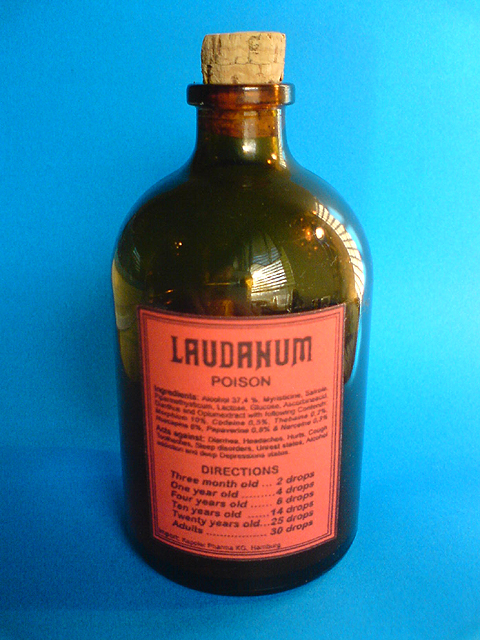
Though laudanum was easily available, doctors cautioned against their overuse as opiates “only palliate the symptoms, and generally afterwards increase the disease (and) habit render them at last absolutely necessary.”
Multiple forms of nervous conditions were recognized including: melancholy, nightmare, swoons, low spirits, hysteric affections and hypochondriac affections. Practioners recommended a unique approach to treatment for each disorder though they were all considered modifications of the same basic disease.
OF MELANCHOLY
 Melancholy was considered a state of insanity that rendered an individual incapable of enjoying the pleasures or performing normal duties of life and might terminate in absolute madness.
To ameliorate melancholy, a patient’s diet should consist of cooling and opening foods. This meant primarily a fruit and vegetable diet, avoiding animal proteins, including fish and shell fish. Onions and garlic were to be avoided as they ‘generate thick blood.’ Melancholic patients should avoid strong liquors of every kind, coffee and tea, instead drinking water, whey or small beer.
Open air exercises of all kinds were recommended to “dissolve the viscid humours, … remove obstructions, promote the perspiration, and all the other secretions.” (Buchan) In contrast, confinement to a closed room would be the very worst thing for the patient.
A patient’s companions could play a key role in his or her improvement by providing the melancholic with a variety of amusements, entertaining stories, pastimes and music. Music in particular was considered highly efficacious.
Since suppression of ‘customary evacuations’, hard digestion or dryness of the brain were physical factors that contributed to a case of melancholy, medical interventions focused on keeping the body open and evacuating. Bleeding was often employed as a means of evacuation.
Purging medicines as well as those which increased urine or perspiration were often prescribed for days, weeks or even months at a time. External applications such as blistering ointments and warm baths might also be used.
Of Low Spirits
Physicians of the era believed that those with weak nerves were likely to experience some degree of low spirits, a disturbance much like melancholy, but less severe. Symptoms could include sleeplessness, headaches, indigestion and loss of appetite. These would be exacerbated by solitude and gloomy thoughts.
Treatment for low spirits depended on the suspected cause. Generous diets, cold baths, exercise, cheerful company and good amusements were thought to be the best medicine overall. When the stomach or bowels were involved, infusions of Peruvian bark with cinnamon or nutmeg, or purges might be used. When suppression of menstrual or of the hemorrhoidal flux was suspected, bleeding, blistering or other similar approach was called for.
Those with low spirits were cautioned against the use of too much alcohol, “as the unfortunate and melancholy often fly to strong liquors for relief, by which means they never fail to precipitate their own destruction.” (Buchan)
Of Hypochondriac Affections

The hypochondriac patient should enjoy a solid and nourishing diet, avoiding windy vegetables. Flesh meats were highly recommended, the claret or madeira to wash them down. Every kind of exercise and cold bathing were considered beneficial as were long travels to warmer climates.
Medicines for this disease focused on strengthening the alimentary canal and promoting secretions. Thus the recommendation for “gentle opening medicine, [such] as pills composed of equal parts of aloes, rhubarb, and asafœtida, with as much of the elixir proprietatis as is necessary to form the ingredients into pills. Two, three, or four of these may be taken as often as it shall be found needful, to keep the body gently open. Such as cannot bear the asafœtida may substitute Spanish soap in its place.” (Buchan)
Of Hysteric Affections
Women, who were considered particularly delicate, were thought to be most susceptible to hysterical complaints. These included fits or laughter or crying, fainting, convulsions, low spirits, anxiety, heart palpations and cramps throughout the body.
Treatment of this disease sought first to shorten the fit, then to prevent their return. Strong patients might be bled during a fit. Weaker ones required more gentle methods to end the spell.
Strong smells, hot bricks to the bottoms of the feet, placing the feet and legs into hot water or strong rubbing on the legs, arms or belly might be used to bring a patient back from a paroxysm.
Practioners recommended a milk and vegetable diet, with water to drink, supplemented by a small quantity of spirits, to help cure an individual of their fits. Additionally cold bathing and everything ‘bracing’ and that kept the mind easy and cheerful was encouraged.
Family and friends were cautioned not to offer too much sympathy for these spells lest they inadvertently excite further episodes. Young ladies who experienced hysterical fits were advised to avoid boarding schools when the disease may be caught by imitation.
Of the Night-mare
Nightmares were thought to result from indigestion. Some recommended a dram of brandy before bed which was thought to prevent the problem. Others thought it a poor custom and that foods easy to digest, cheerfulness, exercise and a light supper, early in the evening were better interventions.
If something more was needed, a glass of peppermint-water was recommended in place of the brandy. And for young people ‘full of blood’, frequent purging could be particularly useful.
References
Buchan, William. Domestic Medicine: Or, A Treatise on the Prevention and Cure of Diseases by Regimen and Simple Medicines, 11th ed., (1790)
Parissien, Steven. Regency Style. Phaidon Press Limited (2000)
Perkins, John. Every Woman Her Own House-keeper; Or, the Ladies’ Library. James Ridgeway: London (1790)
Sales, Roger. Jane Austen and Representations of Regency England. Routledge (1994)
Shoemaker, Robert B. Gender in English Society 1650-1850 Pearson Education Limited (1998)
Tennet, John . Every Man his own Doctor: or, The Poor Planter's Physician, Williamsburg, VA, (1736).
The Home Book of Health and Medicine. Philadelphia: Key and Biddle. (1834)
Wilson, Ben. The Making of Victorian Values, Decency & Dissent in Britain: 1789-1837 The Penguin Press (2007)
Wiltshire, John - Contrib. to Jane Austen in Context. Cambridge University Press (2005)
~~~~~~~~~~~~