by M.M. Bennetts
Today, for your edification and delight, I am going to rant about a thing very dear to my heart but which causes me no end of frustration and, even, dare I admit it, shuddering rage.
It is this--this often firmly held conviction (in defiance of the facts) that the Regency England about which Jane Austen wrote was this idyllic, peaceful, sheep-may-safely-graze land, nothing more than a jammy backdrop for aristos to chase young women in flimsy muslin gowns, wholly untouched by the war which just across the Channel was ravaging every Continental land, destroying societies and lives from a spreading cancer of French military tyranny and conquest.
So, some of those facts. In the myriad country towns during the period, the places where most of the population still dwelled, what might have made up the fabric of their daily existence? Jane Austen's or anyone's, really?

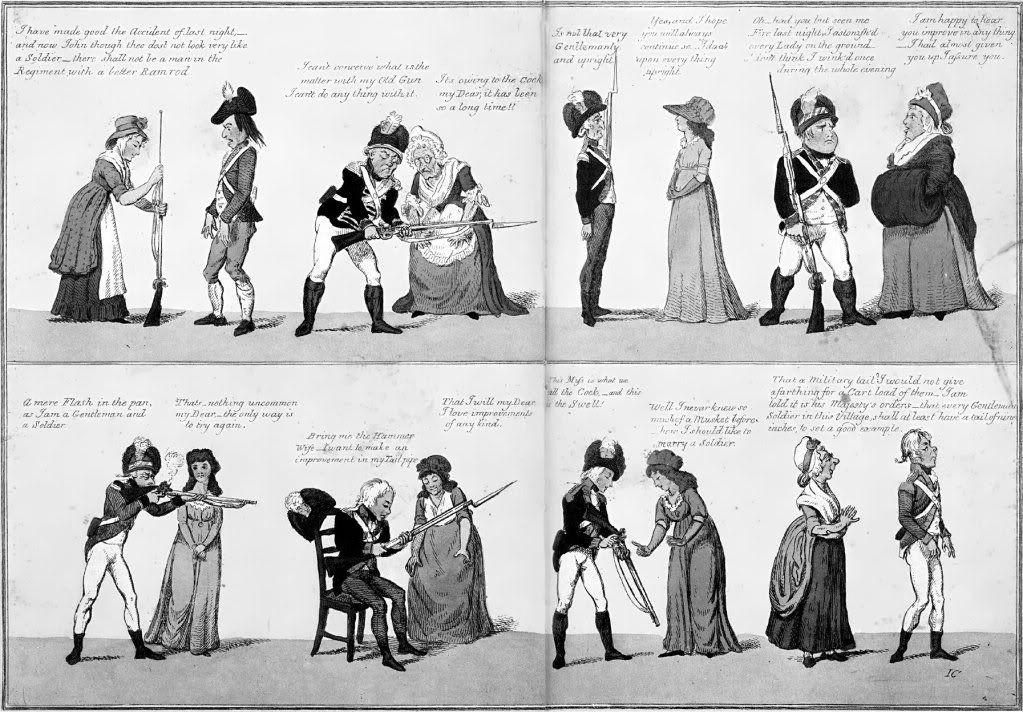
Well, let's start with what they heard. Daily. Writing in 1806, the British satirist, George Cruikshank noted, "Every town was...a sort of garrison--in one place you might hear the 'tattoo' of some youth learning to beat the drum, at another place some march or national air being practiced upon the fife, and every morning five o'clock the bugle horn was sounded through the streets, to call the volunteers to a two hours' drill...and then you heard the pop, pop, pop, of the single musket, or the heavy sound of the volley, or distant thunder of the artillery..."
So much for waking to the gentle bleating of spring lambs and baby blackbirds learning to sing as melodiously as their parents, then. The place was a sea-to-sea military base with all the serenity of a WW2 siren call.
And what about the sceptred isle landscape, the rolling beauty of the hills and Downland, the endless fields, pieced, ploughed, sown and fallow? The landscape beyond every village and town, all of covered by farms and estates? This perfect setting for a breath-taking ride with one's Mr Wickham in a high-perch phaeton? Right?
Well, it may surprise and amaze you to know that from well before 1802, the great fear in Britain was that of invasion by the French. It was a national obsession and the preparations to repel such an invasion wherever it came from and whenever were all-consuming. And it wasn't for another decade, until Napoleon and his Grand Armee were well and truly whooped in Russia, that the national fever of defensive building works started to calm down.
They weren't exactly paranoid about nothing either in their fears. There had been the unsuccessful attempt to invade the British Isles in 1797 by the French--a huge storm, gales, blizzard and all that had blown the estimated 40,000 troops off course and had saved the day...but you can't count on that sort of divine intervention every day, can you?
So, hoppity poppity into the new Napoleonic era of the new century. The short Corsican tyrant is in prime position in France. He loves nothing better than a good conquest with himself as the new ruler. Britain is allegedly at peace with France during the period known as the Peace of Amiens, which, just like later dictators have done, Napoleon is using to get his military machine in gear and ready to roll.
What's happening on the ground? Once the peace of Amiens was officially over, well, across those counties thought to be most at risk--the southern coastal counties--everyplace became immersed in the preparations for war and invasion.
 By August 1803, it was being reported that in fifteen counties, from Devon in the west across to the Isle of Wight, including the Cinque Ports along the coast, and all the way up in Northumberland and Fife, that over 50% of the male population, those aged between seventeen and fifty-five, were in uniform, wearing regular, yeomanry or volunteer uniform.
That's a lot of fellows in uniform if you think about it. The counties of Kent and Sussex had 49% and 45% of their men in uniform respectively. That's half the male population. Imagine.
Another snippet you might like...they weren't all wearing red coats which shone brightly in the sunshine as we see in the old portraits. Yes, originally, the uniforms were meant to be red.
But for the uniforms of the men, the government didn't have the money for the well-dyed red wool--that was for officers who could afford their own. The enlisted or volunteer uniform was provided by the government, so obviously they were getting all they could on the cheap. And the dye used in those job lots was madder, which after a year in the sun and perpetual rain of this country fades to a kind of rusty, blotchy sienna brown...Good for camouflage in autumn, I dare say.

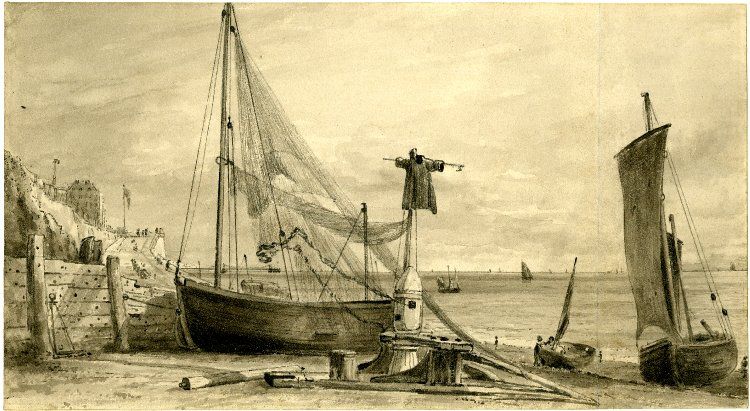
These were quite impressive defensive towers they were building too. Not cheap. The walls were of varying thickness, but generally from between six to thirteen feet thick, with the heaviest walls facing seaward. The bricks were bedded in hot lime mortar (imagine the smell as they were constructed) calculated to withstand bombardment from the sea. The roofs were flat, supported from underneath by a central column, and carried on top a 24-pounder cannon which would have been mounted on a sliding traverse carriage which enabled it to fire round 360 degrees...
Anyone for a Regency stroll by the seaside? Bring those parasols...
Finally, food. The years of the early 19th century had seen a number of harsh winters and bad late harvests--courtesy of a mini-Ice Age--which had left the English feeling vulnerable on this point, and the government took this quite seriously. Bread riots or any food shortages can too easily cause panic. Hence, with the threat of invasion and the assumption that the French would head for London first--probably via Kent--great plans were laid to stockpile foodstuffs for the capital, so that it might hold out under siege.
Thus plans were made to create emergency stores near the capital, including rice, flour and salted provisions as well as 250 tons of biscuit meal, all stockpiled in depots around and in the capital at locations such as Fulham, Brentford and Staines...

Also, there were huge stockpiling needs across the South Coast to feed those thousands of militia, gathered to repel and defend the land--in 1804, more than 18,000 regular troops were stationed in Sussex, with another 20,000 more stationed nearby to be deployed at short notice. There were thousands more stationed in Kent, particularly ready to defend Dover, where it was assumed the 'big assault' would happen.

There was not a day not an hour of any day, which did not include some element of the Napoleonic conflict. And they knew it.
The plethora of English World War Two dramas and films will give one the true picture of the state of things--just change the uniforms to 200 years back and add sideburns. Then you'll have it.
War everywhere, bulwarks, vast defensive buildings like Martello tower, drums, artillery practice, the post office going through all foreign post (probably Austen's letters to and from her sister-in-law were opened and read), the food shortages, the militia on every street corner of every village and town, the recruiting officers in the public houses, the thousands of marching, marching, marching men...And the drums at Portsmouth beating out Hearts of Oak at dawn, or the fife thinly whistling a new recruits poor-boy's version of Rule Britannia...
This then, 200 years ago was "This royal throne of kings, this sceptred isle, This earth of majesty, this seat of Mars, This other Eden, demi-paradise, This fortress built by Nature for herself Against infection and the hand of war...This precious stone set in a silver sea...This blessed plot, this earth, this realm, this England."
This post from the #EHFA Archives was originally published on March 2, 2014.
~~~~~~~~~~~~~~~~~
 M.M. Bennetts, co-founder of English Historical Fiction Authors, passed away in August, 2014. She was a specialist in early 19th century British and European history and the Napoleonic wars and penned two novels, May 1812 and Of Honest Fame set during the period. A third novel, Or Fear of Peace, was to have been published in 2014.
For further information, please visit the website and historical blog at https://mmbennetts.wordpress.com/
For further information, please visit the website and historical blog at https://mmbennetts.wordpress.com/