Showing posts with label Kent. Show all posts

Friday, March 13, 2020

Austen's England: Peaceful as all that? I don't think so

by M.M. Bennetts


Today, for your edification and delight, I am going to rant about a thing very dear to my heart but which causes me no end of frustration and, even, dare I admit it, shuddering rage.

It is this--this often firmly held conviction (in defiance of the facts) that the Regency England about which Jane Austen wrote was this idyllic, peaceful, sheep-may-safely-graze land, nothing more than a jammy backdrop for aristos to chase young women in flimsy muslin gowns, wholly untouched by the war which just across the Channel was ravaging every Continental land, destroying societies and lives from a spreading cancer of French military tyranny and conquest.

So, some of those facts.  In the myriad country towns during the period, the places where most of the population still dwelled, what might have made up the fabric of their daily existence?  Jane Austen's or anyone's, really?


Well, let's start with what they heard.  Daily.  Writing in 1806, the British satirist, George Cruikshank noted, "Every town was...a sort of garrison--in one place you might hear the 'tattoo' of some youth learning to beat the drum, at another place some march or national air being practiced upon the fife, and every morning five o'clock the bugle horn was sounded through the streets, to call the volunteers to a two hours' drill...and then you heard the pop, pop, pop, of the single musket, or the heavy sound of the volley, or distant thunder of the artillery..." 

So much for waking to the gentle bleating of spring lambs and baby blackbirds learning to sing as melodiously as their parents, then.  The place was a sea-to-sea military base with all the serenity of a WW2 siren call.

And what about the sceptred isle landscape, the rolling beauty of the hills and Downland, the endless fields, pieced, ploughed, sown and fallow?  The landscape beyond every village and town, all of covered by farms and estates?  This perfect setting for a breath-taking ride with one's Mr Wickham in a high-perch phaeton?  Right?

Well, it may surprise and amaze you to know that from well before 1802, the great fear in Britain was that of invasion by the French.  It was a national obsession and the preparations to repel such an invasion wherever it came from and whenever were all-consuming.  And it wasn't for another decade, until Napoleon and his Grand Armee were well and truly whooped in Russia, that the national fever of defensive building works started to calm down.

They weren't exactly paranoid about nothing either in their fears. There had been the unsuccessful attempt to invade the British Isles in 1797 by the French--a huge storm, gales, blizzard and all that had blown the estimated 40,000 troops off course and had saved the day...but you can't count on that sort of divine intervention every day, can you?

So, hoppity poppity into the new Napoleonic era of the new century.  The short Corsican tyrant is in prime position in France.  He loves nothing better than a good conquest with himself as the new ruler.  Britain is allegedly at peace with France during the period known as the Peace of Amiens, which, just like later dictators have done, Napoleon is using to get his military machine in gear and ready to roll.

What's happening on the ground?  Once the peace of Amiens was officially over, well, across those counties thought to be most at risk--the southern coastal counties--everyplace became immersed in the preparations for war and invasion.

By August 1803, it was being reported that in fifteen counties, from Devon in the west across to the Isle of Wight, including the Cinque Ports along the coast, and all the way up in Northumberland and Fife, that over 50% of the male population, those aged between seventeen and fifty-five, were in uniform, wearing regular, yeomanry or volunteer uniform.

That's a lot of fellows in uniform if you think about it.  The counties of Kent and Sussex had 49% and 45% of their men in uniform respectively.  That's half the male population.  Imagine.

Another snippet you might like...they weren't all wearing red coats which shone brightly in the sunshine as we see in the old portraits.  Yes, originally, the uniforms were meant to be red.

But for the uniforms of the men, the government didn't have the money for the well-dyed red wool--that was for officers who could afford their own.  The enlisted or volunteer uniform was provided by the government, so obviously they were getting all they could on the cheap.  And the dye used in those job lots was madder, which after a year in the sun and perpetual rain of this country fades to a kind of rusty, blotchy sienna brown...Good for camouflage in autumn, I dare say.  

By 1804 then, a consensus had been reached on coastal defenses and across the face of the south coast, an intense programme of building ensued for the next several years, so that by 1808, 73 Martello towers and two 11-gun circular forts had been built.  Another 29 towers had been constructed along the Wash--the coasts of Suffolk and Essex. (Eventually the number of Martello towers constructed reached 168, extending all along the coast all the way to Orkney.)

These were quite impressive defensive towers they were building too.  Not cheap.  The walls were of varying thickness, but generally from between six to thirteen feet thick, with the heaviest walls facing seaward.  The bricks were bedded in hot lime mortar (imagine the smell as they were constructed) calculated to withstand bombardment from the sea.  The roofs were flat, supported from underneath by a central column, and carried on top a 24-pounder cannon which would have been mounted on a sliding traverse carriage which enabled it to fire round 360 degrees...

Anyone for a Regency stroll by the seaside?  Bring those parasols...

Finally, food.  The years of the early 19th century had seen a number of harsh winters and bad late harvests--courtesy of a mini-Ice Age--which had left the English feeling vulnerable on this point, and the government took this quite seriously.  Bread riots or any food shortages can too easily cause panic.  Hence, with the threat of invasion and the assumption that the French would head for London first--probably via Kent--great plans were laid to stockpile foodstuffs for the capital, so that it might hold out under siege.

Thus plans were made to create emergency stores near the capital, including rice, flour and salted provisions as well as 250 tons of biscuit meal, all stockpiled in depots around and in the capital at locations such as Fulham, Brentford and Staines...


Also, there were huge stockpiling needs across the South Coast to feed those thousands of militia, gathered to repel and defend the land--in 1804, more than 18,000 regular troops were stationed in Sussex, with another 20,000 more stationed nearby to be deployed at short notice.  There were thousands more stationed in Kent, particularly ready to defend Dover, where it was assumed the 'big assault' would happen.

And, within these troop numbers and within their training too, it's important to note that within each year, these troops would march hundreds of miles across counties, going where they were sent, training, marching, recruiting...England in the early 19th century was a country at war.  Fully and wholly at war.

There was not a day not an hour of any day, which did not include some element of the Napoleonic conflict.  And they knew it.

The plethora of English World War Two dramas and films will give one the true picture of the state of things--just change the uniforms to 200 years back and add sideburns.  Then you'll have it.

War everywhere, bulwarks, vast defensive buildings like Martello tower, drums, artillery practice, the post office going through all foreign post (probably Austen's letters to and from her sister-in-law were opened and read), the food shortages, the militia on every street corner of every village and town, the recruiting officers in the public houses, the thousands of marching, marching, marching men...And the drums at Portsmouth beating out Hearts of Oak at dawn, or the fife thinly whistling a new recruits poor-boy's version of Rule Britannia...

This then, 200 years ago was "This royal throne of kings, this sceptred isle, This earth of majesty, this seat of Mars, This other Eden, demi-paradise, This fortress built by Nature for herself Against infection and the hand of war...This precious stone set in a silver sea...This blessed plot, this earth, this realm, this England."

This post from the #EHFA Archives was originally published on March 2, 2014.
~~~~~~~~~~~~~~~~~
M.M. Bennetts, co-founder of English Historical Fiction Authors, passed away in August, 2014. She was a specialist in early 19th century British and European history and the Napoleonic wars and penned two novels, May 1812 and Of Honest Fame set during the period. A third novel, Or Fear of Peace, was to have been published in 2014.

For further information, please visit the website and historical blog at https://mmbennetts.wordpress.com/

Wednesday, October 24, 2018

Ecgberht: The Refugee Returns to Claim the Throne

By Kim Rendfeld

In 789, Ecgberht was a refugee in the Frankish court, driven from his home in Kent. His exile was another chapter in the long struggle between his kinsmen and Mercian King Offa.

Twenty-seven years earlier, Kent suffered a succession crisis, with the death of Æthelberht II. Over the next few years, five men claimed to rule the kingdom or at least eastern or western half of it. One of them was King Ecgberht II, who at the time claimed the western half. This Ecgberht is not our hero but was perhaps a relative. Medieval aristocrats were fond of reusing names, especially to remind subjects, allies, and enemies of prior rulers.

The chaos about who exactly was in charge of Kent was an opportunity for Offa. He might have felt entitled to the kingdom next door because Kent had acknowledged his predecessor, Æthelbald, as overlord by 731. Whether that relationship lasted until Æthelbald’s murder in 757 is unknown.

By 765, Offa imposed himself as overlord of Kent, and apparently held on to the kingdom for several years.

14th century image of Offa
(public domain via Wikimedia Commons)


The Kentish people apparently weren’t happy with Mercian rule. In 776, Ecgberht II led soldiers to drive Offa out. They fought at Otford, and Kent likely won its independence, if we are to believe circumstantial evidence like coins with Ecgberht II’s name and charters with his name but not Offa’s. This time Ecgberht II ruled all of Kent.

We know Ecgberht II flourished between 765 and 779, but don’t know how his reign ended. King Ealhmund, our hero’s father, might have succeeded him. Evidence is scant. One piece is that his name appears on charters. Ealhmund’s relationship between Ecgberht II, assuming there is one, is unknown. Ealhmund did name his son after the warrior who triumphed over a foreign invader.

But Offa was not one to sit quietly. By 785, he reimposed his authority on Kent, issuing charters in his name without a reference to a Kentish king. Ealhmund’s fate is a mystery. Was he killed? Driven out?

Ecgberht, Ealhmund’s son, was still around. Considering that he lived until 839, 50 years after he went into exile, he might have been an adolescent when his father lost Kent. Offa likely saw Ecgberht as a threat, as he likely perceived anyone with a claim to the throne.

In 789, Offa enlisted the aid of his new son-in-law, Beorhtric, to help solve his problem—perhaps it was one of the reasons the Mercian king and his wife arranged of his daughter Eadburh to the king of Wessex. Until this time, Beorhtric probably had no quarrel with Ecgberht and no concern about Kent. But he did have this new alliance and might have felt obligated to fulfill it.

Driven from home, Ecgberht found refuge in Charlemagne’s court or in Francia. Either way, he would have had the permission of the Frankish king to be there, much to Offa’s aggravation. Ecgberht might have met fellow exiles during his time in Francia, including Eadberht Præn. Sharing the name of prior Kentish kings, Eadberht likely had been tonsured against his will—a common way to deny rivals their inheritance to the crown.

Seven years later, Mercian rule in Kent was again challenged. Offa died in July 796, and his son, Ecgfrith, succeeded him. Although Ecgfrith had be crowned co-ruler, he didn’t seem as strong as his father. Some aristocrats in Kent might have seen opportunity.

That same year, Eadberht Præn decided to leave the priesthood and seize power. He reigned for two years, having coins minted in his name and getting rid of a troublesome archbishop. In the meantime, Ecgfrith died, and his successor, Cenwulf, was able to stabilize Mercia then try to regain Kent.

Eadberht Præn was captured in 798 and taken in chains to Mercia. Things turned out horribly for him. Because he had been ordained, he could not be killed, but he suffered what some might see as a worse fate. Be warned: it is gruesome. His captors blinded him, chopped off his hands, and sent him to Winchcombe, an abbey Cenwulf had recently founded. Thus crippled, Eadberht Præn would never be able to rule again.

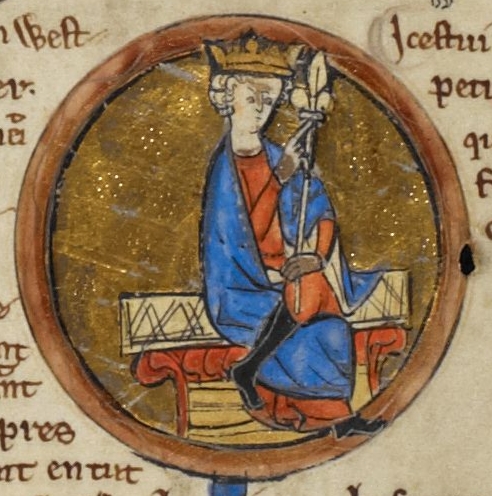
13th century image of Ecgberht
(public domain via Wikimedia Commons)


In 802, Ecgberht decided to claim power, but he didn’t go for Kent. Instead he invaded Wessex. It’s uncertain why he decided on Wessex. Perhaps it was the easier target, and Ecgberht had not forgotten how Beorhtric had helped Offa steal what was rightfully his. The two likely met on the battlefield at Wiltshire. Beorhtric died, and Ecgberht seized the crown.

He didn’t stop at Wessex. During his 37-year reign, Ecgberht would extend his rule to include Surrey, Essex, Sussex, and Kent.

Sources
Oxford Dictionary of National Biography, including
“Offa” by S.E. Kelly
“Eadberht Præn” by S.E. Kelly
“Ecgberht” by Heather Edwards
“Æthelberht II” by S.E. Kelly

~~~~~~~~~~

In Kim Rendfeld's Queen of the Darkest Hour, Queen Fastrada must stop a conspiracy before it destroys everyone and everything she loves. The book is available on Amazon, iBooks, Barnes & Noble, Kobo, and Smashwords.

Kim has written two other books set in 8th century Francia. In The Cross and the Dragon, a Frankish noblewoman must contend with a jilted suitor and the fear of losing her husband (available on Amazon). In The Ashes of Heaven's Pillar, a Saxon peasant will fight for her children after losing everything else (available on Amazon). Kim's short story “Betrothed to the Red Dragon,” about Guinevere’s decision to marry Arthur, is set in early medieval Britain and available on Amazon.

Connect with Kim at on her website kimrendfeld.com, her blog, Outtakes of a Historical Novelist at kimrendfeld.wordpress.com, on Facebook at facebook.com/authorkimrendfeld, or follow her on Twitter at @kimrendfeld.


Tuesday, October 3, 2017

The Social Organisation in the Seventh Century

by Annie Whitehead

The seventh century is a long way away, and elusive in terms of surviving written records. Bede is our major source for historical events, but he tells us little about everyday lives. Most of the information on this subject is found in the law codes of the rulers of Kent – these being Æthelberht, Hlothherre and Eadric, and Wihtred – and the laws of Ine, king of Wessex. These law codes give a relatively comprehensive view of the status and importance of the varying social classes.

Before taking a close look at these, however, a basic introduction to the social system is probably useful, in order to understand the references and terminology used in the law codes.

Anglo-Saxon Chronicle (Abingdon Manuscript) showing Æthelberht's name

In the eyes of the law, the chief mark which distinguished one class of society from another was the price that had to be paid in compensation for the slaying of one of its members, and this was called the wergeld (or wergild) - literally a man price.

Life in a nobleman’s hall was very like that at court, but on a smaller scale. Like the king, lay and ecclesiastical lords had their officials. All great households included one of more domestic chaplain, whose functions were secretarial as well as religious. Stag-hunting, fox-hunting and hawking were favourite pastimes for kings and nobles.

There is little information about the activities of the women of the class, but we may assume that the mistress of the house supervised the running of it, which would entail baking, brewing, spinning and weaving. An Anglo-Saxon lady could hold land in her own right, and defend her right in the courts.

The ordinary freeman is most commonly called a ceorl. Though he apparently lived at a lower economic level than his Kentish counterpart, the ceorl in the other kingdoms of the heptarchy * was nevertheless a man with the full rights of a freeman, and often held land that he had inherited from his ancestors and would leave to his children, and he paid a freeman’s duties to the church.

The slave had no wergeld. He was a chattel, and if anyone killed him, he had merely to pay his value to the owner. Slaves were sometimes included in inventories of stock. As he had no property, the slave could not be punished by fines when convicted of crime, and was therefore liable to flogging for minor offences, or to mutilation and death for serious offences. If his owner ill-treated him, he incurred ecclesiastical penalties, but it was not the concern of the law.

As mentioned already, most of the law codes pertinent here emanate from Kent, and I'll look first at that of Æthelberht, which can be dated from between the adoption of Christianity in 597 and the king’s death in 616.

Law code of  Æthelberht - 12th Century manuscript

It is clear that the lowest rank was filled by slaves. Some of the female slaves were employed as domestic servants, and penalties for raping them were in proportion not to their feelings but to their master’s rank. Higher values were set on the honour of other slave-women, presumably employed not in the household but on the farm. To distinguish slaves from freeborn women, their hair was cropped. If the male slave stole, he was supposed to have means to pay twice the value of the stolen goods as compensation.

More is said about the esne - a strange word. In other texts the word is used to translate the Latin ‘servus’, and no doubt a taint of servility clung to the esne – at best he was only half-free. He may have had a household of his own, rather than a mere lodging in the outbuilding of his master’s farm.

Another oddity is the læt, who is mentioned only in Æthelberht’s laws. It seems natural to connect him with the laetus of the Roman Empire, where he was a member of a subject people settled on the land in a position intermediate between freemen and slaves.

Next in the social scale is the ceorl, or husbandman. The word tells nothing of the ceorl’s racial origin, nor does it carry any connotation of freedom. He was certainly a commoner, and the clearest indication of his social status is his mundbyrd, the fine payable for an offence against one of his dependents: six schillings, as against twelve schillings for a nobleman, or fifty schillings for the king.

Four classes of widow are distinguished by their mundbyrd, and the grades are presumably determined by the standing of their late husbands (or their brothers). The lowest, six schillings, is identical to the mundbyrd of the ceorl, the highest, fifty schillings, with that of the king. The first class widow would be nobly born, perhaps of the royal house, the twenty schilling widow a non-royal noblewoman, and the twelve schilling one the widow either of a lesser gentleman or a freeman.

Æthelberht says very little about the eorl (nobleman). Twelve schillings is the penalty for slaying a man on the premises of a nobleman and for seducing his domestic slave-woman. This is enough to show that the eorl stands twice as high in social estimation at the ceorl.

Dated between 673 and 685, the laws of Hlothherre and Eadric only supplemented those already in force. Nowhere is it stated that these two ruled jointly, although this was not uncommon.

The code adds little information on the social structure. It speaks of the esne and his owner, who must surrender the esne if he kills a man, and the owner must pay compensation proportionate to the rank of the victim.

Graves of Hlothherre (2nd left) & Wihtred (3rd left) - attribution

The freeman’s home is in a village, or tun. If accused of stealing, he must bring at least one witness from his own village. This probably means that some villages were populated by freemen who acknowledged no superior other than the king, especially when remembering Æthelberht’s laws implying a close relationship between king and freeman.

An important provision relating to the slave or to the servile esne, is that the Church protects him by decreeing that his master may not lawfully deprive him of his money or livestock which he has earned by his own toil.

By the time of Wihtred’s reign, manumission was by now treated as a religious act which could take place at the altar. The code issued by Wihtred in 695, provides that although a man freed at the altar shall be ‘folk-free’ that is, free as against all men except his lord, the lord shall be the guardian of his household even if he is settled elsewhere than on the lord’s estate, and when he dies, his property and wergeld will belong to the lord.

In Wihtred’s laws, the nobleman is styled gesithcundman. He owes his standing partly to his birth, but now the emphasis is on his position as a gesith, or companion to the king. Between him and the slave stands the ceorliscman, or commoner. This term includes freemen, husbandmen, læts, and perhaps the folk-free esne.

The laws of Ine of Wessex were issued at some time between 688 and 694. We owe their survival to their being added as a supplement to the laws of Alfred, who expressly mentions his use of them. It is not safe to assume that they are complete, since presumably Alfred would only have preserved those clauses which were relevant to his own laws, but they are of particular interest, since they are the earliest we possess.

If the slave of Ine’s Wessex has a master who makes him work on Sunday, he is to be set free, but if he works of his own accord, he must be whipped or pay a fine. The freeman who works on a Sunday, however, may be reduced to slavery unless he can pay a heavy fine, or plead to his lord’s command. So it would seem that a Wessex freeman may have a lord set over him.

Peterborough Chronicle, contains the oldest surviving copy of Ine's laws

The esne appears only once in Ine’s codes, where penalties are appointed for anyone who actively helps him to abscond.

Ine’s laws provide a definite place for Britons in the social scheme. The wergeld payable for taking a Welshman’s life is arranged in seven grades: -
• Welsh Slave 50 Schillings
• Landless Welshman 60
• Landless Welshmen with ½ a hide 80
• Son of a Welsh rent payer 100
• Welsh rent payer or landed Welshman with 1 hide 120
• Welsh horseman in the king’s service 200
• Landed Welshman with five hides 600
The hide is a unit of assessment for calculating the payments in money or kind due to the king or other landlord. Ine’s laws throw no light on the method by which the assessment was imposed, or the extent of land which lies behind it.

The Welshman with five hides is clearly a man of substance, but other men, probably English, held as much as ten or twenty hides. The wergeld of a five-hide Welshman is 600 schillings, but we are not told whether the same or a higher compensation is exacted for the murder of a five-hide Saxon.

Here again, the nobleman is styled gesithcundman, and is contrasted with the ceorliscman or commoner. Normally, he is a landholder. He forfeits his land by neglecting military service and has to pay a fine of 120 schillings, twice as much as that paid by a landless man of his own class, four times that paid by a commoner.


Little is known of the other kingdoms. The Northumbrian nobleman was also known as a gesith, a companion of the king, as he was in Mercia. In East Anglia and Essex, there is no reason to suppose that the social systems differed greatly. The collection of tribes known as the Middle Angles may have been governed by ealdormen, as there is no record of a traditional of a royal house. (King Penda of Mercia's son became king of the Middle Angles around the year 653, but this was an appointment, not an inheritance)

In general, what we learn from these law codes it that there seems to be a highly class-conscious society. Around the king stand the nobles, who will be rewarded for service with grants of land. They form a territorial aristocracy supported by rents of the tillers of the soil, whom they are bound to protect and keep in order.

At the other end of the scale are the slaves. Some are Britons serving new masters, and the class is recruited from prisoners of war, convicts and hungry freemen who sell themselves for food.
Of the intermediate class, there is the husbandman, free by birth, accustomed to speaking his mind on public affairs in popular assemblies, and acknowledging no superior but the king.

We hear of the Kentish freeman living in a village, and of the West Saxon ceorl who shares arable and meadow with his neighbours. The husbandman who must hire a yoke of oxen before he can plough is obviously a man of slender resources. There was no such thing as economic independence of these men and, against a lord who could fetch them back and fine them heavily is they absconded, their legal freedom was worth very little.

*heptarchy - the seven kingdoms:  East Anglia, Essex, Kent, Mercia, Northumbria, Sussex and Wessex.

~~~~~~~~~~

Annie Whitehead is an author and historian, and a member of the Royal Historical Society. Her first two novels are set in tenth-century Mercia, chronicling the lives of Æthelflæd, Lady of the Mercians, who ruled a country in all but name, and Earl Alvar who served King Edgar and his son Æthelred the Unready who were both embroiled in murderous scandals. Her third novel, also set in Mercia, tells the story of seventh-century King Penda and his feud with the Northumbrian kings. Her nonfiction book, Mercia: The Rise and Fall of a Kingdom, will be released by Amberley Publishing, in Sep 2018.
Amazon Page
Website
Blog