Showing posts with label Women in WWII. Show all posts

Tuesday, June 6, 2023

British Women at War -- The "Land Girls"

 by Helena P. Schrader

Throughout history, when men went to war, the burden of maintaining agricultural production — often the mainstay of the economy — fell to the family members left behind. That meant old people and children – and women. Yet in WWII, something new happened. Rather than relying on whatever family members happened to remain behind, the British government organized an external labor force to help farmers cope; it called on women to help out on the land and created the “Women’s Land Army.”

The Women's Land Army (WLA) had its origins in WWI. Established in 1917, the Women's Land Army employed some 23,000 women before the end of the First World War. This precedent encouraged early planning for a similar deployment of women in agricultural work as Europe slid slowly but inexorably towards war in the late 1930s. 

Logically for an agricultural employment scheme, the Women's Land Army (WLA) was organized geographically and divided into fifty-two regions each with a "county office." This office employed a permanent and paid staff which administered recruitment, placement, and complaints. The "local representative," most commonly an older woman with standing in the community and an appreciation for agricultural issues (e.g. a woman who owned a country estate), was responsible for visiting each Land Girl in her district at least once a month. She noted and reported on billeting, food, pay, time-off and recreation facilities available. She handled complaints and tried to mediate between the Land Girls and their employers, but if differences could not be resolved, the Land Girls were free to change employers.

Young women interested in the WLA applied at a county office and were interviewed by at least two people. Applicants came from across the country with widely different educational backgrounds and training. An astonishing third of all so-called "Land Girls" came from urban backgrounds. Many conscientious objectors were found among the ranks of the Land Girls. 

The work week was set at 48 hours in winter and 50 hours in summer, although during harvest and other periods of particular need the Land Girls like farmers and agricultural workers around the globe worked dawn to dusk. Most of the year, however, Land Girls got off work at noon on Saturday and did not need to report back until Monday morning. The majority spent their weekend at home with their families. 

The Land Girls were hired and paid directly by farmers, receiving the same wages as female agricultural workers -- i.e. the minimum wage of one pound, two shillings and sixpence a week. However, their room and board were deducted from this wage, leaving only ten shillings a week for personal expenses. Girls working more than 20 miles from home were also entitled to a "railway warrant," which was free train transportation to their home once every six months.

The work was extremely varied. It included, for example, driving tractors and ploughs, feeding and herding livestock, milking cows, mucking out barns, weeding kitchen gardens, harvesting grains, vegetables, and fruits, threshing, thatching and rat-catching/killing. Land Girls were expected not only to know how to use all usual farm equipment but also to be able to repair it. The only kind of work they were exempted from was domestic work -- something not all farmers appreciated in the early years. Furthermore, except for some correspondence courses, most of the Land Girls had to learn about farming on the job. 


Although Land Girls had a "uniform" and badges that declared their seniority in the service, the WLA was never a military or paramilitary organization. There were no ranks, no drill, and no regimentation. Girls could both give notice and be fired. Many Land Girls lived on the farms where they worked -- sometimes treated like members of the family, although some had the misfortune to be treated like cheap labor instead. Others lived in hostels together with other Land Girls. The biggest problem with individual billeting was loneliness and boredom. Girls in hostels had each other for company both when “at home” and for forays to local towns and events. 

In 1942, the "Timber Corps" was formed as a component of the WLA. The women who joined this corps were engaged in forest management including felling trees and transporting lumber. They lived in communal huts, usually 20 to a hut, and engaged in particularly heavy labor. 

The major appeal of the WLA was the opportunity to work in the sunshine, fresh air and away from the bombing. A secondary appeal was the "extras" like fresh eggs, milk, vegetables and fruits that the girls were able both to enjoy and to share with families.

Altogether, roughly 90,000 women served in the WLA during the Second World War. Their contribution is best measured by the fact that the organization was not disbanded until 1950. From the middle of the war until that time, Britain's dependence on homegrown foods had become acute, and the extra labor in the agricultural sector was essential to meet even minimal demands.

Award-winning novelist Helena P. Schrader is the author of three books set in Britain during WWII: Where Eagles Never Flew, Grounded Eagles and Moral Fibre.  You can find out more about them, their awards and read reviews and excerpts at: https://helenapschrader.com


Thursday, March 23, 2023

British Women in the Women's Voluntary Services of WWII

by Helena Schrader

Britain was slow to wake up to the danger of war and pacifist sentiment was strong right up until the Munich Crisis. Yet as early as January 1937, the government charged local authorities with organizing air raid protection. This was formalized in the Air Raid Protection Act of 1938 and from the start, women formed a vital part of plans and execution.


The main tasks envisaged for civil defence organizations were air raid wardens to ensure compliance with air raid precautions, first aid and ambulance services, and anti-gas units. In addition, a demand for nurses was anticipated, but nurses were organized as before in existing organizations such as the British Red Cross Society, the Order of St. John of Jerusalem, the First Aid Nursing Yeomanry and Voluntary Aid Detachments (VADs). The various organizations took responsibility for both recruitment and training. Other aspects of civil defence, however, were handled separately as voluntary war work. In these tasks, the pay was only for the actual hours worked, uniforms were initially only an armband and a tin hat. Members had no ranks or command structure, but they did receive training. From the very beginning, women volunteered in greater numbers than men.  


In addition to the above, volunteers were sought to augment the capacity of the fire brigade and the police. They were organized in the Auxiliary Fire Brigade and Women's Auxiliary Police Corps respectively. Some ten thousand women were employed as auxiliary police, while 70,000 women served in the Fire Brigade. Women were not, however, employed fighting fires directly, certainly not in the midst of bombing raids. Primarily, they worked in control centres and fire stations handling switchboards and clerical work. They did fire watching in shifts and sometimes drove fire trucks. 


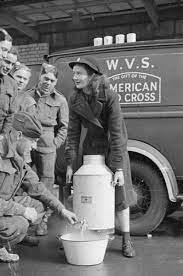
Yet some visionary women recognized that much more was going to be needed than the government had planned and so the Women's Voluntary Services (WVS) was born. The WVS did not have a clear mandate. Instead, it was designed to respond to needs as they came up, but organized regionally to be available anywhere in the country.


It started by offering training courses such as driving in the black-out, first aid, fire-fighting etc. During the war scare associated with the Munich Crisis and at the start of the war a year later, the WVS organized the evacuation of over a million children, pregnant women and young mothers out of urban areas. That is it organized both the registration and mustering of those seeking evacuation and the billeting of evacuees on arrival at the other end. Not all went well in either September 1938 or 1939, but each time "lessons learned" led to improvements that facilitated things the next time evacuation became necessary. 


While the evacuation of Dunkirk took nine days, the Blitz of London lasted nine months. At the start, London endured 57 straight nights of bombing.  At the end, 43.500 civilians had been killed, 159,000 injured and 2.25 million made homeless. And through it all the WVS was in action. It established and ran rest centers where those bombed out could get food and a bed until new housing was organized. It provided clothing and blankets to those who had lost everything. It created and manned Incident Inquiry Points in areas near the destruction to help relatives find one another. It operated mobile canteens to bring tea and sandwiches to firemen, first-aid workers and to the air raid shelters. In some cases, where local supplies could not cope after a massive raid, it organized convoys of food, blankets and clothing from areas of the country not affected by the bombing. These convoys often brought food and clothing donated by the United States or the Commonwealth. On arrival, a in the bombed out area, a distribution point would be set up, which remained sometimes for several days feeding and clothing thousands. 

Meanwhile, the WVS had been tasked with carrying out a billeting survey, something soon put to use when Hitler's armies rolled over Poland, Denmark, Norway, Holland, Belgium and France, sending tens of thousands of refugees to England. The "refugee crisis" came to a crescendo with the emergency evacuation of 340,000 troops off the beaches at Dunkirk. Much has been written about the "little boats" that contributed to the astonishing success of Operation "Dynamo," but less has been written about the women who met those troops with tea and sandwiches, warm, dry clothing, baths and clean socks, and help in contacting families. Across southern England, troop trains were taking the evacuated soldiers out of the landing ports to military bases across the country. At the height of the evacuation, trains arrived at some of the stations every twenty minutes for an eight-minute "food stop." It was the WVS that made and served thousands of sandwiches each day, working 24/7.


When the Blitz tapered off, the WVS took over less dramatic but nevertheless vital tasks such as organizing collection drives for scrap metal, waste paper, wool, books for service libraries, and even garbage for pig swill. They organized the distribution of ration books and conducted fundraising. Throughout the war, they provided mobile canteens to help harvest workers and when the Americans joined the war, they established "welcome clubs" for American servicemen. During the Allied landings in Normandy, the WVS returned to the train stations of southern England to again provide tea and sandwiches for troops -- now going on the offensive rather than withdrawing from a defeat. And of course, when the V1s and V2s struck, they again set up rest and information facilities for those who had lost their homes or relatives.


Roughly one million British women served in the WVS. Most of them were older women. Women whose children were already out of the house -- often in the armed services or at sea. The founder of the WVS, Lady Reading, claimed: "We know we look shabby and we know our members are not young but we are proud of the fact that we are trusted by ordinary people." [Quoted in Carol Harris. Women at War 1939-1945. Sutton Publishing, 2000. 47] 


In the wartime film The Heart of Britain, the following sentiments were put in the mouth of a character representing a member of the WVS. "You know, you feel such fools, standing there in the crater, holding up mugs of tea while the men bring up bodies. You feel so useless until you know that there is someone in that bombed house who you can actually give the tea to." The evidence of hundreds of memoirs suggests that many hundreds of thousands sincerely welcomed that cup of tea, the sandwich and the warm clothes too.


~~~~~

Award-winning novelist Helena P. Schrader is the author of three books set in Britain during WWII: Where Eagles Never Flew, Grounded Eagles and Moral Fibre.  You can find out more about them, their awards and read excerpts at: https://CrossSeasPress.com