

By Mark Noce
This topic has gotten controversial in recent years, as archaeologists and historians reexamine the historical record in order to identify a history of female warriors across the British Isles. What specifically am I talking about here?
This topic has gotten controversial in recent years, as archaeologists and historians reexamine the historical record in order to identify a history of female warriors across the British Isles. What specifically am I talking about here?
Well, believe it or not, years ago archaeologists identified
bodies in very simplistic ways. For instance, if the skeleton had armor on it
was considered male and if it had something resembling a dress it was
considered female. But recent bone forensics have turned this old time notion
on its head, as several instances of female skeletons have been identified from
various eras decked out in full armor or with various weapons. So what’s it all
mean?
To some, the facts have been staring us in the face all this
time. Even written records from the days of Caesar down through the Renaissance
depict women going into battle beside men, but many of these remarks were
dismissed as exaggeration or even as outright satire. Others have opted for a
middle path, suggesting that women in various eras did go into combat beside
men, but that these were rare instances. There are several eras of British history,
however, that point to a larger cultural involvement of women warriors across
Britain and Ireland.
Firstly, the Celts. It’s no secret that women held equal
sway with men in ancient Celtic society. An ancient chariot burial unearthed in
Yorkshire identified a Celtic woman buried in full battle dress along with her
chariot. Both a wealthy woman and one clearly accustomed to using a sword. In
west Ireland, an even older grave identified a female skeleton buried with her
bow, war horse, and the hide of a red stag. Clearly, these aren’t just one-off
instances. Such cultural practices may have even continued into the medieval
era in regions where Celtic culture remained strong, such as Wales and
Scotland.

Secondly, the Viking era, surprisingly is revealing more and
more female skeletons buried in Norse armor throughout the British Isles. The
Scandinavian Sagas are replete with tales of Shieldmaidens that until recently
were written off as fanciful storytelling, but now it seems that hardly a
Viking ship set out without at least one or two women warriors abroad it. Some
historians have posited that the rough and tumble Vikings didn’t include women
on their raids because they necessarily believed in equality, but because it
made sense to utilize as much of their population as possible in order to
continue their aggressive expansion into Northern and eventually Southern
Europe.
Thirdly, one doesn’t have to look into ancient history to
see women contributing to a war effort. Just look at the FANYs and WAAFs who
served Britain in uniform during World War II. Some even ended up in dangerous
Resistance work as part of SOE (Special Operations Executive) fighting the
Nazis behind enemy lines. In one form or another, well over half a million young
women served as auxiliaries for the UK during WWII, doing everything from
driving trucks to wireless operations to working in factories.

Is it really that difficult to imagine that women have served
as warriors throughout the many centuries of human habitation across Britain?
I think that in the years to come both archaeology and historical
analysis will only reveal more and more evidence that women warriors have
played an integral part in shaping the fate of the British Isles to this day.
~~~~~~~~~~~~~
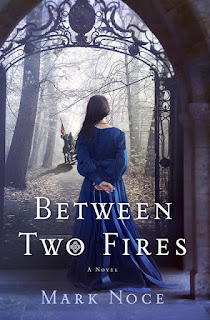
Mark Noce writes historical fiction with a passion. His medieval Welsh novel, Between Two Fires, comes out with Macmillan and St. Martin’s Press on August 23, 2016.


