Showing posts with label WAAF. Show all posts

Friday, February 26, 2016

Women Warriors

By Mark Noce

This topic has gotten controversial in recent years, as archaeologists and historians reexamine the historical record in order to identify a history of female warriors across the British Isles. What specifically am I talking about here?

Well, believe it or not, years ago archaeologists identified bodies in very simplistic ways. For instance, if the skeleton had armor on it was considered male and if it had something resembling a dress it was considered female. But recent bone forensics have turned this old time notion on its head, as several instances of female skeletons have been identified from various eras decked out in full armor or with various weapons. So what’s it all mean?

To some, the facts have been staring us in the face all this time. Even written records from the days of Caesar down through the Renaissance depict women going into battle beside men, but many of these remarks were dismissed as exaggeration or even as outright satire. Others have opted for a middle path, suggesting that women in various eras did go into combat beside men, but that these were rare instances. There are several eras of British history, however, that point to a larger cultural involvement of women warriors across Britain and Ireland.

Firstly, the Celts. It’s no secret that women held equal sway with men in ancient Celtic society. An ancient chariot burial unearthed in Yorkshire identified a Celtic woman buried in full battle dress along with her chariot. Both a wealthy woman and one clearly accustomed to using a sword. In west Ireland, an even older grave identified a female skeleton buried with her bow, war horse, and the hide of a red stag. Clearly, these aren’t just one-off instances. Such cultural practices may have even continued into the medieval era in regions where Celtic culture remained strong, such as Wales and Scotland.

Secondly, the Viking era, surprisingly is revealing more and more female skeletons buried in Norse armor throughout the British Isles. The Scandinavian Sagas are replete with tales of Shieldmaidens that until recently were written off as fanciful storytelling, but now it seems that hardly a Viking ship set out without at least one or two women warriors abroad it. Some historians have posited that the rough and tumble Vikings didn’t include women on their raids because they necessarily believed in equality, but because it made sense to utilize as much of their population as possible in order to continue their aggressive expansion into Northern and eventually Southern Europe.

Thirdly, one doesn’t have to look into ancient history to see women contributing to a war effort. Just look at the FANYs and WAAFs who served Britain in uniform during World War II. Some even ended up in dangerous Resistance work as part of SOE (Special Operations Executive) fighting the Nazis behind enemy lines. In one form or another, well over half a million young women served as auxiliaries for the UK during WWII, doing everything from driving trucks to wireless operations to working in factories.


Is it really that difficult to imagine that women have served as warriors throughout the many centuries of human habitation across Britain?

I think that in the years to come both archaeology and historical analysis will only reveal more and more evidence that women warriors have played an integral part in shaping the fate of the British Isles to this day.

~~~~~~~~~~~~~

Mark Noce writes historical fiction with a passion. His medieval Welsh novel, Between Two Fires, comes out with Macmillan and St. Martin’s Press on August 23, 2016.

Learn more at marknoce.com or preorder his novel here.


Friday, August 14, 2015

"Scramble" - Remembering the Battle of Britain and Why it Still Appeals to us Today

by Helena P. Schrader

"Scramble!" RAF Squadron is given the order to
take off very early in the Battle of Britain
Courtesy of the Imperial War Museum

The Battle of Britain was more than a military victory. The Battle of Britain was a critical psychological and diplomatic victory as well. The psychological impact of defeating the apparently invincible Luftwaffe was enormous at the time. The RAF had proved that the Luftwaffe could be beaten, and by inference that the Wehrmacht could be beaten. This fact alone encouraged resistance and kept hope alive all across occupied Europe. Even more important, as a result of British tenacity and defiance in the Battle of Britain, the United States, which at the start of the Battle had written Britain off as a military and political power, revised its opinion of British strength.  Because of the Battle of Britain, the U.S.A. shifted its policy from ‘neutrality’ to ‘non-belligerent’ assistance. With American help, Britain was able to keep fighting until Hitler over-extended himself in the Soviet Union. The Battle of Britain was the necessary pre-requisite for future victory in Europe.

Yet, any such purely objective assessment of the Battle of Britain does not explain the appeal of the Battle of Britain to people today.  There were, after all, many other decisive battles in WWII from Stalingrad to Midway. The appeal of the Battle of Britain is less military and diplomatic than emotional.

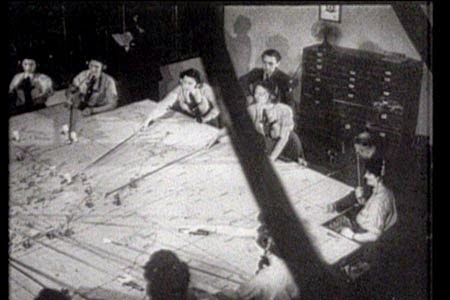
Fighter Command Control Room;
Courtesy of the Imperial War Museum

The Battle of Britain appeals to us today because it was not only a clear case of good against evil, but of the underdog winning against a bully. RAF Fighter Command was tiny!  Even including the foreign pilots flying with the RAF, there were only roughly 1,200 trained fighter pilots in Britain at the time of the Battles. (Numbers varied due to training, casualties and recruiting.) These men were a highly trained elite that could not be readily replaced. Pilots were not mere “cannon fodder.”  They were specialists that took years to train. In the summer of 1940, they stood against apparently overwhelming odds. Churchill – as so often – captured the sentiment of his countrymen when he claimed that “never in the field of human conflict has so much been owed by so many to so few.”

This image of a small “band of brothers” standing up to a massive and invincible foe in a defensive battle for their homeland was reminiscent of other heroic battles – Henry V at Agincourt, Edward the Black Prince at Poitiers, Leonidas and his 300 at Thermopylae.  Such battles, pitting a few defenders against a hoard of enemy, have always appealed to students of history and readers of historical fiction like almost nothing else.

RAF Pilots at "Readiness,"
Courtesy of Chris Gross

Furthermore, the Battle of Britain still resonates with us today in part because it wasn’t a battle won by generals, technology or even “aces” — but rather by young men barely out of their teens.  (The average age of RAF fighter pilots in the Battle was 22.)  They fought in beautiful, fragile machines that still awe aviation enthusiasts. And the casualties were devastating.  In just four months, Fighter Command lost roughly 40% of its pilots.  That means that each pilot had only a slightly better than 50% chance of surviving the Battle.  Furthermore, the effective casualty rate of killed and wounded was closer to 70%.  This situation was aggravated by the fact that, as a rule, the more experienced pilots had a 5-6 times greater chance of surviving than did the replacement pilots coming into the front line with very little flying and no combat experience.  The most critical period for a replacement pilot was his first fortnight in a front-line squadron.  Many pilots did not survive four hours.  That makes for an element of tragedy even in victory that catches at our heart-strings.

Funeral for PO Billy Fiske,
U.S. citizen and RAF fighter pilot, during the Battle of Britain,
Courtesy of  Andy Saunders

We shouldn’t forget, however, that the pilots alone did not win the Battle.  The RAF had worked hard to ensure that its pilots were supported by some of the best trained ground crews in the world.  With an ‘apprentice’ program, the RAF had attracted technically minded young men early and provided them with extensive training throughout the inter-war years. In some ways, ground crews were better educated than many pilots. Under the circumstances and given the fact that many pilots came up from the ranks themselves, it is hardly surprising that the relations between pilots and crews were on the whole excellent.  The RAF had a notoriously relaxed attitude toward discipline in any case, and this further worked to break down barriers. Last but not least, at this stage of the war, individual crews looked after individual aircraft and so specific pilots.  The ground crews identified strongly with their unit – and ‘their’ pilots. After the bombing of the airfields started in mid-August, the ground crews were themselves under attack, suffering casualties and working under deplorable conditions – often without hot-food, dry beds, adequate sleep or time-off.  The ground crews never failed their squadrons.  Aircraft were turned around – rearmed, re-fuelled, tires, oxygen, airframe etc. checked – in just minutes.

Ground Crews Refuelling in the Rain.
Imperial War Museum

Equally notable was the RAF’s early and exceptionally positive attitude toward women.  The RAF actively encouraged the establishment of a Women’s Auxiliary, which by the end of the war served alongside the RAF in virtually all non-combat functions.  Even before the start of the war, however, the vital and highly technical jobs of radar operator and operations room plotter, as well as various jobs associated with these activities, were identified as trades especially suited to women.  The C-in-C of Fighter Commander, ACM Dowding, personally insisted that the talented women who did these jobs move up into supervisory positions – and be commissioned accordingly. During the Battle of Britain over 17,000 WAAF served with the RAF, nearly 4,500 of them with Fighter Command. A number of WAAF were killed and injured and six airwomen were awarded the Military Medal during the Battle.

WWII WAAF Recruiting Poster.
Imperial War Museum

Last but not least, given the losses and the sheer physical demands placed upon the RAF pilots at the time, it was their ability not only to keep flying but to keep drinking and laughing that awed their countrymen, their leaders and their enemies — when they found out.  And it still appeals to us today.

Pilots of "B" Flight, 85 Squadron, July 1940,
Courtesy of Edith Kup
~~~~~~~~~~~~~

My novel on the Battle of Britain, Chasing the Wind (Kindle edition: Where Eagles Never Flew), pays tribute to the entire spectrum of participants, male and female, from mechanics and controllers to WAAFs as well as to the pilots. I based my account on the very meticulous records now available from both the UK and Germany to ensure that the raids, casualties, and claims each day are correct. Yet the most important research was reading the memoirs of dozens of participants and corresponding with others to try to get the atmosphere “right.” My greatest moment as a historical novelist came when I received a hand-written letter from a man I had only read about up until then: RAF Battle of Britain “ace” Bob Doe. Wing Commander Doe wrote to tell me I had “got it smack on the way it was for us fighter pilots,” and said that Chasing the Wind was “the best book” he had ever read about the Battle of Britain.  It doesn’t get any better than that for a historical novelist!

Here’s a video teaser about the novel. Click here!

For reviews click here: Reviews.