Showing posts with label William Pitt the Younger. Show all posts

Monday, August 14, 2017

Introducing that Amazing Man, William Pitt the Younger ~ Part II

by Jacqui Reiter

Please cast your minds back to 24 November 2013, when I introduced (or re-introduced) you to the Right Honourable William Pitt the Younger and began explaining to you why you should find him worth the trouble of studying. I have already discussed his youth, his intelligence and his humanity. Today I will bring my explanations to a close.

He defied expectations

Pitt was proverbial for his honesty. This was a time when most politicians were happy to cream off every last financial perk they could, and were indeed half expected to do so. Pitt infused the posts of First Lord of the Treasury and Chancellor of the Exchequer with a fresh sense of responsibility.

One of the first things he did on taking office was to turn down the lucrative sinecure of Clerk of the Pells. He later turned down the Garter as well. He did accept the Lord Wardenship of the Cinque Ports in 1792, but only after the King told him he'd take a refusal as a personal insult.[1]

This had a lot to do with Pitt's determination not to be anyone's plaything, even the King's. It's no accident that, when Pitt resigned in March 1801, he did so on an issue (extending the political freedoms of Catholics and other non-Anglicans) with which the King vehemently disagreed.


Pitt was no doctrinaire. He described himself early on as an 'independent Whig'[2] and showed a lifelong reluctance to commit himself to political absolutes (apart, of course, from the admiration for the Glorious Revolution and its religious and political settlement that was sine qua non for any ambitious 18th century politician).

He was an admirer of Adam Smith and formed many of his financial policies on a laissez-faire basis, but when things went wrong he was not afraid to depart from Smith's ideas. In 1800, for example, the harvest failed and Britain was on the brink of famine. Pitt outraged many of his more rigid followers by recommending the importation of grain from abroad to relieve the scarcity.

Politically he was creative enough. Many of his more famous ideas were lifted from others, but crucially Pitt made them work. You can blame him for the first Income Tax in 1798, which helped raise much-needed funds for the war with France despite being criticised as an unprecedented attack on personal property. The newest thing about it-- and I'm not sure this happened again until 1992-- was that the monarch was also taxed.

The forging of the United Kingdom and its new parliament after the union with Ireland in 1801 involved startling corruption but also significant administrative change. Less obvious was Pitt's review of the way government departments were run. These were made more accountable, stripped of excess staff and slim-lined in a way that laid the foundations for 19th century bureaucracy.

And of course Pitt was capable of breaking the rules in a literal sense. During a debate in Parliament in 1798 he accused a member of the opposition, George Tierney, of obstructing the defence of the country. Tierney challenged Pitt to a duel, and Pitt accepted. Thankfully both parties emerged unscathed. but it's just another of those unexpected little details that makes Pitt so interesting.

He is a mystery

For someone so famous there is much about Pitt that is simply not known, starting with his own opinions on major matters and working down from there. Like many politicians Pitt was cagey about taking a stand and was rarely categorical on the 'big issues' such as parliamentary reform, abolition of the slave trade, abolition of political restrictions based on religious beliefs, and so on. His political pronouncements were so woolly that, after his death, his heirs could trace arguments for and against all the above issues to him. 19th century Liberals and Conservatives both traced their ancestry to Pitt, and both were in some degree right to do so.

Part of the problem is the lack of primary evidence. Some of this is due to Pitt himself. He was a notoriously bad correspondent. His friends despaired of him. 'I called [at Downing Street] in hopes of seeing you, for you are so bad a correspondent that nothing can be made of you by Letter,' one wrote in 1796.[3] Pitt's own mother complained she had to hear about him from mutual friends.[4]

But there is more to it than Pitt's laziness. He certainly left a lot more behind him than now exists. One of his executors was his old friend and former Cambridge tutor George Pretyman-Tomline, Bishop of Lincoln, who later also wrote a (dreadful) biography of Pitt.


Pitt was barely cold in the grave before Tomline went through his papers and 'indulged in an orgy of devastation which ensured that nothing of the slightest personal significance ... remained to posterity'.[5] This is Reason Number 1, and there are more, why Tomline's portrait will always be at the centre of my dartboard.

Tomline was not alone; several of Pitt's friends, for example Henry Addington, Viscount Sidmouth, destroyed material in their possession as well. Quite why is hard to say as the material obviously no longer exists, but it means that much of Pitt's private life and public opinions have to be guessed at from the little that remains.

It's really, really annoying for historians, but a perfect boon for novelists. I am surprised so few novelists have taken up the challenge of filling in the blanks. (No, I'm not the first, and I hope I won't be the last either!)

He is relevant

A historical character can be interesting, but in my opinion they only become important historically when what they achieved resonates across the centuries. Pitt, I think, definitely qualifies.

If you will pardon the cliché, Pitt lived in turbulent times. He entered Parliament at the end of the war with revolutionary America, when only a quarter of a million adult males had the vote and the movement for Parliamentary Reform was in full swing. He was later prime minister when reform returned to the fore of the agenda in the shadow of the French Revolution.

Pitt initially supported reform. He introduced three private reform bills in the early 1780s, one as prime minister. All failed. By the time the French Revolution broke out he'd changed his mind and argued that wartime was not the opportunity for reform. He had never been anything but a cautious reformer and clamped down hard on radicalism. For this reason he is mostly remembered as an enemy of the reform movement.

His quashing of popular reform movements in the 1790s in particular earned him a fearsome reputation in some 20th century historiographical circles. Some historians still talk about 'Pitt's Terror', and a book was recently published drawing parallels between Pitt's anti-reform measures and post-9/11 American and British intrusions into personal privacy.[6]

This does not make him any the less influential. The fact that his political acts in the 1790s still resonate today suggests the opposite. And in any case Pitt made a more lasting mark in other areas. He was the friend of William Wilberforce, and helped him galvanise the movement for abolishing the slave trade.

Abolition was not achieved until after Pitt's death, and for a variety of reasons he was not able to make it an official government measure. It was he, however, who first suggested Wilberforce take up the cause in Parliament, and it was Pitt himself who first moved it on Wilberforce's behalf. He continued to support it throughout his life.

Others of Pitt's measures were of great practical importance. For better or for worse, the Act of Union with Ireland in 1801-- passed by Pitt's government-- changed the political complexion of the British Isles completely. We are still (... just about!) the United Kingdom today, so it's safe to say Pitt's policy-making had a lasting impact.

I have no intention of going into the political complexities of the above-mentioned issues here. Reams have been written on the subject. What I want to say is that Pitt was a leading figure in a time of profound change and his actions mattered. He will always be interesting. Like him or not, I trust you will at least concede his importance.


And finally...So there you have it: six reasons why Pitt the Younger is worth your time of day. I hope that my enthusiasm has been catchy, and that any of you who began reading these entries with questions about who Pitt was, or why he is interesting, have now had those questions answered.

I hope, too, that I have whetted your appetite for more. Should you choose to expand your knowledge I would advise you to consult any or all of the following:

John Derry, William Pitt (B.T. Batsford, 1962)
Michael Duffy, Pitt the Younger (Longmans, 2000)
John Ehrman, The Younger Pitt, 3 vols (Constable, 1969-96)
William Hague, William Pitt, the Younger (Harper Collins, 2004)
Robin Reilly, Pitt the Younger (Cassell, 1978)
J. H. Rose, William Pitt and National Revival and William Pitt and the Great War
Lord RoseberyPitt (1891) 
Earl StanhopeLife of William Pitt, 4 vols (J. Murray, 1861-2) 
Michael J. Turner, Pitt the Younger: A Life (Hambledon and London, 2003) 

References: 
[1] Stanhope II, Appendix xv-xvi
[2] Ehrman I, 58
[3] Lord Mulgrave to Pitt, 14 May 1796, Cambridge University Library Pitt MSS f 1961
[4] Holland Rose,
[5] Robin Reilly, Pitt the Younger
[6] Kenneth R. Johnson, Unusual Suspects: Pitt's reign of alarm and the lost generation of the 1790s (OUP 2013)


An EHFA Editor's Choice, originally published December 11, 2013.
~~~~~~~~~~~~

Jacqueline Reiter has a PhD in late 18th century political history from the University of Cambridge. A professional librarian, she lives in Cambridge with her husband and two children. She blogs at www.thelatelord.com and you can follow her on Facebook (www.facebook.com/latelordchatham) or Twitter (https://twitter.com/latelordchatham). Her first book, The Late Lord: the Life of John Pitt, 2nd Earl of Chatham, was published by Pen & Sword Books in January 2017.

Wednesday, June 3, 2015

Bias in Historical Research

by Stephenie Woolterton

As historical fiction authors and historians, we study and create characters, plots, and worlds that transport our readers to the past. Although we cannot actually visit these bygone times (when will they invent that time machine?), we are able to build worlds so powerful that we hope our readers feel as though they are transported to them through their imaginations. Even if we’re writing about people who once lived, we will never be able to actually meet and speak with them. What we can do, however, is use the intensive historical detective skills we’ve gathered to construct stories of distant times and places - periods accessible only through research. An unavoidable part we encounter in this research process is bias.

What exactly is bias?

Simply put, bias is perspective. Perspective is largely the consequence of the author’s background and the current political, social, and economic circumstances of the time in which the author is writing. Bias in historical research refers to the adoption of a particular perspective from which some things become salient and others merge into the background. It is a conscious or unconscious tendency on the part of the writer or researcher to interpret what they research.

For instance, history was once predominately written by powerful white males who assumed that only wealthy white males made history. They determined what history was deemed worth recording, and the role of others (e.g. servants, wives, mothers, etc.) was felt to be insignificant. These days, historians often allow for bias in the evidence they gather, and even explain it when reconstructing what happened in the past. The problems encountered involve matters of the ‘truth’ of historical events, the question of a balance between historical details and fictional elements, and the demand for authenticity and accuracy in the material we write about. In this case, for both the novelist and the historian, meaning lies not in the chain of events themselves, but in the writer's interpretation of what occurred. Pressures to conform to existing norms can be strong. What is taken to be historically ‘true’ by powerful, highly acknowledged historians is not easy to dispute. There can be great difficulty with challenging existing historical authorities or established interpretations of how an event happened or the taken for granted, ingrained ‘facts’ about an historical figure. This can even influence what is published versus what is rejected.

Yet historians and authors do not live their everyday lives in a vacuum: gender, ethnicity, sexuality, religious beliefs, social background, and nationality all mean something. They influence the historian in terms of which topics to focus on, what questions to ask, which sources to consult, and the interpretations they glean. To practice research and to create historical stories of our own is to question and consider interpretations that are different from our own. A way to discern bias in research involves being reflective over your work, and to consider various viewpoints.

Is it possible to overcome bias?

Although complete detachment may not be possible, historians can put commitment to rational standards of historical inquiry ahead of a desire for a certain outcome, thereby significantly reducing the outright bias in their work. Even if historians are fair-minded, the information available to them is often biased. The best way to reconcile bias is to acknowledge it when using quotes or paraphrasing material, and to point out where similar sources agree or disagree. Never forget to interrogate and question your sources. Who wrote it? What was their motivation or intention? What was the context or background behind this document? Did someone have an axe to grind when they wrote it?

Historians have long been aware that the information available to them, be it in historical texts or visual sources, have often been selected for certain purposes: these artifacts reflect the concepts and interests of their creators. The historian’s job is to look at explanations that account for the motivations behind them so they can then look for coherence among various explanations of the same historical period (i.e. The French Revolution). Critical historians should always interpret their evidence cautiously.

Unfortunately, there are occasions where historians cannot get to the ‘facts’ behind biased or missing evidence. The available information may have been so culled as to yield an inaccurate impression of events. For instance, in my own research into the private life of the late eighteenth century British politician William Pitt the Younger, I have found ample evidence to suggest that large swathes of Pitt’s private papers were deliberately destroyed by his executor, Bishop Tomline. What was Tomline’s purpose for systematically destroying Pitt’s papers? His wife was in direct collusion, and together they acted to conceal something about Pitt’s domestic life that they did not approve of and felt did not fit with the posthumous image of the pure, unsullied Minister. Instead, the untarnished image of Pitt was portrayed: the stately politician without any taint or scandal. Here Tomline’s motivation was to set himself up as Pitt’s official biographer by sifting out what did not fit with the interpretation – the image – of Pitt that he intended to portray. After over two centuries, my intention through my biography of Pitt is partly to expose Tomline’s bias of Pitt’s character.

Historical writing as a cooperative endeavor: Historians working together 

A balanced and well-argued account with supporting evidence to assert your claims is central in historical research. It’s important to get your friends and colleagues to look over your work and to discuss your findings. History should be viewed as a cooperative, collective endeavor, with historians working together to arrive at and challenge accounts of the past. The freedom to question your own views, and those of others, in an open-minded way is a great method for reaching fair descriptions of the past.

Image Source: My photo of a framed letter from William Pitt to his friend William Wilberforce (August 8, 1792) announcing his acceptance as Lord Warden of the Cinque Ports.

About the Author:

Stephenie Woolterton is currently writing a biography of William Pitt the Younger’s private life, primarily surrounding his female attachments. Her website is www.theprivatelifeofpitt.com and she’s on Twitter @anoondayeclipse.

Sunday, March 8, 2015

Lady Mahon: The Short Life of William Pitt’s Eldest Sister

by Stephenie Woolterton

Lady Hester Pitt, Viscountess Mahon
by an unknown artist, c. 1770s
Little is known about the short life of William Pitt the younger’s eldest sister, Lady Hester (Pitt) Stanhope, Viscountess Mahon (1755-1780). Unlike her daughter, also named Lady Hester Stanhope, Lady Mahon did not live past the age of sixty, and travel throughout Europe and the Middle East. Instead, she married at the age of 19 and died before her twenty-fifth birthday, her body exhausted from five successive pregnancies in as many years. Nevertheless, her life is worthy of historical attention as, like her younger siblings, she was raised under the backdrop of two political dynasties - The Pitts and the Grenvilles - and she was an example of a highly educated 18th century woman.

Lady Hester Pitt was born in October 1755, the first child of William Pitt the Elder (later 1st Earl of Chatham) and his wife Lady Hester (née Grenville). The Dictionary of National Biography lists her birthday as October 18th, 1755, although this has not been verified in baptismal registers. She was likely to have been born at the Pay Office, where her parents were then residing, and her mother was under the care of the famous 18th century London physician Dr. John Hunter [1]. It is probable that her father was absent when she was born as there are letters passing between the couple at the time [2].

It is not surprising that such was the case, as the Pitts spent great stretches of time apart throughout their marriage, much of it due to Pitt the Elder's own volition. Government business and trips to Bath (sometimes also for his health) usually kept him away from his wife, and she was forced to accept his frequent absences.

Unlike most girls at the time, Lady Hester benefitted from a thorough private education, being tutored at home by the family chaplain, Reverend Edward Wilson, alongside her sister Lady Harriot, and her three brothers, John (Lord Pitt), William, and James Charles. All five children were proficient in classical languages, translating ancient Greek, and quoting lengthy passages from Thucydides and Polybius [3]. Her childhood was split primarily between her parent’s two residences at Hayes Place, near Bromley in Kent, and Burton Pynsent, just outside the village of Curry Rival, Somerset.

She was accustomed to an upbringing full of scholarly stimulation and politics. Her father was raised to the peerage in the summer of 1766, the ‘Great Commoner’ becoming the first Earl of Chatham. In the following year, in a letter dated 17th June 1767, Jane Hamilton, Lady Cathcart writes to Hester’s mother Lady Chatham, speaking of a recent visit from three of the Pitt children. Lady Hester was eleven years old:

"…We had the finest Cricket Match in our Court you can imagine. You never saw anything more like a School Boy than Ld Pitt [John], wch I think says a great deal for his Education. The Young Ladies danced: Ldy Harriet in particular I think a genius in that talent, her little feet and all her little fair figure is delightful. Ldy Hester’s Stile and Air is different ... There is an openness, a Solidity and goodness in her [Hester] that makes one quite her friend. She was as Womanly and Careful that her Br and Sisr shd not over Eat or over Heat themselves as Dame Sparry [the children’s nurse] herself could have been, wch at her age [she was 11] is delightful, as she has as much of good hum[ou]r and liveliness as any of them…" [4]

From this passage, she is depicted as the caring sister looking after her younger siblings. Several years later, her mother the Countess of Chatham wrote to their cousin Mrs. Pitt, remembering Lady Hester and Lord Pitt’s recent stay at Boconnoc: “…Our Boy [John, Lord Pitt] and Girl [Hester], tho’ Harp and dancing, and Hounds and Hunting, have furnish’d their amusements, the delights of Cornwall do not cease to be regretted." [5]

Although Lady Hester did not suffer from nearly as many childhood illnesses as her brother William, there are records of her being treated by the family physician, Dr. Anthony Addington, for muscular pains and a rash in early 1772. At the time, the sixteen year-old Lady Hester was forced to take to her bed. Dr. Addington told her mother that, "The Pains which Lady Hester has felt in her Neck, Shoulders, Collar-Bone and Side, have been all muscular," and "...bleeding, purging and James’s Powder [quinine]" were used to treat her. [6]

After weeks of lying in her bed, and following Dr. Addington’s strictures, her ailment was still persisting. The doctor wrote again to Lady Chatham on February 1, 1772, advising a new course of treatment: “…I find it necessary for Her [Lady Hester] to have Patience with her Bed … I believe Your Ladyship and Lord Chatham are satisfied with me, that it is necessary to support Lady Hester with light and nutriceous [sic] diet … For this Reason, it must be right to allow Her Chicken, or Turkey or Rabbit for Dinner with Wine and warm water; to give Tea with toasted or untoasted Bread and very little Butter for Breakfast only; to use Broth or Sago or Panada for Supper; and thin jellies or Gruel between Meals…” [7] The nature of Lady Hester’s complaint is not entirely clear, but she recovered with time.

Charles, 3rd Earl Stanhope, by an
unknown artist (Wikimedia Commons)
By 1774, she was an eligible young woman, described by a family friend as “one of the most accomplished persons of the age.” [8] She certainly caught the eye of her second cousin, Charles Stanhope, Viscount Mahon. He was a tall, lanky, and eccentric young man who had recently returned to England after being educated in Geneva for ten years. Their grandparents Lucy Pitt and James, 1st Lord Stanhope, had married in 1713, producing six children including Charles’s father, Philip [9]. Unlike today, the couple’s familial relationship was deemed unimportant, and was in any case common amongst aristocratic marriages.

Lord Mahon was intelligent, scientifically inquisitive, and passionate about social reform. It was a love match, despite the familial connection, and he quickly proposed. On September 24, 1774, Mahon’s father Philip, 2nd Earl Stanhope, wrote to Lord Chatham to express his joy on hearing of the engagement: “My Son has rejoiced his Mother and me exceedingly by acquainting us with the proposal he has taken the liberty to make to dear Lady Hester, to whom he assures us it is not disagreeable. Our hearty approbation of a connexion which does him and us so much honour is already given, and nothing remains but the obtaining of your Lordships and Lady Chatham’s concurrence, which we flatter ourselves that the short acquaintance you have had with the young suitor has given you no cause to refuse. If we are so happy as to find you in the favourable dispositions which we wish, nothing in our power shall be wanting to settle everything as much as possible for the lasting happiness of so beloved a couple…” [10]

Lady Hester’s marriage settlement was duly drawn up. In an extract from the indenture, there was a particular provision stipulating that if she died before him, Lord Mahon would receive the Sum of £2,000 per year, “free from all Taxes and Deductions whatsoever.” [11] It may seem small in today’s currency, but it was quite a hefty sum at the time.

The couple married on December 19, 1774 at St. Mary the Virgin church in Hayes. Lady Mahon quickly fell pregnant, but she miscarried in April 1775. Her mother, the Countess of Chatham, attended her, and later wrote to Mrs. Pitt: “…I was obliged to quit my Patient at Home [Lord Chatham] yesterday to make a visit to my Daughter Mahon who is indispos’d from a Circumstance that brings some Mortification and disappointment with it. I had the Consolation however to find her better than I could have expected, and not likely to suffer long confinement…” [12]

Good news came in August, when Lady Chatham apprised Mrs. Pitt that, “…My daughter Mahon’s situation you will best understand by being told that she is both very sick, and very well.” [13] Lady Mahon was pregnant again. That child was Lady Hester Lucy Stanhope, born in London on March 12, 1776.

1778 Rate Book for Harley Street
(Westminster City Archives)
In the late 1770s, the Mahons were living at number 52 Harley Street, and paying £140 in rent [14]. Since the late 18th century, 52 Harley Street has become number 61. It served as their London residence when they were not staying at Chevening. Throughout her short marriage, Lady Mahon served as her husband’s secretary, assisting him in his new-fangled electrical experiments after he became obsessed with observing lightning strikes. At one point, Lord Mahon even attempted to induce lightning using a cow on the Chevening estate as a conductor. [15]

Over the next few years, Lady Mahon had a pregnancy that resulted in the birth of a stillborn son, and a daughter named Grizelda. In late February 1780, she gave birth to a third daughter, Lady Lucy Rachel Stanhope. Her recovery was complicated by the onset of puerperal fever. Lady Mahon was not able to write to her mother for over two months. On April 24, 1780, she told her mother, “I begin to feel very comfortable again after this long Illness,” and “…I go out every day in the Post Chaise and feel very great advantage from the Air which will I trust do all that is now to be done.” It was to be her last surviving letter. [16]

Chevening House in Kent (Wikimedia Commons)
Her health seemed to rally in the spring, and she was able to attend a ball, take drives in her chaise, and go shopping with her sister Lady Harriot for lute strings and chintzes [17].
Nevertheless, her condition suddenly worsened in the summer. On June 17, 1780, the Mahons were staying at their house on Harley Street, and Grace Trevor, the great friend Lady Lucy Stanhope, the unmarried sister of Philip, 2nd Earl Stanhope, wrote to Lady Chatham that she had recently had the pleasure “…to hear dear Lady Mahon is well. We felt much for them on account of the [Gordon] Riots in London: they are, I find, as we are, under the care of the Military.” [18]

St. Botolph’s Church, Chevening (Wikimedia Commons)
Then in a letter to their former tutor Rev. Wilson on July 11, 1780, William Pitt stopped him from visiting the Mahons in Harley Street, telling him, “Ld and Lady Mahon are both at Chevening, which I hope will have agreed better with her than London seem’d to do latterly.” [19] Sadly, the air of Chevening did not improve her failing health, and Lady Mahon died the following week on July 18, 1780. [20] She was buried in the South-east vault of St. Botolph’s church beneath the Stanhope Chapel. After Lady Mahon’s death, her three little daughters were left to the care of their grandmother, Lady Grizel Stanhope.

Within a year, Lord Mahon married his deceased wife’s cousin, Louisa Grenville, and he later had three surviving sons by her. It was an unhappy marriage, and in the coming years Charles, 3rd Earl Stanhope after 1784, would fall out with all six of his children, become estranged from his second wife, and take up with a music instructor. There is no mention in the surviving Pitt family correspondence concerning Lady Mahon’s death, but they would have been greatly affected by it. Lady Mahon's death came two years after her father's passing, and by the end of 1780, her younger brother James Charles also died in the West Indies. William Pitt had stood as godfather to Lady Lucy, Lady Mahon's youngest daughter, and he would later assist her when she married an apothecary. Viscountess Mahon’s legacy continued in her free-spirited daughter Lady Hester Stanhope, and in the descendants of her daughter Lady Lucy Rachel (Stanhope) Taylor.

References:
1. Birdwood, V. (ed.) So Dearly Loved, So Much Admired: Letters to Hester Pitt, Lady Chatham from her relations and friends (1744-1801). London: HMSO, p. 5.
2. Ibid, p. 6.
3. Lord Rosebery (1895) Pitt. London: Macmillan, p. 3.
4. Birdwood, V. (ed.) So Dearly Loved, So Much Admired: Letters to Hester Pitt, Lady Chatham from her relations and friends (1744-1801). London: HMSO, pp. 97-98.
5.  Hester Chatham to Mrs. Pitt, August 27, 1771. Dropmore Papers. British Library Add Ms 59490, f. 4
6. Birdwood, V. (ed.) So Dearly Loved, So Much Admired: Letters to Hester Pitt, Lady Chatham from her relations and friends (1744-1801). London: HMSO, p. 258.
7. Ibid.
8. Kent RO: Pitt MSS U1590, Thomas Cholmondeley of Vale Royal to Lady Stanhope, 8 October 1774.
9. Ellis, K. (2008) Star of the Morning: The Extraordinary Life of Lady Hester Stanhope. London: Harper Press, p. 12.
10. Philip, 2nd Earl Stanhope to Lord Chatham. September 24, 1774. PRO 30/70/5 f. 344.
11. An extract from Lady Hester Pitt’s marriage indenture. Stanhope MSS (C45), 17th December 1774.
12. Hester Chatham to Mrs. Pitt, April 13, 1775. Dropmore Papers. British Library Add Ms 59490, f. 24.
13. Hester Chatham to Mrs. Pitt, August 7, 1775. Dropmore Papers. British Library Add Ms 59490, f. 27.
14. The 1778 Rate Book entry for Harley Street, showing number 52: The house of Lord Viscount Mahon. Westminster City Archives, London.
15. Ellis, K. (2008) Star of the Morning: The Extraordinary Life of Lady Hester Stanhope. London: Harper Press, p. 21.
16. Lady Mahon to Lady Chatham, April 24, 1780. PRO 30/70/5, f. 358.
17. Headlam C. (ed.) The Letters of Lady Harriot Eliot. (1914) Edinburgh: Constable, Letter of 29 May 1780. 
18. Birdwood, V. (ed.) So Dearly Loved, So Much Admired: Letters to Hester Pitt, Lady Chatham from her relations and friends (1744-1801). London: HMSO, p. 213.
19. William Pitt to Reverend Edward Wilson, July 11, 1780. Rubenstein Rare Book & Manuscript Library, Duke University, Pitt MSS.
20. There are two primary sources for this date: The Gentleman's Magazine, Vol. 50, 1780, page 348, and The Dictionary of National Biography, Volume 45, by Sir Leslie Stephen and Sir Sidney Lee, (1896) page 366.

Image Credits:
Images were found via Wikimedia Commons. The portrait of Viscountess Mahon can be accessed via www.findagrave.com.

~~~~~~~~~~~~~~~

About the Author:
Stephenie Woolterton is currently writing a biography of William Pitt the Younger’s private life. Her website is www.theprivatelifeofpitt.com and she’s on Twitter @anoondayeclipse. 

Thursday, March 5, 2015

The Cinque Ports Volunteers: A Napoleonic Volunteer Regiment

by Jacqui Reiter


Last month I introduced the main auxiliary forces on which the British government relied between 1793 and 1815 to defend the nation against a French invasion. By 1804 up to 90,000 militia (raised by ballot) and over 400,000 volunteers (organised by statute but raised locally) were available to act alongside the regular forces in case of attack.

Today I will focus on one corps of Volunteers in particular: the Cinque Ports Volunteers, formed in 1794, briefly disbanded 1802-3, and reformed 1803-9.

French Map of the Cinque Ports (Wikimedia Commons)

The Cinque Ports Volunteers would have been on the front lines of defence had the French ever decided to cross the Channel. The Cinque Ports was an ancient trade confederation consisting of Hastings, New Romney, Hythe, Dover, and Sandwich, along with the Antient Towns of Winchelsea and Rye, and the Confederation Towns of Faversham, Folkestone, Lydd, Margate, Ramsgate, and Tenterden. All were in Kent and East Sussex, many within sight of French soil. Their importance in terms of national defence is best demonstrated by the number of castles built over the centuries, such as Dover, Deal, Walmer, and Sandown.


The Cinque Ports Volunteers, 1794 – 1802

The Cinque Ports responded to the government circular of 1794 calling for volunteers by forming Yeomanry (cavalry) and Fencible (infantry, short for “Defencibles”) regiments, along with artillery units at Deal and Sandown.

The Cinque Ports Fencible Cavalry was commanded by Robert Bankes-Jenkinson, a future prime minister (as Lord Liverpool). Nearly 500 men, including officers and NCOs, enlisted. The Cinque Ports Fencibles were sent to Scotland in 1796, where they assisted in the funeral of the poet Robert Burns.

Despite being raised in response to an invasion threat, however, the Fencibles were rarely used for purposes other than peace-keeping and quelling civil unrest, as well as suppressing smuggling. They were disbanded in 1802 on the signing of the Peace of Amiens, which ushered in a truce between Britain and France.


The Cinque Ports Volunteers, 1803 – 1809

In May 1803, however, war broke out again with France. Napoleon immediately made it clear he meant to attempt an invasion of Britain, and positioned 150,000 men along the Channel coast for the purpose. Henry Addington's government turned again to volunteers, and the Cinque Ports once more responded enthusiastically -- this time with the personal involvement of the Lord Warden of the Cinque Ports, former prime minister William Pitt the Younger.

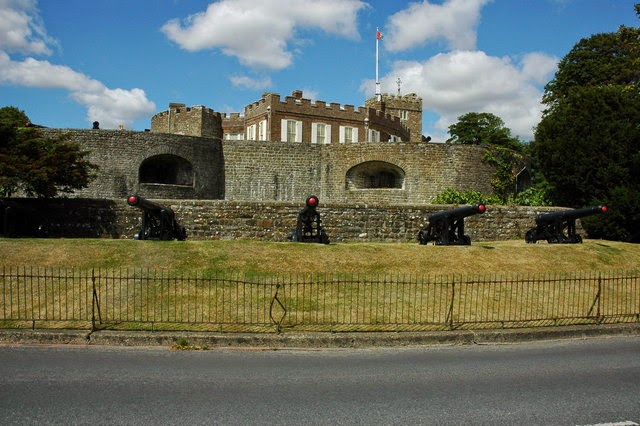
Pitt had accepted the sinecure of Lord Warden in 1792. After resigning the premiership in 1801 and selling his country home in 1802 he retired to the Lord Warden's official residence, Walmer Castle, and lost no time in responding to the Addington government's request in June 1803 for prominent local gentlemen to raise volunteers.
 
Walmer Castle (Wikimedia Commons)


Pitt wrote in his capacity as Lord Warden to Lord Hobart, the Secretary of State for War, on 27 July 1803:

I have the honour of transmitting enclosed a Memorandum of the proposal which I laid before your Lordship this morning for raising a Regiment of Volunteers within the Cinque Ports, to serve in case of invasion in any part of England, and to consist of three Battalions: and I have to request that your Lordship will submit the same to His Majesty's consideration.[1]

The proposal was accepted, and three thousand men were raised between July and November 1803. The officers were all local gentry and aristocracy, but the rank and file were mostly skilled labourers and artisans who could afford to leave their businesses for long stretches. The three battalions were headed by Pitt's step-nephew, Philip Stanhope, Lord Mahon; Robert Smith, Lord Carrington, Warden of Deal Castle and Pitt's personal friend; and Thomas David Lamb, a local dignitary from Rye.

The Volunteers were required by statute to drill for at least two days a week, or 24 days' service in three months. If there appeared to be a threat of invasion the men were called out on “Permanent Duty” and required to serve on the same basis as regular troops, under martial law, until the threat was over (they would, of course, be paid a shilling a day in compensation for lost earnings – although in the case of the Cinque Ports Volunteers, Pitt estimated the average man did not earn less than 2s6d a day ordinarily).[2] In return the Volunteers received uniforms and weaponry from the government, along with a very important benefit: exemption from the militia ballot.

In the 1790s the local gentlemen in charge of raising the volunteers had been allowed to choose their uniforms, but in 1803 the government wanted more control over the way the volunteers were raised and deployed. They insisted that all volunteer infantry regiments should be clothed in red, like the infantry.[3] The Cinque Ports Volunteers, therefore, wore red uniforms faced in pale yellow and blue pantaloons (white for ceremonial occasions), although none of the Cinque Ports battalions had yet received their uniforms before they were called out for the first time on Permanent Duty from 21 November to 14 December 1803.[4]

In July 1804 Kent was divided into three Volunteer Brigades, and the Cinque Ports Volunteers fell under the Cinque Ports Infantry Brigade under the command of General Charles Hope.[5] Their duties were to garrison forts, redoubts and batteries, including the Martello towers built along the coast between 1805 and 1809. Once again they were also used to deter smugglers and quell civil unrest, although these were comparatively minor features of their remit.

Military men seemed generally impressed with the quality of the Cinque Ports Volunteers, although some of what they said may of course have been intended to flatter Pitt. Not everyone in the army, however, was delighted at the prospect of working with "amateur" soldiers. Pitt allegedly told General John Moore, who commanded the local regular encampment at Shorncliffe, “On the very first alarm of the enemy's coming, I shall march to aid you with my Cinque Ports Volunteers. You have not yet told me where you will place us.”

Moore replied: “Do you see that hill? You and yours shall be drawn up on it, where you will make a most formidable appearance to the enemy, while I with my soldiers shall fight on the beach.”[6]

The Kentish Gazette also seemed underwhelmed by the Volunteers' ability to act as a military body. Remarking on the celebration of the King's official birthday at Deal in June 1804, the newspaper reported in some astonishment: “The Volunteers … fired three remarkably good volleys”.[7]

William Pitt as Colonel of the Cinque Ports Volunteers

Pitt's personal Volunteering zeal was well known. Some found it amusing, but there was an element of respect even in the satire:

Come the Consul whenever he will,
And he means it when Neptune is calmer,
Pitt will send him a damn'd bitter pill
From his fortress the castle of Walmer.”[8]

As for Pitt himself, he was confident. A toast attributed to him at a Volunteer dinner in 1803 went: “To a speedy meeting with the enemy on our own shores!”[9] At public meetings with Cinque Ports dignitaries Pitt expressed his expectations that the men of the Cinque Ports would rise to Napoleon's challenge:

As the Cinque Ports had the honor to form the advanced guard of the nation, their exertions ought, and he trusted would be, such as to enable them fully to resist any attempt the enemy might make at landing … The county ought not to content itself with the limitation of volunteers directed by government, but … should shew itself worthy of the eminent character it retained in history, and by a suitable exertion, at least double its proportion … The situation of this country was widely different from the inland counties, and … one man near the coast was worth ten at a distance.[10]

Pitt's example in leading his own men in the field – in the words of Lady Hester Stanhope, his niece, he “absolutely goes through the fatigue of a drill-sergeant … [and is] determined to remain acting Colonel when his regiment is called into the field” – had its effect on his men.[11] The Cinque Ports Volunteers were lucky to have such an involved and colonel, and they repaid his enthusiasm. When Pitt reviewed the Volunteers at Sandwich in November 1803 to tell them they were being called out on Permanent Duty, they reacted cheerfully to the news:

The battalion being formed into a circle, the First Speaker in the world then addressed them in one of the most eloquent and impressive speeches that could be delivered … and though the wind was very high, his audience large, and very considerably extended, his stentorian voice carried his words home to every animated breast; and no sooner was his harangue completed, than the Margate companies set the example, which was immediately followed by the whole line, of declaring their unanimous approbation of the proposal, by giving their Colone nine of the most hearty cheers that ever proceeded from the lips of the Men of Kent.[12]

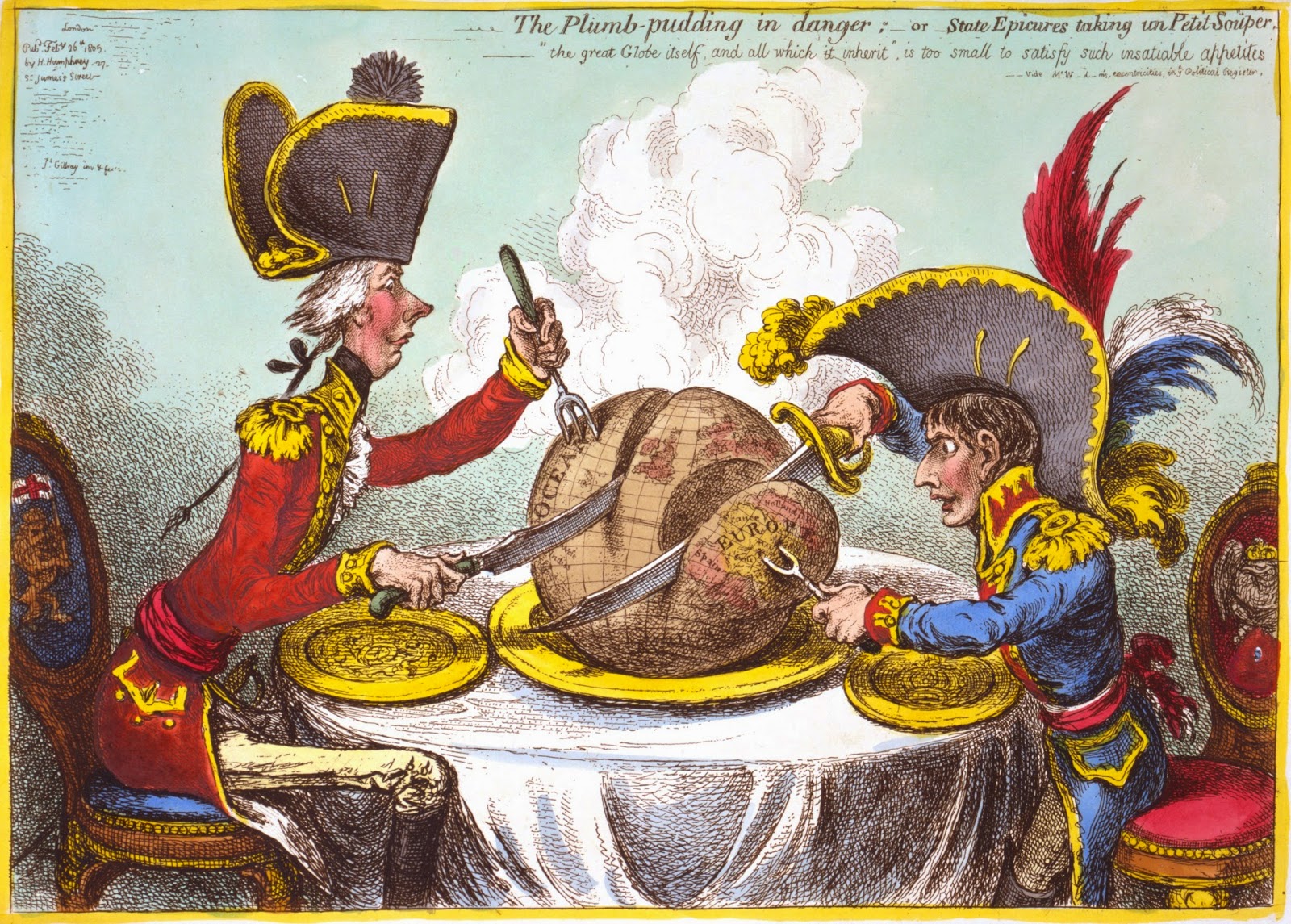
Gillray's famous caricature of Pitt and Napoleon (1805). Pitt is wearing his CPV uniform

The end of the Cinque Ports Volunteers

Pitt died in January 1806. The first two battalions of the Cinque Ports Volunteers attended his funeral at Westminster Abbey, marching in the procession with black bands around their arm. They had lost their Colonel, but they were about to lose much more than that.

Pitt's government was succeeded by Lord Grenville's “Ministry of All the Talents”, which appointed William Windham – a long-standing enemy of the Volunteers – as Secretary of State for War. Windham had a low opinion of the Volunteers' ability to withstand an enemy invasion: he much preferred the idea of relying on a strong regular force, with a large auxiliary force, raised by ballot, to supplement it. Windham's 1806 Training Act effectively killed the volunteer movement by removing all government financial support and reducing the hours spent training a year from 85 to 26.

Forced to rely on their own devices, the Cinque Ports Volunteers could not survive. The regiment issued a protest to the Secretary of State: “Resolved, that it appears to us that the plan of Establishment recently proposed to us by the Honourable Secretary  … will be attended with … serious difficulties, with considerable individual expence, and must in a short time, render the Battalion inefficient”.[13]

I have used my utmost endeavours to enduce as large a proportion of [the men] to remain embodied as possible,” Lord Hawkesbury wrote to the Secretary of State in September 1806. “... I think it right to inform you that though some of the officers who belonged to the First Battalion have tender'd their Resignations … I hope I shall be able to preserve within the Town of Dover Four Companies of Eighty Men Each which together with the Two Companies at Walmer, and four at Faversham will form a respectable Force. I am in hopes likewise that a greater Proportion of the Second Battalion will be dispos'd to continue their services.” The Third Battalion issued its last pay on 24 June 1806 and disbanded, although an Independent Company continued in Rye till 1809.[14]

Despite Hawkesbury's best efforts, attendance was already lapsing. “It [has] been observed for many Months past that the Attendance of the Corps instead of supporting its acquired Credit has most materially disgraxced it & if persevered in will render it altogether ineffectual,” was entered into the Battalion Order Book in September 1806.[15] Pitt's death and Windham's policies together spelled the end of the Cinque Ports Volunteers.

The regiment limped on a little longer, but by 1808 most of the remaining men enlisted into the Local Militia, a force created by Lord Castlereagh, Windham's successor as Secretary of State for War. It was a sad end for Pitt's own Volunteers, but sadly not untypical. In any case the immediate threat was past, and when a French invasion again became an issue – in the 1850s and 1860s – the Cinque Ports would again rise to the challenge.


 ______________

References

[1]  National Archives Home Office Papers HO 50/63

[2] Pitt to Lord Hobart, 8 November 1803, National Archives Home Office Papers HO 50/63

[3] Lt. Col. Metzmen to William Windham, 5 November 1803, British Library Add MSS 37882 ff 4-5

[4] Kentish Chronicle, 28 October 1803; Kentish Gazette 24 January 1804 

[5] Kentish Gazette 10 July 1804

[6] Richard Cannon, Historical record of the Fourth, or King's Own Regiment of Foot (London, 1839), p. 86

[7]  Kentish Gazette, 4 June 1804

[8] Peter Pindar [John Wolcot], “Invitation to Bonaparte”, The works of Peter Pindar (London, 1835), p. 433
 
[9] Arthur Bryant, The Years of Victory, p. 67

[10] Kentish Chronicle, 2 September 1803

[11] Lord Stanhope, Notes and Extracts of letters referring to Mr Pitt and Walmer Castle (London, 1866), p. 9

[12] Kentish Chronicle, 17 November 1803

[13] National Archives Home Office Papers HO 50/151

[14] Lord Hawkesbury to ?, 9 September 1806, National Archives Home Office Papers HO 50/151

[15] British Library Add MSS 38359 ff 79-80

  
______________

About the Author
Jacqui Reiter has a Phd in 18th century political history. She believes she is the world expert on the life of the 2nd Earl of Chatham, and is writing a novel about his relationship with his brother Pitt the Younger. When she finds time she blogs about her historical discoveries at http://alwayswantedtobeareiter.wordpress.com/.