Showing posts with label Whitehall. Show all posts

Friday, January 24, 2020

The Banqueting House

By Cryssa Bazos

January 30 is the anniversary of the execution of King Charles I in 1649, and I am reminded of the place where this drama played out--the Banqueting House at Whitehall.

The Banqueting House- Wikimedia Commons

Completed in 1622, the Banqueting House is the only remaining structure of Whitehall Palace and is situated across from Horse Guards Parade. During the Tudor age, the original Banqueting House was little better than a temporary venue. When King James I of England (VI of Scotland) succeeded Elizabeth on the throne in 1603 and ushered in the Stuart Age in England, he got down to work building a proper Banqueting House. His queen, Anne of Denmark, had been fond of masques and was a patroness of the arts.

The famous 17th century architect, Inigo Jones, was commissioned to design the building. What you have is a beautiful example of Palladian architecture with stately pillars and expansive high ceilings. Galleries line the upper hall. But what is truly a marvel in the Hall did not exist until King Charles I succeeded his father to the throne.

Interior Hall: Photo by C. Bazos

Charles commissioned the great Flemish artist, Peter Paul Rubens, to create a series of paintings to grace the ceiling. The panels were completed in Ruben's workshop before being shipped to England for installation.

The paintings were a delight of classical gods and motifs, the most noteworthy being the centre panel titled The Apotheosis of James I. The scene glorifies his late father, James I as though he were being crowned by the heavens. It is meant to reinforce the concept of the king being God's representative on earth and his divine right to rule.

Detail of ceiling:Wikimedia Commons

These paintings remain the only work of Rubens on display outside of a museum. Fortunately for the preservation of the paintings, masques ceased to be performed following their installation. The smoke from the candles would have damaged them over time.

Below the Banqueting Hall is an area known as the Undercroft. During King James's time, it was used as the royal party den, but in later years, they held other amusements such as lotteries. It's curved ceilings gives the impression of a cosy cave. One can imagine how it once looked, crowded with men drinking and gambling while lit with golden torchlight.

The Undercroft: Photo by C. Bazos

Ironically, the Banqueting House, which evolved as a testament to the divinity of kings, would stand as a confirmation of their mortality.

On a cold winter day, on 30 January, 1649, a scaffold was erected outside the Banqueting House, accessed from a second story landing. King Charles I stepped out on the scaffold, clad only in two shirts and a cap. Facing his subjects, he left them with his famous parting words, "I go from a corruptible to an incorruptible crown." Here ended his reign.

There is so much art and history wrapped up in the Banqueting House. The next time you are visiting London, I encourage you to visit this marvellous building. You may even be greeted by a Parliamentary soldier.

Parliamentary guard: Photo by C. Bazos

~~~~~~~~~~~~~
Wikimedia Commons attribution:
The Banqueting House: "Banqueting House London" by en:User:ChrisO - Own work. Licensed under CC BY-SA 3.0 via Commons - https://commons.wikimedia.org/wiki/File:Banqueting_House_London.jpg#/media/File:Banqueting_House_London.jpg

Apotheosis of James I: "Banqueting House 03" by The wub - Own work. Licensed under CC BY-SA 3.0 via Commons - https://commons.wikimedia.org/wiki/File:Banqueting_House_03.jpg#/media/File:Banqueting_House_03.jpg

This post is an Editor's Choice from the #EHFA archives, originally published February 2, 2016.
~~~~~~~~~~~~~
Cryssa Bazos is an award-winning historical fiction author and 17th-century enthusiast with a particular interest in the English Civil War. Her debut novel, Traitor's Knot is the Medalist winner of the 2017 New Apple Award (historical fiction), a finalist for the 2018 EPIC eBook Awards (historical romance) and a finalist for RNA Joan Hessayon Award. Her second novel, Severed Knot, is a B.R.A.G Medallion Honoree and has been shortlisted for the 2019 Chaucer Award. For more information, visit her website www.cryssabazos.com

Severed Knot is available through all online retailers: https://books2read.com/SeveredKnot

Sunday, August 9, 2015

Henry VIII, Anne Boleyn and the Lost Palace of Whitehall

by Nancy Bilyeau

At about 4 p.m. on January 4, 1698, during the reign of King William III, a fire broke out in the Palace of Whitehall. The possible cause was linen left to dry by a fireplace. The "devouring flame," in the words of James Vernon, destroyed the king's and queen's lodgings and most of the rest of the sprawling complex. "Except the banqueting house and the great gate, all is burnt down or blown up." The scene was chaotic, with court officials desperately trying to retrieve their possessions as the "gates were locked up to prevent the mob coming in."

The Palace of Whitehall, seen from
St. James Park in a painting from 1675.

This was the end of Whitehall as a royal residence, the palace where Henry VIII and Charles II died, where Elizabeth I entertained the French prince come to court her, where The Tempest was first staged for James I, where Hans Holbein designed a gatehouse and Inigo Jones a banqueting house, where Charles I was beheaded. Years after the fire, Queen Anne, the last Stuart monarch, said she wanted to rebuild Whitehall, but it came to nothing.

Today little remains above ground of the royal residence that covered 23 acres in Westminster, on the edge of London. The name "Whitehall" is synonymous with the British government and its civil service. Yet present-day Downing Street once was part of Henry VIII's royal entertainment grounds, with the street's first known house leased by Elizabeth I to a favorite, Sir Thomas Knyvet. The Tudor roots are strong.

Not everyone mourned the palace's destruction in the late 17th century. The duc de Saint-Simon said in his memoirs "a fire destroyed Whitehall, the largest and ugliest palace in Europe."

But Whitehall, the obsession of royal lovers Henry VIII and Anne Boleyn, had once been thought beautiful.

It was Cardinal Thomas Wolsey, Henry VIII's lord chancellor, who turned a bishop's residence on the Thames, just a short distance from Westminster Abbey, into a place of splendor. Since Wolsey held the bishopric of York, he was entitled to make use of York Place, as it had been known since the 13th century. Wolsey borrowed money and devoted his considerable energies to expanding it "most sumptuously and gorgeously." Banquets were held there, and elaborate "masques and mummeries."

Cardinal Wolsey

On March 1st, 1522, Cardinal Wolsey looked on as an elaborate entertainment was performed at York Place after supper. A "Chateau Vert" was raised, with the King and his friends masqued to storm the castle, occupied by costumed ladies, including a young brunette named Anne Boleyn, who was named "Perseverance" and had "black and beautiful eyes."

Anne Boleyn

Five years later, Henry VIII made public his quest to divorce his longtime wife, Catherine of Aragon, and marry Anne Boleyn. It was a struggle with momentous consequences, among them the downfall of Cardinal Wolsey, whom, the king felt, didn't work hard enough to win his master the annulment.

On Oct. 19, 1529, Wolsey was deprived of the great seal and he threw himself on the king's mercy. Hampton Court, York Place--the palaces became Henry's. A week later, Henry VIII arrived at York Place for a royal walk through, accompanied by Anne Boleyn, her mother Elizabeth, and the courtier Henry Norris. (Norris would be executed for adultery with Queen Anne in 1536, but that's another story.) The king found "the present more valuable even than he expected." No one gave a thought to Cardinal Wolsey, who would the following year die, arrested and alone, on his way to the Tower of London.

Turning York Place into a palace fit for a king and his future queen was no simple matter. Wolsey's residence revolved around a great hall, privy chamber and a receiving room, a cloister and a chapel, and kitchens; there were no lodgings for the vast number of people who lived in a Tudor royal residence. No tiltyard for jousting or ornamental garden. On one side was the Thames. On the other was a large marsh that once contained a leper hospital. Not a lot of room for expansion.

Yet expand it did.

During the same tumultuous years that Henry VIII fought for his annulment, breaking with the Pope and alienating those still loyal to Queen Catherine and her daughter the Princess Mary, he was personally directing the legal procedure of seizing the surrounding land for the new Whitehall. He inspected each building plan before it went forward. Anne Boleyn was as involved as the king in overseeing the design of the new palace, taking tremendous interest in its architecture as well as the stylish details. Anne possessed the sort of sophisticated taste that came from serving the French queen as a teenager. She and Henry shared a fondness for French and Italian decor. Anne liked "antique" touches, such as classical columns and ceilings and patterned grotesque work.

The Spanish ambassador Eustace Chapuys wrote that the king concentrated on Whitehall "to please the lady who prefers that place for the king's residence to any other." Perhaps planning their new home was an escape from stress for the embattled couple.


Henry VIII ordered his people to survey the surrounding property, purchase the leases and then demolish buildings. This caused "great discomfort" to those who still lived in Westminster, but the king wasn't concerned. At one point, the up-and-coming Thomas Cromwell drew up a list of the leases. When Cromwell accompanied Henry and Anne to France to meet the French king, an official left behind wrote a reassuring letter that "there is as much speed as can be made there."

Whitehall had to be everyone's priority!

In his detailed book, Whitehall Palace: An Architectural History of the Royal Apartments, 1240 to 1699, Simon Thurley wrote about the astonishing lengths taken to build a wall along the river.
The whole area was low lying and prone to flooding from high tides...In July 1531 a pump was installed in the foundations at Lamb Alley and leather buckets were also in use to bail out the waterlogged trenches. To keep the works dry torches were provided so the pumpers and diggers could work through the night, and in reward forty barrels of beer, forty dozen loaves and four whole cheeses were distributed to the workers.

Sheriffs, bailiffs and constables were informed that at absolutely any time the king's representatives could seize workmen for the "speedy furnishing and building of our new manor." Anyone who refused to relinquish bricks and other materials was subject to arrest.

New galleries and chambers were built, extensive gardens, jousting and tennis yards, a bowling green, cock-fighting pit and, of course, the magnificent Holbein gatehouse, with its checkered pattern and fleur de lis. Historians believe that on the upper floor of this gatehouse, in January 1533, Henry and Anne married in secret. Now she would reside in the palace as the king's wife.

Expansions and renovations Whitehall continued for much of Henry VIII's life. But Anne Boleyn never saw the completion of their cherished plans, since she was beheaded three years after their wedding. Some have speculated that the king did not reside in Whitehall as much after her death out of a sense of guilt, and he seems to have gone to great lengths to obliterate her memory there. But he definitely was at Whitehall at important moments: Henry VIII married Anne's successor, Jane Seymour, in the Whitehall chapel. The famous mural of the king and his family painted by Holbein shows Jane at his side, displayed in the privy chamber of Whitehall. And Henry seems to have deliberately chosen Whitehall as the place where he wanted to die.

Holbein's mural in Whitehall, from a copy made in
early 17th century. The original mural burned in 1698.

Today it's nearly impossible for us to inhabit--to imagine--the dazzling Whitehall palace that Henry VIII was so obsessed with. The Banqueting House that survived the fire was built by the Stuarts, after all. But there is one 16th century room that remains. Underneath the Ministry of Defence is a preserved chamber referred to as Henry VIII's Wine Cellar. It may be named for the Tudor monarch, but the stone-ribbed, brick-vaulted chamber was built by Wolsey.

In that, the cardinal had the last word.

Queen Mary, widow of George V,
insisted the Tudor wine cellar be preserved

~~~~~~~~~~~~~

Nancy Bilyeau is the author of the historical mystery trilogy The Crown, The Chalice and The Tapestry, published by Simon & Schuster and available in North America, the United Kingdom and Germany. The Crown was an Oprah magazine pick. Much of the third novel, The Tapestry, takes place in the palace of Whitehall in 1540. For more information, go to www.nancybilyeau.com.

Amazon

Wednesday, November 27, 2013

Hans Holbein: Politics of Art in the Court of Henry VIII

By Nancy Bilyeau

Just two years into the reign of James I, a Dutch painter and poet named Karel van Mander toured Whitehall Palace and came upon something truly memorable: a large wall mural of two generations of Tudors. Dominating the nine foot by twelve foot mural was the long-dead Henry VIII. At his side was his third wife, Jane Seymour; above the couple were his parents, Henry VII and Elizabeth of York.

Whitehall mural, a 17th century painting reproduction

Van Mander was stunned. He wrote that Henry VIII "stood there, majestic in his splendor...so lifelike that the spectator felt abashed, annihilated in his presence."

Lifelike. This was the supreme achievement of the mural's creator, Hans Holbein. then and now. Peter Ackroyd has written, "He illustrates his sitters in the light of some sudden but characteristic emotion, as if he had caught their thought on the wing."

Hans Holbein the Younger

It is in part because of Holbein that we feel we know the Tudor personalities, from Henry VIII and Jane Seymour to Thomas More and Thomas Cromwell to a baby Prince Edward. But do we really know Holbein?

It seems to us now as if Hans Holbein the Younger was always there, the favorite, the prize artist of the king. But in fact his artistic reign was fairly brief. He did not become "court painter" until shortly before painting that famous mural. It had taken years to win the trust of Henry VIII and secure royal commissions. Just three years after the Whitehall mural, he was under a cloud because of his painting of Henry's fourth wife, Anne of Cleves. Three years after that, he was dead.

--------------------------------------------------------------------------------------------------------

Hans Holbein was born in 1497 in Augsburg, now the third largest city in Bavaria, Germany. Then it was a "free Imperial city" within the Holy Roman Empire, faithful to emperor and pope. Hans Holbein the Elder came from a family of talented artists and made sure to teach his son everything he knew. The father painted mostly altarpieces, church windows and other religious works--in the late medieval age, this was where artists found their majority of paying work.

Martin Luther transformed Germany--and then the rest of Christendom--when he challenged papal authority in 1517, nailing his 95 theses to the door of the castle church of Wittenerg. Two years earlier, Hans and his older brother Ambrosius had moved to the thriving Swiss city of Basel to work as journeyman painters. He created portraits and murals and designed woodcuts for printers. But soon enough Hans Holbein was engulfed in Luther's revolution.
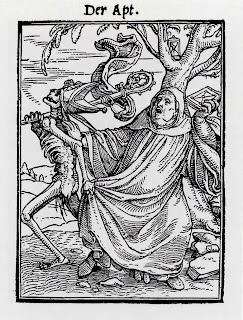
Dance of Death, the Abbot

Holbein's cover of the Luther bible

It is in his woodcuts that Hans Holbein the Younger gives some indication of his religious beliefs. He designed the title page of Martin Luther's bible. And he created woodcuts for The Dance of Death, an eerie series of drawings showing a skeleton reaching for people across every level of society: merchant, king, abbess, old woman---and pope. Death came to everyone, high or low, was the message.

But in the first of several ironies, when Holbein came to England, his sponsor was Sir Thomas More, known for his hatred of Luther and determination to destroy the books written by those who wanted to reform the church.

Holbein departed from Basel in 1526, leaving a wife and children behind. Religious commissions had dried up as Lutheranism ignited. No one wanted altarpieces anymore. To earn enough money to live--and to, hopefully, find fame--he'd need to establish himself in a foreign court. He tried France first, but nothing happened. The famous Dutch Renaissance humanist Erasmus, whom Holbein had painted at least twice, gave him a letter of recommendation to be given to Sir Thomas More, a fellow Humanist and one of the most valued councilors of Henry VIII.

Sir Thomas More

Holbein may have lived in More's Chelsea home for a time. What is known for certain is that he painted a famous portrait of Sir Thomas as well as many of his family members. More raved about the artist's abilities in a letter to Erasmus. If he knew about Holbein's belief in religious reform, he'd decided to overlook it.

 In 1529 Sir Thomas More became chancellor of England. It would seem that Holbein couldn't have picked a better patron.

But More was devoted to Catherine of Aragon, the first wife of Henry VIII, and although he tried hard to avoid it, he got caught up in the Great Matter of the king's divorce. More did not have a high opinion of Anne Boleyn, who would eventually become Henry's second queen, and could not swear an oath of supremacy to king over pope. In 1532 he resigned as chancellor, in anguish, claiming illness.

Holbein was not damaged by his patron's fall from power because he'd returned to Basel, to his family and his circle of artist friends. But this was no place for an artist. The pendulum had swung so far in Basel that religious reformers were destroying statues and works of art in churches. It is believed that some of Holbein's paintings were burned in the rages of iconoclasm. Holbein decided to go  back to England. Before he left, he painted his wife, looking undeniably sad.

Holbein's wife and two of their children

There was a whole new group running the Tudor court in 1533, and Holbein headed for the top. His new patron? The stylish Anne Boleyn. He designed decorations for her coronation; pieces of jewelry; and several silver cups. It is believed that he painted Queen Anne's portrait, but after her fall, Henry VIII had many images of his second wife destroyed. One that survives is a sketch of Anne signed by Holbein.
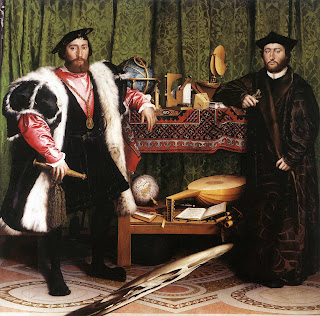
The Ambassadors

Perhaps the greatest contribution Anne made to the legacy of Holbein was sponsoring his painting The Ambassadors, considered his master work. The strongest clue that Anne commissioned the work is that on a table between the two Frenchmen is a wooden cylinder used to determine dates. Visible is April 11, the day that the court was officially told that Anne Boleyn would be awarded royal honors.
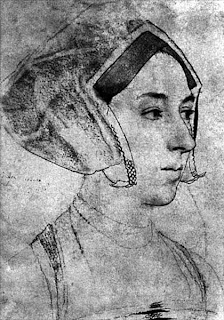
Holbein's sketch of Anne Boleyn

Anne's execution in May 1536 could have led to Holbein's downfall. Instead, he shifted again, becoming the favored painter of Henry VIII himself and Thomas Cromwell, who many believe concocted the charges against Anne of adultery and incest.

Henry VIII, the year Anne Boleyn was executed

Holbein painted Jane Seymour, Anne Boleyn's prim-looking replacement as queen, and the family mural in Whitehall. He received the all-important commissions to paint the king himself and his heir, Prince Edward. He painted Cromwell. This was when Holbein's status at court became official and he earned an annual salary of thirty pounds.

Jane Seymour died the same year that the mural was painted. Henry VIII was reluctant to marry a foreign princess without having any idea of what she looked like. So Holbein was sent to various courts to paint the candidates: France, Flanders, Germany.
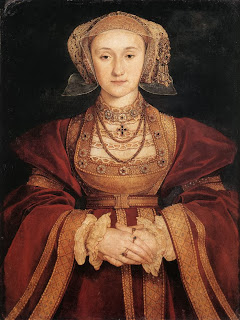
Anne of Cleves

In Cleves, he painted Anne, the older sister of Duke William, and Henry was charmed by her appearance. Yet from almost the moment he set eyes on her when she arrived, days before their wedding, he loathed Anne of Cleves. "I like her not," the king declared.

Did Holbein, the artist celebrated for his lifelike images, over-flatter Anne of Cleves in his painting? Did he feel pressure from Cromwell, who supported the marriage alliance to a German power, to make her look more attractive than she was? Cromwell was arrested and then executed in 1540, and one of the reasons for his shocking fall from power was that Henry felt his minister had bungled his fourth marriage. "I am not well handled," the king said, menacingly.

Thomas Cromwell

Did Holbein handle his part well? Others have said that Anne of Cleves' painting must have been accurate because, unlike Cromwell, Holbein was not punished in the fallout of the Cleves divorce. Which is strictly true. But Hans Holbein did not receive any more high profile royal commissions. He concentrated on private commissions, such as miniatures of various members of the nobility, like Katherine Willoughby, the young wife of the Duke of Suffolk.

In late 1543 at the age of 45, Hans Holbein died, perhaps of the plague, in London. He left a will, written in haste. His debts were settled and some of his monies went to the care of the children in Basel he had left behind. His grave is unmarked.

---------------------------------------------------------------------------------

Ackroyd, Peter, The Life of Thomas More

Ives, Eric, The Life and Death of Anne Boleyn

Thurley, Simon, Whitehall Palace: An Architectural History of the Royal Apartments, 1240-1690

Weir, Alison, Henry VIII: The King and His Court

Wolf, Norbert, Hans Holbein the Younger, the German Raphael

-------------------------------------------------------------------------------

Nancy Bilyeau is the author of an award-winning trilogy of historical thrillers set in the time of Henry VIII. The protagonist is a Dominican novice. The first two novels, The Crown and The Chalice, are on sale in North America, the United Kingdom, and Germany, The third book, to be published in March 2015, is called The Tapestry. Hans Holbein is a character in the novel.

U.S. publication

UK publication

To learn more, go to www.nancybilyeau.com