Showing posts with label Nicholas Culpeper. Show all posts

Saturday, June 25, 2016

Herbalist, astrologer, republican and altruist - meet the talented Mr Culpeper

by Anna Belfrage

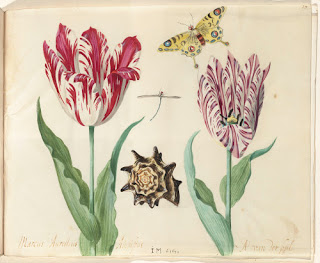
Some people are born with a major interest in flowers and such. Take my eldest son, who at the tender age of fourteen months methodically chomped his way through every single one of my hundred odd tulips, leaving half chewed petals in his wake. Or take Nicholas Culpeper, whose interest in flora was somewhat more scientific. I don’t think he ever ate a tulip – but that may have been more out of parsimony than disinclination, as tulips were rare plants indeed during Nicholas’ lifetime.

My son no longer remembers what tulips tasted like, and seeing as these plants – or at least their bulbs – are mildly poisonous, he was never given an opportunity to repeat his gastronomical excursions. Culpeper tells us nothing of the tulip in his writings. I guess we can conclude that Culpeper wasn’t all that interested in flowers that were “merely” beautiful.

There are very few authors around who can boast at having their book in constant publication for more than 350 years. Obviously, this is to some extent due to the fact that very few authors live long enough to experience such a long print run, but leaving witticisms aside, Nicholas Culpeper is one of the few authors around whose book has been in constant demand since it was first published, back in 1652.

So what was so great about his book? Did he reveal the secrets of alchemy? Was he perhaps an early George R.R. Martin, riveting people to their seats by a complex and convoluted tale involving dragons, feuding kings and resilient damsels? Nope – although Nicholas’ own life contained enough adventure to fill a book or two, what with the times he lived in. But what Nicholas experienced in life resulted in an entirely different kind of book; Nicholas published an herbal, The English Physitian, a DIY manual to keeping hale and hearty in a time where what medicines were to be found came from plants.

If we start at the beginning, Nicholas was born in 1616, the posthumous son of Reverend Nicholas Culpeper, lord of Ockley manor in Surrey. The manor slipped through baby Nicholas’ fingers, and instead he was raised by his maternal grandfather, yet another reverend. By the time he was ten, little Nicholas had a good grounding in Greek and Latin, was familiar with both astrology and medical tracts and was well on his way to becoming a master herbalist. One must assume this passion for plants came from his grandfather, and I have this image of two figures, one stout and leaning on a cane, the other agile and all legs and arms, standing side by side as they inspect a stand of digitalis.

At the age of sixteen, Nicholas was sent to Cambridge to study divinities. He wasn’t all that interested – he wanted to study medicine – and as a consequence he never graduated. Besides, Nicholas had other plans. Since childhood, he had held a special fondness for Judith Rivers, a well-to-do heiress, and the two young lovers were committed to a life together. Judith’s parents disapproved. Nicholas was not a catch, and their precious Judith could do better. I imagine Judith wept. She trailed her mother like a whipped puppy and begged her parents to reconsider – she loved Nicholas, would love no other. Mr and Mrs Rivers remained unmoved. Judith  was meant for other, richer, men.

Well, we all know what teenage fools do for love, right? Faced with her parents’ continued opposition, Judith and Nicholas devised a plan. They were to elope to Holland (Gretna Green had not come into the vogue yet) and stay there until the furore died down. As an aside, parental consent was not required for marriage in the 17th century, but to wed without Mama’s and Papa’s approval was to risk ending up being disinherited. I suppose Judith was hoping that old adage “distance makes the heart grow fonder” would apply to her parents as well.

Whatever the case, Judith and Nicholas were not destined for a happily ever after. On her way to her rendezvous with Nicholas, Judith’s carriage was struck by lightning, and she died. With one bolt of thunder, Nicholas’ hopes of a rosy future were obliterated – even more so when his grandfather decided to disinherit him, so shamed was he by Nicholas’ actions.

Nicholas was now in dire straits. There was no money to pay for his education, there was no bride, no welcoming home. After rousing himself from grief-induced depression, Nicholas apprenticed himself to an apothecary in London. He taught his employer Latin, his employer taught Nicholas everything he knew about plants.

In 1635, Nicholas took over his former master’s apothecary shop on Threadneedle Street. Due to his extensive reading and an inquisitive mind, Culpeper’s education was as extensive as that of a physician - but it was an informal education, and as such of very little value professionally. To his medical interests, Culpeper added astrology, blending these two disciplines into a holistic approach to healing. The Royal College of Physicians was not pleased with this interloper. Nicholas Culpeper retaliated by describing the physicians as “bloodsuckers, true vampires” – not the basis for a long-lasting loving relationship.

In 1640, several years after the sad affair with Judith, Nicholas married Alice Field. His new wife had recently inherited a considerable fortune after her merchant father, and using her money the couple established themselves in Spitalfields, far enough from London proper to allow Nicholas to continue with his healing endeavours despite not being an accredited member of the Royal College of Physicians. In Spitalfields, Nicholas opened the doors of his practise to everyone who needed his help. (How fortunate his wife was rich.)

A cure against rabid dogs...
Most of Nicholas cures were based on herbs. Some were true advancements in medical science, as when he documents the use of foxgloves to treat heart conditions (definitely works. The dosage, however, is somewhat tricky, and if too high will kill your patient). Some sound decidedly strange, such as boiling your bedstraw in oil to make an aphrodisiac. Otherwise, he shares that willow can be used to stem the bleeding of wounds, roses can alleviate the discomfort of menses , raspberries and strawberries are excellent ways of ridding your teeth of “tartarous concretions” (plaque?). The seeds of nettles can be used against the bites of rabid dogs (I think not), meadow-sweet is recommended against fevers (works, as meadow-sweet contains high doses of salicylic acid) and flea-bane helps with bites from venomous beasts. Hmm.  My general conclusion after browsing through Nicholas’ suggested cures is to take them with a pinch of salt – and to make sure I have a herbal with me to ensure I’m picking the right plant!

Our innovative healer did more than just list plants. He combined his herbal lore with his other passion, astrology, and borrowed heavily from Galen’s humoral philosophy, which is why in his herbal the plants are sorted by planets. Some belong to Venus, others to Mars and yet others to Saturn or Jupiter. He adds to all this his own comments – like when he dismisses black currants as having a “stinking and somewhat loathing savour”, thereby dismissing a plant we know to contain very high levels of vitamin C as well as a number of anti-inflammatory agents.

Foxglove
After some years of contented calm in Spitalfields, things were to change yet again for our intrepid healer. By now, the ravages of the Civil War were upon the people of England. Culpeper was a radical republican and wanted to do his thing for the cause. Besides, there was the matter of a slanderous accusation for witchcraft, plus an increasingly more infected relationship with both the Royal College of Physicians and the Society of Apothecaries. These august bodies disliked Culpeper’s translations of medical texts from Latin to English, making hitherto restricted knowledge available to the broader masses. It sort of undermined their business concept...

Nicholas kissed his wife goodbye, may have stooped over a cradle to coo at one of the many children his wife was to give him – puny little things that all but one died young – and rode off to fight for Parliament. The recruiting officer was less than flattering regarding Nicholas’ physique, but more than impressed when he heard Culpeper’s credentials, and instead of fighting, Nicholas was put to work as a field surgeon.  He attended the wounded at the battle of Edgehill, joined in the initial fighting at the battle of Newbury but was quickly called upon to use his medical skills instead.  Culpeper was operating on an injured soldier when a stray musket ball wounded him severely in the chest, effectively ending his military ambitions.

Back in London, Nicholas returned to treating the poor. His own health was deteriorating rapidly through a combination of too much work, his unhealed injury and tuberculosis. It didn’t help that his children kept on dying, causing both Nicholas and his wife more than their share of grief. On top of this, Nicholas took up a one man crusade against the “closed shop” policies of the Royal College of Physicians and the Society of Apothecaries. This “closed shop” policy was effectively a monopoly, based on the fact that so many of the guidelines to making medicines and treating diseases were only in Latin and only available to a few.

Nicholas made it his purpose in life to crush this monopoly. He translated one text after the other, he wrote treatises on diseases, on midwifery, on the properties of plants. He translated Galen into English, he devoted time to his destitute patients, and in all this he also managed to produce his masterpiece, The English Physitian – a giant handbook on what herbs to use for what diseases.

By now, Nicholas knew he was dying. He was burning his candle both ends as life gasped and fluttered within him, driven by a need to write down as much as possible to help his fellowman. And he was clearly very productive, because when he finally did die, in January of 1654, his wife wrote that her husband had left her “79 books of his own making or translating in my hands.”

Nicholas Culpeper was an idealist. He was a man who combined compassion and passion into a constant endeavour to help the sick and ailing. He considered it a human right to have access to medical care – a precursor of the future welfare state – and like Don Quijote he was not afraid to take on an army of windmills while fighting for what he thought was right. In difference to Don Quijote, Culpeper fought using pen and ink rather than lance. And the fact that his book is still there, is still being read, is a testament to his success.

The English Physitian quickly became very popular. Housewives all over wanted a copy, and when people set off for the wild unknown of the New World, many of them carried with them a precious copy of Culpeper’s book, hoping to find cures for whatever ills might afflict them in their new homeland within the covers. I think Nicholas would have been pleased. I also think he would have liked my tulips – no matter that they have very few medicinal uses.

Editor's Choice: This article was originally published on June 24, 2014. 
~~~~~~~~~~~~


Had Anna Belfrage been allowed to choose, she’d have become a professional time-traveller. As such a profession does not exist, she became a financial professional with two absorbing interests, namely history and writing.

Presently, Anna is hard at work with The King’s Greatest Enemy, a series set in the 1320s featuring Adam de Guirande, his wife Kit, and their adventures and misfortunes in connection with Roger Mortimer’s rise to power. And yes, Hugh Despenser plays a central role.The first book, In The Shadow of the Storm was published in 2015, the second, Days of Sun and Glory, will be published in July 2016.

When Anna is not stuck in the 14th century, she's probably visiting in the 17th century, specifically with Alex and Matthew Graham, the protagonists of the acclaimed The Graham Saga. This is the story of two people who should never have met – not when she was born three centuries after him.


Tuesday, May 10, 2016

The Herbal in England: A Brief History


by Margaret Porter
'Talke of perfect happpinesse or pleasure, and what place was so fit for that as the garden place wherein Adam was set to be the Herbarist?' 
                                          John Gerard, Herball (1597)

17th century herbal

When foul weather or other matters keep the gardener from tending or admiring the garden, the next best occupation is reading about garden plants. For many centuries, plantsmen with a cataloguing mindset have produced lists, descriptions, guides, and advice. The growth of printing expanded knowledge about plants and their various uses and merits, disseminating information beyond the most learned classes to anyone who happened to be literate.

During the Middle Ages in England, religious communities compiled the sort of lists we know as herbals, detailing their medicinal uses. The composition of plants and the beauty of flowers was recorded in florilegia, books containing floral artwork. With the rise of printed books in the Renaissance period, with improvements in the printing process, metal engraving, and the skills of colourists, this category of literature and plant lore increased in availability and popularity.

In 1557, Thomas Tusser produced possibly the first advice book, A Hundred Pointes of Good Husbandrie. He offers up useful rhymes such as 'Good titlth brings seedes, ill tilture weedes.' And here we find the earliest evidence that flowers and herbs were used not only for physic, but for decorating the house. His recommendations include plants still grown today, though his spelling varies from ours:

batchlors buttons
columbines
daffadowndillies
sweet brier
flower de luce [the iris]
hollihockes
lavender
lark's foot [larkspur]
paoncies [pansies]
hartease [viola]
rosmarie
snap dragons
violets
The next important contributor to garden literature is Thomas Hyll (or Hill), who chose as his pseudonym Didymus Mountain. The Profitable Arte of Gardening: A most briefe and pleasaunte treatyse, teachynge how to dresse, sowe, and set a garden (1563) is recognised as the first guide to gardening printed in England. He followed it in 1577 with The Gardener's Labyrinth.

John Gerard

John Gerard, gardener to Lord Burghley, is responsible for the most famous horticultural volume of this period. The Great Herball, or General Historie of Plantes appeared in 1597. Its author lived in Holborn and was employed at his lordship's London house as well as at the Theobalds estate. Primarily a description of the plants' medicinal properties with advice on cultivation, he solicited--or permitted--his wife to contribute some topics of particular interest to females.  Illustrations in Gerard's first edition were not created for the book, but were reprints from a German book published several years earlier. In 1633, botanist Thomas Johnson edited and revised Gerard's Herball, correcting errors and improving the scientific content.


Varieties of thyme in the Herball

It is very likely that William Shakespeare was familiar with the Herball. Within the past year, evidence was presented that his portrait illustrates the frontispiece of of Gerard's 1597 work. 

Is this really the face of William Shakespeare?

Regardless of whether the gentleman brandishing a fritillary is the Bard, his plays and poems are crammed with plant and flower references and metaphors.
"The marigold that goes to bed with the sun
And with him rises weeping; these are flowers
Of middle summer, and I think they are give
To men of middle age." The Winter's Tale

In the tragedy Romeo and Juliet, Friar Laurence is conscious of both positive and negative powers of the herbs he gathers:

"Within the infant rind of this small flower
Poison hath residence and medicine power:
For this, being smelt, with that part cheers each part;
Being tasted, slays all senses with the heart.
Two such opposed kings encamp them still
In man as well as herbs, grace and rude will;
And where the worser is predominant,
Full soon the canker death eats up that plant."

John Parkinson

John Parkinson was very much aware of the decorative value of flowers. This author's Long Acre residence was adjacent to Covent Garden, and his proximity to the market gardens served him well. For adorning the house he suggested scented daffodils ('many are so exceeding sweet that a very few are sufficient to perfume a whole chamber'), wallflowers ('generally used in nosegays, and to deck up houses'), and iris. He was a great admirer of the newly popular tulip, introduced to England in the 1570s. The descriptive language used by Parkinson, and others, to convey the beauty can be quite poetic and evocative:
"The Anemonies likewise or Windeflowers are so full of variety and so dainty, so pleasant and so delightsome flowers, that the sight of them doth enforce an earnest longing desire in the minde of any one to be a  posessor of some of them at the least." Paradisus Terrestris (1629)
Nicholas Culpeper's The English Physican (1652) must be the best known of all the herbals.


Nicholas Culpeper

A polymath, after his apprenticeship to an apothecary he advanced to become a translator of medical texts, a physician, a botanist, and an astrologist. During England's Civil War he was under suspicion of practising witchcraft. He opposed the insular nature of the medical sciences, in particular the Society of Apothecaries. 

A firm proponent of the dissemination of medical knowledge, he published his works with the ordinary person in mind, using language and terms that could be easily understood and pricing his works cheaply. For these reasons, and because he disputed many of the accepted treatments and cures, he was unpopular with contemporary physicans.

If Culpeper had a favourite herb, it must have been rosemary:
"The oil of Rosemary. It hath all the virtues of the oil of connamon, nutmegs, carraway, and juniper berries; besides which it is much more powerful than any of them, strenghtening the brain and memory, fortifying the heart, resisting poison, and curing all sorts of agues; it is absolutely the greatest strengthener of sight, and restorer of it also, if lost: it makes the heart merry, and takes away all foolish phantasms out of the brain. It cleanseth the blood, cures tooth-ache, easeth all pains, and takes away the causes which hinder conception: it hath a very grateful taste, and hath so many virtues that I can never express them all, or give it its due commendation."
Culpeper's English Physician

Before Culpeper's day, the herbal (primarily a descriptive botanical catalogue) had inspired the publication of explicit guides to gardening practices, with recommendations for cultivation of all varieties of herbs, flowers, vines, trees, shrubs, and fruit, and instructive essays. Here is list of some publications produced during the 17th century, popular with the gentry and yeomanry, often dedicated to prominent patrons from the aristocracy:

The Countrie Farme (1600) Richard Surflet
The Fruiterers Secrets (1604) N.F.
Floraes Paradise (1608) Hugh Platt
The English Husbandman (1613) Gervase Markham
The Second Booke of the English Husbandman (1615) Gervase Markham
The Country House-wifes Garden (1617) William Lawson
A New Orchard and Garden (1618) William Lawson
Of Gardens (1625) Francis Bacon
Theatrum Botanicum (1640) John Parkinson
A Treatise of Fruit Trees (1653) Edward Hobday
Adam in Eden: or, Natures Paradise (1657) William Coles
The French Gardener: Instructing How to Cultivate all sorts of Fruit-Trees, and Herbs for the Garden (1658) John Evelyn (translation from the French)
The School of Physic (1659) Nicholas Culpeper
The Garden Book (1659) Thomas Hamner
Sylva, or a Discourse of Forest Trees and the Propagation of Timber in His Majesties Dominions... (1664) John Evelyn
The Gardener's Almanack (1683) Samuel Gilbert
The Compleat Gardeners Practice (1664) Stephen Blake
Kalendarium Rusticum (1675) John Worlidge
The Florist's Vade-Mecum (1682) Samuel Gilbert
An Improvement to the Art of Gardening (1694) Robert Sharrock
The Gardener's Almanack (1697) Leonard Meager


Throughout the 18th century, gardening guides proliferated. In that century and well into the 19th, voyages of discovery returned exotic specimens to England, hybridisers created ever more spectacular plants, botanical art flourished, and printing technology advanced. These simultaneous developments resulted in exquisitely produced and lavishly illustrated florilegia. 

Robert Furber's The Flower Garden Display'd (1732) was intended as an advertisement for his Kensington nursery business. 


Furber's flowers for March

It wasn't not merely a sensation in its own time: even now prints for each of the twelve months continue to be reproduced, framed, and placed on walls all over the world. Flora Londinensis (1777-1798), written by Richard Curtis and amply illustrated, is another fine example of botanical information combined with artistry.

Although modern science has expanded our knowledge of plants, their culture, and their habits, these wonderful books from the past contain interesting lore--and gardening advice never really goes out of style!


Illustration from Culpeper's herbal
~~~~~~~~~~~~~~

Margaret Porter is the award-winning and bestselling author of twelve period novels, whose other publication credits include nonfiction and poetry. A Pledge of Better Times, her highly acclaimed novel of 17th century courtiers Lady Diana de Vere and Charles Beauclerk, 1st Duke of St. Albans, is her latest release, available in trade paperback and ebook. Margaret studied British history in the UK and the US. As historian, her areas of speciality are social, theatrical, and garden history of the 17th and 18th centuries, royal courts, and portraiture. A former actress, she gave up the stage and screen to devote herself to fiction writing, travel, and her rose gardens.


Tuesday, June 30, 2015

Preserving the World in Paint - Women Artists of the Stuart Period

by Deborah Swift

The story of  The Lady’s Slipper is a story about a rare wild flower, but it is also the story of the 17th century artist who wished to capture its unique beauty in paint.

When researching the heroine of my novel I looked to female artists of the seventeenth century, especially those who painted flowers and the natural world. Unsurprisingly not many are documented, but here I give you just a taste of three extraordinary women who really lived, and one imaginary artist who only lives between the pages of my novel. Can you spot the imaginary artist amongst the real ones?

Maria Sybilla Merian (1647-1717)
Maria seemed to be an infant prodigy and Maria’s step-father, who was also a painter, doted on her, predicting that she would increase the fame of the Merian family name; so, apparently, did her half-brothers Matthäus and Caspar, twenty years her senior. She studied flowers, and more importantly - insects, keeping her own live specimens, and often travelling abroad in search of more specimens to draw. In her time, it was very unusual that someone would be genuinely interested in insects, which had a bad reputation and were colloquially called "beasts of the Devil." She described the life cycles of 186 insect species, amassing evidence that contradicted the contemporary notion that insects were "born of mud" by some sort of spontaneous generation.


Just one of Merian’s superb paintings
of pomegranates, insects and butterflies

Alice Ibbetson (1635 - 1701)

Alice was an English watercolourist whose studies of natural forms were some of the earliest annotated studies of medicinal herbs and flowers. Brought up by her botanist father John Ibbetson, who built his renowned Physic Garden with the help of John Tradescant, her work was collected by wealthy patrons including Sir John Fairfax. Unfortunately her early studies of flowers and fruit were lost when Parliamentary troops fired her home during the English Civil War, and the family were forced to flee for their lives. John Ibbetson’s notes survive however, and are much influenced by the herbals of Nicholas Culpeper. Ibbetson’s early life was beset by tragedy, but later she made her home in New Hampshire where she continued to record native medicinal flora, some for the first time.
 
A page from Alice Ibbetson’s notebook. Her flower
paintings were much admired for their fluidity of line.

Mary Beale (1633 – 1699)

Mary Beale was the first fully professional woman artist in England. Her husband Charles even left his job as a clerk to help Mary prepare her canvases and mix her paints. He experimented with pigments and became an expert in the field. She quickly made enough from the business to support her family, including her sons Bartholomew and Charles (later an admired society miniaturist). While she painted, Charles would write up detailed notebooks in which he customarily referred to his wife as 'Dearest Heart' and described the sittings, the sitters and his own technical discoveries. The majority of his notes have been lost, but those for the years 1677 and 1681 survive in the archives of the Bodleian Library at Oxford and the National Portrait Gallery. His notebook of 1677 details a busy year: 83 commissions, bringing in earnings of £429. During the 1660s, when the plague ravaged London, Beale moved her home and workplace out of the city to the safety of Allbrook Farmhouse.

Nell Gwyl (Nell Gwyn) by Mary Beale. I can definitely see
from this painting why she would attract the notice of the King!

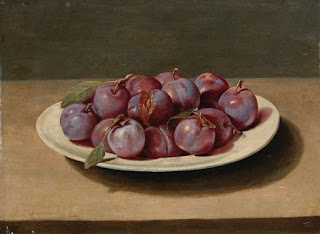
Louise Moillon (1610–1696) was one of seven children. Her father was the landscape and portrait painter Nicolas Moillon, but he died when she was an infant, and her mother when she was only twenty. Her mother’s inventory of possessions included a series of paintings on wooden panels by her daughter Louise, so it would appear that Louise showed talent from an early age. The high esteem in which her work was held is demonstrated by the fact that in 1639 Charles I of England had five still life pieces by the artist, framed in pear wood and ebony. Mouillon’s work was admired for its lifelike quality but also for its restrained stillness.


Bowl of Plums by Louise Moillon

~~~~~~~~~~~~~

I hope you enjoyed the pictures. An earlier version of this post appeared here in 2010.
www.deborahswift.com
Twitter @swiftstory