Showing posts with label Joanna of Navarre. Show all posts

Monday, October 5, 2015

The Ill-Fated House of Lancaster


by Anne O'Brien

The House of Lancaster has become of interest to me since writing about Elizabeth of Lancaster in The King's Sister and then more recently about the marriage of King Henry IV and Joanna of Navarre in my new novel The Queen's Choice to be published in January 2016. 

What a short-lived dynasty the House of Lancaster turned out to be in spite of the promising beginnings.

In 1399 Henry Bolingbroke, Duke of Hereford, son and heir of John of Gaunt and grandson of Edward III,  usurped the Crown of England from his cousin Richard II and was himself crowned King Henry IV after acclamation by the Lords and clerics.  Thus the first King of the House of Lancaster took the throne of England.  With four healthy sons and two daughters, all grown to adulthood, all married, Henry might have expected that England was set fair for a time of regal stability with a healthy and increasing number of Lancaster children and grandchildren to occupy the throne.  Even though Henry's wife, Mary de Bohun, was dead by 1399, and Henry had no more children with his second wife Joanna of Navarre, probably due to his own ill-health, Henry had no need of more heirs.


In 1399, with a new and potent king, who would have believed that the House of Lancaster would have been so short lived, that by 1471 it should have come to an end with no more possible claimants?  Although its demise was indisputably influenced by death in battle, disease and mental frailty - all prevalent in many medieval families at this time-  it was also due to the Lancaster inability to reproduce themselves, or at least legitimately. 

Without legitimate descendents, the House of Lancaster was doomed.

Henry's four sons laid down the pattern for lack of heirs.

Henry, Prince of Wales, later Henry V:  his marriage to Katherine de Valois, of short duration, produced only one son who would become Henry VI.  Henry V died at Vincennes in France, probably from a severe form of dysentery in 1422 at the age of 35.


Thomas, Duke of Clarence: married to Margaret Holland but killed in 1421 at the Battle of Bauge in France at the age of 34 without legitimate issue.  He had one illegitimate son, Sir John Clarence, who was granted lands in Ireland and is buried in Canterbury Cathedral.

John, Duke of Bedford: married twice, first with Anne of Burgundy and then with Jacquetta of Luxemberg.  There were no children from either marriage.  In addition, out of wedlock he had a daughter named Mary, who married Pierre de Montferrand with whom she had a son, Richard.  John died in 1435 at the age of 46.

Humphrey, Duke of Gloucester: also married twice, first to Jacqueline of Hainault, a marriage that was annulled, and then to Eleanor Cobham.  There were no children from either marriage.  Humphrey had two illegitimate children:  Arthur of Gloucester who died in 1447 and Antigone of Gloucester who married Henry Grey, Earl of Tankerville, Lord of Powys.  Humphrey was the longest lived of the four sons of Henry IV.  He died in 1447 at the age of 57.

So of the four sons of Henry IV, there was only one legitimate descendent to carry on the royal claim to the throne. 

Henry IV's two daughters fared no better:

Blanche married Louis, the Elector Palatine.  She died in childbirth in 1409 at the age of 17 after the birth of a son Rupert.  This young man died in 1429 at the age of 19 years, unmarried and without issue.  Blanche's dowry included the oldest surviving royal crown known to have been in England.  It probably belonged originally to Anne of Bohemia, Queen of Richard II.

Philippa married Eric, King of Denmark, Sweden and Norway.  She gave birth to a stillborn boy in 1429, and herself died in 1430.  Philippa was the first documented princess in history to wear a white wedding dress during a royal wedding ceremony: she wore a tunic with a cloak in white silk bordered with grey squirrel and ermine.

Henry IV had an illegitimate son Edmund Lebourde who was born in 1401.  He was educated in London.  It is thought that he entered the church since in 1412 a Papal dispensation was granted to allow this, but Edmund thereafter disappeared from history as so many illegitimate children did.

The legitimate line of Lancaster after Henry V fared no better with Henry VI.  Mentally unstable, he married Margaret of Anjou with whom he had only one child, a son Edward of Lancaster.  Edward, married to Anne Neville, had no children and died in 1471 at the Battle of Tewkesbury.  Henry VI died, murdered, in the same year. 


Thus ended of the House of Lancaster.  What a sad tale of inability to produce legitimate heirs to the crown.  Battle and disease took its toll, far more than with most medieval families, yet we might have expected a much higher degree of fertility, being descended from Edward III who, with Philippa of Hainault, had thirteen children. Henry IV's family had promised so much but lasted less than a century.

~~~~~~~~~~~~~

My novel of Joanna of Navarre, The Queen's Choice, will be published in hardback in the UK on 15th January 2016.  To keep up to date with all events and promotions, visit my website.

Wednesday, July 8, 2015

Historical Paintings: Authenticity v. Drama

by Anne O'Brien

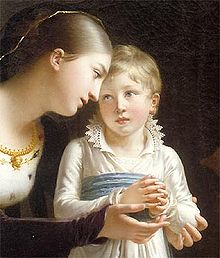
Is this the real Joanna of Navarre?  If so, it would be a valuable addition to the little we know of this fifteenth century Queen of England.

This is a painting of Duke Arthur III of Brittany, painted by the French artist Henriette Lorimier and exhibited in the Paris Salon of 1806 when Romanticism was the order of the day.


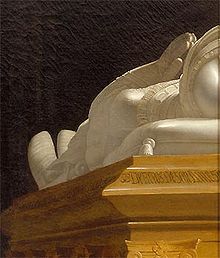
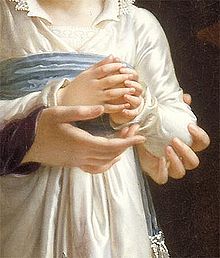
It is of interest to me because it is one of the few representations we have of Joanna of Navarre, second wife of King Henry IV of England.  It shows her, beside the tomb of her late husband Duke John V of Brittany, in the role of caring mother, instructing her young son in the need for piety, in the importance of family history, and in his duty to the role of Duke which he would inherit from his dead father, John de Montfort.  Joanna is dark-haired, attractive, every inch a Navarrese and Valois princess.

I would like to think this would be a valuable image for me in bringing Joanna to life when writing about her.  But how accurate a representation is it?  There is much to intrigue the historian in this painting, and the choice that Henriette Lorimier made when deciding to portray Arthur as the young Duke.

In colouring and appearance of Joanna, we have no historical idea.  It is not on record.  We have no contemporary portraits of her.  If she is seen kneeling at her husband's impressive tomb, it would have been after 1409, when Joanna had personally had the alabaster image sculpted in England and sent to Nantes Cathedral.  She would have been at least 40 years old.  Arthur by this time would have been 16.  Yet both mother and son look younger than this - clearly to maintain the romantic image of the young and beautiful widow and the young child with all the duty on his shoulders.  As Queen of England, Joanna never returned to Brittany to see the tomb completed, as far as the records show. 


It could be argued of course that this image was from the date of Duke John's death in November 1399, in which case Joanna was only thirty one, and Arthur was six years old, which makes the image more realistic, but still does not explain the magnificent tomb beside which she is kneeling.

Another interesting point: Arthur was not the heir to the Dukedom when John de Montfort died.  Why chose to paint this child, receiving his mother's encouragement and instruction?  The heir was another John, the eldest son, who became John VI on the death of his father in 1399.  So why paint Arthur?

The choice of costume is also highly romantic.  Joanna is wearing a fur trimmed cote-hardie, which by 1409 would have been regarded as not the height of fashion by members of the Court.  Joanna, who was known to spend extravagantly on clothes, would have worn a houppelande with its high neckline and heavy folds, and her hair would certainly have been covered with a veil or one of the fashionable rolled chaplets or a caul.  Her hair would not have been uncovered in public as it is here.  As for Arthur, he appears to be wearing something  romantically childlike for 1409.  I expect that the artist thought that a romantic, easily recognisable 'medieval' image was more important than authenticity.


And finally to return to why Henriette chose to paint Arthur.  He actually became Duke of Brittany but not until 1457 in the final year of his life, taking the title after his nephew Peter who died childless.  Arthur was 64 years old when he became Duke.  Was he chosen for the subject of this highly romantic picture because he played a notable part in French history?  He fought alongside Joan of Arc.  He was Constable of France and a notable leader of the French army, taking an important part in the negotiation to bring peace between France and Burgundy at the Treaty of Arras. This alliance led ultimately to the end of English pretensions to the French crown.  Furthermore Duke Arthur led the French army in the battle of Formigny in 1450 which resulted in the conquest of Normandy.  Thus Arthur was undoubtedly a heroic figure in French military history.  I can only presume that this was the reason for this painting in the nationalistic days of Napoleonic France.


What a sentimental portrait this is. Do the historical inaccuracies matter?

I would suggest that accuracy has no bearing on the subject.  It was not painted to make a genuine historical comment but to heighten the emotion of the relationship between the young widowed duchess and her little son, to tug at the heart-strings of the onlooker.  It makes her an appealing figure, which is what was intended.  As long as we know the intentions of the artist, then we are able to appreciate the worth of this romantic painting.

As an interesting post script; this painting gained an immense success when it was exhibited in 1806. Empress Joséphine immediately purchased it for her paintings gallery at the Malmaison.

My novel of Joanna of Navarre, The Queen's Choice, will be published in Hardback and eBook in January 2016, followed in May in Paperback.

www.anneobrienbooks.com