Showing posts with label Haddon Hall. Show all posts

Wednesday, February 24, 2016

The Great Wash - Laundry in the 17th century

by Deborah Swift

Washing in the 17th century was certainly labour-intensive. In the Stuart period outer garments could not easily be washed because fine fabrics - the silks, brocades and velvets, (beloved of those who wanted to show their status) would not stand up to the harsh treatment. Clothes were hand-made and valuable, and were worn until they were too dirty to be tolerated. However, the undergarments were usually linen, which was tough and hard-wearing, and could be washed.

'Before that you suffer it to be washed, lay it all night in urine, the next day rub all the spots in the urine as if you were washing in water; then lay it in more urine another night and then rub it again, and so do till you find they be quite out' 

Hannah Woolley, in The Compleat Servant-Maid, 1677


So where did this urine come from, and where was it used?

It came from chamberpots and was used neat straight from the pot. Apparently men's was more effective than women's so this was much in demand. (They would say that, wouldn't they?)The ammonia in the urine removed grease and stains before the washing was then soaked in a 'buck tub.' After that a buck cloth was spread over the top and potash or lye was poured through and collected from a hole in the bottom. Sometimes the clothes were layered, hung on sticks, and the lye, which was alkaline, was poured through. This is a possible origin of the term ‘passing the buck’.
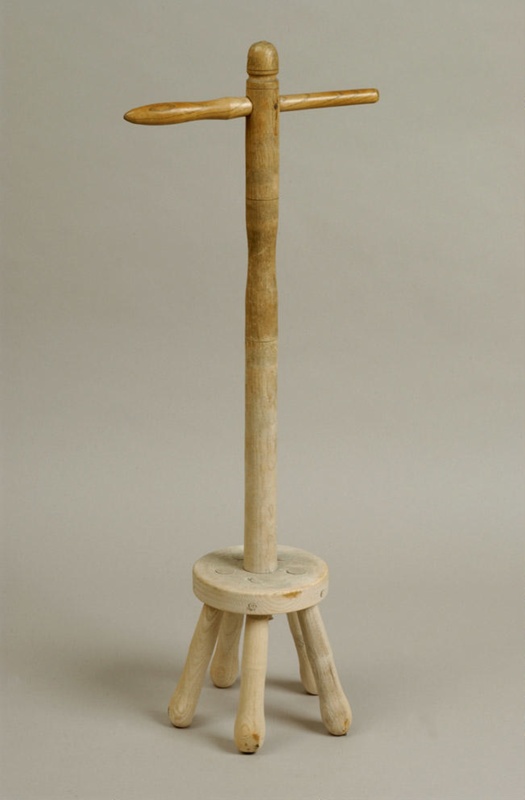
modern dolly stick (1950's)
the design stayed unchanged
The water was then boiled up again and passed through as many as eight times. (See the picture of the woman using a buck tub, above.) Then the linen was soaped by hand and paddled with 'dolly sticks' or slapped against washboards before rinsing. Soap was a new commodity - In the 17th century the first soap factory was built in Toulon for the mass production of soap for laundering. The soap was made of goat's or sheep's fat, and ash. Rinsing was necessary to remove the lye before it caused damage to the fabric. In rural England, clothes were taken to the nearest stream or river and either paddled, with a wooden bat, or trodden. Sometimes used wash water was donated to the poor because soap was still an expensive luxury.

Generally a 'Great Wash' would only be done twice a year by most households unless they had many servants. This event could take three days, and usually took place at the same time as a 'spring clean' of the house. The Great Wash was often seen as a symbolic purification of the house. 

From Old and Interesting blog, (do visit it - it's indeed very interesting) here are the laundry expenses for the Duke of Bedford's Great Wash in 1675.

'For washing sheets and napkins before the great wash when the two masters was in town 2s
For four pounds of soap 1s
For six pounds of candles 2s 6d
For three women one day to wash 4s 6d
A woman two days to help dry up the linen 3s
For oil, ashes, and sand to scour 1s 8d
A woman to scour two days 3s
For washing of twelve pair of sheets at 4d per pair 4s
For two pounds of soap to scour the great room 6d
For nine pounds of soap 2s 3d
For four mops 4s
For Fuller's earth and sand to scour the rooms 1s 8d
A woman six days to help to wash all the rooms after the workmen left the house 6s
A woman six days for scouring and washing the rooms and cleaning the irons against the family's coming to town 6s
A woman to help air the bedding when the family came to town 2s' (2s = $0.34)


Some better off English houses had many staff, and used a brass tally of rotating discs to keep track of the linen that had been sent away for starching.. Each disc lists an accessory - for example neckwear -  'Ruffes' and 'Bandes', and lace-topped boot hose. These small items of linen that were worn next to the skin were washed more often than the sheets or napkins for example. Professional whiteners of linen were called 'whitsters' and they would bleach and starch the linen, and sometimes offer crimping or goffering for ruffs, collars and cuffs. This tally board (above) was originally from Haddon Hall, near Bakewell, Derbyshire, Click the picture for more information.

Whenever I think about the characters in my books I have to be aware of this - that people would have taken care not to get dirt on their clothes, because washing was such an ordeal. In my most recent novel, Lady Katherine Fanshawe has lost all her servants because of the Civil War. In a big house, the loss of servants for washing and mundane tasks creates a radical shift in daily life. So many processes were incredibly labour-intensive, and without servants to help, many things were forced to change. In many ways this was echoed three centuries later after WWI.

There is another good blog on washing in the colonies on the Plymouth Pilgrim's site here

Thanks for reading!
visit my website to sign up for a free book, or say hello on Twitter @swiftstory

Sunday, July 7, 2013

One of England's Hidden Treasures

by Cassandra Grafton


There is a road in England's Peak District that wends its way from the spa town of Buxton to another former watering place at Matlock. Off this road, just beyond the market town of Bakewell, where it winds and turns, cosseted by thick hawthorn hedgerows, lies a hidden treasure. The cars rattle along this road at a fair pace, their drivers set upon their destination, wherever that may be, oblivious to what is concealed behind the screen of lush greenery: a fortified manor house steeped in history.

A discreet roadside sign and the small gravelled car park on the opposite side of the road are all that indicate its presence to the passer-by, for nothing can be seen of it from here other than a break in the hedgerow and a short drive to a small gatehouse.

It is a gentle stroll under the gatehouse’s arch and along the drive, and before long a small bridge comes into view and up beyond it towers the house, perched on a limestone bluff high above the river, exuding an air of mystery and romance as it beckons you into the past. This is Haddon Hall, a building rich in history, its origins stemming from the 12th Century, a home that has passed most of its life in the hands of just two families and that retains much of its original character.

There have been various descriptions over time of this medieval manor, more recently “the most perfect English house to survive from the Middle Ages”, from Simon Jenkins in England’s Thousand Best Houses.

Back in 1836, however, S. Rayner's The History and Antiquities of Haddon Hall described the house thus:

“In the midst of romantic scenery, on a rocky eminence, at the foot of which flows the River Wye, and not far from its confluence with the Derwent, stands the castellated mansion of Haddon. Its embattled parapets and crested turrets, proudly towering above the branching woods in which it is embossed, cause it, when viewed from the vale, to assume the appearance of a formidable fortress.”


Then there is this, from Edward King's Observations on Ancient Castles (1782) regarding castellated houses (as he says in the introduction, “mansions adorned with turrets and battlements; but utterly incapable of defence, except against a rude mob, armed with clubs and staves, on whom the gates might be shut”):

“The high turrets of this mansion stand proudly towering on a rock, in the midst of thick woods, and in a most beautiful situation. It has undergone fewer alterations, and retains more curious vestiges of the residence of an old English Baron, and exhibits more manifest indications of the ancient mode of life, than any building I ever saw.”

The manor of Haddon was bestowed upon the natural son of William the Conqueror in the 12th century, passing thereafter through marriage to the Vernon family who, over the centuries that spanned the years 1180 to 1565, constructed most of the Hall as it is seen today.

The Vernons’ tenure came to an end in 1565 through lack of a male heir and the marriage of a daughter to the family who still own and manage the estate today, the Manners.

Herein lies a legend and, as with all good tales from the past, its truth and origin remain mysteries that will likely never be solved, a tale of illicit romance and an elopement.

In the mid-16th Century, the Hall was under the guardianship of Sir George Vernon, a man known as ‘The King of the Peak’, mainly down to his larger than life persona, his lavish lifestyle and his love of entertaining. He was the last male in the Vernon line, having fathered only two daughters, Margaret and Dorothy, who were joint co-heiresses to the estate.

Dorothy married Sir John Manners in 1563, and when her father died in 1565, her share of the estate, which passed to her husband, included Haddon Hall.

The legend has it that Dorothy’s father was against the match and banned the couple from seeing each other. There are several schools of thought on what the reason might have been for this. Dorothy was eighteen at the time, and it is believed that Sir John was substantially older, most likely in his thirties. This alone would probably not be an issue, but there is also speculation that, as a second son, his future was considered too uncertain despite the illustrious family name. Another line of thought suggests that religion was the cause as the Manners family was Protestant and the Vernons were Catholic.

As the story goes, Dorothy made her escape from the house under cover of a hunt or masked ball and fled into the woods where John had been waiting, dressed in disguise. They fled the neighbourhood and were wed the following day.

Charming though the story is, we only have certainty on two facts: the marriage definitely took place in 1563 (though where remains another unsolved mystery) and, whatever the circumstances at the time, if there was an estrangement with Sir George due to an elopement or for any other reason, the matter was resolved within a relatively short time, for the couple took up residence at the Hall during the last few years of the gentleman’s life and inherited their share of the estate on his passing in 1565.

Could this house, therefore, be considered one of the most romantic in the country, with its charming situation, its air of mystery and romance, the walls rich in history and wrapped in the myth of a forbidden love?

In a film-maker’s eyes, it could well be, for Haddon Hall, in the present day, has association a-plenty with some of the most romantic stories of yesteryear - a perfect 'set', it has starred in adaptations of Charlotte Bronte’s Jane Eyre (on no less than three occasions) and Jane Austen’s Pride & Prejudice, whilst this year sees the 25th anniversary of the cult classic The Princess Bride's filming at the hall, where it had the role of Humperdinck's castle. It has also taken centre-stage in the films Elizabeth I and The Other Boleyn Girl, along with several television series, including Moll Flanders and The Prince and the Pauper.

Perhaps John Leyland, in his description of Haddon Hall in Articles on Derbyshire (1891) summed it up best:

“These charms of a truly English landscape, and an old English mansion, have long had, and must continue to have, a spell of fascination for the artist and the lover of the picturesque; what other place can wake such impressions of old-time greatness touched by the witchery of bygone romance? It is here - better, perhaps, than in any other spot in England - that we can grasp the conditions of life of the mediaeval and Tudor gentleman”.


So, if you are ever driving along the A6 in Derbyshire between Buxton and Matlock, keep an eye out for that break in the hedgerows. Stop a while, leave the car behind and step through the gatehouse for a wonderful journey into the past at Haddon Hall.

~~~~~~~~~~~~

Sources: the official guide book to Haddon Hall, published by Heritage House Group.
Observations on Ancient Castles by Edward King, The History and Antiquities of Haddon Hall by S. Rayner and Articles on Derbyshire by John Leyland, all of which have been edited by David Trutt who has also written an introduction to each publication, can be found on David’s website at www.haddon-hall.com, where you can also find links to the documents and several others that relate to Haddon Hall and the legend of Dorothy Vernon.

~~~

Cassandra Grafton has always loved words, so it comes as no surprise that her favourite pastimes are to read and write. Having spent many years wishing to be a writer and many more dreaming of it, she finally took the plunge in 2002, offering short stories to online communities. A few years later, it was a natural next step to attempting a full length novel, and thus A Fair Prospect, a story inspired by Jane Austen’s Pride & Prejudice, was born.

A former college lecturer, Cassandra has two grown up children and splits her time between North Yorkshire, where she lives with her husband and two cats, and Regency England where she lives with her characters.

LINKS

You can find Cassandra on:

Website
Facebook
Twitter

A Fair Prospect is a tale of Darcy and Elizabeth. It is one story told across three volumes. The books are available in paperback in all the usual online bookstores and in eBook format in the Kindle, Nook and Kobo stores and in all eBook formats, including PDF, at Smashwords.

Kindle

Nook
Kobo
Smashwords