by Anna Castle
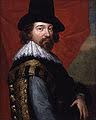 |
| Sir Francis Bacon |
The philosopher Francis Bacon (b. 1561 - d. 1626) is the protagonist of my historical mystery series. The more I learn about him, the more I like him, but that hasn’t always been the common view. Bacon wrote, “All rising to great place is by a winding stair” (Of Great Place.) His reputation rose and fell during his own lifetime and has taken many twists and turns through the centuries since his death.
Start at the top
Bacon was recognized as exceptional from early childhood. His father, Sir Nicholas Bacon, was Queen Elizabeth’s Lord Keeper of the Great Seal. His mother, Lady Anne Bacon, was one of the five daughters of Sir Anthony Cooke, who were renowned for their intelligence and learning. The queen visited the Bacons in Gorhambury in 1572, when Francis was eleven. When she asked him how old he was, he replied, “Two years younger than Your Majesty’s happy reign.” The felicity of that response earned him the nickname ‘the little Lord Keeper.’
A sharp setback
Sir Nicholas died when Francis was 18, depriving him of crucial support in finding a place in government. His uncle, Lord Burghley, was the Lord Treasurer, but he held Francis at arm’s length throughout Elizabeth’s reign, probably to advance his own son, Robert Cecil, without competition from his brilliant cousin.
Bacon never stopped trying, though his early efforts were often clumsy and poorly received. We have a letter from him to his aunt, Lady Burghley, apologizing for some apparently over-ambitious request dated 1580 from Gray’s Inn. His colleagues at the Inns of Court complained about his poor social skills a few years later. He apologized for that too. His letters and others give us a portrait of a shy intellectual, more comfortable with a quill than in person.
A slow, laborious climb
The queen “pulled him across the bar” in 1582, making him one of the youngest barristers in Gray’s Inn history. She granted him the reversion of the office of the Clerk of the Counsel in Star Chamber in 1589, a post worth £1600 per annum -- except that he had to wait twenty years for the present office-holder to die. That’s all she and his powerful uncle ever did for him, other than exploiting his talents and his deeply ingrained sense of duty.
Bacon served as a translator during visits of the French ambassador, having spent his late adolescence studying civil law in France. He served on a commission to interview Catholic prisoners in jail in 1588. That must have been weary work, especially since one of his co-commissioners was Sir Richard Topcliffe (not yet notorious as a torturer.) In 1594, Elizabeth made him one of her Learned Counsel, a legal advisory body; yet another unpaid honor.
Bacon managed the correspondence of his brother Anthony, an intelligencer based in southern France. He attended upon the queen at court and wrote masques for the court’s entertainment on behalf of the gentlemen of Gray’s. He also wrote ‘advice literature,’ essays about current affairs read by the queen’s counselors. He never received payment for any of this work, though his writings were widely circulated. His extraordinary mental clarity shines through these works, urging moderation in all things and consideration of the needs of the common folk.
He was a Member of Parliament, participating in every session of the House of Commons from 1584 to 1601. He had the unfortunate habit of speaking his mind, whether it conformed with the queen’s wishes or not. In 1589 and 1593 he argued against increases in taxes, earning her wrath. Bacon was a persuasive and compelling speaker, often using humor to defuse contention. He introduced a bill against enclosures in 1597, arguing that “I should be sorry to see within this kingdom that piece of Ovid’s verse prove true,
‘jam seges ubi Troja fuit;’ in England nought but green fields, a shepherd, and a dog.” Ben Jonson wrote, "when he spoke his hearers could not cough or look aside without loss... The fear of every man that heard him was, lest he should make an end."
There was never a breach between Bacon and his uncle. Even so, it seems obvious to me that Lord Burghley did far less for his worthy nephew than he could have done; certainly far less than his sister-in-law, Lady Anne Bacon, thought he ought to do. Burghley seemed content to allow Bacon success with the confines of Gray’s Inn, but not one step beyond.
A rash and temerarious patron
 |
| 2nd Earl of Essex |
As Bacon entered his third decade, he began a friendship with Robert Devereux, the 2nd Earl of Essex and the queen’s rising favorite. Anthony Bacon also entered Essex’ service on his return from France in 1592, eventually moving into rooms in Essex House on the Strand. Anthony managed a network of intelligencers. Knowledge was indeed a form of power in those days, when information was so difficult to obtain. Every principal courtier had his own stable of spies and messengers.
Soon after Anthony returned, Francis wrote the oft-quoted letter to his uncle begging for some position to support his studies: “I confess that I have as vast contemplative ends, as I have moderate civil ends: for I have taken all knowledge to be my province.” No response to this plea has survived; perhaps none was offered. Essex was the brilliant Bacon brothers’ best hope of advancement at that time.
Essex sought an appointment for Francis to the position of Attorney General in 1594. The chief argument, again, was Bacon’s youth and inexperience. At 33, he had been a barrister nearly ten years, but had not argued a single case in court. He swiftly remedied that fault, taking three important cases and arguing them with an éclat that impressed everybody, including the queen. Copies of his arguments were circulated and read with interest. (We must remember that the Elizabethan’s loved rhetorical skill and had an enormous appetite for the spoken word.) In spite of this effort, the post was granted to the older and more experienced Sir Edward Coke.
Bacon had aspired to the lesser position of Solicitor General, but Essex wouldn’t have it. He wanted the best for his man and pressed his suit aggressively, irritating everyone, especially the queen. After Coke was granted the Attorney Generalship, Essex pushed Bacon for the alternate post, but by this time he had so infuriated the queen that she said she would “seek all England for a Solicitor” rather than grant Essex the favor.
Poor Francis! Who would want to be that tattered doll, tugged back and forth by two such forceful personalities? At least he recognized that their contention had nothing to do with him personally. He wrote to his brother, “my conceit is that I am the least part of my own matter...”
The young earl’s ambitions soon outgrew all bounds. Bacon urged him to moderate his behavior toward the queen. After Essex’ greatest moment of glory -- the victory at the Battle of Cadiz -- Bacon advised him to return to a quiet life of study and patient service, aspiring to some sober position such as Lord Privy Seal and withdrawing from military activity. No monarch likes to see a militaristic nobleman grow too popular. This prescient advice fell on deaf ears, as did so much of Bacon’s clear-eyed counsel.
Bacon well understood the hazards of his relationship with Essex. He told the queen, “A great many love me not because they think I have been against my Lord of Essex; and you love me not because you know that I have been for him; yet will I never repent me that I dealt in simplicity of heart towards you both.”
In 1601, the earl led an armed band into the streets, rebelling against the queen and sealing his own fate. The earl and his principal followers were tried for treason. Bacon had been excluded from Essex’ inner circle for some time before the fateful day, so the conspiracy came as a shock to him. As one of the Queen’s Counsel, he was obliged to serve on the legal team prosecuting the case, led by Sir Edward Coke. Bacon’s main job was the examination of witnesses. His hope, unrealized, was to obtain a pardon. The rebellious earl lost his head in the Tower yard.
A swift rise to the summit
Elizabeth died in 1603, succeeded by James VI of Scotland, and Bacon’s star began to rise. James knighted him in 1603 (along with 300 other gentlemen), made him Solicitor General in 1607, Attorney General in 1613, and Lord Keeper in 1617. He elevated Bacon to the peerage in 1618, creating him Baron Verulam. He raised him a step higher in 1621, making him Viscount St. Alban.
Now sixty years old, Bacon had reached the summit in all aspects of his life. He had published one of his major works, the Novum Organum, in which he introduced a new system of logic based on induction, building from facts toward general propositions, discovering facts by careful observation and rigorous experimentation. This is science as we know it today -- a radical idea back then. The work was received with eager appreciation at home and abroad.
On the legal front, he had cleared the enormous backlog of Chancery cases for the first time in living memory. Bacon was praised by his contemporaries both for his comprehensive knowledge of the law and the compassion with which he judged cases, arguing that Chancery must function as the court of the King’s conscience, offering remedy for the harshness of the Common Law.
Bacon persuaded the king to summon a Parliament, after a five year lag, and crafted an agenda that would improve the defenses of the realm, advance trade, address agricultural problems, and reform the law. He intended to initiate a program he’d been arguing for all his adult life: surveying all the legal statutes to identify and abrogate those which had become obsolete.
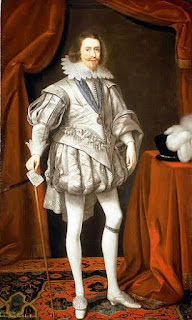 |
| Duke of Buckingham |
On the home front, his new mansion, designed to facilitate and display his philosophical researches, was almost complete. He had a circle of excellent friends, including playwright Ben Jonson, poet Thomas Campion, and many others. He had the ear of the king and more importantly, the king’s favorite: George Villiers, Duke of Buckingham. Thirty years older than the handsome and powerful duke, Francis considered himself a fond advisor and respectful tutor, and hoped Buckingham could be persuaded to advance the cause of the new science, aimed at the benefit of all mankind.
Pushed off the stair, straight to the bottom
Alas, Buckingham cared little for mankind and nothing for the future, apart from gathering power and money into the hands of his own kinsmen. The besotted king allowed him absolute control of patronage and Buckingham rewarded his supporters lavishly. Sir Henry Montagu paid £20,000 to be made Lord Treasurer. Sir Edward Coke, Bacon’s longtime rival, paid £30,000 for the privilege of marrying his daughter to Buckingham’s brother and regaining a seat on the Privy Council. He wanted the Chancellorship, but even more, he wanted Francis Bacon brought down.
Coke stirred up a committee in Parliament to levy charges of corruption against Bacon, accusing him of taking bribes from defendants with suits in his court. Bacon was shocked. Of course he had accepted bribes; everyone did. They were called ‘gifts’ and were a routine part of doing business in those times. He protested that gifts never influenced his decisions, which even the gift-givers attested to be true, but the damage was done.
Buckingham threw his counselor to the wolves. Francis spent a few days in the Tower. He endured a humiliating trial and confessed all his sins, turning the same searching light of truth on his own actions that he had applied to every other inquiry. He had allowed his servants (we would say, ‘his staff’) free rein, and they had taken advantage of it, soliciting secret bribes for favors granted and controlling access to Chancery behind Bacon’s back. “Sit down, my masters,” he said when they rose to greet him. “Your rise has been my fall.”
He correctly blamed himself for not managing them better, but that indulgence was his only real offense. Everyone knew it; nevertheless, Bacon was stripped of his viscountcy, banished from court, banned from all positions of authority, banned even from London, and confined to his house in Gorhambury. Buckingham took York House for himself. A fine of £40,000 was levied, although the King forgave him of it later, and Bacon was eventually allowed to return to Gray’s Inn. Those were the only helps James offered him, although he treated him with compassion during the trial. The king and his favorite wanted the people’s wrath to remain focused on Bacon, not turned toward their actions.
Most of us would have spent the rest of our lives either grumbling in a dark parlor or obsessively pursuing revenge against Coke and his minions. Not Francis Bacon. He had never been given to bitter recriminations about the past; like a true visionary, his focus was always toward the future. He went home and wrote the works that made him immortal. He died in 1626 of a chill caught during an experiment in refrigeration. He thought he might be able to preserve a chicken by storing it in snow.
And the stair just keeps on winding
Those who loved him, especially his secretary Sir Thomas Meautys, rushed to preserve Bacon’s letters and works for posterity. He had always known that he wrote for the ages. He considered himself a plowman, preparing a new field for others to sow and reap. “I have been content to tune the instruments of the muses, that they may play that have better hands.”
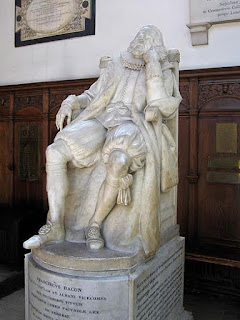 |
| Statue of Francis Bacon |
For two centuries after his death, his reputation rose. His legacy inspired the foundings of the Royal Society in England, the Imperial Academy in Germany, and the French Academy of Science, all during the latter half of the seventeenth century. John Milton, Robert Hooke, and Joseph Addison admired him. David Hume wrote that Bacon was “a man universally admired for the greatness of his genius and beloved for the courteousness and humanity of his behaviour.” In the eighteenth century, Thomas Jefferson wrote, “Bacon, Locke, and Newton. I consider them as the three greatest men that have ever lived, without any exception...”
But the stair wound back around, when anti-Stuart polemicists began writing ‘secret histories,’ purporting to tell the true stories of corruption and influence around the throne. Bacon once again became a pawn in their tales, portrayed as the ultimate schemer, the epitome of corruption and servile manipulation. Real historians like Addison and Jonathan Swift disdained these libelers, but as we know in our time, scandal travels faster and farther than its rebuttals.
By the eighteenth century, Bacon had become the avatar of the Tories among the more rabid Whig writers. I’ve never been able to keep my Whigs straight, but somehow Bacon was drawn into that conflict as well. In 1837, Whig politician Lord Macaulay published an influential essay in which he trotted out every vicious rumor invented by the seventeenth-century scandal-mongers. Bacon was reviled as the betrayer of noble Essex, the two-souled monster who schemed his way to power and was justly cast down by a democratic Parliament.
Victorian historian James Spedding devoted his life to a comprehensive and objective study of Bacon’s life and works, refuting every scrap of malicious gossip and eventually producing the fifteen volume edition that remains the authoritative source. Every subsequent historian has based their work on Spedding, but his rational voice continues to be overwhelmed.
Bacon was a versatile genius who spent most of his time serving in government posts. He wrote something wise and witty about nearly every topic known to his age. The multi-faceted nature of his abilities continues to fascinate people, just as the wildly divergent biographies continue to confuse them.
Some people think Francis Bacon wrote Shakespeare’s plays. (To me, this is like saying, “No, seriously; Woody Allen was the real director of Jaws.”) Some people think he never died, that he faked his death in 1626 and traveled secretly to the Continent, aided by his fellow Rosicrucians. Eventually he ascended to another plane in a castle in Transylvania where he lives forever. Ecofeminists blame him for the Gulf Oil Spill of 2010. And worse, now some irreverent Texan has expropriated his very character for the production of works that can only be regarded as frivolous.
References
Matthews, Nieves. 1996.
Francis Bacon: The History of a Character Assassination. Yale University Press.
Spedding, James, ed. 1890.
The Letters and the Life of Francis Bacon. Vol. I. London: Longmans, Green, and Co.
Wikipedia. 2015. “Occult theories about Francis Bacon.” https://en.wikipedia.org/wiki/Occult_theories_about_Francis_Bacon
~~~~~~~~~~~~~
Anna Castle writes the Francis Bacon mysteries and the Lost Hat, Texas mysteries. She’s earned a series of degrees -- BA Classics, MS Computer Science, and PhD Linguistics -- and has had a corresponding series of careers -- waitressing, software engineering, assistant professor, and archivist. Writing fiction combines her lifelong love of stories and learning. Find out more at
www.annacastle.com.
Amazon


