
by Anna Belfrage
 This, ladies and gentlemen, is Elizabeth Stuart, princess of Scotland and England, daughter to James VI & I and his Danish queen, Anne. Like her younger brother, Charles, Elizabeth was destined for a life of tragic adventure, but fortunately this was something she was totally unaware of during her childhood. As an added boon, she never had her head chopped off – even if the Stuarts are somewhat over-represented when it comes to beheading statistics, what with both Mary Queen of Scots and her grandson, Charles I, dying under the executioner’s blade.
Back to our Elizabeth. Born in 1596, she was James’s and Anne’s second child, and seeing as they already had a thriving male heir, the little girl was received with open arms. A Scottish princess, no less – named for the ageing English queen to curry favour not only with Virgin Bess but also with James’ potential future subjects, one imagines.
Elizabeth’s early years were spent in Linlithgow Palace. Early on, she developed a strong bond with her older brother, Henry Frederick, while showing little interest in her sister who was born in 1598. Seeing as Margaret died within the year, maybe this was not a bad thing. In 1600, the nursery saw yet another addition, little Charles. Elizabeth was only vaguely interested. Yet another brother was born – and died – in 1602.
In 1603, Queen Elizabeth died. James VI of Scotland was to become James I of England, and off he went with wife and his two eldest children in tow to claim the English throne (Charles was considered too frail to make the journey). Now we have to remember that James was a Scot. For most English people that translated as being the enemy, almost as bad as being French. Almost. And where England could boast a population of four million and healthy trade, Scotland was home to a fifth as many souls and had suffered one economic set-back after the other during the last few decades. It was very much a case of the poor cousin being invited to the party, and James, always painfully aware of his dignity, had every intention of making a good impression. His children were part and parcel of this ambition, and both Henry Frederick and Elizabeth were expected to be on their best behaviour.
Royal children at the time were good at being on their best behaviour. In this particular case, the children were also bright and comely. James’ new subjects thawed somewhat: here was a handsome boy, their future king, and beside him his pretty sister. Even better, the children – just as their father – were raised as staunch Protestants, maybe a tad too Calvinistic for English tastes, but still.
Not everyone in England was thrilled with a Scottish king. A minority of the English were also of the opinion that England needed to be returned to the true Catholic faith – an opinion that was reinforced when James showed no intention of being more lenient towards Catholics than his successor. (In all fairness to James, he was prepared to be open-minded, but a planned attempt on his life in 1603 featuring Catholic priests and nobles sort of soured his relationship with the recusants).
While little Elizabeth applied herself to her lessons, monitored by Lord Harrington, others planned yet another devious plot centred round the little girl. Once again, we have a group of Catholic nobles conspiring against the king. This time, the intention was to kill the king by blowing up Parliament, probably killing the Prince of Wales as well, and then place Princess Elizabeth on the throne, a little puppet queen to be raised a Catholic and eventually to be married to a Catholic. As we all know, the infamous Gunpowder Plot failed, and Elizabeth was never to be queen of England.
James was a great believer in education, even for his daughter. Well, he drew the line at Latin, being of the opinion that women had no benefit from studying the classics, but all the same, by the time she was 12, Elizabeth spoke several languages, including French, and was well-versed in her bible and the Protestant faith. She was also, by all accounts, a great rider and quite attractive.
Suitors flocked like drones round a queen bee. The future Swedish king was one of them, but Gustav Adolf was crossed off the list at Queen Anne’s behest (no love lost between Swedes and Danes). Otherwise, there was an assortment of princes, of dukes and earls. Elizabeth had little say in who the lucky groom would be. Her marriage was a matter of state, and Elizabeth could only hope her father would make a wise choice.
 Fortunately, James did. After much consideration, he chose Frederick, Count Palatine of the Rhine. Of impeccable lineage, the young man came with the added benefit of being a devout Protestant and having a sweet disposition. In 1612, Frederick arrived in London, there to woo his bride. Well, woo and woo: the marriage was more or less a done deal anyway, but James was happy enough to allow the young couple some time to get to know each other.
In November of 1612, Henry Frederick died, and Princess Elizabeth was suddenly second in line to the throne, after her rather sickly younger brother Charles. Queen Anne felt this required a better groom than Frederick: her daughter was now in a position to marry a future king, not an insignificant Count Palatine. But Elizabeth had set her heart on Frederick, and James agreed with her – the poor man was probably too distraught by his heir’s death to really care one way or the other.
In 1613, Elizabeth and Frederick were married, and the wedding itself was a lavish feast that more or less wiped out King James’s funds. After the wedding, Elizabeth and her husband set out for Heidelberg, Frederick’s principal home, where they settled down to refurbish the castle, including a magnificent garden, and to make babies.
As regular as clockwork, out came a baby, with the eldest born in 1614, and the youngest in 1632. In total, this happy couple produced thirteen children in 18 years – thirteen! Elizabeth was effectively pregnant for 9 years and nine months…. No wonder she reputedly had a distant relationship with her children – she was always busy expecting the next one. Anyway, all those pregnancies do not seem to have cramped her style, seeing as she accompanied her husband all over the place. Like to Bohemia.
Bohemia…Situated in the present day Czech Republic, this was a kingdom in which the king traditionally was elected by the aristocracy. Well, that’s the way it used to be, until Bohemia was annexed by the Hapsburg Empire. Hapsburg Emperors had little time for this election nonsense, and the Bohemians were smart enough to realise they had no chance in hell to withstand the powerful Empire – nor did they feel the need to do so as long as the Hapsburgs allowed them to practice their Protestant faith.
But in 1618 things changed: the old emperor was ailing and demanded that Bohemia recognise his heir, Ferdinand as their crown-prince. Problem was, Ferdinand was virulently anti-Protestant, so when he sent a couple of Catholic counsellors to Prague, the Bohemian nobles responded by throwing these gentlemen out of the window, the so called Prague Defenestration. Did not go down well with Ferdinand. In fact, it made him even more determined to wipe out the Protestant heresy from his lands.
 In 1619, Emperor Matthias died. The Bohemian nobles seized the opportunity offered, invoked their ancient right to choose their king themselves, and offered the crown to Frederick, Count Palatine. Fredrick wasn’t so sure about this. Being an intelligent young man, it took him like five seconds to work out that Bohemia was very, very small in comparison to the very, very big Hapsburg Empire. His wife, however, thought the idea of going to Bohemia was great – well, I think she liked the idea of being a queen. Plus, both Frederick and Elizabeth genuinely believed they needed to do this to defend their faith.
Off they went to Bohemia, and one month after her coronation, Elizabeth gave birth to her third son, Prince Rupert of English Civil War fame. (See? Eight months along and she travels all the way from Heidelberg to Prague). That, essentially, was the high point of Elizabeth’s sejour in Bohemia. Emperor Ferdinand II was not about to allow the Bohemian revolt to go unpunished (and for those of you who like your history, the Bohemian Revolt is generally considered to be the starting point of the Thirty Years’ War),- and in November of 1620 the imperial force routed Frederick’s army. The King of Bohemia had lost his crown.
One would have thought Elizabeth and Frederick could return to Heidelberg. Nope. The Rhine Palatinate was part of the Hapsburg Empire, and so, in one fell swoop, Frederick was reduced to a landless exile – more or less simultaneously with becoming a father for the fifth time, seeing as Prince Maurice was born in January of 1621.
This was not the life Elizabeth had envisioned. Our Stuart princess was no longer a queen, she was reduced to being grateful for the invitation from the Prince of Orange to come to Hague, there to set up a much reduced court. But at least they still had each other, and apparently Frederick and Elizabeth found comfort in each other’s arms, resulting in eight more babies. Handsome babies, most of them!
Frederick decided to ally himself with the star of the north, Gustav Adolf of Sweden. In January of 1632, Frederick kissed his newborn son and wife farewell and sat up on his horse. She would never see him again. In late November of 1632, Frederick succumbed to an infection and died, just 36 years old. (And by then Gustav Adolf was also dead, his pillaged body found in the aftermath of the Battle of Lützen.)
 Losing the Bohemian crown was nothing to losing her beloved husband. Elizabeth was prostrate with grief, for several days she neither drank nor ate. Frederick had been the love of her life, far more important to her than their many children, and now he was gone – for good. She wept, she paced her rooms, she wept some more…But after some days of such uncharacteristic behaviour, she pulled herself together: she had a son to fight for, a fifteen-year-old boy who she was determined to see succeed to his father’s lands.
Over the coming years, Elizabeth was to suffer hardship and loss in spades. While she did manage to secure her son’s inheritance, she was to live through the death of four of her children, suffer the shock of her brother’s execution, see her nephews reduced to penniless exiles, and all the while be dependent on the somewhat stingy largesse (I know, I know, but it’s a beautiful contradiction ;)) of the Prince of Orange. It seems all this suffering endowed her with dignity, softened somewhat the haughty edges of the princess.
In 1660, the Stuart dynasty was restored to the throne of England, Scotland and Ireland. Elizabeth, by now in her sixties, yearned to revisit the land of her birth and arrived in England in May 1661. She extended her stay, fell ill in pneumonia and died in February of 1662.
 Elizabeth was buried in Westminster Abbey, her coffin accompanied by only one of her children, Prince Rupert. She would have preferred to be laid to rest beside her beloved Fredrick, but that, sadly, was not possible, as no one knew where Frederick’s remains had ended up. Originally buried in Frankenthal, Frederick’s embalmed body was transported to Kaiserslautern when the Spanish soldiers invaded his resting place. What happened to him afterwards remains unknown.
And so ends the story of Elizabeth Stuart, princess, queen, mother and wife. Most of all wife. Several years later, Elizabeth’s and Frederick’s grandson was to ascend the English throne as the first of the Hanover kings. I think Elizabeth would have been pleased. But I think she would have happily traded that for some more years by Frederick’s side.
NOTE: This post has previously been published on Anna's own blog
~~~~~~~~~~~~~
 Anna Belfrage is the successful author of eight published books, all of them part of The Graham Saga. Set in 17th century Scotland, Virginia and Maryland, this is the story of Matthew Graham and his wife, Alex Lind - two people who should never have met, not when she was born three centuries after him.
 Presently, Anna is hard at work with The King’s Greatest Enemy, a series set in the 1320s featuring Adam de Guirande, his wife Kit, and their adventures and misfortunes in connection with Roger Mortimer’s rise to power. The first instalment, In the Shadow of the Storm, was published on November 1, 2015.
For more information about Anna and her books, please visit her website. If not on her website, Anna can mostly be found on her blog.

Back to our Elizabeth. Born in 1596, she was James’s and Anne’s second child, and seeing as they already had a thriving male heir, the little girl was received with open arms. A Scottish princess, no less – named for the ageing English queen to curry favour not only with Virgin Bess but also with James’ potential future subjects, one imagines.
Elizabeth’s early years were spent in Linlithgow Palace. Early on, she developed a strong bond with her older brother, Henry Frederick, while showing little interest in her sister who was born in 1598. Seeing as Margaret died within the year, maybe this was not a bad thing. In 1600, the nursery saw yet another addition, little Charles. Elizabeth was only vaguely interested. Yet another brother was born – and died – in 1602.
 |
| James VI & I |
Royal children at the time were good at being on their best behaviour. In this particular case, the children were also bright and comely. James’ new subjects thawed somewhat: here was a handsome boy, their future king, and beside him his pretty sister. Even better, the children – just as their father – were raised as staunch Protestants, maybe a tad too Calvinistic for English tastes, but still.
Not everyone in England was thrilled with a Scottish king. A minority of the English were also of the opinion that England needed to be returned to the true Catholic faith – an opinion that was reinforced when James showed no intention of being more lenient towards Catholics than his successor. (In all fairness to James, he was prepared to be open-minded, but a planned attempt on his life in 1603 featuring Catholic priests and nobles sort of soured his relationship with the recusants).
While little Elizabeth applied herself to her lessons, monitored by Lord Harrington, others planned yet another devious plot centred round the little girl. Once again, we have a group of Catholic nobles conspiring against the king. This time, the intention was to kill the king by blowing up Parliament, probably killing the Prince of Wales as well, and then place Princess Elizabeth on the throne, a little puppet queen to be raised a Catholic and eventually to be married to a Catholic. As we all know, the infamous Gunpowder Plot failed, and Elizabeth was never to be queen of England.
James was a great believer in education, even for his daughter. Well, he drew the line at Latin, being of the opinion that women had no benefit from studying the classics, but all the same, by the time she was 12, Elizabeth spoke several languages, including French, and was well-versed in her bible and the Protestant faith. She was also, by all accounts, a great rider and quite attractive.
Suitors flocked like drones round a queen bee. The future Swedish king was one of them, but Gustav Adolf was crossed off the list at Queen Anne’s behest (no love lost between Swedes and Danes). Otherwise, there was an assortment of princes, of dukes and earls. Elizabeth had little say in who the lucky groom would be. Her marriage was a matter of state, and Elizabeth could only hope her father would make a wise choice.

In November of 1612, Henry Frederick died, and Princess Elizabeth was suddenly second in line to the throne, after her rather sickly younger brother Charles. Queen Anne felt this required a better groom than Frederick: her daughter was now in a position to marry a future king, not an insignificant Count Palatine. But Elizabeth had set her heart on Frederick, and James agreed with her – the poor man was probably too distraught by his heir’s death to really care one way or the other.
In 1613, Elizabeth and Frederick were married, and the wedding itself was a lavish feast that more or less wiped out King James’s funds. After the wedding, Elizabeth and her husband set out for Heidelberg, Frederick’s principal home, where they settled down to refurbish the castle, including a magnificent garden, and to make babies.
As regular as clockwork, out came a baby, with the eldest born in 1614, and the youngest in 1632. In total, this happy couple produced thirteen children in 18 years – thirteen! Elizabeth was effectively pregnant for 9 years and nine months…. No wonder she reputedly had a distant relationship with her children – she was always busy expecting the next one. Anyway, all those pregnancies do not seem to have cramped her style, seeing as she accompanied her husband all over the place. Like to Bohemia.
Bohemia…Situated in the present day Czech Republic, this was a kingdom in which the king traditionally was elected by the aristocracy. Well, that’s the way it used to be, until Bohemia was annexed by the Hapsburg Empire. Hapsburg Emperors had little time for this election nonsense, and the Bohemians were smart enough to realise they had no chance in hell to withstand the powerful Empire – nor did they feel the need to do so as long as the Hapsburgs allowed them to practice their Protestant faith.
But in 1618 things changed: the old emperor was ailing and demanded that Bohemia recognise his heir, Ferdinand as their crown-prince. Problem was, Ferdinand was virulently anti-Protestant, so when he sent a couple of Catholic counsellors to Prague, the Bohemian nobles responded by throwing these gentlemen out of the window, the so called Prague Defenestration. Did not go down well with Ferdinand. In fact, it made him even more determined to wipe out the Protestant heresy from his lands.

Off they went to Bohemia, and one month after her coronation, Elizabeth gave birth to her third son, Prince Rupert of English Civil War fame. (See? Eight months along and she travels all the way from Heidelberg to Prague). That, essentially, was the high point of Elizabeth’s sejour in Bohemia. Emperor Ferdinand II was not about to allow the Bohemian revolt to go unpunished (and for those of you who like your history, the Bohemian Revolt is generally considered to be the starting point of the Thirty Years’ War),- and in November of 1620 the imperial force routed Frederick’s army. The King of Bohemia had lost his crown.
One would have thought Elizabeth and Frederick could return to Heidelberg. Nope. The Rhine Palatinate was part of the Hapsburg Empire, and so, in one fell swoop, Frederick was reduced to a landless exile – more or less simultaneously with becoming a father for the fifth time, seeing as Prince Maurice was born in January of 1621.
This was not the life Elizabeth had envisioned. Our Stuart princess was no longer a queen, she was reduced to being grateful for the invitation from the Prince of Orange to come to Hague, there to set up a much reduced court. But at least they still had each other, and apparently Frederick and Elizabeth found comfort in each other’s arms, resulting in eight more babies. Handsome babies, most of them!
Frederick decided to ally himself with the star of the north, Gustav Adolf of Sweden. In January of 1632, Frederick kissed his newborn son and wife farewell and sat up on his horse. She would never see him again. In late November of 1632, Frederick succumbed to an infection and died, just 36 years old. (And by then Gustav Adolf was also dead, his pillaged body found in the aftermath of the Battle of Lützen.)

Over the coming years, Elizabeth was to suffer hardship and loss in spades. While she did manage to secure her son’s inheritance, she was to live through the death of four of her children, suffer the shock of her brother’s execution, see her nephews reduced to penniless exiles, and all the while be dependent on the somewhat stingy largesse (I know, I know, but it’s a beautiful contradiction ;)) of the Prince of Orange. It seems all this suffering endowed her with dignity, softened somewhat the haughty edges of the princess.
In 1660, the Stuart dynasty was restored to the throne of England, Scotland and Ireland. Elizabeth, by now in her sixties, yearned to revisit the land of her birth and arrived in England in May 1661. She extended her stay, fell ill in pneumonia and died in February of 1662.
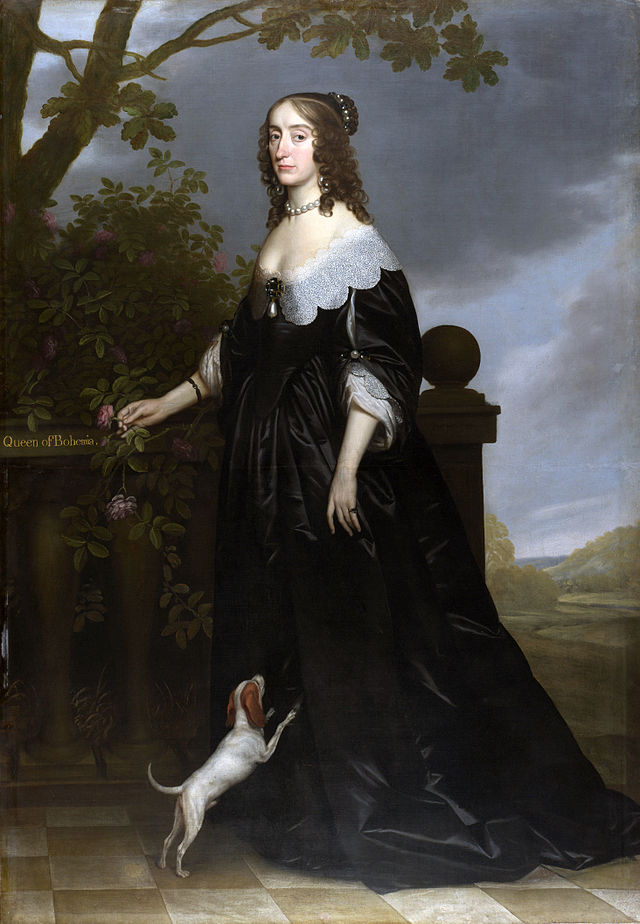
And so ends the story of Elizabeth Stuart, princess, queen, mother and wife. Most of all wife. Several years later, Elizabeth’s and Frederick’s grandson was to ascend the English throne as the first of the Hanover kings. I think Elizabeth would have been pleased. But I think she would have happily traded that for some more years by Frederick’s side.
NOTE: This post has previously been published on Anna's own blog
~~~~~~~~~~~~~


For more information about Anna and her books, please visit her website. If not on her website, Anna can mostly be found on her blog.


