Showing posts with label 19th-century england. Show all posts

Saturday, May 11, 2013

Victorian Violence: Repelling Ruffians (Part One)

by Terry Kroenung


 "The housebreaker freed one arm, and grasped his pistol. The certainty of immediate detection if he fired, flashed across his mind even in the midst of his fury; and he beat it twice with all the force he could summon, upon the upturned face that almost touched his own.

She staggered and fell: nearly blinded with the blood that rained down from a deep gash in her forehead; but raising herself, with difficulty, on her knees, drew from her bosom a white handkerchief--Rose Maylie's own--and holding it up, in her folded hands, as high towards Heaven as her feeble strength would allow, breathed one prayer for mercy to her Maker.

It was a ghastly figure to look upon. The murderer staggering backward to the wall, and shutting out the sight with his hand, seized a heavy club and struck her down."
    --- Oliver Twist, Charles Dickens

To judge by this disturbing scene (or, indeed, any episode of Ripper Street) it was as much as a man’s life was worth to walk the streets of Victorian London. Robbery and murder were commonplace, pickpockets were as ubiquitous as fleas on a mongrel, and as for an unaccompanied woman, well…

But was that true? Or were the news reports of that era just as slanted toward the sensational as are our own? ‘If it bleeds, it leads’ is the motto of modern media and certainly British journalism of the 19th century could hardly claim to be more scrupulous. The truth is that we do not know with any degree of certainty.

Then as now circumstances and geography dictated risk. Jack the Ripper’s outrages were committed in sordid Whitechapel, after all, and not in genteel Kensington. A critical mass of the poor and desperate has always led to increased criminality.

Wise ladies and gentlemen preferred to avoid dirty, ill-lit areas with foul reputations. Forewarned is forearmed and all that. Yet an assault could happen at any time and place. It was no respecter of persons, either. In 1862 a Member of Parliament was garroted and robbed in broad daylight in Pall Mall.

Earlier centuries may well have been worse. The gin-soaked gutters of Hogarth’s time, with none of Robert Peel’s bluebottles or even the Bow Street Runners to keep the peace, were likely a horror-show. A noticeable decrease in wretchedness did occur with the advent of the Metropolitan Police, though it took until the 1880’s for that force to gain wide-spread respect. Ennui was not a risk faced by the Peelers.

In a typical Dickensian year (1856) the force arrested over 73,000 people. And we would do well to remember that an enormous percentage of crimes went unreported or unrecorded. The citizenry did not trust its own officers, often with good reason. Particularly in the early days the policeman was often just as likely as the most hardened East Ender to be guilty of an offense.


Even if the bobby was honest, many residents felt it a waste of time to make a complaint, since so many crimes were not solved. Let us give savagery the benefit of the doubt and presume that it was enough of a concern that measures had to be taken.

To this end most men of the middle and upper classes considered training in pugilism and singlestick to be an essential part of their education. When faced with a determined defender, many a hooligan would likely seek easier prey. Quite apart from such practical considerations, the manly arts also served to toughen the mind and spirit, preparing a fellow for the rugged vicissitudes of life. Instructional manuals abounded, all stressing this point:

"Physical education is indispensable to every well-bred man and woman. A gentleman should not only know how to fence, to box, to ride, to shoot and to swim, but he should also know how to carry himself gracefully, and how to dance, if he would enjoy life to the uttermost. A graceful carriage can best be attained by the aid of a drilling master, as dancing and boxing are taught. A man should be able to defend himself from ruffians, if attacked, and also to defend women from their insults."
     --- Our Deportment, 1879

Naturally certain of these skills were better-suited to the country house than the alleys of the metropolis. Be that as it may, expertise with stick and fist doubtless preserved many a life when faced with a resolute robber in a fetid corner of the Empire’s capital. At a minimum it would have enabled the victim to keep a cool head and react with grace under pressure.

In Part Two we shall investigate what techniques and tools would have been available to a gentleman, or lady, in such duress.

~~~~~~~~~~~~

Terry Kroenung is the author of Brimstone and Lily, a seriocomic fantasy novel set in 1862, and its sequel, Jasper’s Foul Tongue. Book 3 in the series, Jasper’s Magick Corset, will be available in September. Paragon of the Eccentric, his Steampunk prequel to War of the Worlds, is pending. He has also written dramas set in the 19th century, such as Gentle Rain and Coolness and Courage.

Friday, February 1, 2013

The Publication of Pride and Prejudice

This week marks the 200th anniversary of the publication of Jane Austen's Pride and Prejudice. It actually was on Monday, January the 28th. Today, though, is my day in our haphazard rotation, and as I have mostly presented pieces of history from the Regency era, this is one of them.

File:PrideAndPrejudiceTitlePage.jpg


Often we equate John Murray (1778-1843) as a preeminent publisher of the period. He was. His father, also John (1745-1793), had started the famous publishing business. John II brought forth such works as Scott's Marmion, Byron's Childe Harold,  The Quarterly Review with the help of future prime minister George Canning.


Still, John Murray was not the first publisher of Austen's works, and not the publisher of Pride and Prejudice. This fell to Thomas Egerton. A man who did publish Austen's Sense and Sensibility.

Jane Austen began the writing of her most famous novel in 1796 and finished this novel then called First Impressions in August of 1797. On November 1 Austen's father, George, sent a letter to the London bookseller Thomas Cadell to see if he might have an interest in it. Cadell declined.

Jane revised the novel in 1811 and 1812. Fifteen years after she had written it, as a writer it is safe to say that her technique and skill would have improved in that time. She also of course changed the name of her novel during this time. Also of importance was that her Sense and Sensibility had been published.

But even prior to this, Austen had secured a publisher. In 1803 her brother henry had offered to Benjamin Crosby, Susan. The sum of £10 was paid. Crosby did nothing with the book beyond advertising it was "in the press." Even with her later success, the company did nothing and Austen repurchased her rights to the piece in 1816.


SenseAndSensibilityTitlePage.jpg


Thomas Egerton in the meantime accepted Sense and Sensibility for publication in three volumes in 1811 for his Military Library publishing house. Austen paid for the book to be published and then paid a commission on sales of the book. It cost more than a third of the annual household income of Jane and her family at the time. Yet she made a profit of £140 on the first edition, 1000 copies which sold out by July of 1813. A second edition was then published in October of 1813, but this is after Pride and Prejudice was released.

Thomas Egerton was obviously doing much better at taking a book from manuscript to sales than Crosby, and so Pride and Prejudice was offered to Egerton as well. Yet At the time, Austen did not know how well the book would sell, and Sense and Sensibility still had not finished selling its first printing. She sold the rights for a one-off payment to Egerton who made £450 from the first two editions. The amount Jane had paid Egerton to produce just the first printing of Sense and Sensibility.

You could have purchased the first edition of Pride and Prejudice for 18s. Today one of those editions would cost you more than £60,000. The first print run of 1500 copies sold out and a second edition was printed in November of 1813. A third edition was published in 1817. A French edition also appeared in 1813, and there were translations in German, Danish and Swedish. The First US edition was published in 1832. At the present time, Pride and Prejudice sells approximately 110,000 copies a year in about 130 different editions.


* * *


Mr. Wilkin writes Regency Historicals and Romances, Ruritanian (A great sub-genre that is fun to explore) and Edwardian Romances, Science Fiction and Fantasy works. He is the author of the very successful Pride & Prejudice continuation; Colonel Fitzwilliam’s Correspondence. He has several other novels set in Regency England including The End of the World and The Shattered Mirror. His most recent work is the humorous spoof; Jane Austen and Ghosts, a story of what would happen were we to make any of these Monsters and Austen stories into a movie.

And Two Peas in a Pod, a madcap tale of identical twin brothers in Regency London who find they must impersonate each other to pursue their loves.


The links for all locations selling Mr. Wilkin's work can be found at the webpage and will point you to your favorite internet bookstore: David’s Books, and at various Internet and realworld bookstores including the iBookstore, Amazon, Barnes and Noble, Smashwords.


He is published by Regency Assembly Press
And he maintains his own blog called The Things That Catch My Eye where the entire Regency Lexicon has been hosted these last months as well as the current work in progress of the full Regency Timeline is being presented.

You also may follow Mr. Wilkin on Twitter at @DWWilkin
Mr. Wilkin maintains a Pinterest page with pictures and links to all the Regency Research he uncovers at Pinterest Regency-Era


Thursday, January 31, 2013

SOME LIKED IT HOT! Cooking Curry in Jane Austen's Time

by Lauren Gilbert


On my first trip to England, one of the first things I wanted to try was Indian food, particularly curry.  I used to think that trying spicy food from other places was a modern taste, and it was not a concept that I associated with typical English cuisine of Jane Austen’s time.  However, history proves me wrong.  Cookbooks and recipes from the 18th and 19th centuries show that flavorful food was important, and herbs and seasonings were as important to cooks then as they are today.  Trade and colonies yielded new seasonings and tastes.   Travellers and immigrants had brought different seasonings and dishes into England, as did returning soldiers, sailors and traders.  Spices, especially pepper, at different times were an exchange item, valued as money.  Clearly, strong, distinct, spicy flavors had been incorporated into the culinary landscape, and hot seasoning was a part of that.  I had intended to present a broad overview of the use of herbs and spices in cooking during Jane Austen’s day.  However, I was distracted by Martha Lloyd’s curry recipes, so today our focus will be curry in Jane Austen’s time.
           There is a perception that the popularity of spices in earlier times was based at least in part on their value as preservatives, which is actually not correct.  It was driven by flavor and medicinal values.  Lack of refrigeration resulted in the “high” (tainted) flavor of meat, fish and poultries, so seasonings were used to disguise the taste.  (Spices were not effective as preservatives, and were too expensive to use in a quantity required for preserving, the way salt is used).  Cubeb and cayenne are both hot and spicy, and are listed in Culpeper (which indicates they could be grown in England). Uses of sauces and strong tastes, such as nutmeg, cloves, cinnamon etc. produced complex, sophisticated flavors that appealed to the wealthy.  When combined with the supposed medicinal values (hot spicy seasoning balanced cool moist humours of meat and fish), we can see how the desire for spices grew.
            Before 13th century, the taste for spice came back with the crusaders. Originally, the spice trade was controlled by the Arabs in the Middle East, but the Dutch and Portuguese became competitors, with the Dutch ultimately assuming control.   In order to participate in (and to try to ultimately control) the spice trade, the British East India Company was formed in 1600 to compete with the Dutch.  In 1608, the British East India Company established its first base in India, and, for the first time, Britain had access to spices that were not controlled by the Dutch.  Spice trade was driven by the craving for varied and exotic tastes as well as the medicinal values of various spices (spice was the first globally-traded commodity, one of the first pushes to globalization).  It is interesting to note that hot peppers (capsicum-cayenne peppers) were introduced into Asia by European traders after they were found in the New World (the name “Indian peppers” relates to the New World, not India).  English traders began to settle in India in the early 1600’s. 
           Indian seasonings gained increasing popularity in England as their flavors were brought with returnees from India who desired to recreate flavors they had come to enjoy, and shared them.  The cost of spices remained high in spite of English control of spice trade-almost constant warfare disrupted trade and consequently affected cost and availability.  There is disagreement on the origin of the word “curry”, but it was applied to Indian dishes with spiced sauces by the English in the 17th century.  The Hindostanee Coffee House was opened by Dean Mahomed in London in 1809, advertising Indian dishes better than any curries made in England before. (Hookah pipes could also be smoked there.)  Although Mr. Mahomed went bankrupt in 3 years (people did not dine out then as commonly as now), this restaurant remained open for some years under various owners.  Popularity spread to middle classes, in spite of cost.  (Note that the cachet of spices lessened somewhat as their perceived medicinal value declined due to improved modern medical knowledge, a loss of status which may have resulted in a slightly reduced monetary value that may have allowed them to be a bit more easily purchased by other than the wealthy classes. However the cost did not reflect any significant decline during the Georgian era, thanks to war, blockades and piracy.)  
          Curry was an established element of English cooking in the Georgian era.  In the 1st edition of of Hannah Glasse’s THE ART OF COOKERY MADE PLAIN AND EASY, she included a recipe for “Fowle Rabbit Currey” in which rabbit is stewed with rice flour (thickener), coriander seeds and black peppercorns, which would have been very mild (in the 4th edition, ginger and turmeric are included).  Hannah Glasse’s original recipe may have been one of the earliest examples of changing a recipe to suit a different population’s taste.  The 1774 new edition contains a recipe for “To make a currey the Indian way” (chicken with turmeric, ginger, salt and pepper) and for “A Pellew the Indian Way” (rice pilau with pepper, mace and cloves) on page 101.  
           John Mollard’s THE ART OF COOKERY Made Easy and Refined, 2nd edition had a recipe for “currie” (curried chicken) on page 81, referring to 2 T of “currie powder”, and cayenne pepper to taste, which seems to indicate an increasing fondness for the Indian spices and for heat.  There is also a “Currie of lobster” on page 83 and “A Peloe of rice” (pilau of rice) on page 95, while on page 254 there is a recipe for Currie (Pepper Water) which is apparently a version of what became known as Mulligatawny Soup.  Available information indicates that curry powders were widely known and subject to individual tastes; recipes for curry powder were highly variable.
           Curry is mentioned in Martha Lloyd’s household book: curry powder, curry soup, curried chicken. Martha was Jane Austen's friend, and lived with Jane, her mother and sister, before she finally married Jane's brother Francis.  It is safe to assume Jane Austen would have had curry dishes.  Note that Martha mentions use of cayenne and black pepper “to your taste...” so it seems evident that the heat level was a personal matter even then.  Martha’s recipe for curry powder contains turmeric, galangal (a ginger relative), cayenne pepper and rice flour.  (The use of few spices could be a matter of taste or a matter of cost, or elements of both.)   I made it up and used it in a dish similar to “A Receipt to Curry after the Indian Manner” from THE JANE AUSTEN COOKBOOK.  It is very mild, and has a nice flavor, perfect for someone who has never tried curry or for someone who doesn’t care for a strong or pungent curry.  The flavor could be deepened by increasing the turmeric and/or galangal, or by adding other Indian spices, such as cumin, coriander, or other spices.  One source indicated the rice powder would be a thickener of the sauce but I noticed very little thickening effect.  
           Curry maintained its popularity through the 19th century, coming to a peak in Victoria’s reign.  It declined in the early 20th century, but has become a staple of British cuisine again.  While the flavors may be somewhat different than those with which Jane Austen and her family may have been familiar, the concept and the spices combined to make curry would not be foreign to her.
Sources:  

Black,Maggie & Le Faye, Deirdre.  THE JANE AUSTEN COOKBOOK.  1995 : McClelland & Stewart Ltd., Toronto, Canada. 
Hickman, Peggy.  A JANE AUSTEN HOUSEHOLD BOOK with Martha Lloyd’s recipes.  1977: David & Charles Inc., North Pomfret, Vermont.
Tannahill, Reay.  Food in History.  1988, 1973: Three Rivers Press, New York, New York.
GoogleBooks.com. THE ART OF COOKERY Made Easy and Refined.  By John Mollard.  2nd edition, 1802.  https://play.google.com/books/reader?id=3nEEAAAAYAAJ&printsec=frontcover&output=reader&authuser=0&hl=en
GoogleBooks.com.  THE ART OF COOKERY MADE PLAIN AND EASY.  By Hannah Glasse.  A new edition, 1784.  https://play.google.com/books/reader?id=xJdAAAAAIAAJ&printsec=frontcover&output=reader&authuser=0&hl=en
A History of Curry.  (Undated, no author shown.) http://www.indepthinfo.com/curry/history.shtml
BBC News Magazine.  “How Britain got the hots for curry”, by Rumeana Jahangir.  (Page last updated 11/26/2009)  http://news.bbc.co.uk/2/hi/8370054.stm 
National Bureau of Economic Research website.   “The Worldwide economic impact of the Revolutionary and Napoleonic Wars”  by Kevin H. O’Rourke.  May 2005.  Dept. of Economics and IIIS, Trinity College, Dublin, and CPER and NBER.  http://www.nber.org/papers/w11344
The Curry House Online.  “A History of Curry” by David W. Smith, 2012.  http://www.curryhouse.co.uk
The East India Company website.  “East India Company Timeline”. Undated and no author shown.  http://www.theeastindiacompany.com/24/timeline
 YaleGlobal Online.  “SPICES: How the Search for Flavors Influenced Our World” by Paul Freedman, posted March 11, 2003.  http://yaleglobal.yale.edu/print/396

Lauren Gilbert lives in Florida with her husband, who has actually eaten and survived vindaloo curry.  She is the author of HEYERWOOD: A Novel, her first published book.  Her second novel is due out later this year.  Visit http://www.heyerwood.com!
 

Thursday, November 22, 2012

Tambour Work

by Lauren Gilbert


Madame de Pompadour at her Tambour Frame by Henri Drouais
 
Regency novels frequently refer to “tambour frames” and “tambour work”.  One novel contained an amusing story where a lady used a tambour frame as a weapon.   I assumed It was a form of embroidery but knew nothing about it.   I enjoy needlework and thought it would be interesting to see what it was.
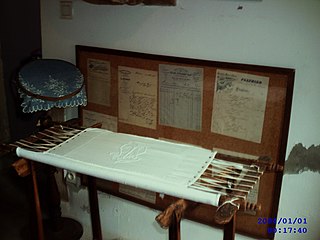
Tambour embroidery was a very popular and fashionable craft.   Thought to have originated in China, it was supposedly introduced to France in the mid-18th century, and subsequently spread to England and western Europe.   Ladies occupied their time with tambour work as well as other needle crafts, while professionals used this technique on a larger scale until machines were able to produce similar effects.  The stitcher uses a needle with a hook, similar to a modern latch hook, and makes a chain stitch on fabric stretched in a round frame. 
The frame is a two-part object, with an inner frame over which the fabric is stretched with the exterior frame holding it in place.  It is called a tambour or tambour frame because it resembles a drum (“tambour” is French for drum).  It is similar to modern embroidery hoops, but much heavier.   (I can now see how it could actually do some damage if used to strike someone!)  The thread is held underneath with one hand, while the other hand pushes the hooked needle through the fabric to catch the thread and pull it through. 

This shows the position of the hands, and the sturdiness of the frame.

Bringing the thread back up through the same hole forms a loop, and the pattern evolves as each new stitch is formed near the previous stitch, catching the loop from that stitch.  The stitches form a continuous chain.  The hooks used were small, sometimes not much more than a wire bent at the tip, and produced a lacy design.   It was commonly used to produce white on white design, such as the flower and vine designs popular on white muslin.  Tambour work was used to embroider gowns, shawls, reticules and other wearable items.  Using the finest hooks and threads, the chain stitch would also lend itself to monogramming handkerchiefs.  Obviously, fabrics with a more open weave such as muslin, gauze and net lend themselves beautifully to tambour work, as can be seen in the illustration below: 

At Fontenoy Chateau

Tambour embroidery is now also referred to as tambour crochet.  Crochet work as we know it seems to have evolved from tambour embroidery at least in part, being worked as a continuous chain, using a hook and thread or yarn, without the background fabric.  Tambour embroidery is still done today.  There are numerous resources on the internet for supplies, hooks and frames, and videos of instruction.
References:
de Dillmont, Therese.  THE COMPLETE ENCYCLOPEDIA OF NEEDLEWORK.  Third edition.  1996: Running Press, Philadelphia, PA.  (Illustrations of the tambour hook (fig. 280), and the position of the hands with the frame (fig. 281) from p. 144 used with permission.)
The Embroidery Site.  BellaOnline.com.   “Tambour Work” by Megan McConnell.  Not dated.  http://www.bellaonline.com/articles/art67103.asp
Clan Iain Abrach~McClain blog.  “A Brief History of Crochet” by Catie Rua the Weaver.  Posted 11/1/2003. http://www.iainabrach.org/blogitem.asp?ID=6  
Design.Decoration.Craft blog.  “Tambour Emboridery Work.”  (no author shown.) Posted 7/22/2010. http://thetextileblog.blogspot.com/2010/07/tambour-embroidery-work.html  
Illustrations of Madame de Pompadour and the Fontenoy tambour frame are from WikiCommons.  

Lauren Gilbert is the author of  HEYERWOOD: A Novel.  The heroine, Catherine, is a skilled needlewoman.  (More about the novel at http://www.heyerwood.com )
 

Sunday, November 11, 2012

Ashes, Tallow and Turpentine: Coming Clean in the Regency Era

By Maria Grace

Keeping clothes has always been a challenge.  Today, we can simply go to the store and buy a specialized product according stain that needs cleaning. In centuries past, the mistress of the house needed to be well versed on what home preparations could be used to keep her household fresh and clean. Some of their solutions are similar to what we use to today and some were positively stomach churning.

Lye
Plain lye formed the backbone of much of the everyday laundry cleaning arsenal and was fairly easy to obtain. Ashes from household fires were packed into a barrel with holes drilled in the bottom and lined with hay. Water was poured through the ashes and concentrated lye dripped from the holes.

The strength of the solution was critical for its cleaning power.  If an egg did not float high enough in the solution it was too weak and would be poured through the ashes again. Lye that was too strong could burn skin and damage fabrics and would need to be diluted. Urine, for its ammonia content might also be added to a lye solution it improve its cleaning power.

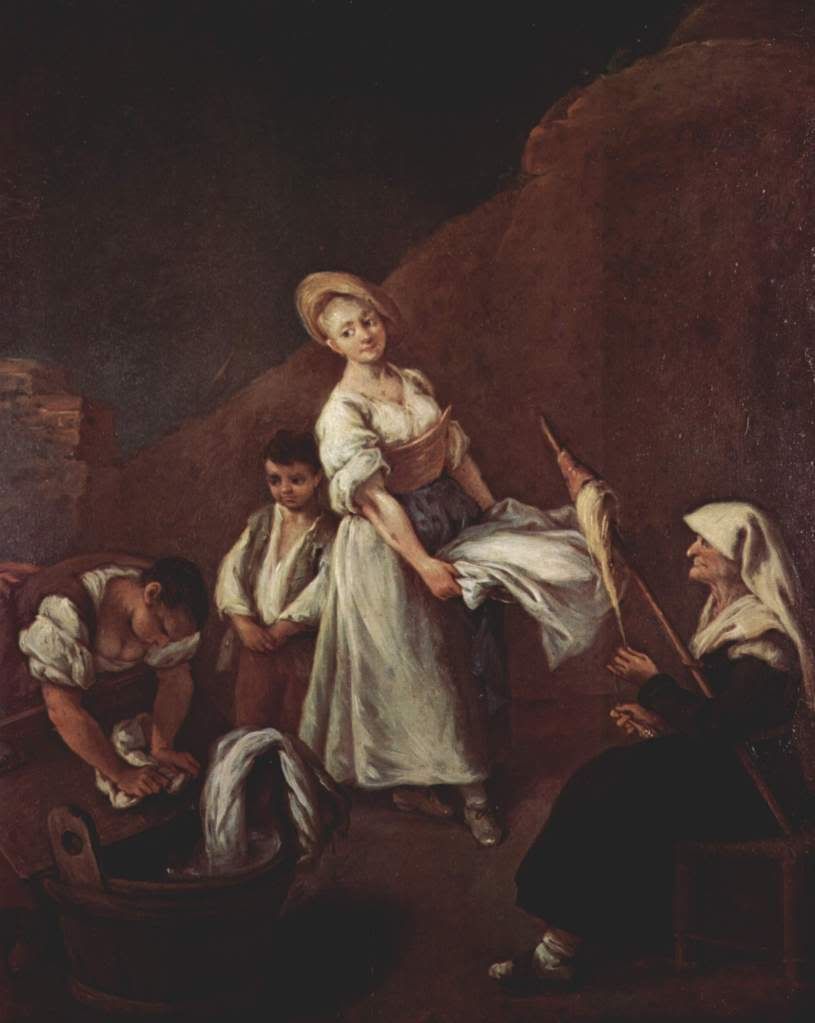
Body linen, other garments whose colors did not need to be protected, sheets and household linens were soaked in a vat of lye prior to being boiled on laundry day. The process was called ‘bucking’ and attempted to restore the white or off white color to the laundry.

Soap
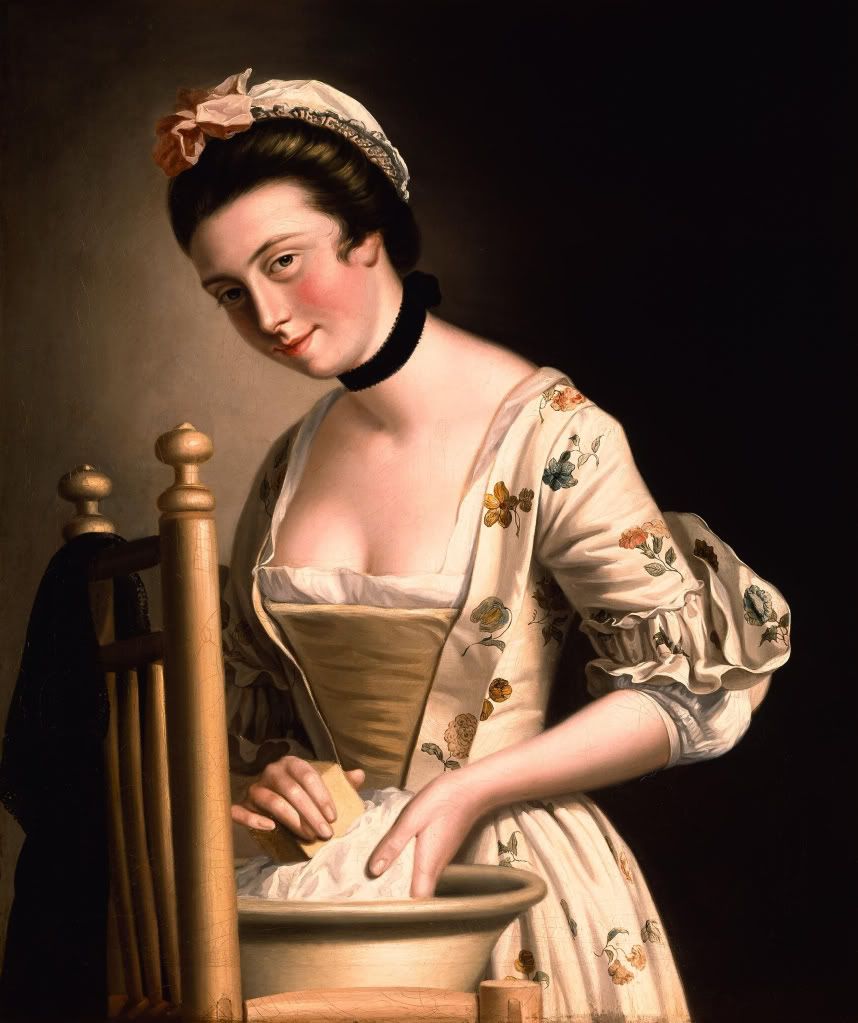
The generous use of soap was a modern advance in dealing with dirty laundry. At first it was used sparingly, only to treat stains. Later, it would be added to the main wash for cleaning.

Though soap could be purchased, what could be made at home often was, especially in areas away from larger urban areas. Soap could be made in several ways. A pail of lye could be added to about three pounds of melted animal fat and boiled all day. To avoid all that boiling and stirring, four pails of lye could be stirred into a barrel of 30 pounds of animal fat. Additional lye was added until it looked ‘right’ to the soap maker.  The soap might be used while it was still soft or it might be set up—dried and hardened with warm weather and salt.

Household manuals often contained various specialized recipes for soap with different fats and additives touted as better for one use or another. Individual households would also have their own recipes handed down from mother to daughter.

Water Softeners
Sodium borate (borax) and sodium carbonate (washing soda) were often added to the water to improve the action of the soap. Borax was preferred to washing soda which would yellow whites and damage their texture.  Borax could be added to the soap when it was made to eliminate the need to add it to the laundry water separately.

Both borax and washing soda had to be purchased and might not be available to poorer or more remote households.

Stain Removal
Stains were as much a problem then as they are now. Different recipes were used for different stains. These included:
  • Grease and oil stains: chalk, brick dust and pipe clay
  • Grass stains: alcohol, lemon and onion juice, kerosene
  • Blood stains: kerosene, lemon juice
  • Wax stains: a hot coal wrapped in a clean rag or wet brown paper
  • Urine stains: milk
  • Fruit stains: milk, lemon juice, onion juice

    Ox-Gall
To deal with stains on expensive colored fabrics which would bleach in a lye solution, ox-gall was the favorite solution. Ox-gall was obtained by sending a bottle to the butcher who filled it with the contents of cows’ gall-bladders.

     Bleaching
Despite soaking in lye, stubborn articles sometimes required additional bleaching. Human urine and hog manure were often used for this purpose as was lemon juice.

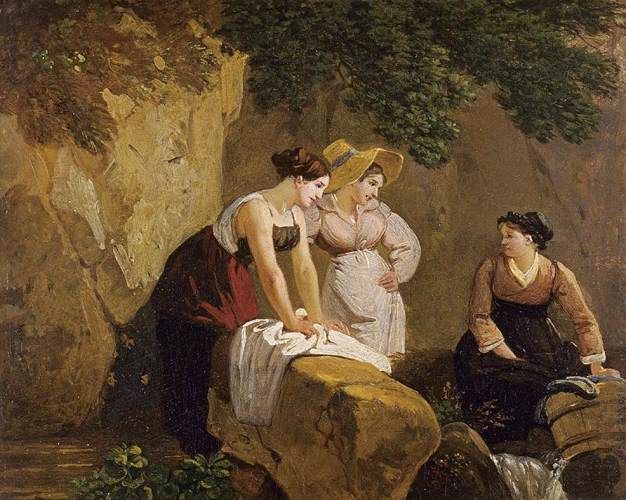
Sunshine in combination with lemon juice or lye was a freely available bleaching agent. Some estates and towns set aside areas of mown grass as ‘bleaching grounds’ where articles could be spread on laundry day. The chlorophyll in the grass helped in the bleaching process.

     Bluing
Since soap and washing soda often yellowed white articles, bluing would be added to the rinse water to neutralize the yellowing.  Blue dye, of various formulations, was placed in a small bag which would be swished through the rinse water and removed leaving a slight blue color behind.

Stiffening
Like other laundry necessities, starch was made at home. Wheat, potato gratings, and rice were common sources. Wheat starch might be added directly to water. The water used to cook rice or potatoes might be saved for starching. Similarly grated potatoes could be soaked in water then removed and the water used for starching laundry.

For delicate laces, sugar might be added to the final rinse water rather than starch. Alternately, gum arabic, made from the sap of acacia trees, might be used to stiffen laces and collars.

Dry Cleaning
Silk and woolen clothes never touched water. Several dry cleaning techniques were developed to preserve the fabrics through the cleaning process.

Fullers used fuller’s earth, an absorbent clay, and a thistle to clean wools.

Scourers spot cleaned silks once a year. Salt, chalk, or fuller’s earth as well as solvents like turpentine, kerosene, gasoline, lemon juice, warm milk, or even urine were used on the fine fabric. The whole garment was never immersed and scrubbed.

Leather breeches were scrubbed with a ‘breeches ball’ made of a mixture of ox-gall and fuller’s earth.

Interestingly, because many fine garments were not laundered with harsh lye, scrubbing and boiling, then remain preserved today.  Far fewer examples of body linen survive today because of the harsh measures used to keep them clean.

References
Kristina Harris. Victorian Laundry (or, Aren't You Glad You Didn't Live Then?) 
The Complexities of Wash Day in the 18th Century
History of Washing Clothes
History of Laundry 
Michael Olmert.  Laundries: Largest Buildings in the Eighteenth-century Backyard   
________________

 Maria Grace is the author of Darcy's Decision and The Future Mrs. Darcy. Click here to find her books on Amazon. For more on her writing and other Random Bits of Fascination, visit her website. You can also like her on Facebook, find her on twitter @WriteMariaGrace or email her.

Wednesday, October 10, 2012

Mistress of the Manor-what did she do all day?


By Maria Grace


Period dramas have left many of us with the notion that ladies of the landed gentry in the Regency era had little to do but dress in lovely gowns, embroider and gossip.  Reality could not be farther from this image. In general, both masters and mistresses of the house did a great deal of work around the estate, often working alongside the servants in the efforts to get everything done.
Labors tended to be divided along gender lines. So much so that single men sought female relatives to manage their households. Bachelors looked to sister or nieces while widowers often called upon daughters or the dead wife’s kin.  So, even if a woman did not marry, there was a very strong possibility she might take on the responsibilities of a household sometime in her lifetime.  Gentlemen tended to respect the household mistress’ authority; her contributions to the home had worth equal to his.

Responsibilities of the Mistress

The role of an estate’s mistress was the equivalent of, depending on the size of the estate, managing a small hotel to being the CEO of a major corporation. She oversaw the finances, food service, hiring and training of the staff, procurement, charitable contributions of the ‘company’ as well as the interior design of the ‘corporate headquarters.’ Depending on her intelligence, she might also assist her husband with overall estate business. While accomplishing all this, she was also expected to raise her children and cared for sick family members Talk about a working mother.

Children

The mistress’ responsibilities to her children are perhaps the most obvious.  First, she was expected to provide them in the first place.  Once they were born, it was on her shoulders to hire the nursery maids and governess, if the estate could afford them. If not, she would care for them herself. She was responsible for their education, whether she conducted it herself or hired others to teach them.

As her daughters grew older, it was her role to insure they acquired the necessary accomplishments that would be expected of them, including, interestingly enough, sufficient understanding of mathematics to manage household ledgers. She would also tutor them in the skills necessary to manage a household of their own.

Finances

Managing the household budget and accounts made up a large part of the mistress’ efforts.  Numerous domestic manuals, including Mrs. Rundell’s, "A New System of Domestic Cookery", were available to assist women in the process.  Mrs. Rundell warned 'the welfare and good management of the house' depended on their careful surveillance. Accounts should be regularly kept and 'not the smallest article' omitted. That included weighing meat, sugar and similar commodities when they came from the retailer and comparing them with the charge. So, the mistress also served as the CFO of her domestic organization.
She might earn some additional money from managing the dairy and poultry, which was almost exclusively a female domain. Selling eggs, milk and surplus fowl could bring a tidy sum into the household, if carefully managed. Of course, doing so also meant more that required her attention.

Supplying the Manor

All manner of supplies for the home were handled by the mistress.  What could not be made in house was purchased.  What could be made was. Planning for and managing the creation of necessary products could be a huge year-round endeavor.

All manner of foodstuffs and herbs were raised and preserved using recipes and instructions passed down from their mothers and grandmothers. To neglect this process was to risk the family going without during the winter when it was often difficult to purchase supplies.

Beyond this, the mistress of an estate oversaw the making, mending and cleaning of the family's clothes. Clothing for the servants might also be included in her purview. Soap for laundry and household use required animal fat and wood ashes to be saved and stored until needed. Water from boiling rice and potatoes was saved for starching clothes. Animal and even human urine (yikes!) was also saved for wash day.

Servants

Although men were legally responsible for hiring and firing servants, the mistress oversaw the engaging, instructing and supervising of domestic servants.  Close control and supervision could be necessary. Many records of the era note inefficient and dishonest servants were common place.  Not only did the mistress manage the servants, she was also in a position to care for their needs. She typically kept herself informed about their families, illnesses and needs and provided for their care.

Community

The responsibilities of a landowner’s wife extend beyond the home into the community at large, both to those who were her social equals and to those below her in social rank.
To those on her level, she would be expected to host dinners and social gatherings. Regular calls would be normal among her social circle.
To her social inferiors, she owed another kind of duty. In rural areas where no doctor was available, she might be called upon for her advice in treating the sick and injured. The village children needed to be educated—she was the one to organize the dame school to teach them to read and write. At Christmas time, she would provide gifts of baby clothes, blankets, shawls, coats, stockings and flannel petticoats to the villagers.
The mistress of the estate also was expected to care for the poor. She might meet with the local clergy man to find out their needs and determine how to meet them.  It was her role to visit them, deliver food, give advice, and listen to their complaints. Since the indigent had no other support system the gracious provision of the estates mistress provided a needed safety net.

So much for covering screens and eating biscuits. The Regency estate’s mistress was no lady of leisure, she was a full time working mother, business partner to her husband, and ideally, a leader in her community.

References

Davidoff, Leonore & Hall, Catherine.  Family Fortunes: Men and Women of the English Middle Class 1780-1850. Routledge (2002)
Horn, Pamela. Flunkeys and Scullions, Life Below Stairs in Georgian England . Sutton Publishing (2004)
Le Faye, Deirdre.  Jane Austen: The World of Her Novels. Harry N. Abrams (2002)
Sullivan, Margaret C.  The Jane Austen Handbook .Quirk Books (2007)
Vickery, Amanda.  The Gentleman's Daughter. Yale University Press (1998)


~~~~~~~~~~

Though Maria Grace has been writing fiction since she was ten years old, those early efforts happily reside in a file drawer and are unlikely to see the light of day again, for which many are grateful. 

After penning five file-drawer novels in high school, she took a break from writing to pursue college and earn her doctorate. After 16 years of university teaching, she returned to her first love, fiction writing.

Click here to find her books on Amazon. For more on her writing and other Random Bits of Fascination, visit her website. You can also like her on Facebook, or follow on Twitter.


Tuesday, July 31, 2012

A Shocking Catalogue of Human Depravity: Patrick Colquhoun and cataloging of 18th-century London Crime

For the bulk of English history, organized and centralized law enforcement was conspicuously lacking, even in London, a city hardly free from crime. Even as the population of the city in the mid-18th century grew to over a half-million souls, policing was a scatter-shot and limited affair due to various cultural factors, including the English population’s inherent distrust of the concept of centralized and organized police forces. As Mary Simsonsen covered in the EFHA blog last month, the latter half of the 18th century and the 19th century finally saw the rise of centralized and organized police forces.

In the social, legal, and cultural struggles that led to the rise of these forces, those who wanted more organized police forces first had to persuade the populace, and those in positions of influence, that such groups were even needed. One key player in that task was Patrick Colquhoun.

Colquhoun was, among other things, a former Lord Provost of Glasgow, businessman, and trader. Toward the end of the 18th century, he became particularly interested in the issue of crime and became a magistrate in London. During this time he explored the links between crime and socioeconomic factors. One of his chief concerns was the idea of preventive policing. He felt that the mere presence of more professional police, particularly in areas and around people associated with crime, would contribute to a reduction in crime. While many, if not all modern police forces, make heavy use of this concept, at the time it was considered a bit more radical in England.

It’s not necessarily that the English didn’t believe in the idea of preventative policing or think it couldn’t work, but more that they were very concerned the cost to personal liberty would not be worth it. The English of the time distrusted the idea of centralized and organized police almost as much as they did large standing armies. The French had such a system, which also included heavy spying on the public, something that did little to raise the esteem of the concept among the English public.

Colquhoun's studies led him to write several works on the subject, the most influential of which was his Treatise on the Police of the Metropolis. In this work he strongly argued for the need for centralized police authorities. While that concept was not unique at the time or pioneered by Colquhoun, his book was unusual in that it attempted to bolster his argument by giving detailed statistics on the state of crime of London. Indeed, he referred to the Treatise as a “shocking catalogue of human depravity” and hoped that his data would show that police reform wasn’t just a good idea but a necessity to save a city sliding into immoral decay.

The Treatise didn’t just give simple numbers of criminals. It broke down crimes into specific categories to let the full range of criminality be known. For example:

“1. Professed Thieves, Burglars, Highway Robbers, Pick-Pockets and River Pirates, who are completely corrupted; —many of whom have finished their education in the Hulks, and some at Botany Bay: N.B. There will be an increase of this class on the return of Peace, now estimated at about: 2000.”

Hulks, incidentally, were prison ships. Botany Bay was the name of an Australian penal colony (even though the actual colony ended up being located elsewhere).

Everything from gambling foreigners to gin-drinkers were included. Some categories are a bit uncomfortable for modern readers in that they may be more reflective the prejudices of the time necessarily than objective presentations of criminality, such as counts of “itinerant Jews … holding out temptations to pilfer and steal." Of course, the world’s oldest profession was included:

“20. Unfortunate Females of all descriptions, who support themselves chiefly or wholly by prostitution: 50,000.”

In total, he came up with a total of 115,000 people who were “supposed to support themselves in and near the metropolis by pursuits either criminal — illegal — or immoral.” The population of London at that the time was a little over 950,000. He also included detailed information on the estimated losses to the public from theft, fraud, robbery, et cetera. For example, he claimed that Thames-related thefts alone totaled over 500,000 pounds a year, which, depending on what estimate of inflation one uses, would be between 40-400 million in today’s pounds.

The numbers, both crimes and monetary losses, shocked the public. Many people dismissed them and claimed Colquhoun was exaggerating. It’s hard for us to judge the accuracy of the figures. He was attempting to do a systematic analysis, but various modern tools, such as advanced statistical sampling and population error analysis, weren’t available to him.

Colquhoun based his numbers mostly on sampling from his time as a magistrate. He even went so far to suggest that his numbers were actually low-ball estimates as he excluded certain classes of “delinquency” that might still account for a significant number of people.

Whether or not Colquhoun’s numbers were completely accurate, they had a tremendous impact. Many people began to see more of a need for police. That being said, the culture was still very much against centralized policing. A strong and centralized police force, it was feared, would run rough-shod over the rights and freedoms of the citizens. Although various additional social factors, government bureaucracy, and Napoleon pulled attention away and effort away from the idea of strengthening, organizing, and centralizing police by the government, merchants worried about river thefts took notice.

Colquhoun, with the aid of influential utilitarian philosopher Jeremy Bentham and John Harriot, a Justice of the Peace and mariner, secured funding in 1797 to form a professional Thames River Police force to help curtail the rampant cargo theft afflicting the Thames and merchants.

While it might seem odd on first brush that a philosopher was involved in the formation of the police force, it’s important to note that utilitarian ideas concerning cost-benefit analysis of moral and ethical issues, along with its emphasis on careful analysis, were very influential on Colquhoun’s approach to criminology. Bentham himself was considerably interested in social reform, and the reform of crime and punishment was part of that.

The River Police were based heavily on the ideas of preventive policing. Although this police force met with extreme resistance and even violence on occasion, they were successful enough that the government would eventually take control of them and make them into a public policing entity by 1800. The influence of the Treatise itself would be cited in later decades as more generalized centralized organized public police forces were formed.