Friday, May 22, 2015

James III and the Second Battle of Bannockburn

by Louise Turner

James III of Scotland
Everyone knows the Battle of Bannockburn, fought in 1314 between the Scots and the English. The Second Battle of Bannockburn isn’t so well known – it was renamed, in fact, in 1655, perhaps to avoid confusion with its more celebrated predecessor. Known today as ‘The Battle of Sauchieburn,’ it was fought in more or less the same location as its more illustrious predecessor. But that’s where the similarity ends. The Second Battle of Bannockburn took place on the 11th June, 1488, and it was fought not between the Scots and their Auld Enemy England, but by two Scots armies fighting - on the one side - for the reigning King James III and on the other for his son and heir Prince James, Duke of Rothesay.

The details of the battle are unclear, though it seems to have been as much a series of small-scale skirmishes as an organised engagement, but its consequences were grave nonetheless. By its end the reigning King of Scots was dead and his army routed, leaving his son to succeed to the throne unchallenged.

The Battle of Sauchieburn tends to be overlooked, perhaps on account of the qualities of the young man who gained most from it. Prince James, Duke of Rothesay went on to become one of Scotland’s finest medieval kings: James IV. Though he’s often remembered as much for his untimely and unfortunate demise at Flodden (along with around 10,000 of his men), the positive impact James had upon his nation cannot be underestimated. He promoted Renaissance flair throughout his kingdom: a keen patron of the arts and sciences, he was a cultured and intelligent prince who longed to dazzle on a European stage, and to a certain extent he succeeded, with buildings like Linlithgow Palace rivaling contemporary equivalents across Europe.

But there’s no escaping it. The beginning of James IV’s reign was at best murky, at worst extremely suspect. Though to be fair, the death of James III wasn’t exactly his doing – it was more happy accident than carefully-engineered assassination. In its aftermath, the new regime took great pains to distance themselves from the killing. James IV himself made prominent acts of atonement: throughout the rest of his life, he publicly sported an iron chain around his waist as an acknowledgement for the part he played, and his coronation procession was led by a man carrying St Fillan’s bell, a holy relic reputed to cure mental affliction. James’s coronation, incidentally, took place on an auspicious day - the anniversary of Bannockburn #1.

Rather than reflecting genuine remorse, the regime’s collective contrition was probably undertaken more to reassure the wider circle of European monarchs, for whom regicide would never have gone down well. It also helped to mollify James III’s supporters, who still posed a very real threat to the fledgling regime a year or so later. Alongside these expressions of regret came justification, if not for James III’s death, then for the rebellion against his rule. James IV’s government were quick to accuse James Senior of ‘dissaitful and perverst counsale on the one hand, and ‘the inbringing of Inglsmen to the perpetuale subiccieone of the realm’ on the other (MacDougall, 2009, 335). Fingers were also pointed at those who’d assisted in the provision of this ‘dissaitful and perverst council’ in the last few years of James III’s life. Chief offenders were the former Lord Advocate, John Ross of Montgrennan and one of his closest familiars, Sir John Ramsay, Earl of Bothwell. Tellingly, both men fled to England when the battle turned in the rebels’ favour, where they were welcomed at the court of Henry VII. There they seem to have busied themselves in the task of actively supporting a fifth column against James IV’s rule: unrest continued during the early years of James IV’s reign , though with the return of Montgrennan and his subsequent appointment to the Privy Council a year or so later the dust finally settled on what had been an inauspicious period in James’s kingship.

James III’s death at Sauchieburn followed six disastrous years throughout which his authority was progressively eroded. The rot started in 1482, at an incident in Lauder. This has earned historical notoriety, not for James’s role in it, but for the actions of Archibald Douglas, Earl of Angus, who was much later dubbed ‘Bell the Cat’ for the leading part he allegedly played in it. James had mustered the host at Lauder to counter a very real threat from south of the border, but instead suffered a rebellion amongst his nobles and then saw a number of his closest advisers hanged. The same John Ramsay of Bothwell who later fled the country after Sauchieburn was also present here: aged just eighteen at the time, he supposedly escaped death by clinging tightly to the king, who begged fervently for the young man’s life to be spared.

The debacle at Lauder conveys the impression of an ineffective monarch railroaded by his nobility, but - as MacDougall meticulously points out - James’s reign prior to this point could hardly be classed as an unmitigated disaster (MacDougall 2009). To begin with, he’d proved himself both a competent and a decisive ruler. Not bad going considering the unfortunate circumstances which led to his inheritance: he had the misfortune to come to the throne as a minor aged 8 years of age, succeeding when his father James II lost his life at the Siege of Roxburgh, killed by an exploding bombard.

Once he reached his perfect age, he showed much promise. He regained Berwick from the English, while, closer to home, he managed to squash the ambitions of the powerful Boyd family, which had been challenging his authority in much the same way as the Black Douglases had his father’s almost two decades previously. He also acquired Orkney and Shetland through his marriage to Margaret of Denmark, bringing territorial expansion to Scotland which had been hitherto undreamed of.

By the 1480s, these early successes had been forgotten, eclipsed by a number of perceived shortcomings that were not limited to deceitful and perverse council and the inbringing of Englishmen.

James is often remembered as a keen patron of the arts and arguably Scotland’s first Renaissance king: amongst the favourites who died at Lauder were an architect named Thomas Cochrane (who’d recently been appointed Earl of Mar) and also the court tailor. This suggests that the nobility who turned on James that day were a bunch of brutal thugs who were pathologically opposed to Renaissance culture and thinking, but if this is the case, why did many of the same men wholeheartedly embrace these same principles during the succeeding reigns of James IV and V? It’s true that James IV was exceptionally charismatic, but this whole argument can be overplayed.

Instead, James III’s unpopularity was rooted far more deeply. His failures had nothing to do with culture, and everything to do with politics and economics. Thomas Cochrane may have been an architect, but his main crime was to have been born from lowly stock. His presence at the king’s side was an insult to those members of the nobility whose place had been usurped by someone of lesser status. Coupled with this was another major source of dissatisfaction: throughout his reign, James increasingly debased the coinage, adding ever greater quantities of copper to the once-silver low denomination coins and creating the so-called ‘black money.’ This was certainly a source of criticism in contemporary chronicles written around the time of the Lauder crisis (MacDougall, 2009, 183).

Seen in this context, I think we can probably accept that it wasn’t James’s luxury-loving Renaissance lifestyle with its patronage of fine arts and architecture that was the problem – it was instead the amount of money he was perceived to have spent on it. He was accused both of hoarding wealth and of being avaricious and miserly. This added to the list of grievances felt at every level in society, from the highest to the lowest in the land.

Hot on the heels of this financial mismanagement was his remoteness. As his reign progressed, he ran an increasingly centralised government from Edinburgh, dispensing justice from this single location. This was counter to the ideal vision of medieval kingship, where the ruler toured the land in person and participated in justice ayres. Such processions across the kingdom encouraged personal interaction with the monarch and gave the impression, at least, of a ruler who cared and who was listening. As time passed, James became increasingly cloistered within ‘Fortress Edinburgh,’ with access to his person restricted to all but a select few. With decisions made by this close band of favourites, it is perhaps small wonder that increasing numbers of his nobility were feeling disenfranchised.

Coupled with this was the loss of Berwick. James had negotiated the town’s return early in his reign, but this victory was short-lived: in 1480 diplomatic relations with Edward IV (who once again raised the thorny issue of English overlordship) broke down and an English army was sent north on his behalf. Led by the future Richard III, then Duke of Gloucester, it also contained James’s exiled brother the Duke of Albany, there with the expectation of seizing the throne from the beleaguered king.

James certainly made strenuous efforts to regain his lost territory by force: the mustering of the host at Lauder was undertaken with the direct of aim of raising an army which might march south and engage Gloucester and Albany in battle. Instead, James found himself taken bodily to Edinburgh Castle and incarcerated there for two months, trapped while Gloucester rode as far as Edinburgh and indeed into the city itself, where others conducted negotiations on the king’s behalf.

Berwick was lost during Gloucester’s onslaught, but only five years later, Richard himself was dead on Bosworth Field. With Henry VII as yet insecure upon his throne, a substantial portion of the Scots nobility (and perhaps the wider populace, too) no doubt felt that James should have been using this period of relative insecurity to press for the return of their territory by invading England, if needs be.

But James, it seems, was still hamstrung by recent events, preferring now to rely upon negotiations.

All these factors hindered James’s popularity, but even together they might not have been sufficient to see him deposed. One last flaw in his kingship proved his undoing. He seemed incapable of recognising good loyal service from those closest to him, and incapable to an even greater extent of rewarding it.

An example of such behaviour can be seen in his treatment of Colin Campbell, 1st Earl of Argyll. After serving in James’s council for twenty years, Campbell was appointed Chancellor in 1483. Campbell’s loyalty could not be described as unswerving – his allegiance had wobbled in the aftermath of the Lauder incident, and he’d been one of the individuals who’d negotiated with Gloucester at Edinburgh when James himself was incarcerated in the castle.

Not long before that final decisive clash at Sauchieburn, Campbell was removed from his post. At the very least, this was a short-sighted move, for it alienated a man whose household performed a crucial role as a buffer between the Scots-speaking mainland and the Gaelic-speaking Isles. But Argyll’s influence extended over a much broader area. His Campbell kinsmen also held an important office in south west Scotland: they were the hereditary Sheriffs of Ayr. The Argyll Campbells had also strengthened their power-base in this area by marrying into the Montgomerie family: in the years immediately preceding Sauchieburn, Argyll’s son-in-law Hugh, 2nd Lord Montgomerie was embroiled in a legal battle with his local rivals, the Cunninghames, over his inherited titles of Bailie of Cunninghame and Constable of Irvine. James III clearly favoured the Cunninghames in this dispute: just weeks before Sauchieburn, James created Alexander Cunninghame Earl of Glencairn (MacDougall, 1997, 36). These actions were sufficient to make both Argyll and Montgomerie join the rebels, and in the end, it cost Glencairn his life, for not only did Montgomerie take an active part in the battle, but he also appears to have been directly responsible for Glencairn’s death.

This fuelling of local feuds and resentments was replicated throughout the realm, and if that wasn’t ill-judged enough, James III coupled it with similar disdain for his eldest son and heir, James, Duke of Rothesay. The death of Queen Margaret in 1486 soon provoked rumours that she’d been murdered on the orders of her husband: at the same time, Prince James found himself progressively stripped of powers and authority by his father, who favoured instead his second son. It’s small wonder that the prince felt compelled to join the rebels. At the time, he may have been genuinely afraid for his future if not indeed his life.

Until recently, it was assumed that Prince James (later James IV) was an unwitting accomplice in the Sauchieburn rebellion. He was a hapless child at the time, just fifteen years old. He appears to have been seized by the rebels at Stirling, where he was subsequently paraded as a hostage and then set up as a puppet king. But James was intelligent, and able and charismatic. I suspect he was fully in command of the situation and he knew full well what he was doing. Perhaps his father, growing increasingly unpredictible and erratic, left him no other choice.

Cambuskenneth Grave
But on the evening of the 11th June, 1488, the crisis ended. The king’s men were routed, and James III fled the field, hoping to escape to England. Tradition states that James III fell from his horse and was injured. He called for a priest, but the robed figure who came to take his final confession was an imposter: instead of providing succour and comfort, the so-called ‘priest’ stabbed and killed his king. A few weeks later James III was laid to rest in Cambuskenneth Abbey with all the pomp and ceremony customarily bestowed upon a monarch, the mourners led by his contrite son. But the killer was never found, nor was there ever any real appetite to pursue them.

(For those interested in reading more about James III and James IV, I can suggest no better introductions than the masterly biographies penned by former Senior Lecturer at the University of Saint Andrews, Norman MacDougall, which formed the basis for this essay and which I found inspirational when I was writing my novel Fire and Sword. They provide a modern, in-depth account of both men, revised in the light of contemporary research, and above all, they are both eminently readable. Full details are included in the bibliography given below.)

Bibliography

MacDougall, N, 2009 James III Birlinn (Edinburgh)
MacDougall, N, 1997 James IV Tuckwell (Edinburgh)

Images
James III: By Anonymous (NationalGalleries.org) [Public domain], via Wikimedia Commons
Edinburgh Castle: By David Monniaux (Own work) [GFDL (http://www.gnu.org/copyleft/fdl.html), CC-BY-SA-3.
Cambuskenneth Grave: Adtrace at English Wikipedia [CC BY 2.5 (http://creativecommons.org/licenses/by/2.5), GFDL (www.gnu.org/copyleft/fdl.html) or CC-BY-SA-3.0 (http://creativecommons.org/licenses/by-sa/3.0/)], via Wikimedia Commons

~~~~~~~~~~~~~

Born in Glasgow, Louise Turner spent her early years in the west of Scotland where she attended the University of Glasgow. After graduating with an MA in Archaeology, she went on to complete a PhD on the Bronze Age metalwork hoards of Essex and Kent.  She has since enjoyed a varied career in archaeology and cultural resource management.  Her initial expertise in prehistoric archaeology has expanded over the years to include the medieval and modern periods, and she recently authored a paper on Thomas Telford, James Watt and their contribution to the evolution of Glasgow’s water supply, published in last year’s Proceedings of the Society of Antiquaries of Scotland.

Writing fiction has always been an important aspect of her life and in 1988, Louise won the Glasgow Herald/Albacon New Writing in SF competition with her short story Busman’s Holiday.  Her debut novel Fire and Sword, published in 2013 by Hadley Rille Books, recreates real characters and events  and is set in the turbulent early years of James IV’s reign.  Fire and Sword explores the challenges faced by a Renfrewshire laird, John Sempill of Ellestoun, whose father is killed defending the murdered King James III at the Battle of Sauchieburn in June 1488 .  Louise, who lives in west Renfrewshire with her husband,  has recently completed her second novel, a follow-up to Fire & Sword provisionally titled The Gryphon at Bay.

Amazon

Tuesday, May 19, 2015

History of an English Manor House – Ettington Park

by Lynn Kristine Thorsen

If you’ve seen the original movie “The Haunting”, you’ll immediately recognize this structure.


It’s a perplexing gothic blend of towers, chimneys, and odd additions that don’t line up with the other floors. It’s Ettington Park, with a history as curious and interesting as the building itself. The estate is six miles from Stratford-upon-Avon and has a close association with Shakespeare. But more on that later. This was the estate of the Shirley family, one of Warwickshire’s oldest families which can be traced back over 1,000 years to the Domesday book and beyond.

Going further back in time, archaeological evidence indicates that the site has been inhabited for at least 2,000 year, placing it back in the time of the Romans. There have been Roman coins and pottery unearthed on the site, enough to support the possibility that the one of the early structures could have been a Roman villa.

As an example of what went on within 10 km of Ettington Park, archeologists have located 388 archaeological and historical sites including:

• 113 roman sites
• 21 anglo-saxon sites
• 37 iron age sites
• 33 bronze age sites
• 116 medieval sites,
• 10 mesolithic sites
• 15 neolithic sites

So, a lot of activity. The great Roman road, the Fosse Way, passes very nearby in the village of Halford. I made my own possibly Roman discovery when I was at Ettington Park wandering around looking at the ground. I often do this and am often times rewarded. Here are photos of what I found:


But back to Ettington Park. The name was originally spelled Eatendon and then later Eatington, coming from the old Anglo-Saxon words, “Ea” meaning water, and “Don” meaning meadow. The name then gives us an apt description of the site as a meadow near a river.

According to the Domesday Book, at the time of the Norman invasion the manor of Lower Eatendon consisted of a church, a mill, 1,700 acres of land and a village all adjacent to a manor house. The manor was held by the Sewallis, a Saxon Thane of Henry de Feriers, who was his Norman overlord. The Shirley families are descended from the Sewallis, their earliest recorded ancestor.

The church that is mentioned in the Domesday record was founded by Sewallis. It was rebuilt at the end of the 12th century in the Norman style, incorporating the earlier Saxon church. The rebuilt church was dedicated to St. Thomas a Becket.

The antiquarian, Sir Thomas Shirley who lived during the reign of Charles I , wrote: "Close by the church is a very ancient mansion house built by an ancestor of this family so long ago that the memorie, by the revolution of so many ages, is utterly lost and forgotten; for the ancient form and structure of the house is a witness beyond all exception of its pristine antiquity, it being covered with so unknown a covering that none can tell with what it was made, plainly sheweth that it was built in so ancient times, that stuff whereof the texture was made is many ages since, not only worn out of the kingdom, but also the very knowledge that ever any such thing was within this realm".

The House was mentioned in 1287 when the Rolls of Parliament show that Sir James Shirley petitioned Edward I for restitution of the "Manor of Eatingdon" unjustly detained from him by Ralph Shirley, his son, and again in 1294 when Ralph Shirley represented the City of Warwick as the first Knight of the Shire, in Parliament. He and his wife are commemorated in the old church at Ettington where their effigies are still to be seen.


The manor house has gone through many restorations, alterations, and extensions over the years. The original manor house was demolished in 1641 and replaced by a smaller house build from the remnants of the first. Serious extensions started in the 18th century and around this time, the village was moved to a new site two miles away at Upper Ettington. The mill was demolished, and the original church, dating back to 1198 was torn down leaving only the tower, the walls of the nave, and the south chapel that contained the family mausoleum. A new church was built in Upper Ettington.


In 1820, the Entrance Hall was Gothicized, a new story was added, new chimneys, and a Gothic stained-glass window was installed. The window had been removed from a redundant chapel near Chipping Campden. Continued renovations involved taking down the external walls and rebuilding around the interior of the old house. The roofline was raised; more chimneys were added as well as contrasting round and square turrets. Much of this work was under the design of the architect John Prichard and produced one of the finest examples of the French and Italian Gothic style that was promoted by John Ruskin. The striking visual impact of the contrasting layers of yellow limestone and iron stone is unforgettable.


Shakespeare and Ettington Park

In 1541, Sir Francis Shirley leased Ettington Manor to the Underhill family for a term of 100 years. It was from these same Underhills that William Shakespeare purchased the Great House in New Place, Stratford-upon-Avon. Shakespeare was a friend of the family and well known at Ettington. He may have hunted there with the Underhills and would have been well aware of the Shirley family history, including their connections with the Battles of Shrewsbury and Agincourt which Shakespeare wrote about in two of his plays. There is also a somewhat more obscure connection. In the south transcript of the chapel, there is an epitaph to Anthony Underhill who died in 1587 which some ascribe to Shakespeare. It reads:

As dreams doe slide, as bubbles rise and fall;
As flowers doe fade and flourish in an houer;
As smoke doth rise, and vapours vanish all
Beyond the witt or reach of human power;
As somer’s heat doth parch the withered grasse,
Such is our stay, soe lyfe of man doth passe.

The Underhills were also linked to the Sir Francis Bacon families through the Chapel of St. Thomas a Becket at Ettington. Members of the two families are interred closely together there. One tablet on the tower has a long description of Thomas Underhill (1521-1603) and his wife Elizabeth who lived together 65 years, had 20 children, and died a few months of each other. Next to this is a memorial for the Bacon family. Members of the Bacon family were well established in Warwickshire at that time.

The Strange and Unusual

In August 1859, the workmen, under the direction of John Prichard, were dismantling the outer wall overlooking the garden when they made an unusual discovery. They found a live toad in a cavity within the wall. There was no access from the outside, or anyway that air could penetrate through to the cavity. It was concluded that the toad could only have gained access during the previous work that took place in 1740. They could only suppose that the toad had gone into a state of suspended animation for 119 years. The workmen kept the toad, which refused all food and survived for another three months. The incident was commemorated by carving a stone toad which was placed in the new outer wall close to the spot where the original toad was found.

In 1935, Ettington Park became a nursing home, and during the Second World War it was a prisoner of war camp. After a multi-million pound restoration program, Ettington Park opened as a luxury hotel. The Automobile Association has named Ettington Park the most Haunted Hotel in Britain!

There are numerous priest holes at Ettington Park, and over fifteen documented ghosts that are frequently heard and seen by visitors. The priest holes suggest that the Underhills continued to practice the Catholic religion well after the establishment of the Church of England.

I had a nice tea and walked the grounds. I found Ettington Park to be charming, historically fascinating, and, yes, a bit unusual.

Sources:
“The History of Ettington Park and the Shirley Family” – pamphlet offered by Hand Picked Hotels Heritage Calling, a Historic England Blog
“Lower Eatington : its manor house and church”, by Evelyn Philip Shirley
“Unearthing Underhills” blog by Isaac Kremer
“The Shirley Family Association” website

~~~~~~~~~~~~~

Lynn’s first collection of short fiction entitled The Friends of Emily Martine will be released this summer under the new title, Fever Dreams. Her second collection, Mischief will be published at the same time. She is currently at work on a historical novel that takes place during Tutor England. She publishes under the name Lynn Kristine Thorsen.

Facebook: Lynn Thorsen Jensen

Monday, May 18, 2015

Giveaway: The Sword and Scabbard by Allen Woods

Allen is giving away a print copy and an ecopy of The Sword And Scabbard:
Thieves and Thugs and the Bloody Massacre in Boston.
You can read about the book HERE. Comment below to enter the drawing, and please be sure to leave your contact information.

The Three Women in Dean Jonathan Swift's Life (1667-1745)

by Arthur Russell

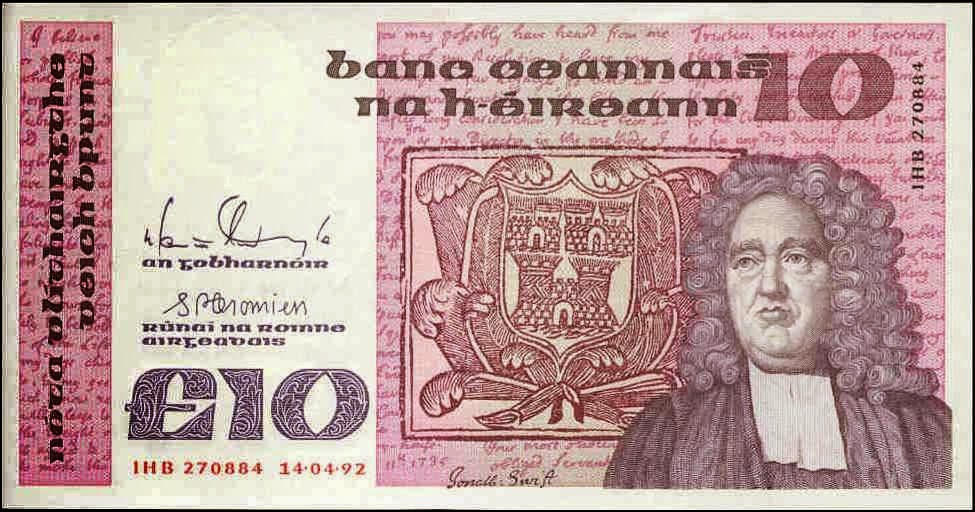
Dean Jonathan Swift as featured on the Irish £10 Note
during the 1970's and 80's
The author of that most famous fantasy book Gulliver’s Travels was never a man noted for showing his emotional side, which goes some of the way to explain the fact that he never married. In his lifetime he was associated with three women, two of whom came close to presenting the possibility of prospective marriage while the third lady some commentators believe he might well have secretly married during long years of friendship and acquaintance though there is no tangible evidence that a marriage ever took place. This last possibility draws some credence from the fact that the Dean and the lady in question have for almost 3 centuries lain side by side under the aisle of St Patrick’s Cathedral in Dublin, the place where Swift served as Dean for over 20 years.

The first lady in Swift's life - an ill-advised liaison with ‘Varina’ 

The first lady that Swift was engaged to marry was the sister of a friend called Waring from Belfast whom he met while he was a rector in his first clerical posting to the parish of Kilroot near Carrickfergus in Antrim. Before the marriage with Miss Waring (Swift had given her the pet-name ‘Varina’) took place, either he, she or both of them together thought better of the idea and the marriage did not happen. It seemed to have been a parting that was conducted and concluded with mutual consent. Neither of them thought their marriage was a good idea?

The second lady - ‘Vanessa’ 


The second romantic entanglement of the Dean was not to be so simple or easy. It was with a lady called Hesther vanHomrigh, to whom he gave the pet-name ‘Vanessa’. He met Miss vanHomrigh while he was attending college in England. Hester was the 20 year old daughter of a Dutch merchant who had died some time before. The vanHomrighs had a house close to Swift’s lodgings and had made a lot of money from a series of land and property forfeitures in the aftermath of the success of King William’s war in Ireland in the early 1690’s.

Hesther was obviously much struck with the up and coming clergyman and pamphleteer to the extent that she followed him back to Ireland, where she bought a house called Marlay Abbey in the town of Celbridge about 15 miles from Dublin to be close to the man she considered the man of her dreams. She had by that time openly declared her affections for the Dean and her willingness to marry him – if he cared to ask her.

While Swift was a regular visitor to Marlay Abbey, there are no letters or other signs that he held reciprocal feelings for the lady. He was not to be drawn. There is evidence that suggest he tried to establish relationships for her with two “suitable” young men of his acquaintance to put an end to what was clearly a one way love affair.

Vanessa showed her determination to win the Dean’s affections by making enquiries about and actually wrote to a longer term female friend of the Dean’s, someone she obviously viewed as her rival for his attentions. This lady was Esther Johnson, a long time friend who had earlier followed the Dean from England and had bought a house in his parish of Laracor, near Trim in Co Meath.

Vanessa would have been well aware that the Dean was a frequent visitor to Laracor. Her letter to the lady in question, when it was brought to his attention; had the effect of annoying Swift, causing him to upbraid Vanessa severely, putting her in no doubt about the true status of their relationship from his perspective.

Poor Vanessa, who had been in poor health anyway, died several weeks after the altercation with Swift at the relatively young age of 36 years. She was buried in the nearby churchyard of Leixlip, Co Dublin. She was dutifully mourned by Swift, who felt a degree of guilt about his own possible role in her demise, though her own will and writings portray no hint of any blame being laid on his shoulders.

“She had loved not wisely but too well”.

The third lady - Esther Johnson (‘Stella’) - a lifelong friend if not lover

Possibly the main focus of any romantic interest which the Dean displayed during his entire lifetime was for the aforementioned Esther Johnson, who was a full ten years older than Miss vanHombrigh. He had first encountered Esther Johnson as a nine year old, along with her younger sister Anne while he was attending college in England in 1690. The girls’ mother was friend and companion of Lady Gifford, who was the sister of Swift’s patron, Sir William Temple of Moor Park, an influential member of the English Parliament and confidant of King William III. Swift became the volunteer teacher of the young girls and developed a friendship with Esther (to whom he gave the pet-name “Stella”) which continued for the rest of their lives. In later years he related how he had “guided her little hand in writing and how his spirit had given hers its first impress”.

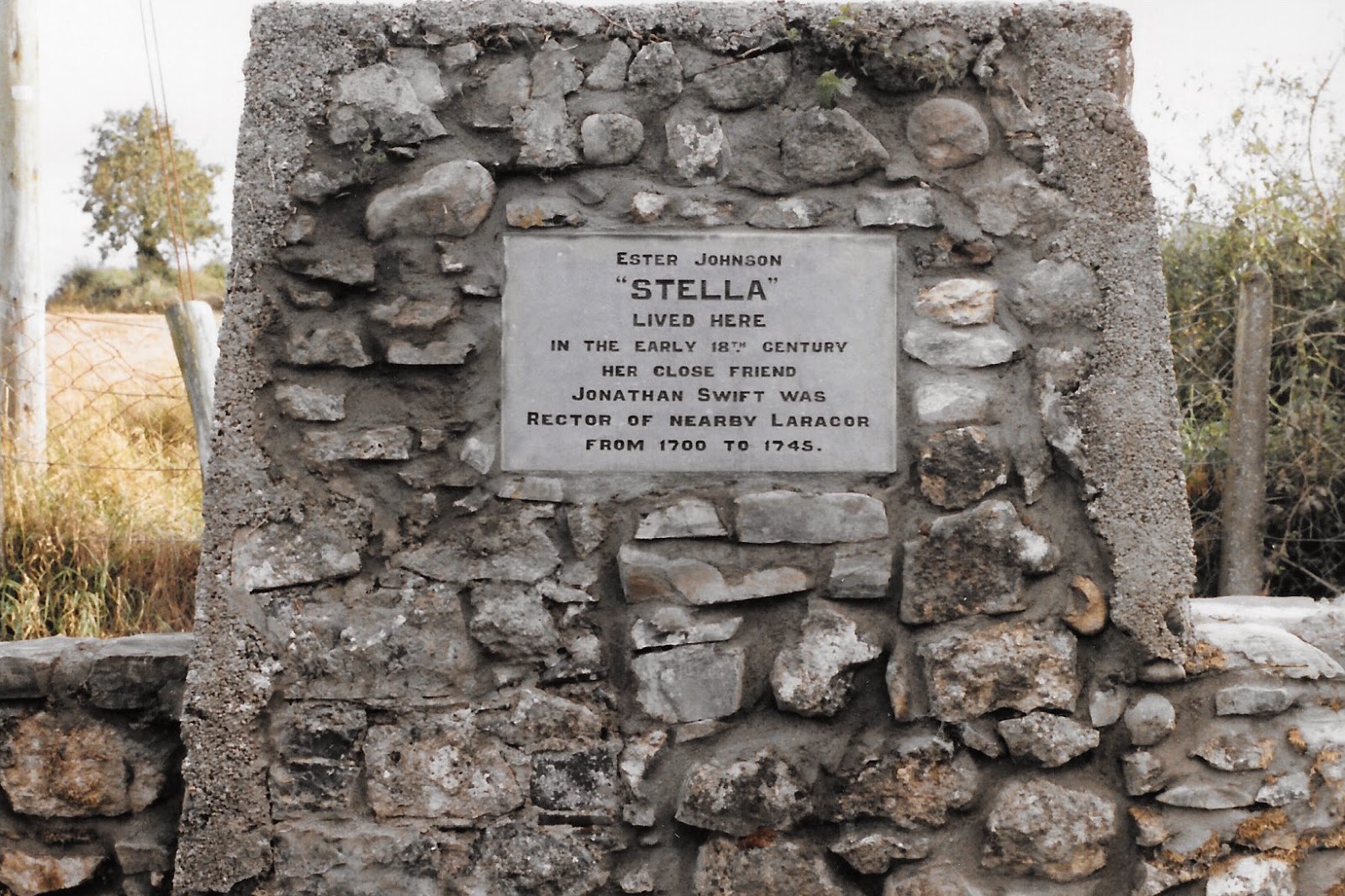
Soon after Swift was appointed Vicar of the small parish of Laracor near Trim in Co Meath, Ireland in 1700, he persuaded Esther to come to live there with her constant companion, Rebecca Dingley, a lady some years older than herself. Their house, which became known as ‘Stella’s Cottage”, was regularly visited by Swift while he was Vicar of Laracor and subsequently after he was appointed Dean of St Patrick’s Cathedral in Dublin. Stella and Rebecca were also frequent visitors to Swift after he was appointed Dean of St Patrick’s in Dublin and were active in the city’s social circles for the early decades of the 18th century, years that coincided with the most productive years of the Dean’s literary life.

The remains of Stella's cottage at Laracor, Trim
A clergyman of some style: 

There is an amusing anecdote from Swift’s first months of his clerical appointment in Laracor, a small congregation of no more than 15. He notified his audience during one of his first Sunday services that that he would hold prayer services every Wednesday and Friday evening in the small church.

On the first evening, his clerk Roger Cox duly rang the church bell to summon them to prayer. Swift and his clerk vainly waited patiently for at least some of the congregation to respond to the summons. After a quarter of an hour, the conscientious clergyman obviously concluded none were going to come; so he got to his feet, walked composedly to his pulpit and very gravely began the service with the words “Dearly beloved Roger ------------“. Roger was the solitary audience for that evening's service.

A constant friendship

The Dean’s friendship with Stella had by then become a constant in both their lives. Theories abound that they were secretly married, but there is no documentary evidence of any such ceremony, religious or civil. Neither is there any anecdotal evidence of marriage from close acquaintances of either party. Rebecca Dingley, who was well positioned to be aware of anything relating to her friend and companion, was most dismissive of all rumours of marriage or even anything approaching intimacy between the pair. For his part, and no doubt with an eye to potential scandal, Swift always took pains to ensure he was never in company with Stella except when they were in the presence of a third party.

Stella's untimely death


It was while he was in London promoting his recently published masterpiece, Gulliver’s Travels in 1727, that he received urgent news of Stella’s sickness back in Laracor. He rushed back to Ireland to be at her side. She lingered for a year and died on January 28th, 1728.

At her request, her body was laid to rest under the floor of the aisle of St Patrick’ Cathedral in Dublin. Swift was inconsolable. Few nobler tributes have ever been paid to the memory of a deceased friend than the one written by him in the aftermath of Stella’s death:
‘The truest, most virtuous, and valuable friend that I, or perhaps any other person, was ever blessed with. I knew her from six years old, and had some share in her education, by directing what books she should read, and perpetually instructing her in the principles of honour and virtue, from which she never swerved in any one action or moment of her life... Never was any of her sex born with better gifts of the mind, or who more improved them by reading and conversations... Her advice was always the best, and with the greatest freedom, mixed with the greatest decency. She had a gracefulness somewhat more than human, in every motion, word, and action. Never was so happy a conjunction of civility, freedom, easiness, and sincerity... With all the softness of temper that became a lady, she had the personal courage of a hero." 

Swift and his lifelong friend Stella lie side by side under the
aisle of St Patrick's Cathedral in Dublin
Swift was executor of Stella’s will but never really recovered from losing her companionship. He had been subject to episodes of giddiness, and these increased as he grew older. By 1740 he was forced to retire to an institution for the mentally unstable where he died in 1745. His funeral was one of the largest seen in Dublin at that time, bearing testimony to the affection in which the Deanwas held by Catholic as well as the Protestant people of Dublin. He was one of the first, and would not be the last Protestant (and a clergyman at that) who wrote in defence of the down-trodden Catholic population of Ireland who at that time were suffering under the worst impositions of the so called “Penal laws” that had been passed and implemented by the Protestant dominated Irish Parliament in the aftermath of the Williamite wars of the 1690’s. He was buried beside his good friend, Esther Johnson (‘Stella’) under the aisle of St Patrick's Cathedral in Dublin where he had served for so long as Dean.

 Dear friends in life; now forever united in death.

~~~~~~~~~~~~~

Arthur Russell is author of  an historic novel Morgallion set in early 13th century Ireland during the invasion of Ireland by King Robert Bruce's younger brother, Edward, who is determined to establish the Bruce dynasty as High Kings of Ireland, thereby creating a "Celtic Empire of the West".

For more information - website www.morgallion.com

Amazon

Sunday, May 17, 2015

Everyday Medieval Possessions

By E.M. Powell

For me, one of the most interesting parts of historical research for my novels is getting up close and personal with history. I've mentioned this in previous posts, along with my fondness for looking at the lives of ordinary people. A recent research trip saw me heading off to Ireland and one of the stops was the port city of Waterford.

Waterford's Medieval Reginald's Tower.

Waterford has a long history, having been first settled by the Vikings. The Anglo-Normans took the city in 1170, with Henry II of England arriving in 1171 and making it a Royal City. Waterford has taken the preservation of its heritage extremely seriously and its medieval past has an entire museum dedicated to it.

Medieval Museum, Waterford

This is in addition to Reginald's Tower, which also has a number of wonderful everyday medieval possessions on display. I found it extraordinary that so many of these objects are almost 900 years old. There was also something very special looking at these objects in the same place in which they had been found. I'd like to share my favourites with you.

Looking Good

To look your medieval best, you of course needed a comb. These are made from antler horn, with the single-sided ones being more typical of medieval combs.

Combs carved from horn.

Archaeologists also found offcuts of antler horn, which tells us that the combs were made in Waterford. And where did you keep your comb? Why, in your medieval comb case of course!

Comb Case

Made of leather, it is beautifully decorated with a pattern of leaves and dates from around 1250.

Another way to make sure you looked smart as well as keeping your cloak secure, was to use pins.

Stick Pin Selection

These stick pins were used to tie a cloak and are made of copper alloy. Each design is different, because they were hand made. 250 pins have been found at Waterford. This represents almost a quarter of all Viking-Age and medieval stick pins excavated in Western Europe, an extraordinary number.

Feet old and young had to be protected from the city's wet clay among other things. This adult's shoe dates from around 1150.

Adult Medieval Shoe

And this calfskin shoe would have been worn by a child. Wooden planks and wicker panels covered the ground to give the wearers some protection from the wet clay that the city is built on. It is due to this same soil that objects have been so well preserved.

Child's Shoe

House Beautiful

I found this set of kitchen implements absolutely remarkable. They could have been picked out of a twenty-first century kitchen drawer, and yet are around 870 years old.

Curfew Bowl & Kitchen Tools

The less familiar object to the left is part of a curfew bowl. A curfew bowl was placed over the hearth at night, which kept embers hot so the fire didn't need to be started from scratch again in the morning. They also helped to prevent house fires.

Houses had be lit as well as kept warm and a variety of candle holders were used. Some were attached to the wall, or inserted into wooden posts or masonry joints. Others were for table top use.

Rush Light Holder & Candle Sticks

Alcoholic drinks were widely consumed in the medieval period due to unsafe drinking water. Waterford was the chief port for importing wine into medieval Ireland. This jug and cup date from around 1320 and are probably French in origin.

Wine Jug & Cup

And, as today, people were mindful of their home's security. These keys are from the mid-twelfth century and would have been used for doors or storage chests.

Keys & Latch Lifter

The object in the middle is an iron latch lifter. This would be used to open a door that was merely latched shut (as opposed to locked) and was probably more for convenience than security.

Make Do and Mend (Or Just Make)

Spinning was of course women's work and they need the tools to do it.

Spinning Tools & Shears

On the left is part of a wooden distaff, which was used to hold the unspun wool fibres and stop them from tangling. Next to it are the wooden spindles and whorls made of bone and stone, which were used for drop spinning.

At the top is a pair of iron shears, which date from around 1190. These were all-purpose and used for spinning tasks, cloth and hair cutting and the odd spot of sheep-shearing where necessary. There are some beautiful carvings on the distaff, which dates from around 1260.

Carved Distaff

What was spun had to then be woven, and it was over to the men who were the weavers. This selection of their tools still looks so new, though they all date from the twelfth and thirteenth century.

Weaving Tools

We have the weaver's comb, made of wood and a range of pin beaters, needles, needle cases and loom weights which are all made of bone.

All Work and No Play

The medievals loved a bit of R&R the same as the rest of us. Here's a selection of wonderful gaming pieces.

Board & Gaming Pieces

The gaming board dates from c1150 and was used for playing hnefatafl, a common board game in the Viking era. The gaming pieces could be pegged into the board, which meant it could be played anywhere, including on board a moving ship. My favourite piece is the knight on the right hand side. He was excavated beside the hearth of a Hiberno-Norse house and is slightly charred. I hope no-one mistook him for firewood- he's far too lovely.

Flute & Whistle

And of course there was music: this is Ireland, after all. The beautiful flute is from the mid twelfth century and has been carved from the bone of a swan or a goose. The little whistle is even earlier- 1100- and again carved from a bird bone.

And finally

While these objects might have been treasured by their owners, none of them are the crowns of kings or the jewels or silks of nobility. Most are ordinary objects worn or used by everyday men, women and children. Yet it's the passage of almost nine hundred years that makes them truly extraordinary.
I shall finish with a cheat object, which would have been owned by someone very wealthy but to which I was particularly drawn.


It's made of copper alloy and at first glance, I assumed it was a necklace or a headpiece. But no. It would have been backed with the best leather and worn around the neck of a greyhound or a wolfhound. Yes; it's a medieval dog collar. As the possessor of a slightly less noble furry friend, how could I resist?

Noble? No.

References:
All photos are copyright E.M. Powell 2015.
Note: the websites listed here only give a flavour of what's on offer. I highly recommend visits if you get the opportunity.
Heritage Ireland- Reginald's Tower: http://www.heritageireland.ie/en/South-East/ReginaldsTower/
Medieval Museum, Waterford: http://www.waterfordtreasures.com/medieval-museum
OPW- The Office of Public Works/Oifig na nOibreacha Poiblí: http://www.opw.ie/en/heritage/
Pollock, Dave, Medieval Waterford- Above & Below Ground: Waterford, Archaeografix (2014)
Scott, A.B. & Martin, F.X. eds., The Conquest of Ireland by Giraldus Cambrensis: Dublin, Royal Irish Academy (1978)

~~~~~~~~~~~~~~~

E.M. Powell’s medieval thrillers The Fifth Knight and The Blood of the Fifth Knight have been #1 Amazon bestsellers. Born and raised in the Republic of Ireland into the family of Michael Collins (the legendary revolutionary and founder of the Irish Free State), she lives in northwest England with her husband, daughter and a Facebook-friendly dog. She blogs for EHFA, reviews for the Historical Novel Society and contributes to The Big Thrill. She is working on the next novel in the series, Lord of Ireland, based on the Lord John's disastrous 1185 campaign in Ireland. Find out more at www.empowell.com.
Amazon (Universal)
Barnes & Noble
Walmart

Friday, May 15, 2015

What Are the Ozarks?

by Steve Wiegenstein, Finalist for the M.M. Bennetts Award for Historical Fiction
Winner to be announced at the Historical Novel Society Luncheon on June 27, 2015 and HERE.

My novel series is set in the Ozark Mountains, an area of the United States that is not well known, even to most Americans. Those who have heard of the Ozarks probably only know it from a couple of sources: the simple, comically rustic family on the television show “The Beverly Hillbillies” or the clannish methamphetamine dealers of the novel and movie “Winter’s Bone.” Both narratives, oddly enough, have (fictional) roots in the same location, Taney County, Missouri.

The Ozarks are a rugged region of hills (the “mountains” descriptor is essentially honorific) in the central part of the United States, mainly in the states of Missouri and Arkansas. Because the hills obstructed travel, the region was lightly settled during the westward expansion period and developed a reputation for backwardness and poverty. The literary Ozarks begin with The Shepherd of the Hills (1907), the first American novel to sell a million copies. The Shepherd of the Hills took the hillbilly stereotype and added a layer of Christian uplift over the top of it, along with enough melodrama to fuel a contemporary TV mini-series for two or three seasons.

Although the people of the Ozarks are poor, the region itself has long been attractive to outsiders. The earliest European settlers, French, came for lead and iron. In the late Nineteenth Century, the nation’s craving for building materials led to indiscriminate timber cutting that changed the landscape permanently. In the mid-Twentieth Century, the region’s steep and narrow valleys drew power companies and government dam builders, who envisioned a network of hydroelectric power dams feeding the electrical needs of the rest of the Midwest (only a few of which have actually proven efficient). The 1960s saw a renewal of the lead and iron boom. And for the last several decades, the commodity in demand has been natural beauty, as retirees and tourists flock to the rivers and lakes of the Ozarks in search of a rustic ideal.

Ozark Lumber Company

Rural hill people everywhere are experienced in dealing with exploitative outsiders, and Ozarkers are no different. The classic legend/fiddle tune “The Arkansas Traveler,” in which a country bumpkin baffles a traveling city slicker with his incomprehensible logic, exemplifies this interaction as well as anything I know. The old fiddler is either a fool or a genius, and the city slicker can’t tell which. The great Ozark folklorist Vance Randolph, quoting one of his informants, titled one of his books We Always Lie to Strangers, an approach that lives on today. That phrase, fittingly enough, was reused by the creators of the 2013 documentary film about Branson, Missouri, the current high temple of all things Ozarks, both faux and authentic.

The history of the Ozarks is rich in contradictions: the idyllic landscape that has existed in grinding poverty since its first colonial settlements, the beautiful isolation that draws political extremists and criminals looking for a place to hide, the residents who resent the stereotypes placed on them but who are willing to employ them when useful. I set my novels in the Ozarks partly because I’m a native of the region and I feel a kinship to it unlike any other; but I also write about the Ozarks because as a novelist who is interested in issues of the environment, social class, the land, and the romantic ideal of Nature, it’s a near-perfect setting to engage with those issues.

An Ozarks Trail

~~~~~~~~~~~~~

Steve Wiegenstein is the author of Slant of Light and This Old World, the first two novels in an anticipated multi-book series. Slant of Light, published in 2012, was the runner-up for the David H. Langum Prize in American Historical Fiction, and This Old World, published in September 2014, is currently a finalist for the M.M. Bennetts Award for Historical Fiction. Both books were published by Blank Slate Press, a literary small press in St. Louis, Missouri.

See more about Steve and his work on the M.M. Bennetts Award for Historical Fiction website.


The Man who Made William Marshal

by Helena P. Schrader

Everyone familiar with the story of William Marshal knows that he was born the fourth son of John Marshal — and that at a very early age learned about his dispensability.  When he was no more than five or six, his father not only gave him up as a hostage, he then broke his word, and added insult to injury by explicitly inviting his enemies to hang young William because he had the “hammer and anvil” to forge “betters sons.” So much for paternal love. Clearly, William Marshal was not born to destiny.

Nor were his first attempts at gaining fame and fortune auspicious. He famously fought so valiantly in his first engagement that his horse was fatally wounded but he failed to capture any hostages or booty.  He was forced to continue his search for fame and fortune on foot with his arms tied to the back of an ass — it doesn’t get much more humiliating than that in the 12th century world of chivalry. Of course, Marshal soon won fame and booty at other tournaments, but the life of a “free lance” was not only risky it was looked down upon. In the 12th century, every knight who was not himself a land-holder or heir to lands (no matter how humble) aspired to belong to a household, i.e. to be retained and so have an assured income and a hearth at which to eat and rest.

Knight errantry was glamorized
in 19th Century romances,
but the reality was quite different.

William Marshal, after a short period proving himself on the tourney fields of France, returned to England and applied for service with his maternal uncle, Patrick Earl of Salisbury. He was welcomed into the Earl’s ménage, and it should have been a comfortable and safe berth.  If it had been, we might never have heard of William Marshal, the faithful retainer of the Earls of Salisbury. But a quirk incident was to earn him the attention — and gratitude — of royalty. 

It was in the spring of 1168. The Earl of Salisbury was escorting Queen Eleanor of England to Poitiers with a small escort including William Marshal.  Suddenly the party was ambushed by “the Lusignans.” The Lusignans had recently been dispossessed of their lands for rebelling against Eleanor, Duchess of Aquitaine (and therefore her husband, Henry II). They hoped by capturing Eleanor to gain a bargaining chip for the restoration of their fortunes. The Earl of Salisbury turned over his own horse, which was stronger and faster, to Eleanor so she could escape, but while he was remounting he was fatally pierced from behind by a lance. William defended his dying uncle with all the desperation of innocence lost until he too was treacherously stabbed in the back of his thigh through the hedge he had backed up against. He was taken captive and denied even bandages for his wounds; only the kindness of a lady, who dared not openly help him but send him bandages in secret, saved his life. Being of no value (as his father had drummed home when he was six) and with his lord dead, William’s prospects were not good. Fortunately for him, however, Eleanor of Aquitaine did not forget that Salisbury and his nephew had prevented her capture. She ransomed William and so began his rise  — all the way to regent of England.

One of my favorite allegorical images of a lady
helping a knight in distress from the 15th century
Le Livre de cuer d'amour espris by Renee d'Anjou.

But who was the rogue who stabbed an unarmed Earl in the back?

According to the 13th century biography of William Marshal, commissioned by his eldest son and based on the accounts of many of Marshal’s contemporaries, this ambush was led by Guy de Lusignan and his brother Geoffrey. Some sources claim that Guy himself wielded the murderous lance.

And what became of Guy de Lusignan?  Allegedly, the murder of Salisbury made Guy persona non grata in the courts of the Plantagenets and induced him to seek his fortune in Outremer. Maybe, but there was a gap of some 12 years, so maybe not. At all events, he arrived in Jerusalem in late 1179 or early 1180 at the invitation of his elder brother Aimery.

Aimery was making a career in Jerusalem, according to some, by sleeping with the Queen Mother, Agnes de Courtenay. At the time Guy arrived in the Holy Land, Baldwin IV was King — and clearly dying of leprosy. Since it was also clear that Baldwin IV would not sire heirs of his body, his nephew Baldwin was his heir apparent.

Seducing heiresses could
be a very lucrative pastime.

This boy had been born to Baldwin IV’s elder sister Sibylla after the death of her first husband, William of Montferrat. Sibylla herself was thus a young (20 year old) widow. There were rumors, however, that she had pledged herself to the Baron of Ramla and Mirabel. The rumors were widespread enough for Salah-ad-Din to demand a king’s ransom (apparently in anticipation of Ramla becoming King of Jerusalem) when Ramla was taken captive on the Litani in 1179 — and for the Byzantine Emperor to pay that exorbitant ransom (that Ramla could not possibly pay from his own resources) in anticipation of the same event.

But suddenly at Easter of 1180, Sibylla married not Ramla (who was on his way back from Constantinople) but the virtually unknown and landless Guy de Lusignan.  The wedding was concluded in a hasty ceremony lacking preparation and pomp. According to the most reliable contemporary source, the Archbishop of Tyre (who was also Chancellor at the time and so an “insider,”) Baldwin rushed his sister into the marriage with the obscure, landless and discredited Guy because the Prince of Antioch, the Count of Tripoli and the Baron of Ramla were planning to depose him and place Ramla on the throne as Sibylla’s consort. Perhaps, but there is no other evidence of Tripoli’s disloyalty, and Ramla’s hopes of marrying Sibylla had been known for a long time — and all the way to Damascus and Constantinople. Why did that marriage suddenly seem threatening to Baldwin VI?

An illustration allegedly depicting
a royal wedding in Jerusalem.

Another contemporary source, Ernoul, suggests another reason for the hasty and unsuitable (for there is no way the third son of a Poitevin baron could be considered a suitable match for a Princess of Jerusalem) marriage: that Guy had seduced Sibylla. Aside from the fact that this had happened more than once in history, the greatest evidence for a love match is Sibylla’s steadfast — almost hysterical — attachment to Guy, as we shall see.  Meanwhile, however, the marriage alienated not only the jilted Baron of Ramla, but Tripoli as well. In short, it was not a very wise move and so hard to explain as a political decision.  Last but not least, even the Archbishop of Tyre admits the King soon regretted his decision. All factors that point to Ernoul’s explanation of a seduction, a scandal and an attempt to “put things right” by a King who was devoted to his sister.

Guy was named Count of Jaffa and Ascalon and appears to have been accepted by the Barons of Jerusalem as a fait accompli that could no longer be changed — until, in September 1183, Baldwin became so ill that he named his brother-in-law Regent.  As such, Guy took command of the Christian forces during Salah-ad-Din’s fourth invasion of the Kingdom. What happened next is obscure. Yet something did happen on this campaign because just two months later, when word reached Jerusalem that the vital castle of Kerak was besieged by Saladin, the barons of Jerusalem “unanimously” refused to follow Guy. King Baldwin had no choice but to take back the reins of government and command of his army himself.

The powerful border fortress of Kerak today

As a footnote, it was at about this time that William Marshal himself turned up in the Holy Land. Henry the Young King had died in agony, begging William to fulfill his crusading vow for him. William dutifully took Henry’s cloak with the cross on it and travelled to the Holy Land. One wonders if he started talking to members of the High Court about that incident with Guy de Lusignan so long ago? Certainly Marshal had not forgotten or forgiven.

After Kerak had been successfully relieved, Baldwin IV sought desperately to have his sister’s marriage to Guy annulled. This had nothing to do with personal grievances against Guy (although he had those too); it was necessary in order to find a long-term solution to the succession crisis. His heir, his nephew, was a sickly boy, and the kingdom needed a vigorous and militarily competent leader. Baldwin’s efforts to replace the discredited Guy were thwarted by Sibylla, who staunchly refused to consider a divorce — something she is hardly likely to have done if the marriage had been political in the first place.

Baldwin IV died in 1185 and was succeed by his nephew with Raymond de Tripoli as Regent.  The fact that Tripoli was made Regent — with the consent of the High Court — and the Count of Edessa was made the boy's guardian are both, again, indications of the intensity of the animosity and suspicion the bishops and barons of Jerusalem had for Guy de Lusignan by this time.

At the death of Baldwin V roughly one year later hostility to Guy had not substantially weakened. As was usual following the death of a king, the High Court was convened to elect the next monarch. Some modern historians have made much of the fact that Tripoli summoned the High Court to Nablus rather than convening it in Jerusalem itself. This is interpreted as a sign of disloyalty, but there is nothing inherently disloyal about meeting in another city of the kingdom. High Courts also met in Acre and Tyre at various times.  Nablus was part of the royal domain, comparatively close to Jerusalem, and the Templars under their new Master, Gerard de Ridefort (surely the worst Master the Templars ever hand) were said to have taken control of the gates and streets of Jerusalem. The Templars did not have a seat in the High Court, but they controlled 300 knights and the decision to hold the High Court in Nablus can just as easily been explained as the desire to avoid “undue” influence from the Knights Templar.

In any case, while the bulk of the High Court was meeting in Nablus, Sibylla persuaded the Patriarch to crown her Queen in the Church of the Holy Sepulcher.  In addition to the Patriarch (allegedly another former lover of her mother) and the Templars (whose Grand Master had a personal feud with Tripoli), Sibylla was supported by her uncle Joscelyn Count of Edessa and the colorful and controversial Reynald de Chatillon, Lord of Oultrejourdan by right of his wife.  We know of no other supporters by name, but we know that Reynald de Chatillon sought to increase Sibylla’s support by saying she would be Queen in her own right without mentioning Guy.  And even Bernard Hamilton, one of Guy’s modern apologists, admits that: "Benjamin Kedar has rightly drawn attention to sources independent of the Eracles[e.g. Ernoul] and derived from informants on the whole favorable to Guy de Lusignan, which relate that Sibyl's supporters in 1186 required her to divorce Guy before they would agree to recognize her as queen.” (The Leper King and His Heirs, Cambridge University Press, 2000 p. 218). 

According to these sources, Sibylla promised to divorce Guy and choose another man for her husband as her consort. Instead, once she was crowned, she chose Guy as her consort — and crowned him herself when the Patriarch refused.  Once again, Sibylla had chosen Guy over not only the wishes of her subjects but in violation of an oath/promise she had made to her supporters (not her enemies note, to her supporters). I repeat: this is not the behavior of a woman who had been forced in to a hasty and demeaning marriage by her brother out of political expediency; it is consistent with a woman who was passionately in love with the man who she had foisted upon her brother and her subjects against their wishes.

The coronation of Sibylla and Guy as
depicted in Ridley Scott's Film
"The Kingdom of Heaven"
With this dual coronation, Sibylla and Guy had usurped the throne of Jerusalem, but without the Consent of the High Court they were just that — usurpers.  The High Court (or rather those members of it meeting at Nablus) was so outraged that, despite the acute risk posed by Salah-ad-Din, they considered electing and crowning Sibylla’s half-sister Isabella. To risk civil war when the country was effectively surrounded by a powerful and united enemy is almost incomprehensible — and highlights just how great the opposition to Guy de Lusignan was. In retrospect, it seems like madness that men would even consider fighting their fellow Christians when the forces of Islam were so powerful, threatening and well-led.

Then again, with the benefit of hind-sight, maybe it would have been better to dispose of Guy de Lusignan before he could lead the country to utter ruin at Hattin?

In the event, Humphrey de Toron, Isabella’s young husband, didn’t have the backbone to confront Guy de Lusignan, and so the baronial opposition collapsed.  Ramla, however, preferred to quit the kingdom altogether rather than pay homage to Guy.  He turned over his lucrative lordships to his younger brother and went to seek his fortune in Antioch. Tripoli simply refused to recognize Guy as his King and made a separate peace with Salah-ad-Din.

And there was one other man who also refused to serve King Guy: William Marshal.  Based on the fact that William joined the Knights Templar on his deathbed, it is quite probable that he had been one of many “lay” knights that joined the Templars on a temporary basis while in Outremer.  It would have been a perfect means to do penance for the sins he had committed in Henry the Young King’s service and still be the fighting man he was. Yet with Gerard de Ridefort’s election to Grand Master and his decisive role in Guy’s coup d’etat, Marshal appears to have been repulsed by Ridefort’s policies to the point where he left the Templars and returned to the other end of the earth — despite the acute danger the Holy Land was in.

Two months latter, Guy de Lusignan proved that Ramla, Tripoli and the majority of the High Court had rightly assessed his character, capabilities and suitability to rule. Guy led the entire Christian army to an unnecessary but devastating defeat that led to the loss of the holiest city in Christendom, Jerusalem, and indeed the entire kingdom save the city of Tyre. Only a new crusade would restore a fragment of the Kingdom and enable Christendom to hang on to the coastline for another century.

The slaughter at Hattin from the
film "The Kingdom of Heaven"

And Guy? Guy was taken captive at Hattin, but cravenly ordered the strategically important city of Ascalon to surrender to Saladin to obtain his freedom. The garrison refused. Saladin then let Guy go free a year later on a promise that he not take up arms against the Muslims ever again, and Guy promptly broke his oath to lay siege to Acre. When Sibylla and his daughters by her died, he refused to accept that his claim to the throne was also dead and, with the backing of his father’s liege Richard the Lionheart, clung to the title of “King” of the kingdom he had lost.  After two years of trying to impose Guy on the remaining fighting men of Jerusalem, even Richard the Lionheart acknowledged it was pointless and dropped his support for Guy. But he offered a consolation prize: the Island of Cyprus that Richard had conquered but could not possibly control. In 1192, Guy went to Cyprus to try to subdue the Byzantine subjects already up in arms because of the injustices suffered during two years of Templar control of the island. He died there in 1194 to be succeeded by his more competent elder brother, Aimery.

~~~~~~~~~~~~~

Helena P. Schrader is the author of numerous works of history and historical fiction.  She holds a PhD in History from the University of Hamburg.  The first book of a three-part biographical novel of Balian d’Ibelin, who defended Jerusalem against Saladin in 1187 and was later one of Richard I’s envoys to Saladin, is now available for sale.  Read more at: http://defenderofjerusalem.com
http://helenapschrader.com or follow Helena’s blogs: Schrader’s Historical Fiction and Defending the Crusader Kingdoms.

Amazon

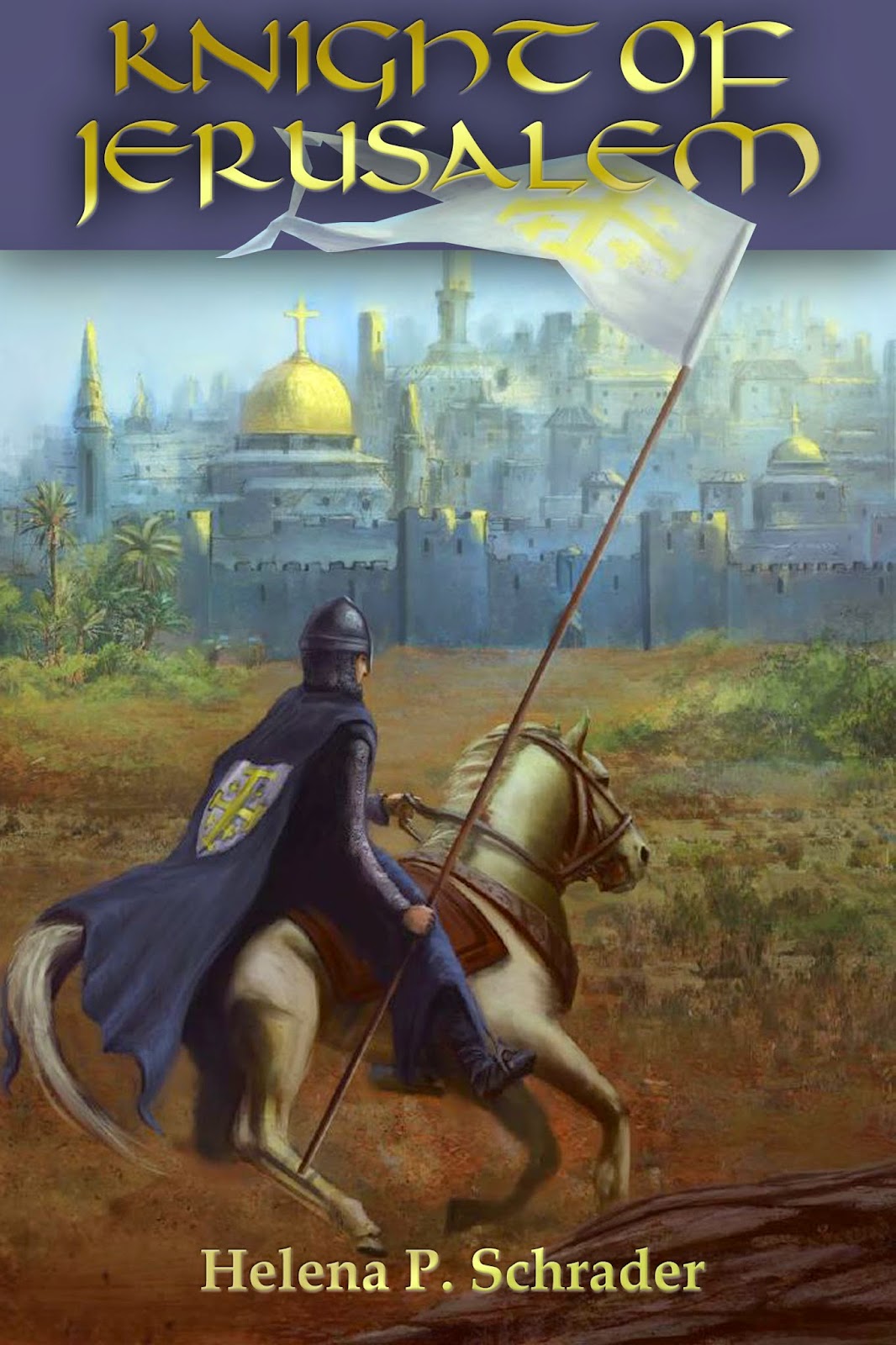
Knight of Jerusalem
A Biographical Novel of Balian d’Ibelin
Book I


A landless knight,
                A leper King
                                And the struggle for Jerusalem.


 Buy now in Paperback or Kindle format!