Thursday, July 25, 2013

Aethelflaed, Lady of the Mercians

by Lisa Yarde


During the late ninth century in England, the Anglo-Saxon King Alfred of Wessex and his wife Ealhswith, a descendant of the royal family of Mercia, welcomed their first child. Their newborn daughter Aethelflaed entered a dangerous world, made so by frequent incursions from the Danes who had harried the English coasts and countryside for decades. Aethelflaed would have two brothers and two sisters, with whom she shared pivotal roles or eclipsed entirely.

During the children’s early years, their father Alfred brokered a treaty with the Dane, Guthrum. This chieftain had carved out a portion of northwestern England called the Danelaw, which included a ravaged portion of Mercia. The ensuing period of peace allowed for a marriage between Aethelflaed and the warrior Athelred, alternatively called an ealdorman or Lord of the Mercians.

Alfred supported his regime and gave him control of London and part of the Oxford area. The bride might have been in her late teens when the marriage took place, but Athelred’s age remains uncertain. They would have one child, a daughter named Aelfwynn. During the marriage, the couple issued joint charters. They also transferred the relics of Saint Oswald of Northumbria to the Gloucester priory they founded in his name.

In 899, Aethelflaed lost her father, whose son Edward eventually succeeded after fending off a rival claim for the throne from Alfred’s cousin. Aethelflaed and her husband continued to govern Mercia, though all of the country’s coinage bore King Edward’s name.

After the year 900, Athelred’s health steadily declined. His wife’s responsibilities increased until she became the de facto ruler. It is possible her power exceeded that of most women of her time as she fortified the defenses against Mercia’s Welsh and Danish enemies.

On the west, Mercia abutted northern Wales and Athelred had endured several conflicts with its people, which continued under Aethelflaed’s reign. In 905 when the Danes attacked Chester, she safeguarded the town. Aethelflaed also established new defenses at the boroughs of Bridgnorth and Bromsgrove.

For four years after Athelred’s death and his burial at Saint Oswald’s priory in 911, Aethelflaed also allegedly began strengthening several areas around Tamworth, Stafford, Warwick, Runcorn, and Eddisbury; there is some dispute as to whether Edward ordered the work instead. He reclaimed the London and Oxford lands his father had granted Athelred, rather than allowing the widowed Aethelflaed to rule them.

It remains certain that she also struck out against Mercia’s foes. In 916, she led an incursion into Wales to avenge the death of a Mercian abbot. She allied with her brother Edward for a fight against Northumberland’s Danes in 917. She gained Derby and Leicester in the struggle. Aethelflaed also pledged to intervene in the fight against Norse raiders determined to take York, but she died at Tamworth before this could occur. Interred at Saint Oswald’s priory after death, her tireless efforts against the Danes and Welsh gained her the title, Lady of the Mercians.

~~~~~~~~~~~~~


Lisa J. Yarde writes fiction inspired by the Middle Ages in Europe. She is the author of two historical novels set in medieval England and Normandy, The Burning Candle, based on the life of Isabel de Vermandois, and On Falcon's Wings, chronicling the star-crossed romance between Norman and Saxon lovers. Lisa has also written three novels in a six-part series set in Moorish Spain, Sultana,  Sultana’s Legacy and Sultana: Two Sisters, where rivalries and ambitions threaten the fragile bonds between members of a powerful family. Her short story, The Legend Rises, which chronicles Gwenllian of Gwynedd’s valiant fight against English invaders, is included in Pagan Writers Press’ 2013 HerStory anthology.

Born in Barbados, Lisa currently lives in New York City. She is also an avid blogger and moderates at Unusual Historicals. She is also a contributor at Historical Novel Reviews and History and Women. Her personal blog is The Brooklyn Scribbler.

Learn more about Lisa and her writing at the website www.lisajyarde.com. Follow her on Twitter or become a Facebook fan. For information on upcoming releases and freebies from Lisa, join her mailing list at http://eepurl.com/un8on.

Want more information about Lisa? Check out Media Resources.  


Wednesday, July 24, 2013

Tetta: Spiritual Mother of Saints

by Kim Rendfeld


1904 illustration
of a Benedictine nun
from English Monastic Life
by F.A. Gasquet.
Mother Tetta was important in her day. So important that when Saint Boniface needed nuns to assist him in his mission to strengthen the Church in today’s Germany, he wrote to her, not to a bishop. Yet little is remembered about her.

I came across Tetta while writing about Saint Lioba last month. As I researched this post, I found little information about the woman described as Lioba’s “mistress and spiritual mother.” Not even an artistic painting or statue, even though she was also a mentor to Saints Walburga and Thecla of Kitzingen.

Her biographical information is sketchy, even when she was born and died (the latter around 760). The sister of a king of Wessex, she was an abbess of the double monastery at Wimborne. Her baptismal name might have been Cuniberg.

She appears in one or two letters. A priest writing to monks in Glastonbury between 732-54 asks them to tell Mother Tetta and her nuns of his party’s safe arrival in Germany. A letter to Cuniberg from three assistants to Boniface asks her for prayers, a significant request in an age that believed in divine intervention.

Photo by Andreas Praefcke, Lioba (right)
with Saints Walburga and Michael
The importance she placed on education is seen in two of her disciples. Lioba paused from her reading only to pray, eat, or sleep. Walburga wrote her brother’s hagiography and recounted his travels to the Holy Land.

The most tantalizing clues about Tetta are in Lioba’s hagiography, written around 836. Both stories about Tetta involve the supernatural, but I have a feeling there might be some truth about her character in them. As before, I will leave it to readers to decide their accuracy.

One tale involves a set of lost keys to the chapel. The nun responsible for keeping the keys believed she was negligent and, after desperate, fruitless search, threw herself at Tetta’s feet and confessed. Tetta suspected a more sinister cause. Rather than punish the nun, Tetta led her sisters in prayer in another building. Sure enough, a dead fox (a symbol of the devil) appeared at the door with the keys in its mouth.

The other story involves a nun elevated to prioress because of her zeal for discipline and strict observance. Apparently, she was too zealous and too strict. The young nuns hated her so much that when the prioress died, they heaped curses at the grave and stomped on it. The grave sunk six inches, an indication the prioress was being punished in the afterlife. Tetta was horrified.

What she told the nuns will ring true for Christians today. Rudolf, Lioba’s hagiographer, writes, “She counselled them to lay aside their resentment, to accept the ill­ treatment they had received and to show without delay their forgiveness: if they wished their own sins to be forgiven by God they should forgive others from the bottom of their hearts.”

After three days of fasting and prayers, including Tetta prostrating herself before the altar, the grave was restored, a sign that the prioress had been absolved.

If we are to believe Saint Lioba’s hagiography, Tetta was a gentle soul who believed in education and mercy. It’s a shame we know so little about her. She deserves better.

All images via Wikimedia Commons in public domain or have permission granted under the terms of GNU Free Documentation License.

Sources

The Catholic Encyclopedia (1912) articles on Saint Walburga, Saint Thecla of Kitzingen, and Wimborne Minister
Medieval Women Monastics: Wisdom's Wellsprings edited by Miriam Schmitt, Linda Kulzer, pp. 101-103
Medieval Sourcebook: Rudolph of Fulda: Life of Leoba (Note: Leoba is an alternate spelling of Lioba)

~~~~~~~~~~~~

Kim Rendfeld is the author of two books set in Carolingian Francia: The Cross and the Dragon  and the forthcoming The Ashes of Heaven’s Pillar. Fireship Press is the publisher for both. For more about Kim and her fiction, visit kimrendfeld.com or her blog, Outtakes. You can also connect with her on Facebook and Twitter.

Tuesday, July 23, 2013

Uncovering Lady Godiva

by Octavia Randolph


The first of a two part article.  This month we look at the “real” Lady Godiva.

NO other early Englishwoman has been remembered as long, or as provocatively, as Lady Godiva. The name instantly conjures an image of a woman on horseback, clad only in her hair. Whether depicted in a 15th century print or gracing a modern chocolate box, Godiva lives – and rides – on in our imaginations.


Lady Godiva (1867) by P Pargetter for Minton Pottery.
 
Godiva is the latinised form of the Old English name Godgyfu or Godgifu (literally, "God's gift" or "good gift"). Godgyfu was an 11th century Anglo-Saxon aristocrat whose life spanned one of the most tumultuous periods in early English history. Despite her illustrious husband, renowned piety, and religious benefactions, without the tantalising legend of her ride through the Midlands town of Coventry she would likely be completely forgotten.

What is known of Godgyfu is found in the chronicles of various religious foundations, mentions of her or her husband in charters, and the post-Conquest compilation known as the Domesday Book. The first positive record of her is in 1035, when she was already married to Leofric, Earl of Mercia. Her birth date is unknown. Similarly, the date of her ride through Coventry cannot be known, possibly it was linked to the dedication of the Priory she and Leofric built there in 1043.

Here I must also acknowledge that despite records dating to the late 12th century concerning her ride, there are some modern scholars who doubt that it ever took place. I am persuaded that it did.

To return to fact: Like other Anglo-Saxon women of her class, Godgyfu owned property in her own right, both given to her by her parents and acquired through other means - gifts from her husband, inheritance from relatives, and purchases and exchanges from individuals and religious foundations. The modest farming village of Coventry was one of them. The Domesday Book lists it, twenty years after her death, as having sixty-nine families.

It is not known why Godgyfu and Leofric turned their attention to Coventry, which after all, was a small and seemingly unremarkable farming community. As early as 1024 Bishop Æthelnoth (later to be Archbishop of Canterbury) gave to Leofric a priceless relic, the arm of St.Augustine of Hippo, which had been purchased by the bishop in Rome and which he apparently indicated was intended – we do not know why – for Coventry.

The response of Leofric and Godgyfu was to create a suitable sanctuary to house this exceptional relic. The lavishly decorated Benedictine Priory of St.Mary, St.Osburgh, and All Saints was dedicated by Archbishop of Canterbury Eadsige in 1043, on property owned by Godgyfu. Within was a shrine to St. Osburgh (a local holy woman who had earlier founded a nunnery in Coventry) which held her head encased in copper and gold. St.Augustine's arm took its place in a special shrine, and Godgyfu and Leofric also presented to the new Priory many ornaments of gold, silver and precious stones, so that it was famed for its richness. Leofric further endowed the Priory with estates in Warwickshire, Gloucestershire, Leicestershire, Northamptonshire, and Worcestershire.

Their religious endowments were many, restoring, enriching, or founding houses in Much Wenlock, Worcester, Evesham, Chester, Leominster, and Stow in Lincolnshire. This last, the Priory Church of St. Mary's Stow-in-Lindsey, is of particular interest as a significant portion of the beautiful and impressive extant church there issued from their hands. The earliest stonework in the church dates from 955; Godgyfu and Leofric greatly endowed and enriched it from 1053-55. The lofty crossing features four soaring rounded Saxon arches (which now enclose later pointed Norman arches built within the original Saxon arches). A 10th or 11th century graffito of an oared ship is scratched into the base of one of the Saxon arches, possibly a memento from a Danish raider who sailed up the nearby Trent.

The north transept houses a narrow, deep Saxon doorway of honey-coloured stone, which would originally have been lime-washed and over-painted with decorative designs. It likely led to a chapel in Godgyfu's day, and surely she passed through this very arch. To experience St. Mary's Stow, built just ten years after the dedication of the Coventry church, is to begin to imagine what the Priory Church of St. Mary, St Osburgh, and All Saints may have been like.


St. Mary's Stow-in-Lindsey, a 10th c church endowed by Godgyfu and Leofric in the mid-11th c. Note the three windows in the transept, shown below from the interior.


St. Mary's Stow-in-Lindsey.
Three windows, three ages.
The circular window is Saxon;
the very narrow round-headed
one beneath it is Norman; the larger
pointed one later Medieval.


St. Mary's Stow-in-Lindsey.
The crossing. The later, pointed Norman
arches were actually built within
the larger rounded Saxon ones.

St. Mary's Stow-in-Lindsey.
North transept. Narrow Saxon doorway
with your author inserted for scale.
St. Mary's Stow-in-Lindsey.
Ancient stone steps to tower.
Photos by Jonathan Gilman.


Leofric was a man of considerable talent and statesmanship; no man could survive forty years as Earl without these qualities. Elevated to Earl (a title and position new to the English, replacing and expanding the Anglo-Saxon ealdorman) in 1017 by the Dane Cnut, he survived and thrived through Cnut's reign. Then followed that of Harold Harefoot (1035-1040), in whose selection as successor to Cnut Leofric was instrumental. Hardacnut, Cnut's other son, reigned next (1040-1042), and then began Edward the Confessor's rule (1042-1066).

Unsurprisingly for his age, Leofric could alternate between great rapacity and great piety, his depredations and subsequent generous benefactions upon the town of Worcester being a case in point. In 1041, when Hardacnut was king, two of his tax collectors were murdered by an angry and over-taxed group of Worcester citizens.

 An act of this nature, upon the direct representatives of the king, was seen as almost an assault upon the king’s body itself. In reprisal Hardacnut ordered Leofric to lay waste to Worcester, which Leofric did with complete and horrifying efficiency, made perhaps even more reprehensible as Worcester was the cathedral city of his own people. Afterwards (and seemingly as personal reparation) Leofric bestowed many gifts of treasure and lands upon the religious foundation there, enough to ensure that his memory would be revered and not reviled.

He seems to have been successful in this. Near the end of his life Leofric experienced four religious visions which were carefully recorded by the monks at Worcester and published after his death in 1057. The Anglo-Saxon Chronicle entry for 1057 noted, "...In this same year, on 30 October, Earl Leofric passed away. He was very wise in all matters, both religious and secular, that benefited all this nation. He was buried at Coventry, and his son Ælfgar succeeded to his authority..." (G.N. Garmonsway translation).

Following his death, Godgyfu made additional gifts to the religious foundation at Worcester to aid in the repose of Leofric's soul and for the benefit of her own. These gifts included altar frontals, wall hangings, bench covers, candlesticks, and a Bible, and joined a long list of items and estates the two had granted to Worcester in the years prior to Leofric's death.

Leofric and Godgyfu had one known child, the above-mentioned Ælfgar, who died in 1062. His daughter Ealdgyth was wed briefly first to a Welsh king and following his death, to Harold Godwineson, killed by William of Normandy's men on the field at Hastings. Thus for nine months Godgyfu was grandmother to the queen of England.

Godgyfu died in 1067, the year following Hastings. At her death she was one of the four or five richest women in England with estates valued at £160 of silver. Her lands were then forfeit to new king William.

Godgyfu was buried next to her husband in the Priory church in Coventry they had created. According to chronicler William of Malmesbury, her dying act was characteristically pious: as a final gift to the Priory, she ordered hung about the neck of a statue of the Virgin Mary her personal rosary of precious stones. (The church was alas, destroyed like so many others during the Reformation, the treasures looted and dispersed.)

Now that we have taken a look at the historical record concerning Godiva, next month we’ll examine the literary legend of her famous ride.

~~~~~~~~~~~~

My short story about Lady Godiva, Ride, was published in Narrative Magazine, and has just been translated and published in Russia in The Translator. Ride is my attempt to re-frame her act in light of the realities of 11th century Anglo-Saxon law and social and religious custom. It is also my tribute to the efforts of women everywhere who seek peace over their own personal comfort.

Octavia Randolph is also author of The Circle of Ceridwen Trilogy, and Book One is available free all day July 24th and 25th. Please claim your copy! Click here for Amazon USA and click here for Amazon UK.

Monday, July 22, 2013

They seek him here, they seek him there - the life of a religious rebel

by Anna Belfrage


Recently – well, for the last three years or so – much of my time has been spent with a slight man with sparse hair, beautiful grey eyes and a voice that can reduce a congregation to tears – or have his followers on their feet, roaring like lions. Not that I have any idea if Alexander Peden matches the above description, but that is how I see this charismatic 17th century minister – a man who became a legend during his lifetime.

“Legend?” you might ask, scratching your head in an attempt to bring forth some sort of information about this Alexander person. Yes, legend – but not far beyond the borders of his native Ayrshire, which might explain why the majority of us have never heard of Prophet Peden. You may, however, have seen his mask, a little thing on display at the National Museum of Scotland. In this disguise, Alexander Peden flitted over the Scottish moors like some sort of religious Zorro, even if he never showed any inclination to mark his victims/foes with a flamboyant Z.

A Peden's mask (D. Monniaux)
Alexander Peden was a stubborn, brave man of God – a man of God as per the Scottish Kirk, not as per the Anglican Church, even if Peden couldn’t care less what the Anglican worthies might have thought of him.  Had not Charles II been restored, Alexander Peden would probably have lived out his life as a capable minister in his small living in New Luce, Galloway. As it was, with the restoration came a number of changes that would drive Alexander – or Sandy, as those of us close to him prefer to call him – into rebellion.

Some background: Charles II seems to have been a reasonable man in matters of faith – I suppose he learnt the hard way that religious contention could lead to nasty repercussions and death. I’d hazard he lived in constant awareness of the fact that his father – an anointed king – had been executed, and while Charles I’s faith was never cited as a reason for his execution, it must have struck his son that had only Charles I handled the religious conflicts that sparked the Civil War better, things might have ended very differently.

Whatever the case, Charles II was prepared to be conciliatory in most matters – but he held no great love for the powerful Scottish Kirk. Charles II’s closest advisors were Anglicans and after years of penurious exile they saw an opportunity to get their own back.

In 1662 a set of laws commonly known as the Clarendon Code were passed through Parliament. As per these laws, it became illegal to hold religious meetings outside the Anglican Church, it was mandatory to recognise the king as the head of the Church, and all able-bodied men were called to take the Oath of Abjuration, whereby they were required to disavow themselves from any previous oaths in conflict with the new laws. With this legislation in place the time was ripe to grind the Scottish Kirk into submission.

Someone seems to have forgotten about the Scots and their independent – and stubborn – streak. The Scottish Kirk was not an institution to be brushed aside as inconsequential and so the recently restored king had a new religious conflict on his hands – this time mercifully contained to parts of his northern kingdom, but still.

The ministers of the Scottish Kirk who refused to recognise the king as the head of their church were evicted from their livings in 1663. This more or less meant all ministers, Alexander Peden being one of them. Their congregations were urged to attend the Anglican services instead, but rather than flocking to hear the word of God from the king’s chosen representatives, the people of Ayrshire – and elsewhere – chose to follow their ministers out into the wilderness, breaking the law by attending unlawful Conventicle meetings, further breaking the law by having the evicted ministers christen their babies and bless their marriages.

Sandy Peden already had a reputation as a gifted preacher. In the present circumstances, his fame grew exponentially and wherever he preached, Sandy told his flock to never turn their back on the true Kirk, to never kowtow to the Anglican Church, papist whore that it was.

For doing this, and for further heinous acts such as baptising children (many children -- on one occasion he baptised close to thirty babies) and wedding young couples, Sandy was formally outlawed in 1667, with a hefty price set on his head. Over the coming years, an intricate manhunt played out over the Ayrshire moors and beyond. The English soldiers chased; Sandy ran, aided and abetted by his countrymen and women.

Scottish Moor by E Morison Wimpersey
I imagine Sandy Peden dashing off over the moor, his threadbare cloak standing like a billowing sail around him. In my head, the moor is an orgy of flowering heather, here and there dotted with stands of bright yellow gorse, the air permeated by its nutty scent. In reality, poor Sandy squelched through mud and freezing water, ducked down to hide behind a stand of stunted trees, his forearm pressed to his mouth to muffle his constant cough – a consequence of far too many nights sleeping under the bare skies.

For over a decade, Alexander Peden led the English soldiers in a merry dance over the rugged landscapes of his native Ayrshire. In his wake sprung stories of divine intervention, describing how God would help his favourite minister by creating timely fogs into which he could disappear (Given that this is Scotland, it would seem God was doing a lot of fogging well before Sandy and long after him as well).

And then there were all of Sandy’s prophesies, the most well-known of these being when he officiated at the wedding of John Brown to Isabel Weir in 1682. According to legend, Sandy took the bride aside after the ceremony and told her she should keep linen by her side to make her new husband a winding sheet, as John was to die shortly. I’m not quite sure this shows much sense for timing, but Sandy was sadly proved right; in 1685, James Brown was shot dead at his home by John Graham of Claverhouse (Bluidy Clavers as he was known in Ayrshire) this for refusing to take the Oath of Abjuration – and for having a number of illegal weapons in his house.

In 1673 Alexander Peden was arrested – betrayed, some say – and after several years on Bass Rock he was set aboard a ship in 1678 to be deported to the colonies. When the boatload of deportees landed in London, there to be transferred to another vessel, Sandy Peden succeeded in convincing the captain of this new ship that to deport him and his companions would not please God, and so they were left behind on the docks. Sandy and his Merry Ministers walked all the way back to Scotland, receiving a lot of help along the way.

The remaining years of his life, Sandy spent in Scotland and in Ireland, always running, always hiding. And he continued to baptise children and officiate at weddings (as demonstrated above when he wed John Brown and Isabel). In 1686 he was staying on his brother’s farm when he died – in bed, as he had prophesised.

Upon hearing Alexander Peden was dead, English troops chose to disinter him, having the intention of hanging the dead man from the Cumnock gallows. The local powers that were interceded, worried that this might cause an uproar among the people of Ayrshire. Instead, Sandy Peden was reburied by the gallows – in itself an insult.

Many years later, a monument was erected over Sandy’s final resting place. Personally, I think he wouldn’t be all that impressed; Sandy never wanted a monument – all he wanted was the freedom to praise God according to his beliefs.

~~~~~~~~~~~~

Alexander Peden plays a central role in my recently released third instalment of The Graham Saga, The Prodigal Son. Previous titles in the series are A Rip in the Veil and Like Chaff in the Wind. Set in the 17th century, the books tell the story of Matthew and Alex, two people who should never have met – not when she was born three hundred years after him.

Giveaway! The Prodigal Son by Anna Belfrage

This week’s giveaway is a copy of The Prodigal Son, the third in the Graham Saga by Anna Belfrage. Go HERE to learn more about the book. Contest ends midnight PST, July 28th.

To enter, please leave a comment on this post with your contact information so that we can get in touch with the winner. Happy posting and good luck!

Sunday, July 21, 2013

The Stuart Curse: The Tragic Lives of a 17th-Century Dynasty

by Andrea Zuvich


When Elizabeth I had her beautiful cousin, Mary, Queen of Scots beheaded at Fotheringhay Castle, Northamptonshire, in 1587, could anyone have guessed that beheading would prove so tragically common with her descendants? Who would have thought that sickliness, unhappiness and infertility would plague them? The Stuarts had so many instances of doom that it is no surprise that it sometimes seems that they were cursed!

Mary’s son with the profligate Lord Darnley, James, eventually became the last Tudor queen’s heir and began the English line of Stuart kings. But James had potentially dangerous beliefs – beliefs that would ultimately prove fatal for his son and eventual heir, Charles I. The belief they so strongly adhered to was that they had been chosen by God to rule and therefore no one could question their governance of the kingdoms. James and his wife, Anne of Denmark, had a few children, the eldest son and heir, Henry, was the best and the brightest of them all. Sadly, Henry was cut down before his time and he died, aged only 18, from what was probably typhoid.

And so the younger son, Charles, eventually succeeded to his father’s throne. Alas, he was a stubborn man – a common characteristic of the Stuarts – and under his rule the country was plunged into Civil War, which caused widespread devastation. The outcome of all the horrors of war resulted in a Commonwealth under Oliver Cromwell and Charles, just like his grandmother, Mary, was beheaded, but this outside the beautiful English Palladian style Banqueting House at Whitehall Palace. The nation’s pendulum then swung from what some perceived as the Stuart oppression to fresh tyranny under Cromwell. Years passed and the Lord Protector died, and Charles’s eldest son returned to England triumphantly as King Charles II and the Restoration of the monarchy was welcomed with joy.

Future troubles began to take root at this time. Charles’s brother, James, Duke of York eventually became openly Catholic and he and his first wife, Anne Hyde, welcomed two daughters into the world – Mary and Anne. These girls would become very important towards the latter part of the century. King Charles II married the Portuguese Catherine of Braganza, but they were unable to have children together, though Charles had over a dozen children with his many mistresses. One of his earliest mistresses was Lucy Walter, with whom he had a son, James Crofts (later Scott), who became the famous and rebellious Duke of Monmouth. Monmouth, a popular Protestant figure, was extremely handsome, athletic, and an excellent soldier and dancer, a favourite of the ladies, but very malleable.

When his father died in 1685, Monmouth became convinced that he should inherit the throne, not his Catholic uncle, James. What ensued was The Monmouth Rebellion, sometimes referred to as The Pitchfork Rebellion, in which common men rose up against James II’s well-equipped and well-trained armies only to be slaughtered upon the fields at Sedgemoor and later sentenced harshly in the Bloody Assizes. Monmouth himself was subjected to the bloodiest botched execution on Tower Hill on the 15th July, 1685. If you’re counting, this is the third Stuart family member beheading.

I was so fascinated by Monmouth’s story, that I wrote my first book about the last ten years of his life and his relationship with Henrietta Wentworth, His Last Mistress.

“Dismal Jimmy” James II eventually became so unpopular a king that seven of the most influential men of the time, now called the Immortal Seven, wrote an invitation to James’s daughter, Mary, and her Dutch husband, William of Orange, to come and take the throne in what is referred to as the Glorious Revolution of 1688/89.

This was a pivotal moment in English, and British, history because never before or since, has there been a joint monarchy, a diarchy. William and Mary were offered the throne but with new limitations and under them we have the Bill of Rights, the founding of the Bank of England, and major events such as the Battle of the Boyne, the Glencoe Massacre, and the founding of the American College of William and Mary. The new limitations meant that England now had a constitutional monarchy of sorts, a very different situation than what their mutual great-grandfather had experienced.

Though William and Mary seem to have loved each other deeply, they had the tragedy of childlessness. Shortly after these first cousins were wed, Mary got pregnant but ended up suffering a very bad miscarriage, which perhaps was not dealt with properly, leaving her unable to carry a child to term. She had at least one other miscarriage and her memoirs show that she longed for a child, for she loved William dearly and also, it was her duty. Life being what it is, they did not have children, and in late December, 1694, Mary, aged 32 died from hemorrhagic smallpox. Her husband and the nation were devastated. Mary had been much beloved, except by the Jacobites, those who supported her now-exiled father, King James II. William, who himself was chronically asthmatic and ill, never remarried and died in 1702, leaving the throne to the last of the Stuarts, Anne.

Anne was an unhealthy woman, especially after eighteen difficult pregnancies, which resulted in only one boy living until the age of eleven. All the others perished even younger and so for the third time in Stuart history, having viable offspring proved impossible. Laden down by obesity and gout and perhaps a bit of an over-fondness for the brandy bottle, Anne died in 1714.

Almost all of the Stuarts had incredibly tragic lives, the most painful of deaths, the greatest of emotional sufferings despite their more wealthy and comfortable circumstances and the power they had. It’s hard to believe that any family could have such misery, but perhaps this element of misfortune (which is perhaps the case with several historical families) is why there is an increasing surge of interest in this lesser-known 17th-century dynasty.

~~~~~~~~~~~~~

His Last Mistress
Amazon US
Amazon UK

Andrea is a 17th Century historian, a biographical/historical novelist, one of the original developers of and leaders on the Garden History Tour guides at Kensington Palace, and a mezzo-soprano vocalist. His Last Mistress: The Duke of of Monmouth & Lady Henrietta Wentworth is her first novel. She plans on publishing William & Mary: A Novel in December. Originally from the USA from Chilean-Croatian parents, the twenty-seven year-old lives in seaside town in Lancashire, England with her husband.


Saturday, July 20, 2013

Regency Mourning by Christy English

by Christy English

In my new romance, Love on a Midsummer Night, I have my leading lady rediscovering the love of her life at her elderly husband's funeral. I realize now that this scene is a bit of a misnomer. Outside the world of my stylized version of Regency England, well-bred women did not attend funerals.

Ladies and their sensibilities were considered too delicate to experience the rigors of public grief. With the dead being buried soon after they passed, grief was fresh, and the stress of a funeral were considered too overwhelming for gentlewomen to suffer through.


Depending on how close the relationship was to the deceased, a subscribed period of mourning would set in, a year for a wealthy widow. For the first six months, a grieving widow of the ton would be expected to wear only black. Once the mourning period was half over, the lady might revert to gray and purples, but still could not wear most colors.


Once more, in my fanciful version of Regency England, Arabella, the widow in my novel, left off wearing mourning less than a month after her husband's death. Whereas this would have been a serious scandal for a well-born woman in Victorian England, it was slightly more permissible in 1818. During this time, some women did remarry soon after the death of their husbands primarily for financial reasons.

Of course, my leading lady is a duchess, so her quick remarriage is considered more than a little shocking.

One thing I have realized while perusing the fashion plates from 1818, ladies who wore mourning still wanted to look good. Clearly, propriety and public grief did not have to ruin a woman's fashion sense.


For more information, please follow these links:


http://christianregency.com/blog/2012/05/16/mourning-in-the-regency-period/


http://austenauthors.net/mourning-and-burial-practices-in-the-regency


http://janeaustensworld.wordpress.com/2009/05/16/regency-mourning/


Christy English is obsessed with Eleanor of Aquitaine, Paris, France and Regency England, and is the author of the historical novels The Queen's Pawn and To Be Queen as well as the Regency romances How To Tame a Willful Wife and Love on a Midsummer Night. Please visit her on her blog at http://www.ChristyEnglish.com

Thursday, July 18, 2013

Isandhlwana... The Disasters Keep Coming in the Scramble For Africa

by David William Wilkin


Such times that heroism is made of. Many are familiar with the exploits of the British during the Zulu War for the classic movie ZULU! 


starring Michael Caine. It portrays the defense and victory of Rorke's Drift.


Many, however, do not know that earlier that day, on January 22nd 1879, there was a horrible disaster at Isandhlwana. Another movie, ZULU Dawn starring Peter O'Toole, depicted this tragedy. And here I shall relay the details of it. Those who remember the opening of ZULU!  may recall Richard Burton as the narrator making mention of it.

Southern Africa was considered a gem, perhaps not as lucrative for the empire as India, but one that needed care and attention to become so. Sir Henry Bartle Frere had thought that he would one day reach the height of Colonial service as Governor of India, but that did not happen. In London, after he had been Governor of Bombay, he was convinced that he could turn his posting to Southern Africa into a Governorship of Africa.


So in Africa, expanding the Empire's control was something he was clearly concerned with. When a dispute was created between the European colonists and the Zulus, Bartle and his administration pushed the Zulus into war. He could not fathom how a power with 40,000 soldiers (many of whom could not take a wife and have a family until they had been blooded in war) had no designs on the British holdings.

War thus came. (There were months of positioning but ultimately the British powers pushed for this, neglecting to tell the government back in England that they were angling for war.)

Possibly one of the blunders that occurred and the reason for the disaster was that the commander in chief, Lord Chelmsford, did not respect the enemy, nor was he capable of conducting such a war. He micromanaged his subordinates on campaign to the extent that he acted more as the commander of a company or battalion, rather than a general. He would accompany his units and directly order the troops rather than let their commanders give them those orders. 

The incursion into the lands of the Zulu (the Zulu ensured that in this war they did not leave their lands for those claimed by the British or other territories) showed that Chelmsford had no regard for the capabilities of the natives. He set up camp with out defensive perimeters and this would result in the near total destruction of the British camp at Isandhlwana on the 22nd.


Without proper defenses, scouting, or orders, the main camp was left by Chelmsford and a reinforced patrol larger than the force left to the camp. To his credit he did order up reinforcements for the camp. However, there was a great deal of resentment between his own subordinates, made worse by this disaster, so that now, after the battle, blame has caused their animosity to grow. The two officers (Colonel Crealock and Major Francis Clery) who wrote out the orders for the camp commander, Lieutenant Colonel Pulleine, and the commander of the reinforcing column, Colonel Durnford, did so with a vagueness that caused problems once the Zulus attacked.

The British patrols missed the fact and did not send out pickets to see that there were 20,000 warriors close by.


Even so, once the Zulu attacked, the British still had a chance. They were in good order and their skill with modern weapons kept the Zulus at bay. Gun fire held off the natives with their Assegai. Then the next and most likely fatal foolishness of the British came into play.

The Quartermasters. The conundrum of ordering of the camp had the ammunition supplies for the various regiments very far from the fighting. Then Quartermaster Bloomfield of the 2/24th would not give out his ammunition to those from other battalions. Lieutenant Smith-Dorrien came upon this foolishness and took what he needed for his men, asking the quartermaster when he protested if he wished for a requisition.

Yet even an officer who had some common sense was not enough, for the British, worried that ammunition was too easily pilfered perhaps, had altered the security from a simple clasp to open the chests of bullets, to a more permanent solution. Not nails which could have at least been pried up but screws, and in the midst of the battle, finding a screwdriver was very hard to do.

The bullets that the men at the front a few hundred yards away so desperately needed were encased in boxes that the soldiers had fatal difficulty getting into.


Once the British ran out of ammunition, that was the end. Prior to that moment, the Zulus were even beginning to draw away, but they sensed their chance when the gunshots diminished.

That was all they needed. Soon 1700 of the British troops were dead. The only ones to survive were those who had access to horses or were dressed in anything but the famous red coats.

It was a disaster that could have been avoided for several reasons: better scouting by General Chelmsford, better orders from Chelmsford to Pulleine or Durnford (the orders written by Colonel Crealock were never found), and then the fiasco with the Quartermasters.

Research
Thomas Pakenham The Scramble For Africa, 1991
Bryan Perrett Last Stand!, 1991

~~~~~~~~~~~


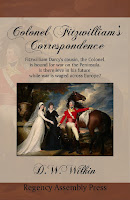
Mr. Wilkin writes Regency Historicals and Romances, Ruritanian (A great sub-genre that is fun to explore) and Edwardian Romances, Science Fiction and Fantasy works. He is the author of the very successful Pride & Prejudice continuation; Colonel Fitzwilliam’s Correspondence. He has several other novels set in Regency England including The End of the World and The Shattered Mirror. 


His most recent work is the humorous spoof; Jane Austen and Ghostsa story of what would happen were we to make any of these Monsters and Austen stories into a movie.


And Two Peas in a Pod, a madcap tale of identical twin brothers in Regency London who find they must impersonate each other to pursue their loves.
He is published by Regency Assembly Press


The links for all locations selling Mr. Wilkin's work can be found at the webpage and will point you to your favorite internet bookstore: David’s Books, and at various Internet and realworld bookstores including the iBookstoreAmazonBarnes and NobleSmashwords.


And he maintains his own blog called The Things That Catch My Eye where the entire Regency Lexicon has been hosted these last months as well as the current work in progress of the full Regency Timeline is being presented.

You also may follow Mr. Wilkin on Twitter at @DWWilkin
Mr. Wilkin maintains a Pinterest page with pictures and links to all the Regency Research he uncovers at Pinterest Regency-Era