Showing posts with label servants. Show all posts

Wednesday, February 17, 2016

Professional Household Staff, a Cut Above the Servants

by Maria Grace
 
Not everyone who worked in a household was considered a servant. During the Regency Era, the wealthiest of households might employ a number of individuals who were considered, not servants, but professionals, firmly part of the middle class. Not surprisingly, these positions were held by men, although some might argue, the governess approached this stratum as well. 

These professional positions included the chamberlain, land steward, and house steward. All required education; reading, writing and managing accounts were necessary skills for these positions.  Specialized knowledge in legal contracts, farming and animal husbandry might also be required. Many men who held these positions were often trained in the law as well. They might have been law clerks or solicitors prior to their employment with the household. Only the largest estates required, or could afford, these services.


Chamberlain

Chamberlains were only found in noble households. This official maintained the living quarters of a sovereign or nobleman. They might also collect rents and manage revenues from the nobleman’s properties as well. 

Land Steward

Large estates might employ a Land Steward to assist the Master in the management of the estate. While he might, at times, serve as the Master’s secretary, the position required greater responsibilities, garnering an average salary of £100-£300 and a private home on the estate. With responsibilities for agricultural and rental properties, the Land Steward would often have an education in the law. His status was on par with the family’s solicitor.

The estate Master might manage some of the estate business or delegate part, or even all of it, to the Land Steward. These duties included collecting rents, leasing farms and other properties, managing tenant contracts and disputes, and all the record keeping related to those activities.

Successful Land Stewards also required expertise in agriculture and husbandry. They supervised the cultivation of the land and assisted tenant farmers in learning methods to improve their yields. They might purchase farm horses, cattle and breeding stock, and manage the breeding and raising of livestock.

On very large estates, Land Stewards might have one or more bailiffs working beneath him.  


House Steward

Very large households, too large for a housekeeper alone to manage, might also employ a House Steward.  Like the Land Steward, he was considered a professional, commanding a salary of £50-£100 per year. Unlike the Land Steward, he would be given quarters in the house itself, including both a bedroom and sitting room to be used as an office for many of his duties.

The House Steward conducted all the domestic business of the household, reporting directly to the Master of the estate. Although in practice much of the House Steward’s business fell under the jurisdiction of the Mistress, and he might consult with her, women rarely supervised men, even male servants.

The House Steward managed all the hiring, firing and payment of the household staff. He did not, though, engage ladies’ maids, companions, valets, nurses or governess. He might be involved in the delegation of work to the household servants, although that often fell to the housekeeper.

The household finances were also the House Steward’s domain. He would place orders for needed goods, pay the household bills and manage the household books. 

The Master might or might not regularly review the house steward’s accounts. In practice, such supervision was advisable, as House Stewards were often known to pad the prices of goods and services to include a healthy portion that went directly into their pockets. 


The Special Case of the Governess

The governess was the only female member of the household staff whose position resembled that of the professional staff. Even so, her position was one of an odd social limbo, neither middle class, nor servant.

Only educated women, usually of genteel birth, could be governesses. Usually they were the unmarried daughters of gentlemen whose circumstances forced them into service to support themselves. Thus, with respect to their education, they resembled professional men. 

Governesses cared for and taught a family’s teenaged girls. The boys would be sent off to boarding school rather than be taught at home. A typical governess would earn just £25 a year, half of what a House Steward might earn, and would have quarters of some kind in the house.

Since she was gently born, a governess often was not accepted by the servants as part of their ranks. But, because she was paid, she was not included in the social life of the family either. 

Many families would expect her to be constantly busy, as the female servants were, to the point of always having sewing in her hands if she was not immediately engaged with the children. Although one might hope her gentle breeding would protect her, in fact, governesses were often imposed upon by their male employers, males in the family or even male servants. Little legal protection existed to protect young women serving in houses not their own.  

These professional (or quasi-professional, in the case of the governess) positions functioned largely outside the servants’ hierarchy. Immediately below them were the upper staff, butler, housekeeper, valet and lady’s maid, the subject of this series’ next installment. 

For more information about servants and household staff, please see previous articles in this series:

~~~~~~~~~~~~

 Maria Grace is the author of Darcy's Decision,  The Future Mrs. Darcy, All the Appearance of Goodness, and Twelfth Night at Longbourn, Remember the Past, and Mistaking Her Character.  Click here to find her books on Amazon. For more on her writing and other Random Bits of Fascination, visit her website. You can also like her on Facebook, follow on Twitter or email her.

Sunday, October 11, 2015

Laws Concerning Domestic Service

by Maria Grace

Since few of us have experience with live-in domestic servants, it is difficult to get a really good sense of the nature of domestic service and the relationship between Regency era employers and employees. A glimpse at some of the laws respecting masters and servants illustrates some of the prevailing concerns and challenges of the era.

Conflicts between servants and masters were a common source of household strife. The legal system was clogged with these complaints. The average servant did not stay more than two or three years in any single situation. The archetype of the servant spending a lifetime with a household was the rare exception rather than the rule. Taken together, these realities suggest that employee servants might not have been the painless luxury the modern mind imagines.
Laws Governing Masters and Servants, 1825


As expected, various laws dealt with the hiring and firing and payment of wages. In addition, a variety of statutes addressed the behavior of the servant during his/her term of service, and character references related to employment.


Employment contracts 


Contracts between servants and masters could be written or verbal agreements, preferably witnessed by another individual. Clearly a purely verbal agreement, even one witnessed, could be problematic to enforce.

Unless otherwise stated, hiring was assumed to be for a ‘year certain’, a full twelve months. The contract would be assumed to continue at the end of that term unless a full quarter’s notice was given by either party

If a contract was established for less than a year’s work, then a month’s warning or a month’s wages were required to end the contract early.

If a master sought to discharge a servant (without cause) before their contract was over, he had to offer a full quarter’s notice (or a month if the contract was less than a year) or pay a quarter (or a month’s) worth of wages at the time of discharge. Failure to do so resulted in a forty shilling fine.

If a servant wished to leave their employment he or she had to offer the same quarter’s (or month’s notice.) Failure to do so could lead to forfeiture of wages and possibly imprisonment. However if both parties wished to terminate the contract, they might do so without penalty.

Things became more complicated with an under-age servant. Many young maids, sometimes as young as eleven were hired for the scullery or maid of all work positions. According to the law, no agreement made by a servant under the age of twenty one with his master could be made to operate against that servant.

Discharging a Servant


An employer could discharge a servant for cause. Depending on the situation, a magistrate or justice might have to approve the action. If the servant committed moral infamy or was taken into legal custody for any offence committed during the time of service, the servant could be discharged without the order of the justice.

By the same token, a master could not discharge a yearly servant for what were considered ‘acts of God.’ These included illness, disability or insanity taking place during the time of contracted labor. Moreover, masters were required to continue paying wages for the full time of the contract under these circumstances. At the end of the year’s hire though, all responsibility of the master ended.

Wage Disputes


Wage disputes were not uncommon. Magistrates settled complaints under ten pounds a year. This represented the wages of the lowest and most commonly hired servants—maids of all work. Complaints of more than that had to be handled through the court system.

Servants could register complaints for unpaid wages, insufficient maintenance (room, board, and allowances), or other ill-treatment at his master’s hand. If a justice agreed, the employment contract could be terminated by the justice.

Quitting Service


If a pregnant woman was hired and her pregnancy was unknown or she became pregnant during her term of service, she might be discharged with the agreement of a magistrate. If the master did not discharge her before a magistrate, then he was required to pay wages through her delivery and a month beyond. In practice, pregnancy ended many employment contracts. 

A female servant who entered into service while married or became married during her contract was required to complete her contract. Her husband could not require her discharge from her position, but the situation was ripe for conflict. Thus, married female servants were far less desirable.

Character References


In an era without the information technology and communication infrastructure we take for granted, ‘characters’, letters of reference written by a master attesting to the quality of an individual’s service, were critical in obtaining positions.

False, forged, counterfeited or altered characters—attested to by the oath of one witness, before two justices was punishable by a fine of twenty pounds (half of which was payable to the informant, who was also likely to be the sworn witness). If unable to pay the fine, the servant was committed to one to three months of hard labor.

Servants were often disgruntled by bad character references. Masters could only be prosecuted if a character was proved not only false, but malicious as well.

Servants who quit or provided unsatisfactory work might be denied a character at all. No laws required a master to provide this document necessary to obtaining further employment.

Liability of Masters and Servants


In most circumstances a master was considered liable for the actions of his servant. Whether in the course of carrying out a direct order or acting in the course of ordinary and appropriate business, the master was liable for his servant’s actions. Similarly, the inactions or neglect of a servant acting on lawful commands, also constituted liabilities on the master’s part.

A servant coming to the physical defense of a master or mistress was not liable to punishment. Likewise, a servant could not be held liable for a loss to his master except in cases of fraud or gross negligence.

Outside of these situations, the servant was considered subject to criminal and civil laws and punishments for his or her actions.

Protection of a master’s interest in his servant


Good servants were a valuable asset, so the law provided protection for the master/employer’s interest in the servant. A master could file an action for compensation of the loss done to him if another injured, detained or enticed away his servant. Further, a master might be considered justified if he assaulted another in the process of protecting his servant.

Inappropriate Behavior by Servants


The close nature of master-servant interactions opened much concern regarding behavior inappropriate for servants, so legal guidelines for their behavior were set in place. Ironically, servants were expected to behave better than their masters in many cases.

Insolence


An insolent servant or one who refused to do their duty was first given a warning. If further insolence occurred, a magistrate could commit the servant to prison for the remainder of their term of service. However, the master would be required to pay the servant’s wages during their imprisonment.

Failure to go to church


Masters could insist that their servants attend church services and could be fined for keeping servants who failed to attend service at least once a month.

Gambling


Any servant caught gambling at a public house could be taken before a magistrate and fined up to twenty shillings. One fourth of the penalty would be paid to the informant. If unable to pay, a servant could be committed to a month’s hard labor.

Drunkenness


Drunkenness, attested to by one witness under oath, in front of a justice, was punishable by a fine of five shillings or six hours in the stocks. After a second offense, the servant would have to offer some form of security that he or she would not offend again.

Cursing and Swearing.


Similarly, the use of foul or inappropriate language was punishable by a fine of one shilling for the first offense, two for the second, and three for the third. Further offense would be punishable by ten days hard labor.

Criminal Behavior by Servants


The servant-master relationship made the master more vulnerable to particular crimes toward person and property. The law spelled out the consequences of these quite clearly.

Arson


If, on the oath of one witness, a servant was convicted of negligently setting fire to a house, a fine of one hundred pounds, to be distributed among the sufferers was assessed. Since it was unlikely that the servant could pay such a fine, the servant was more likely to be committed to eighteen months of hard labor.

Embezzlement and theft of property


If a servant more than eighteen years of age took money, goods, bills, bonds, notes, bankers'-drafts, or other valuable security to which he had been entrusted, the crime was considered a felony and punishable as such.

Theft of goods valued over forty shillings also constituted a felony, punishable by fourteen years transportation.

Pawning a master’s goods without permission was penalized with a fine of forty shillings plus the value of the goods pawned. In lieu of the fine, the servant could be sent to prison for three months and be publicly whipped.

Punishment for an assault on the Master or Mistress


Assault on a master, mistress or other person with charge over that servant (like a housekeeper or butler) was punishable by up to a year in prison.

Servants did not appear to enjoy such protections. His or her things, located on the master’s property, could be gone through by the master. A servant could be physically disciplined by their employers. This was especially true for young servants and female lower servants. Upper staff and adult men were far less subject to such treatment. Apart from gross maltreatment, a servant had no legal recourse against ill treatment. Even sexual assault of female servants was rarely punishable.

Unsurprisingly, conflicts between servants and masters clogged up the legal system. Though laws existed to protect both parties, it is not clear how effective these measures were, especially considering the way witnesses could profit from their role in any litigation.


References

Adams, Samuel, and Sarah Adams. The Complete Servant; Being a Practical Guide to the Peculiar Duties and Business of All Descriptions of Servants ... with Useful Receipts and Tables,. London: Knight and Lacey, 1825.
Ardelie, Susan. "Domestic Servants - Part 1 - Women." Making History Tart Titillating. February 16, 2010. Accessed August 10, 2015. https://lifetakeslemons.wordpress.com/2010/02/16/domestic-servants-part-1-women/.
Ardelie, Susan. "Domestic Servants - Part 2 - Men." Making History Tart Titillating. March 2, 2010. Accessed August 10, 2015. https://lifetakeslemons.wordpress.com/2010/03/02/domestic-servants-part-2-men/.
Barker, Anne. The Complete Servant Maid or Young Woman's Best Companion. Containing Full, Plain, and Easy Directions for Qualifying Them for Service in General, but More Especially for the Places of Lady's Woman, Housekeeper, Chambermaid, Nursery Maid, Housemaid, Laund. London: Printed for J. Cooke, No. 17, Pater-Noster Row, 1770.
BEETON, Isabella Mary. The Book of Household Management. Edited by Mrs. I. Beeton, Etc. [With Illustrations.]. London: S. O. Beeton, 1861.
Cosnett, Thomas. The Footman's Directory, and Butler's Remembrancer Or, the Advice of Onesimus to His Young Friends: Comprising, Hints on the Arrangement and Performance of Their Work ; Rules for Setting out Tables and Sideboards ; the Art of Waiting at Table, and Conduct. London: Printed for the Author ;, 1823.
Giles, Kelly. "Servants." Randolph College Faculty Webserver. Accessed August 10, 2015. http://faculty.randolphcollege.edu/janeausten/reports/servants.htm.
Glover, Anne. "Regency Culture and Society: A Primer on Household Staff." Regency Reader. March 19, 2012. Accessed August 10, 2015. http://www.regrom.com/2012/03/19/regency-culture-and-society-a-primer-on-household-staff/.
Hoppe, Michelle Jean. "Servants--Their Hierarchy and Duties." Literary Liaisons. 2003. Accessed August 10, 2015. http://www.literary-liaisons.com/article046.htm.
Household Work, Or, The Duties of Female Servants Practically and Economically Illustrated, through the Respective Grades of Maid-of-all-work, House and Parlour-maid, and Laundry-maid : With Many Valuable Recipes for Facilitating Labour in Every Departmen. London: J. Masters, 1850.
Koster, Kristen. "A Primer on Regency Era Servants - Kristen Koster." Kristen Koster. November 29, 2011. Accessed August 10, 2015. http://www.kristenkoster.com/a-primer-on-regency-era-servants/.
Schmidt, Wayne. "Victorian Domestic Servant Hierarchy and Wage Scale." Wayne's This and That. Accessed August 10, 2015. http://www.waynesthisandthat.com/servantwages.htm.
The Servant's Guide and Family Manual: With New and Improved Receipts, Arranged and Adapted to the Duties of All Classes of Servants ... Forming a Complete System of Domestic Management. 2d ed. London: J. Limbird, 1831.
Webster, Thomas, and William Parkes. An Encyclopædia of Domestic Economy .. London: Longman, Brown, Green, and Longmans, 1852.

~~~~~~~~~~~~

 Maria Grace is the author of Darcy's Decision,  The Future Mrs. Darcy, All the Appearance of Goodness, and Twelfth Night at Longbourn, Remember the Past, and Mistaking Her Character.  Click here to find her books on Amazon. For more on her writing and other Random Bits of Fascination, visit her website. You can also like her on Facebook, follow on Twitter or email her.

Tuesday, August 11, 2015

Servant Hierarchies

by Maria Grace

Importance of Rank

In Regency England, everyone knew their place. Individuals were keenly aware both of those above them and those below. This social hierarchy extended from the highest peer to the lowest servant in their household, with every servant knowing his or her rank among those of their class.

The number and type of servants in a household depended upon the ranks and wealth of the master/mistress of the household and the size of the establishment that need to be maintained. A first rate household with an income above 5000 pounds a year might employ twenty to twenty four domestics while tenth rate households with an income under 150 pounds a year might employ only a single young girl. Sometimes unique positions were created to tend to unique situations within a household.

Nonetheless, principles of rank could be applied to every servant so they knew where they stood in the world.

Rank of household served

When servants accompanied a master or mistress who traveled, their rank and thus their treatment in the host’s household would be according to the rank of their employer. Servants of higher ranking households were of a higher rank than those who held a similar position for a lower ranking household. This was true despite length of service, so the valet of a peer, even if newly hired, would out rank a mere gentleman’s valet even if he had served that gentleman for a decade.

Rank of household member served

When there were several servants in a household of equal job title, their rank would be determined by the prominence of the person they served within the family. The master’s valet would out rank the eldest son’s valet who would in turn outrank the younger son’s valet. Considerable turmoil in the servant ranks could follow the death of the master. His valet would be replaced in rank by the heir’s valet, and he might very well be out of a job entirely.

Rank within the household

Auguste Serrure A distraction from choresNot all individuals working for the household were considered servants. Some were possessed of skills and training that placed them definitely above the working classes. These professionals, usually men, were generally employed directly by the master of the house to handle managerial responsibilities. Chamberlains, agents, land stewards were hired by large establishments to assist in the management of lands and house stewards might handle the household accounts in households too large for a housekeeper to keep the books. In many cases these men were trained as solicitors, making them part of the middle class.

Two ranks of female servants occupied a similar not-quite-a-servant position in the households that employed them, the governess and the companion. These women were not considered professionals, but they were regarded as genteel, a necessary quality for imbuing young ladies with the accomplishments they would need in life and for protecting their reputations and delicacy. Thus, they were above the servants, but not part of the family either. So their rank was an awkward neither-this-nor-that sort of affair.

Skilled over unskilled

Below these professional and genteel employees were the true servants, members of the working class. Those who worked in these capacities were divided between the skilled—upper staff and senior staff—and the unskilled—the lower staff. Not surprisingly the skilled workers were more highly ranked.

Junger Mann am WeinkühlerIt is interesting to note that males servants, who were far less numerous than female ones, were over-represented among the skilled, higher ranking staff. Within the house, men were charged with protecting the household and its luxuries and overseeing a staff; outside, they managed and worked land and animals. All of these tasks required some form of training, typically apprentice. Thus the positions men filled were more typically considered skilled positions.

In many ways, most households could not afford to employ men for unskilled labor. Because of a tax specifically placed on male servants and the higher wages they commanded by virtue of being male, they were simply too expensive to assign to the unskilled labor that encompassed most housework. Thus female servants ended up with much of the hardest, dirtiest work of the household.

Upper, Senior and Lower Staff

The upper staff servants reported directly to the Master and Mistress of the house. Typically they would rise to their positions through years of experience of service, possibly in multiple households. These included the butler and housekeeper, to whom the lower staff reported, the cook, and the master and mistress’ personal attendants, the valet and lady’s maid.

Cruikshank Loo in the kitchin

Their rank afforded them a number of privileges including private quarters and sitting rooms. They ate at a separate table from the lower servants and were waited on by the lower servants. Their meals consisted of better food, including first pick of what might be leftover from the family's table. Part of their pay often included cast off clothes and household items like used tea leaves and candle stubs. Although these may seem odd to modern sensibilities, they were considered valuable goods in the era and an important part of an upper servant’s compensation.

Senior staff also reported to the master or mistress, but they were hired for very specific skills and did not rise up through the ranks of the servants, thus their slightly lower position than upper staff. These positions included for men: head groom/stable master, coachman, head gardener and head game keeper; for women, head nurse (who minded the children). The governess was often considered among these ranks, although her education and gentility set her apart. Depending on the number of senior staff employed, they might eat and socialize with the upper staff or together with their own ranks.

Lower servants were the least skilled workers among the household. They reported to the upper staff and in large households might never interact with the master or mistress of the house. They slept in large rooms, often dormitory style, with little privacy. Usually the women had quarters in the attics. The housekeeper's room was often by the stairway to those attic rooms so she could monitor the comings and goings of the young women. The men were often quartered in the basement or ground floor, amongst the service rooms, where the butler could supervise them. Male and female lower servants were typically segregated from one another, eating in separate rooms and under strict orders not to fraternize with one another.

Jeune filleThe very lowest ranked servants in a household would often be girls and possibly even boys as young as eleven years old. These children could be hired as scullery maids who would do some of the least skilled, most physically demanding labor, cleaning and laundering, emptying chamber pots and polishing boots.

References

Adams, Samuel, and Sarah Adams. The Complete Servant; Being a Practical Guide to the Peculiar Duties and Business of All Descriptions of Servants ... with Useful Receipts and Tables,. London: Knight and Lacey, 1825.

Ardelie, Susan. "Domestic Servants - Part 1 - Women." Making History Tart Titillating. February 16, 2010. Accessed August 10, 2015. https://lifetakeslemons.wordpress.com/2010/02/16/domestic-servants-part-1-women/.

Ardelie, Susan. "Domestic Servants - Part 2 - Men." Making History Tart Titillating. March 2, 2010. Accessed August 10, 2015. https://lifetakeslemons.wordpress.com/2010/03/02/domestic-servants-part-2-men/.

Barker, Anne. The Complete Servant Maid or Young Woman's Best Companion. Containing Full, Plain, and Easy Directions for Qualifying Them for Service in General, but More Especially for the Places of Lady's Woman, Housekeeper, Chambermaid, Nursery Maid, Housemaid, Laund. London: Printed for J. Cooke, No. 17, Pater-Noster Row, 1770.

BEETON, Isabella Mary. The Book of Household Management. Edited by Mrs. I. Beeton, Etc. [With Illustrations.]. London: S. O. Beeton, 1861.

Cosnett, Thomas. The Footman's Directory, and Butler's Remembrancer Or, the Advice of Onesimus to His Young Friends: Comprising, Hints on the Arrangement and Performance of Their Work ; Rules for Setting out Tables and Sideboards ; the Art of Waiting at Table, and Conduct. London: Printed for the Author ;, 1823.

Giles, Kelly. "Servants." Randolph College Faculty Webserver. Accessed August 10, 2015. http://faculty.randolphcollege.edu/janeausten/reports/servants.htm.

Glover, Anne. "Regency Culture and Society: A Primer on Household Staff." Regency Reader. March 19, 2012. Accessed August 10, 2015. http://www.regrom.com/2012/03/19/regency-culture-and-society-a-primer-on-household-staff/.

Hoppe, Michelle Jean. "Servants--Their Hierarchy and Duties." Literary Liaisons. 2003. Accessed August 10, 2015. http://www.literary-liaisons.com/article046.htm.

Household Work, Or, The Duties of Female Servants Practically and Economically Illustrated, through the Respective Grades of Maid-of-all-work, House and Parlour-maid, and Laundry-maid : With Many Valuable Recipes for Facilitating Labour in Every Department. London: J. Masters, 1850.

Koster, Kristen. "A Primer on Regency Era Servants - Kristen Koster." Kristen Koster. November 29, 2011. Accessed August 10, 2015. http://www.kristenkoster.com/a-primer-on-regency-era-servants/.

Schmidt, Wayne. "Victorian Domestic Servant Hierarchy and Wage Scale." Wayne's This and That. Accessed August 10, 2015. http://www.waynesthisandthat.com/servantwages.htm.

The Servant's Guide and Family Manual: With New and Improved Receipts, Arranged and Adapted to the Duties of All Classes of Servants ... Forming a Complete System of Domestic Management. 2d ed. London: J. Limbird, 1831.

Webster, Thomas, and William Parkes. An Encyclopædia of Domestic Economy . London: Longman, Brown, Green, and Longmans;, 1852.


~~~~~~~~~~~~


Maria Grace is the author of Darcy's Decision, The Future Mrs. Darcy, All the Appearance of Goodness, and Twelfth Night at Longbourn, Remember the Past, and Mistaking Her Character. Click here to find her books on Amazon. For more on her writing and other Random Bits of Fascination, visit her website. You can also like her on Facebook, follow on Twitter or email her.

Friday, July 10, 2015

The Ubiquitous Servant


by Maria Grace

Servants find their way into nearly every work of historical fiction, a familiar stock character in any era. The role and situation of the servant changed dramatically through the ages, in some cases little better than slaves, in others, like the late Georgian/early Victorian era, a person with recognized rights and responsibilities in the eyes of the law.

In the early to mid-1800’s many young people began their adult lives with positions in service. Many moved on to marriage (for the women) or other forms of work. Some remained in service all their adult lives progressing through the ranks to the upper servants ranks: housekeepers, butlers and housestewards. Many households, and nearly all that reached above the lowest classes employed at least one domestic servant.

Servant’s Wages

General recommendations suggested that for incomes of over a thousand pounds a year, about one third of that should go to household expenses and one quarter towards servants and equipage (horses and carriages), the same amount suggested for clothing and other extras. In general, the greater the income, the more servants and the more specialized the servants. A small household might have only one maid of all work whereas a large one might have upper maids, lower maids, laundry maids, dairy maids, nursery maids, still-room maids, scullery maids and a housekeeper to oversee them all.

Most considered an annual income of at least one hundred pounds or guineas a year to be the minimum necessary to employ a servant. At this income level, a household could hire a single young maid servant. (Female servant’s salaries were lower than male servants and the Male Servant Tax 1777-1852 made male servants more expensive to employ.) The expected salary for such a servant would be from five to ten guineas a year, depending on her capabilities.

At an annual income of two hundred pounds, an experienced maid of all work might be hired with an annual salary of twelve to fourteen guineas, but a male servant would probably not be hired until an income level of five to six hundred pounds a year was reached. A male servant’s wages began at around twenty guineas a year for an under footman. A butler might earn fifty and a French trained man-cook eighty. The top paid female servants, the housekeeper and lady’s maid might be paid as much as thirty guineas, notably less than the male servants.

As with the Commander of an Army

"As with the commander of an army, so it is with the mistress of a home" Beeton (1861) wrote. Though the mistress of a household might not be employed outside the home, she had a full-time occupation managing the servants and all the household work. In very large establishments, a housekeeper might manage many of the lower female servants; the mistress was ultimately responsible for directing the housekeeper, governess and lady’s maid. In smaller establishments, the mistress and her daughters might very well work alongside a maid of all work, or even several maids in order to accomplish all that needed to be done in the household. Even if she did not, the mistress of the household had to have a solid understanding of how each task must be done in order to properly supervise the servants.

Often the mistress of the household was herself responsible for hiring (and dismissing) servants. In doing so, household manuals such as Mrs. Beeton’s recommended that she obtain not just a letter of character, but interview the candidate’s previous mistress to ascertain the suitableness of the candidate for a position. Such consideration was important as servants became a kind of dependent upon the family to whom the mistress owed a particular duty of benevolence.

Servants who became ill could not, by law (Adams,1825) be dismissed during the duration of their employment contract. The mistress of the household had the responsibility to see to their proper medical treatment, food and comfort during their illness. Mistresses were encouraged to allow the servants to join family devotions and endeavor to make the servants "spend the Sabbath properly". Day to day, she would both promote their comfort and oversee the steady performance of their duties. Though cautioned not to become overly familiar with her servants, still mistresses were urged to treat them with kindness, gentleness and respect for their feelings.

Desirable qualities for servants

Young persons, on their first entering into service, should endeavor to divest themselves of former habits, and devote themselves to the control of those whom they engage to serve… They will wisely take advantage of the opportunity which Providence fortunately presents to them, to cultivate their minds and improve their principles… They will eagerly embrace every opportunity of learning everything that may be useful to themselves, and of doing anything that may be useful to others. (Adams, 1825)

Though some manuals considered time spent in service as an opportunity to improve one’s character, these same manuals also recommended particular necessary traits for good servants. Mistresses desired servants who were industrious, early-rising, punctual and orderly in their work. Similarly, honesty, loyalty, and cleanliness were also valuable. These traits are similar to those employers would look for today.

Due to the live-in, community nature of the servant employing household, several additional qualities were regarded important. These included, good temper, particularly necessary for getting along both with other servants, and for enduring a cranky mistress ranked high among desirable traits. Humility, modesty and temperance all made it far easier for servants to get along in the household, as did the avoidance of tale bearing. One household manual even devoted an entire section of how female servants were to treat others in the household so as to get along best with everyone.


References

Adams, Samuel, and Sarah Adams. The Complete Servant; Being a Practical Guide to the Peculiar Duties and Business of All Descriptions of Servants ... with Useful Receipts and Tables,. London: Knight and Lacey, 1825.

Barker, Anne. The Complete Servant Maid or Young Woman's Best Companion. Containing Full, Plain, and Easy Directions for Qualifying Them for Service in General, but More Especially for the Places of Lady's Woman, Housekeeper, Chambermaid, Nursery Maid, Housemaid, Laund. London: Printed for J. Cooke, No. 17, Pater-Noster Row, 1770.

BEETON, Isabella Mary. The Book of Household Management. Edited by Mrs. I. Beeton, Etc. [With Illustrations.]. London: S. O. Beeton, 1861.

Cosnett, Thomas. The Footman's Directory, and Butler's Remembrancer Or, the Advice of Onesimus to His Young Friends: Comprising, Hints on the Arrangement and Performance of Their Work ; Rules for Setting out Tables and Sideboards ; the Art of Waiting at Table, and Conduct. London: Printed for the Author ;, 1823.

Household Work, Or, The Duties of Female Servants Practically and Economically Illustrated, through the Respective Grades of Maid-of-all-work, House and Parlour-maid, and Laundry-maid : With Many Valuable Recipes for Facilitating Labour in Every Department. London: J. Masters, 1850.

The Servant's Guide and Family Manual: With New and Improved Receipts, Arranged and Adapted to the Duties of All Classes of Servants ... Forming a Complete System of Domestic Management. 2d ed. London: J. Limbird, 1831.

~~~~~~~~~~~~

 Maria Grace is the author of Darcy's Decision,  The Future Mrs. Darcy, All the Appearance of Goodness, and Twelfth Night at Longbourn and Remember the Past.  Click here to find her books on Amazon. For more on her writing and other Random Bits of Fascination, visit her website. You can also like her on Facebook, follow on Twitter or email her.

Tuesday, December 16, 2014

Below stairs - the Footman

by Deborah Swift


' the lady of fashion chooses her footman without any other consideration than his height, shape, and tourniture of his calf'  Mrs Beeton


Horace Roome, a liveried footman at Shugborough Hall
(1920's)
The footman has been doing his duties in English upper class households since the seventeenth century. His name comes from the fact he was originally employed to run alongside the carriage, to make sure it was not overturned because the original tracks were rutted and full of boulders and tree roots. This then extended to the duties of opening and closing the carriage doors, or running errands when the Lord or Lady were out and about in town.

Image from The Telegraph

'In the eighteenth century they were frequently matched to run against horses and carriages. One of the last recorded contests was in 1770 between a famous running footman and the Duke of Marlborough, the latter wagering that in his phaeton and four he would beat the footman in a race from Windsor to London. His Grace won by a very small margin. The poor footman worn out by his exertions and much chagrined by his defeat, died, it was said, of over fatigue.'
from 'A Handy Book of Curious Information' William Shepard Walsh, 1913

The footman was a personal outdoor servant, who would assist a specific person within a household thus adding to their aura of luxury and status.

Appearances were important, so a tall personable footman was paid more than a shorter plain one. They were often dressed in impractical embellished liveries, which were at odds with the duties they were expected to perform. A 'livery' was a uniform that identified the servant’s employer. The heraldic arms of the employer’s family would be echoed in the colour and decorations of the clothes distributed to these servants. The word 'livery' comes from the French livree - to hand over. For more on livery in the 19thC see this article in Jane Austen's world.

Where more than one footman was employed, they had to match, like bookends, in terms of height and colouring. Because they were supposed to submerge their own personality, footmen were often given a name chosen by the employer. James and John for a matching pair, or John Thomas for a single footman were popular names.


Silent service was the order of the day, so shoes that squeaked were replaced, and a footman was not expected to speak or show signs that he had heard the family's conversation.

Towards the end of the seventeenth century, footmen began to do duties indoors, and one of their first and surviving indoor tasks was to clean all the boots and shoes of the family before they were required, in other words at night. This could be a long task, as several different pairs of shoes were worn each day by each person or guest. The polish was made of  'charcoal, spermicetti oil, treacle and white wine vinegar' in the 17th century.

Another indoor duty was to trim wicks, re-fill wall sconces, and in the later centuries to deal with the many oil lamps. At Belvoir Castle in the 1830's about six hundred gallons of oil were consumed for light in the four months of winter.


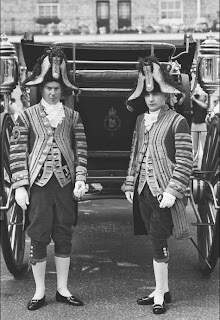
After World War I fewer households could  afford servants, so the position of footman is now rare except in the British Royal Household, where they wear a distinctive scarlet livery on state occasions.

The Gilded LilyShadow on the Highway (The Highway Trilogy, #1)As many of you know, I have been interested in the lives of the servant class, and my seventeenth century books are told from the perspective of ordinary people witnessing extraordinary events.


You might like this lovely Daily Mail article about the real life of servants at Downton Abbey
And this about the duties of the second footman at Manor House

Bibliography
The Duties of Servants Reprinted from 1894 publication by Copper Beech Publishing, Ltd.
The Victorian Domestic Servant - May
Early Modern England, A Social History - Sharpe

Monday, October 20, 2014

The Independent English Domestic

by Diane Scott Lewis

In the eighteenth century, a time when domestic service was seen as easier than toiling in a shop or factory, a poor farmer’s sons and daughters would go happily into this type of work. Even a parson’s family did not look down on the occupation. However, the English domestics thought of themselves as a cut above.

The English servant was quite independent and rarely satisfied with low wages. Instead of being content in the early part of the century with £2 a year, they were demanding as much as £6 and £8. Writer Daniel Defoe wanted to see wages fixed at no more than £5, or soon this rabble would insist on as much as £20.

Lord Fermanagh, when writing to a friend about his butler, who had the audacity to ask for £10, said: "I would have a sightly fellow and one that has had the smallpox, and an honest man, for he is entrusted with store of plate, and can shave, but I will give no such wages as this."

The English servant stood up for himself, giving notice or running away if ill-treated. One servant, after being struck by his master, turned on the man and killed him with a pitchfork.

Foreigners were amazed—since they treated their servants like slaves—to see a nobleman like Lord Ferrers hanged in 1760 for the murder of his steward.

In the earlier part of the century there was a scarcity of women servants, but later, after years of bad harvests, starvation sent many girls into service. One lady, upon advertising for another housemaid, had over 200 applicants.

If wages were low, servants in a large house could supplement their pay with vails (tips). One foreigner complained after dining with a friend at his home: "You’ll find all the servants drawn up in the passage like a file of musqueteers from the house steward, down to the lowest liveried servant, and each of them holds out his hand to you in as deliberate a manner as the servants in our inns on the like occasion."

One clergyman reported that when he dined with his Bishop, he spent more in vails than would have fed his family for a week.

At lease the Duke of Ormonde, when inviting a poor relation to dine, always sent him a guinea ahead of time for the vails.

A movement, rumored to have started in Scotland, was put forth to abolish vails, but nothing came of it.

If servants believed themselves independent, striving for respect, their employers often demanded too much from them for little pay. Mrs. Purefoy advertised for a coachman who can not only drive four horses but must understand husbandry business and cattle, plus he’d also be expected to plough. She also required a footman who could "work in the garden, lay the cloth, wait at table, go to the cart with Thomas, and do any other business that he is ordered to do and not too large sized a man, that he may not be too great a load for the horse when he rides."

Servants were derided by their "betters" as being lazy and selfish, especially when they’d leave their positions for higher wages and vails.


Of course, many servants during the eighteenth century—especially in the larger towns and cities—were mistreated and far underpaid, if paid at all.

Still, some servants were honored and treated as members of the family, as shown by this epitaph on a coachman’s headstone: Coachman the foe to drink and heart sincere; Of manners gentle and of judgment clear; Safe through the chequered track of life he drove; And gained the treasure of his master’s love...

~~~~~~~~~~~~~

Diane Scott Lewis. To learn more about her eighteenth-century novels, please visit her website:

http://www.dianescottlewis.org

Source: English Country Life in the Eighteenth Century, by Rosamond Bayne-Powell, 1937