Showing posts with label The Bayeux Tapestry. Show all posts

Wednesday, June 10, 2020

Ælfgyva: The Mystery Lady of the Bayeux Tapestry Part V

by Paula Lofting


Picture courtesy of Paula Lofting and Regia Anglorum

For those who have not read any of my earlier posts about this puzzling enigmatic woman, Ælfgyva, whose image is portrayed in the Bayeux Tapestry with a priest, we have been exploring her possible identity to ascertain what her role was in the events of 1064-6. It is my aim to try and shed some light and interpret what or how she came to be sewn into this enigmatic tale of Harold’s fateful trip to Normandy. After discounting the known candidates except for one, it would appear that the identity of this Ælfgyva is Ælfgifu of Northampton. She was a consort of Cnut, enjoined to him in the more danico tradition. Marrying her in this way meant that Cnut could take another, more politically convenient wife at a later date, as he did when he married Emma of Normandy, to whom the English also referred to as Ælfgifu.

Just to recap what we have found out about this particular Ælfgifu in my previous posts, she was the daughter of Ælfhelm, a major ealdorman of Northumbria whose familial origins were Mercian. His mother was a wealthy woman named Wulfrun, but I have not been able to find a source for his father. It could be that his mother was of higher status, or his father had died when Ælfhelm was young. Regardless, it was obvious that Ælfgifu came from a very important family. Her father was put to death by his enemy Eadric Streona and her younger brothers were blinded. All this was done with the connivance of King Aethelred, and Ælfgifu may never have forgotten or forgiven this deed and it quite possibly could have shaped her personality from then on. (Incidentally, the office of earldorman was later replaced by the shire-reeve).

Because of her family’s influence in the in the north, it may have been expedient for the Danish invader, Swein of Denmark, to seek an alliance with them, taking advantage of the rift Ælfhelm’s death may have caused between them and Aethelred. So, it seems she was either given as a concubine to Swein’s son, Cnut, or handfastened to him; the latter being the most likely.

Cnut and Emma of Normandy
Handfasted wives were not necessarily cast off when the man later married politically, and the evidence is inclined to show that like Harold Godwinson, half a century later, Cnut kept his affections for Ælfgifu and did not wholly put her aside for Emma. In fact, initially, he may have considered her with great respect, if not affection; she had, after all, provided him with two heirs, Swein and Harald, named in respect for Cnut’s father and grandfather. When Swein was old enough, Cnut sent Ælfgifu with him as regent to rule in Norway. He may have done this to keep her out of the way of his relationship with Emma, though this is not founded in any source, but one can picture that the two women were serious rivals for Cnut’s affection and that they probably felt threatened by one another. On the other hand, Cnut may have simply been keeping the interests of the Northern thegns alive by continuing to honour her and the alliance with her family. Emma may have had the upper hand, however, being the recognised queen. And it is natural to think that Emma, an astute woman that she was, would not have agreed to marry Cnut if any of her future children by him were to not have precedence over Ælfgifu’s.

One might have been forgiven for intuitively assuming that the nature of Ælfgifu of Northampton’s character was somewhat harsh when some years later she and Swein had to flee Norway for her apparent heavy-handed rule. The Norwegians rebelled against her heavy taxation and it seemed, preferred Magnus I as ruler to Cnut’s harridan. Her son, Swein, was to die in Denmark shortly after. In the Norwegian Ágrip, Ælfgifu is mentioned by the Skald Sigvatr, a contemporary of her’s:
Ælfgyfu’s time: long will the young man remember,
when they at home ate ox’s food,
and like the goats, ate rind

She may have died sometime around 1040, as nothing is heard of her after this. The story about her deception of Cnut, is strangely alluded to in the Anglo-Saxon Chronicle, the Abingdon edition (C) where it is mentioned:
‘And Harold, who said that he was the son of Cnut – although it was not true-’
This appears to be referring to the story about Ælfgifu’s sons not being fathered by Cnut, already spoken about in PART IV of this mystery. In my search for the real Ælfgyva, I have discovered that the Encomium Emmae Reginae, commissioned by Queen Emma, makes the allegation that Harold was really the son of a servant girl smuggled into Ælfgifu’s bed chamber and passed off as Cnut’s son. John of Worcester elaborates further and tells us that Cnut’s sons by Ælfgifu were neither his nor hers, even, and that Ælfgifu, desperate to have a son, ordered that the new born son of a priest’s concubine be presented to Cnut as his own son by herself. This was the child called Swein. Harold, he states, was the son of a workman, like the one seen in the border underneath Ælfgyva’s scene in the tapestry (Bridgeford 2002). Bard McNulty (1980) first drew the patrons of the Tapestry to the theory that this was Ælfgifu of Northampton. He also theorizes that William and Harold had a discussion in the previous scene whereby Harold reassures William that the English will not call upon Harald of Norway to become king when Edward dies. I have already rejected this theory because apart from her connection with Norway, her connection to Harald Hardrada is neither tenuous nor existent.


What I do, however agree with is Bard McNulty’s idea that the Ælfgyva scene is not meant to be a sequel to the scene before it, but rather that it represents what they were discussing, an issue involving a priest and Ælfgyva. So, if they were not discussing Harald Hardrada, then what were they discussing that could possibly concern a long dead noble woman and a priest? And what had they to do with the events described in the tapestry, the events that led to the invasion of 1066, or Harold’s time in Normandy?

Let us think for a moment:

What if this whole thing was a case of mistaken identity, and that the right story was projected on to the wrong lady? Or that the wrong lady was associated with the wrong Ælfgifu? The plot thickens even more, so stay tuned for the final part in this mystery. Can we solve it? You’ll have to wait until the next instalment is posted.

References

Encomium Emmae Reginae

Norwegian Ágrip

John of Worcester Chronicon ex chronicis

Further Reading

Bridgeford A, 1066 The Hidden History in the Tapestry

J Bard McNulty, Visual Meaning in the Bayeux Tapestry: Problems and Solutions in Picturing History (Studies in French Civilization)

This Editor's Choice from the EHFA Archives was originally published on January 23, 2018.

~~~~~~~~~~


Paula Lofting is an author and a member of the re-enactment society Regia Anglorum, where she regularly takes part in the Battle of Hastings. Her first novel, Sons of the Wolf, is set in eleventh-century England and tells the story of Wulfhere, a man torn between family and duty. The sequel, The Wolf Banner is also available. Paula is currently working on the third book in the series, Wolf's Bane

Find Paula on her Blog
on her Amazon Author Page

Monday, July 8, 2013

Wilton Abbey and The Bayeux Tapestry

by Carol McGrath


There is a strong argument that panels of The Bayeux Tapestry may have been embroidered at Wilton Abbey. The Bayeux Tapestry is generally thought to have been the product of Canterbury where Bishop Odo, who was responsible for the new Church at Bayeux, had his headquarters. One of the most mysterious vignettes on the Tapestry supports the possibility of Wilton's connection with its construction, depending on its interpretation.

A cleric and Ælfgyva - Bayeux Tapestry, 1070
A Cleric and Elfgyva (just to the side Harold is pointing)


The inscription above this particular vignette has the title 'Where a Cleric and Elfgyva...' We ask: Who was this lady? Why was she included in the Tapestry?  There is a suggestion that Elfgyva was Harold's sister (M.W. Campbell, 1984, E.A. Freeman 1867-9), and that she was alive at the time of Harold's visit to Normandy in either 1064/5 and that she was well-known to a contemporary audience. She is mentioned in The Domesday Book along with other members of the Godwin family. Elfgyva is connected with lands held by the Abbess of Wilton Abbey. Now, why might this lady depicted on  the embroidery be Harold's sister?

  • She was Abbess of Wilton from 1065-67, the time scale of the events depicted on the Tapestry.


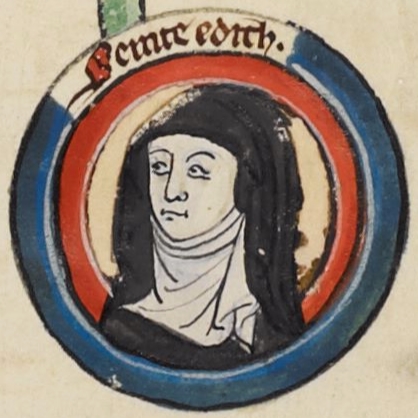
Queen Edith is kneeling at her husband's death-bed.

  • Queen Edith was strongly connected with Wilton and, interestingly, one of the other two vignettes which feature women depicts Edith Godwin, wife of Edward the Confessor rubbing his feet in the death-bed scene. She was also at the abbey during 1065 supervising building work of a new abbey church just as her husband was responsible for the new Westminster Abbey consecrated in January 1066. The third vignette of a woman fleeing a burning house before the battle could also be a Godwin woman, Edith Swan-Neck, King Harold's hand-fasted wife with his youngest son Ulf.


A house is being burned - Bayeux Tapestry, 1070
A House Is Burned

  • Earl Godwin had his daughters educated at Wilton and Harold's youngest daughter was educated there during this period. There was a school for young noblewomen attached to the abbey.

Looking closely at the vignette--one wonders if Harold, who seems animated, is drawing attention to her and telling William something about her. The cleric draws attention to her eyes. Perhaps Harold is telling William and others present, including his brother, Wulfnoth and his nephew Hakon, hostages living at William's court about the miraculous healing of Harold's sister's eyes by St. Edith of Wilton Abbey. Now who could that priest be and why in the Tapestry border below the vignette is there naked male genitalia?  To understand how this connects with Harold's sister one can turn to Goscelin's story.

File:Edith of Wilton.jpg
Saint Edith of Wilton

Goscelin was Chaplin to Elfgyva and he tells the story in 1080 of how St Edith who was the daughter of King Edgar and a woman, Wulfrith, whom he had seduced when visiting the abbey school. Wulfrith returned to the abbey with their baby daughter Edith and became a nun. Edith remained at Wilton all her life. The next king her half brother, Athelred II, built a chapel for her.

After she was interred there prayers were answered and miracles occurred. She quickly became a saint. Elfgyva was lighting a lamp in the chapel which overturned burning her. Her right eye became badly swollen. She lost her sight. However, while she slept she had a vision of St Edith making the sign of the cross over her and telling her all would be well. When she woke the swelling went down and she regained her strength. It is just possible that Harold is telling William this story. The gateway by which she stands is another clue. Goscelin gives details as he also gives details of Westminster Abbey, details that do appear for both on the Tapestry.

Holy Trinity Church, Bosham
Holy Trinity Church Bosham, Harold's Church

The cleric is emerging down some stone steps at an entrance porch. Two double doors are depicted, with crosses set on them. The entrance to this chapel is also described in a fifteenth century poem just as it appears on the Tapestry. The cleric drawing attention to Elfgyva's eyes is surely Goscelin himself, her chaplain. She is standing in her own gateway at Wilton Abbey, just as the abbess of Wilton appears on her Anglo-Saxon seal.

As for the naked figure in the border there is a possible explanation there too, associated with St Edith's story and Wilton Abbey. She is the only woman named on the Tapestry therefore this was obviously an important scene for those making it. The embroiderers throughout convey realistically the typical Wilton chequer-board style of architecture. These are squares made of flint and stone!

It is also likely that Goscelin who was also chaplain to Queen Edith, composed the Vita Edwardii Regis. His description of Westminster Abbey is just as the abbey appears exactly half way through the Tapestry. Further reasons that the Tapestry may have been embroidered at least in part at Wilton are:

  • Praise for Queen Edith's family. Harold is depicted nobly with hawk and hounds as he rides to Bosham.
  • A team of embroiderers may have wanted to show a portion of the Tapestry showing Queen Edith's new building.
  • Queen Edith was an expert embroiderer, one of the greatest in the land, seriously educated and religious and also she was pragmatic towards the Invasion. She was at Wilton during the 1070s.
  • This adds weight to the argument--Muriel, a poetess and possibly Odo's sister, was a widow and lived as a nun at Wilton during the 1070s.
  • Could the Tapestry be seen as a memorial to the dead, Norman and Saxon?
  • Pragmatically, the Norman story takes up the second half of the work restoring the balance from it being Godwin orientated.
  • The story of Elfgyva and her miraculous cure from blindness may foreshadow the death of Harold during which scene he is struck down by an arrow and then hacked to death. Foreshadowing Roland's death in the popular Song of Roland occurs early on in the poem with Charlemagne's vision. A contemporary audience, used to miracles and visions would have understood why Elfgyva and Goscelin were there. The embroiders are denoting the place where a cleric and Elfgyva are performing a miracle.
  • So was the Tapestry embroidered at Wilton and is it, in fact, a memorial to the dead!
I would like to acknowledge Patricia Stephenson whom I heard give a paper on this topic at The British Museum. It is titled Where a Cleric and Elfgyva.

~~~~~~~~~~~~

Carol McGrath is the author of The Handfasted Wife, the story of Harold's common-law wife and a woman's perspective on the events of 1066. It is available as a paperback and for all e readers.