Showing posts with label Stephenie Woolterton. Show all posts

Wednesday, June 3, 2015

Bias in Historical Research

by Stephenie Woolterton
As historical fiction authors and historians, we study and create characters, plots, and worlds that transport our readers to the past. Although we cannot actually visit these bygone times (when will they invent that time machine?), we are able to build worlds so powerful that we hope our readers feel as though they are transported to them through their imaginations. Even if we’re writing about people who once lived, we will never be able to actually meet and speak with them. What we can do, however, is use the intensive historical detective skills we’ve gathered to construct stories of distant times and places - periods accessible only through research. An unavoidable part we encounter in this research process is bias.

What exactly is bias?

Simply put, bias is perspective. Perspective is largely the consequence of the author’s background and the current political, social, and economic circumstances of the time in which the author is writing. Bias in historical research refers to the adoption of a particular perspective from which some things become salient and others merge into the background. It is a conscious or unconscious tendency on the part of the writer or researcher to interpret what they research.

For instance, history was once predominately written by powerful white males who assumed that only wealthy white males made history. They determined what history was deemed worth recording, and the role of others (e.g. servants, wives, mothers, etc.) was felt to be insignificant. These days, historians often allow for bias in the evidence they gather, and even explain it when reconstructing what happened in the past. The problems encountered involve matters of the ‘truth’ of historical events, the question of a balance between historical details and fictional elements, and the demand for authenticity and accuracy in the material we write about. In this case, for both the novelist and the historian, meaning lies not in the chain of events themselves, but in the writer's interpretation of what occurred. Pressures to conform to existing norms can be strong. What is taken to be historically ‘true’ by powerful, highly acknowledged historians is not easy to dispute. There can be great difficulty with challenging existing historical authorities or established interpretations of how an event happened or the taken for granted, ingrained ‘facts’ about an historical figure. This can even influence what is published versus what is rejected.

Yet historians and authors do not live their everyday lives in a vacuum: gender, ethnicity, sexuality, religious beliefs, social background, and nationality all mean something. They influence the historian in terms of which topics to focus on, what questions to ask, which sources to consult, and the interpretations they glean. To practice research and to create historical stories of our own is to question and consider interpretations that are different from our own. A way to discern bias in research involves being reflective over your work, and to consider various viewpoints.

Is it possible to overcome bias?

Although complete detachment may not be possible, historians can put commitment to rational standards of historical inquiry ahead of a desire for a certain outcome, thereby significantly reducing the outright bias in their work. Even if historians are fair-minded, the information available to them is often biased. The best way to reconcile bias is to acknowledge it when using quotes or paraphrasing material, and to point out where similar sources agree or disagree. Never forget to interrogate and question your sources. Who wrote it? What was their motivation or intention? What was the context or background behind this document? Did someone have an axe to grind when they wrote it?

Historians have long been aware that the information available to them, be it in historical texts or visual sources, have often been selected for certain purposes: these artifacts reflect the concepts and interests of their creators. The historian’s job is to look at explanations that account for the motivations behind them so they can then look for coherence among various explanations of the same historical period (i.e. The French Revolution). Critical historians should always interpret their evidence cautiously.

Unfortunately, there are occasions where historians cannot get to the ‘facts’ behind biased or missing evidence. The available information may have been so culled as to yield an inaccurate impression of events. For instance, in my own research into the private life of the late eighteenth century British politician William Pitt the Younger, I have found ample evidence to suggest that large swathes of Pitt’s private papers were deliberately destroyed by his executor, Bishop Tomline. What was Tomline’s purpose for systematically destroying Pitt’s papers? His wife was in direct collusion, and together they acted to conceal something about Pitt’s domestic life that they did not approve of and felt did not fit with the posthumous image of the pure, unsullied Minister. Instead, the untarnished image of Pitt was portrayed: the stately politician without any taint or scandal. Here Tomline’s motivation was to set himself up as Pitt’s official biographer by sifting out what did not fit with the interpretation – the image – of Pitt that he intended to portray. After over two centuries, my intention through my biography of Pitt is partly to expose Tomline’s bias of Pitt’s character.

Historical writing as a cooperative endeavor: Historians working together 

A balanced and well-argued account with supporting evidence to assert your claims is central in historical research. It’s important to get your friends and colleagues to look over your work and to discuss your findings. History should be viewed as a cooperative, collective endeavor, with historians working together to arrive at and challenge accounts of the past. The freedom to question your own views, and those of others, in an open-minded way is a great method for reaching fair descriptions of the past.

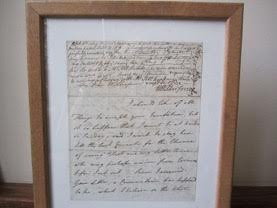
Image Source: My photo of a framed letter from William Pitt to his friend William Wilberforce (August 8, 1792) announcing his acceptance as Lord Warden of the Cinque Ports.

About the Author:

Stephenie Woolterton is currently writing a biography of William Pitt the Younger’s private life, primarily surrounding his female attachments. Her website is www.theprivatelifeofpitt.com and she’s on Twitter @anoondayeclipse.

Sunday, March 8, 2015

Lady Mahon: The Short Life of William Pitt’s Eldest Sister

by Stephenie Woolterton

Lady Hester Pitt, Viscountess Mahon
by an unknown artist, c. 1770s
Little is known about the short life of William Pitt the younger’s eldest sister, Lady Hester (Pitt) Stanhope, Viscountess Mahon (1755-1780). Unlike her daughter, also named Lady Hester Stanhope, Lady Mahon did not live past the age of sixty, and travel throughout Europe and the Middle East. Instead, she married at the age of 19 and died before her twenty-fifth birthday, her body exhausted from five successive pregnancies in as many years. Nevertheless, her life is worthy of historical attention as, like her younger siblings, she was raised under the backdrop of two political dynasties - The Pitts and the Grenvilles - and she was an example of a highly educated 18th century woman.

Lady Hester Pitt was born in October 1755, the first child of William Pitt the Elder (later 1st Earl of Chatham) and his wife Lady Hester (née Grenville). The Dictionary of National Biography lists her birthday as October 18th, 1755, although this has not been verified in baptismal registers. She was likely to have been born at the Pay Office, where her parents were then residing, and her mother was under the care of the famous 18th century London physician Dr. John Hunter [1]. It is probable that her father was absent when she was born as there are letters passing between the couple at the time [2].

It is not surprising that such was the case, as the Pitts spent great stretches of time apart throughout their marriage, much of it due to Pitt the Elder's own volition. Government business and trips to Bath (sometimes also for his health) usually kept him away from his wife, and she was forced to accept his frequent absences.

Unlike most girls at the time, Lady Hester benefitted from a thorough private education, being tutored at home by the family chaplain, Reverend Edward Wilson, alongside her sister Lady Harriot, and her three brothers, John (Lord Pitt), William, and James Charles. All five children were proficient in classical languages, translating ancient Greek, and quoting lengthy passages from Thucydides and Polybius [3]. Her childhood was split primarily between her parent’s two residences at Hayes Place, near Bromley in Kent, and Burton Pynsent, just outside the village of Curry Rival, Somerset.

She was accustomed to an upbringing full of scholarly stimulation and politics. Her father was raised to the peerage in the summer of 1766, the ‘Great Commoner’ becoming the first Earl of Chatham. In the following year, in a letter dated 17th June 1767, Jane Hamilton, Lady Cathcart writes to Hester’s mother Lady Chatham, speaking of a recent visit from three of the Pitt children. Lady Hester was eleven years old:

"…We had the finest Cricket Match in our Court you can imagine. You never saw anything more like a School Boy than Ld Pitt [John], wch I think says a great deal for his Education. The Young Ladies danced: Ldy Harriet in particular I think a genius in that talent, her little feet and all her little fair figure is delightful. Ldy Hester’s Stile and Air is different ... There is an openness, a Solidity and goodness in her [Hester] that makes one quite her friend. She was as Womanly and Careful that her Br and Sisr shd not over Eat or over Heat themselves as Dame Sparry [the children’s nurse] herself could have been, wch at her age [she was 11] is delightful, as she has as much of good hum[ou]r and liveliness as any of them…" [4]

From this passage, she is depicted as the caring sister looking after her younger siblings. Several years later, her mother the Countess of Chatham wrote to their cousin Mrs. Pitt, remembering Lady Hester and Lord Pitt’s recent stay at Boconnoc: “…Our Boy [John, Lord Pitt] and Girl [Hester], tho’ Harp and dancing, and Hounds and Hunting, have furnish’d their amusements, the delights of Cornwall do not cease to be regretted." [5]

Although Lady Hester did not suffer from nearly as many childhood illnesses as her brother William, there are records of her being treated by the family physician, Dr. Anthony Addington, for muscular pains and a rash in early 1772. At the time, the sixteen year-old Lady Hester was forced to take to her bed. Dr. Addington told her mother that, "The Pains which Lady Hester has felt in her Neck, Shoulders, Collar-Bone and Side, have been all muscular," and "...bleeding, purging and James’s Powder [quinine]" were used to treat her. [6]

After weeks of lying in her bed, and following Dr. Addington’s strictures, her ailment was still persisting. The doctor wrote again to Lady Chatham on February 1, 1772, advising a new course of treatment: “…I find it necessary for Her [Lady Hester] to have Patience with her Bed … I believe Your Ladyship and Lord Chatham are satisfied with me, that it is necessary to support Lady Hester with light and nutriceous [sic] diet … For this Reason, it must be right to allow Her Chicken, or Turkey or Rabbit for Dinner with Wine and warm water; to give Tea with toasted or untoasted Bread and very little Butter for Breakfast only; to use Broth or Sago or Panada for Supper; and thin jellies or Gruel between Meals…” [7] The nature of Lady Hester’s complaint is not entirely clear, but she recovered with time.

Charles, 3rd Earl Stanhope, by an
unknown artist (Wikimedia Commons)
By 1774, she was an eligible young woman, described by a family friend as “one of the most accomplished persons of the age.” [8] She certainly caught the eye of her second cousin, Charles Stanhope, Viscount Mahon. He was a tall, lanky, and eccentric young man who had recently returned to England after being educated in Geneva for ten years. Their grandparents Lucy Pitt and James, 1st Lord Stanhope, had married in 1713, producing six children including Charles’s father, Philip [9]. Unlike today, the couple’s familial relationship was deemed unimportant, and was in any case common amongst aristocratic marriages.

Lord Mahon was intelligent, scientifically inquisitive, and passionate about social reform. It was a love match, despite the familial connection, and he quickly proposed. On September 24, 1774, Mahon’s father Philip, 2nd Earl Stanhope, wrote to Lord Chatham to express his joy on hearing of the engagement: “My Son has rejoiced his Mother and me exceedingly by acquainting us with the proposal he has taken the liberty to make to dear Lady Hester, to whom he assures us it is not disagreeable. Our hearty approbation of a connexion which does him and us so much honour is already given, and nothing remains but the obtaining of your Lordships and Lady Chatham’s concurrence, which we flatter ourselves that the short acquaintance you have had with the young suitor has given you no cause to refuse. If we are so happy as to find you in the favourable dispositions which we wish, nothing in our power shall be wanting to settle everything as much as possible for the lasting happiness of so beloved a couple…” [10]

Lady Hester’s marriage settlement was duly drawn up. In an extract from the indenture, there was a particular provision stipulating that if she died before him, Lord Mahon would receive the Sum of £2,000 per year, “free from all Taxes and Deductions whatsoever.” [11] It may seem small in today’s currency, but it was quite a hefty sum at the time.

The couple married on December 19, 1774 at St. Mary the Virgin church in Hayes. Lady Mahon quickly fell pregnant, but she miscarried in April 1775. Her mother, the Countess of Chatham, attended her, and later wrote to Mrs. Pitt: “…I was obliged to quit my Patient at Home [Lord Chatham] yesterday to make a visit to my Daughter Mahon who is indispos’d from a Circumstance that brings some Mortification and disappointment with it. I had the Consolation however to find her better than I could have expected, and not likely to suffer long confinement…” [12]

Good news came in August, when Lady Chatham apprised Mrs. Pitt that, “…My daughter Mahon’s situation you will best understand by being told that she is both very sick, and very well.” [13] Lady Mahon was pregnant again. That child was Lady Hester Lucy Stanhope, born in London on March 12, 1776.

1778 Rate Book for Harley Street
(Westminster City Archives)
In the late 1770s, the Mahons were living at number 52 Harley Street, and paying £140 in rent [14]. Since the late 18th century, 52 Harley Street has become number 61. It served as their London residence when they were not staying at Chevening. Throughout her short marriage, Lady Mahon served as her husband’s secretary, assisting him in his new-fangled electrical experiments after he became obsessed with observing lightning strikes. At one point, Lord Mahon even attempted to induce lightning using a cow on the Chevening estate as a conductor. [15]

Over the next few years, Lady Mahon had a pregnancy that resulted in the birth of a stillborn son, and a daughter named Grizelda. In late February 1780, she gave birth to a third daughter, Lady Lucy Rachel Stanhope. Her recovery was complicated by the onset of puerperal fever. Lady Mahon was not able to write to her mother for over two months. On April 24, 1780, she told her mother, “I begin to feel very comfortable again after this long Illness,” and “…I go out every day in the Post Chaise and feel very great advantage from the Air which will I trust do all that is now to be done.” It was to be her last surviving letter. [16]

Chevening House in Kent (Wikimedia Commons)
Her health seemed to rally in the spring, and she was able to attend a ball, take drives in her chaise, and go shopping with her sister Lady Harriot for lute strings and chintzes [17].
Nevertheless, her condition suddenly worsened in the summer. On June 17, 1780, the Mahons were staying at their house on Harley Street, and Grace Trevor, the great friend Lady Lucy Stanhope, the unmarried sister of Philip, 2nd Earl Stanhope, wrote to Lady Chatham that she had recently had the pleasure “…to hear dear Lady Mahon is well. We felt much for them on account of the [Gordon] Riots in London: they are, I find, as we are, under the care of the Military.” [18]

St. Botolph’s Church, Chevening (Wikimedia Commons)
Then in a letter to their former tutor Rev. Wilson on July 11, 1780, William Pitt stopped him from visiting the Mahons in Harley Street, telling him, “Ld and Lady Mahon are both at Chevening, which I hope will have agreed better with her than London seem’d to do latterly.” [19] Sadly, the air of Chevening did not improve her failing health, and Lady Mahon died the following week on July 18, 1780. [20] She was buried in the South-east vault of St. Botolph’s church beneath the Stanhope Chapel. After Lady Mahon’s death, her three little daughters were left to the care of their grandmother, Lady Grizel Stanhope.

Within a year, Lord Mahon married his deceased wife’s cousin, Louisa Grenville, and he later had three surviving sons by her. It was an unhappy marriage, and in the coming years Charles, 3rd Earl Stanhope after 1784, would fall out with all six of his children, become estranged from his second wife, and take up with a music instructor. There is no mention in the surviving Pitt family correspondence concerning Lady Mahon’s death, but they would have been greatly affected by it. Lady Mahon's death came two years after her father's passing, and by the end of 1780, her younger brother James Charles also died in the West Indies. William Pitt had stood as godfather to Lady Lucy, Lady Mahon's youngest daughter, and he would later assist her when she married an apothecary. Viscountess Mahon’s legacy continued in her free-spirited daughter Lady Hester Stanhope, and in the descendants of her daughter Lady Lucy Rachel (Stanhope) Taylor.

References:
1. Birdwood, V. (ed.) So Dearly Loved, So Much Admired: Letters to Hester Pitt, Lady Chatham from her relations and friends (1744-1801). London: HMSO, p. 5.
2. Ibid, p. 6.
3. Lord Rosebery (1895) Pitt. London: Macmillan, p. 3.
4. Birdwood, V. (ed.) So Dearly Loved, So Much Admired: Letters to Hester Pitt, Lady Chatham from her relations and friends (1744-1801). London: HMSO, pp. 97-98.
5.  Hester Chatham to Mrs. Pitt, August 27, 1771. Dropmore Papers. British Library Add Ms 59490, f. 4
6. Birdwood, V. (ed.) So Dearly Loved, So Much Admired: Letters to Hester Pitt, Lady Chatham from her relations and friends (1744-1801). London: HMSO, p. 258.
7. Ibid.
8. Kent RO: Pitt MSS U1590, Thomas Cholmondeley of Vale Royal to Lady Stanhope, 8 October 1774.
9. Ellis, K. (2008) Star of the Morning: The Extraordinary Life of Lady Hester Stanhope. London: Harper Press, p. 12.
10. Philip, 2nd Earl Stanhope to Lord Chatham. September 24, 1774. PRO 30/70/5 f. 344.
11. An extract from Lady Hester Pitt’s marriage indenture. Stanhope MSS (C45), 17th December 1774.
12. Hester Chatham to Mrs. Pitt, April 13, 1775. Dropmore Papers. British Library Add Ms 59490, f. 24.
13. Hester Chatham to Mrs. Pitt, August 7, 1775. Dropmore Papers. British Library Add Ms 59490, f. 27.
14. The 1778 Rate Book entry for Harley Street, showing number 52: The house of Lord Viscount Mahon. Westminster City Archives, London.
15. Ellis, K. (2008) Star of the Morning: The Extraordinary Life of Lady Hester Stanhope. London: Harper Press, p. 21.
16. Lady Mahon to Lady Chatham, April 24, 1780. PRO 30/70/5, f. 358.
17. Headlam C. (ed.) The Letters of Lady Harriot Eliot. (1914) Edinburgh: Constable, Letter of 29 May 1780. 
18. Birdwood, V. (ed.) So Dearly Loved, So Much Admired: Letters to Hester Pitt, Lady Chatham from her relations and friends (1744-1801). London: HMSO, p. 213.
19. William Pitt to Reverend Edward Wilson, July 11, 1780. Rubenstein Rare Book & Manuscript Library, Duke University, Pitt MSS.
20. There are two primary sources for this date: The Gentleman's Magazine, Vol. 50, 1780, page 348, and The Dictionary of National Biography, Volume 45, by Sir Leslie Stephen and Sir Sidney Lee, (1896) page 366.

Image Credits:
Images were found via Wikimedia Commons. The portrait of Viscountess Mahon can be accessed via www.findagrave.com.

~~~~~~~~~~~~~~~

About the Author:
Stephenie Woolterton is currently writing a biography of William Pitt the Younger’s private life. Her website is www.theprivatelifeofpitt.com and she’s on Twitter @anoondayeclipse. 

Tuesday, August 12, 2014

There’s Something About Those Pitt Brothers

by Stephenie Woolterton and Jacqui Reiter

We have, accidentally and with no prior contact, found ourselves studying a pair of historical brothers. Stephenie has set up a website dedicated to her research on the private life of William Pitt the younger (1759-1806), and is also currently writing a non-fiction biography of his – you guessed it – private life. She is also working on an historical fiction novel about Pitt’s one love story with the Honorable Eleanor Eden. Jacqui is working on a novel about Pitt's elder brother John, 2nd Earl of Chatham (1756-1835), famous for being the "family failure" and commanding a disastrous military expedition to Walcheren in 1809.

Since our historical interests are brothers, we naturally consider ourselves sisters-in-research. We are both passionate about our subjects, and when we get together we tend to talk a great deal. This, then, is a taster for the English Historical Fiction Authors blog of what happens when we Pitt fangirls – or, as someone once called us, the "Pittettes" – put our heads together.

Stephenie has created an open Facebook group called "The William Pitt the Younger Appreciation Group." We asked the members to think of some questions they would like us to answer about Mr. Pitt and Lord Chatham. We received several fabulous questions, and hope our answers will provide an entertaining and informative introduction to the Pitt boys and why we think everybody ought to love them as much as we do.

William Pitt the Younger and John, 2nd Earl of Chatham

 Question 1. Why William Pitt the Younger? Why the 2nd Lord Chatham?

Stephenie: If I had a penny for every time someone asked me this question, I’d be a millionaire! William Pitt the Younger, not to be confused with his father, William Pitt the Elder, was not only the youngest person to ever become head of the British government (at 24 years old), but he was also a Member of Parliament at 21, and his first term as Chancellor of the Exchequer was at the tender age of 22. Apart from Sir Robert Walpole, Pitt was the second-longest serving holder of the combined offices of First Lord of the Treasury and Chancellor of the Exchequer. However, it isn’t just his sheer longevity in office that is noteworthy. Many have heard of Pitt from history lessons in school, or as the man who first instituted income tax (albeit Pitt honestly saw it as a temporary measure). Some might also be aware that he died a bachelor during his second term in office. 

Pitt was an extremely private man, and he was ever careful in the choice of his words and in the content of his correspondence. After his death, much of his private papers were destroyed by one of his executors, his friend and former tutor George Pretyman-Tomline, so his personal life remains a perplexing mystery. Over the past two centuries since his death, his views – political and otherwise – have been interpreted in various contradictory ways, and in truth, he is a figure that appeals to many different types of people. He was a child prodigy, and he spoke and wrote in Greek and Latin by the age of 7. His grasp of mathematics was nothing short of awe-inspiring.

I came to Pitt in an indirect way. As an American interested in history, I learned about Pitt during my research on the American War of Independence. As I’ve lived in London, England for over a decade, my passion for British history and politics also took me in the direction of Pitt. If you study British political history, you almost cannot avoid him. There’s something special about his precociousness, his rise to power at an early age, and his maintenance of that power for over 19 years (and two terms in office), with only death separating him from that position.

Jacqui: Unsurprisingly, I came to Chatham through Pitt the Younger. I started writing a novel about Pitt while working on my PhD thesis on the politics of national defense during the Napoleonic Wars. Somewhere along the line I switched to Chatham's point of view. Somewhat to my own surprise I discovered I liked him.

I say “somewhat to my own surprise” because his historical reputation is  poor. He was reportedly very lazy, nicknamed “the late Lord Chatham”, and the 1809 expedition to Walcheren did not exactly cover him with laurels. He's often characterized as an arrogant scrounger.[1] I shan't say more here, because I could go on for hours, but while he definitely lived up to his reputation for indolence, there was so much more to him than that.

In many ways he is an overlooked figure. His identity and relationship to Pitt put him close to the heart of government, and he was also a wartime First Lord of the Admiralty and Master of the Ordnance. From a novelist's point of view he's pure gold. What must it have been like to be the elder brother of a political prodigy? How must Chatham have felt in the twin shadows cast by his father and brother?

Question 2. What would be Pitt and Chatham's reaction to modern-day Parliamentary politics? Which party would they join?

Stephenie: The only political distinction Pitt ever made was in 1779, at the age of 20, when he declared, “I do not wish to call myself any Thing but an Independent Whig.” [2] He believed in the Constitution as settled at the Revolution of 1688, and yet he stood apart as a non-party man. It is true that at the beginning of his political career he made several unsuccessful motions for parliamentary reform, and he supported the efforts for the abolition of the slave trade. He could have done more, but then he was the prime minister, and he had to be a jack-of-all-trades, as it were.

Pitt was a political pragmatist, and a financial administrator. I believe if he were to see modern-day Parliamentary politics, I truly believe he would be fascinated. Of course, he never supported the idea of universal suffrage, but he did hold quite liberal views for his time. If he could take part in 21st century politics, I believe he would throw himself entirely into it just as he did in the late 18th and early 19th centuries. As far as which political party Pitt would join, I have often thought of this question. I believe if Pitt were to align himself with any party, which he would have to do in order to be successful in the modern political world, he would most likely be a Conservative with liberal leanings.

Jacqui: If Chatham stepped through a wormhole and landed in modern-day Westminster he would probably approve of the way things are still done (he'd probably need a few minutes to calm down from the shock though, as well as a large tumbler of brandy).

He would probably recognize enough of the 18th century political system in the 21st century one to reassure him. Britain is still a monarchy; Parliament is still much as it was, even with universal suffrage, women MPs and so on. He'd be upset about the decrease in importance of the Queen and the House of Lords, but Chatham would probably feel reassured that all the work he and his brother undertook to stop the French Revolution crossing the Channel had not been in vain, and that the British Constitution, though added to, still relies on familiar Blackstonian precedents.

As for what party he would have joined, well...he might not see the point. That doesn't mean he would not have an opinion. Like all Pitts, Chatham definitely knew his political mind. He was not afraid to differ from Pitt, as he did on many of the weighty ideological issues of the period: political emancipation of Catholics and other non-Anglican denominations, the abolition of the slave trade, parliamentary reform, and so on. He would probably find most in common with the Conservatives, although I suspect he would look down his impressively long nose at all that pandering to the middle classes.

Question 3. To quote: "Did John and William ever paint the town red when they were young and wake up next morning blaming each other for the hangovers and a mysterious girl named Augusta?"

Stephenie: Pitt was known for loving port wine to an excessive degree, and Chatham liked wine as well, so I wouldn’t be surprised if the brothers had a bit too much to drink together on more than one occasion.  We do know that on February 28, 1784, Mr. Pitt was presented with the Freedom of the City of London at his brother’s house on Berkeley Square. Lord Chatham then accompanied Pitt and their brother in-law Lord Mahon to Grocer’s Hall for a lavish banquet. Needless to say, if the amount of toasts given is any indication, it can be inferred that much wine was consumed that night:

“The King; The Queen and the Royal Family; the Navy of Great Britain; the three branches of the legislature, and may the balance of power be preserved as fixed at the glorious revolution; may the present administration emulate the conduct of the late earl of Chatham of immortal memory, and may they continue to merit the same confidence and support of the people; the privileges and chartered rights of the United Kingdom; confusion to all those who would usurp on the rights of the king, the lords, or the people; may this free constitution continue unimpaired to the end of time; success to a reform in the representation of the people in parliament, and the shortening the duration of the power of the representatives; may the people continue to love and support their best friends. Mr. Pitt drank “success to the grocer’s company;” Lord Chatham, “the real sense of the people…” [3] You get the picture.

The toasts just kept on going from there. There must have been twenty toasts. On their way home, Pitt’s carriage, with him, Lord Chatham, and Lord Mahon inside, was attacked on St. James’s Street by rioters. Lord Chatham’s gold watch was stolen, and they had to flee inside White’s gentleman’s club in order to escape the blows of their attackers. Although they were largely unscathed, their carriage was completely destroyed. They must have suffered a severe emotional shock from the experience. As far as other occasions go where Pitt and Chatham shared a brotherly tipple together, I’m sure it happened on numerous occasions. As far as “Augusta” is concerned, I don’t think that would be recorded.

Jacqui: Stephenie is right about Chatham sharing Pitt's love of wine. I'm sure they got drunk together on occasion. Still, I doubt they “painted the town red” together. It's just not something I can see Chatham doing, although Pitt would definitely be up for it. Take this for example:

"Some little excess happen'd lately in Wimbledon. ... In the evening some of the neighbours were alarmed with noises at their doors, but nobody, I believe, has made any reflection upon a mere frolic – It has only been pleasantly remarked, that the rioters were headed by Master P– late Chancellor of the Ex–, and Master Arden, late Solicitor Gen".[4]

Chatham was always very conscious of his dignity and standing. Later in life his niece Lady Hester Stanhope described him travelling in great state. Nobody ever contrived "to appear as much of a prince as he does –his led horses, his carriages, his dress, his star and garter, all of which he shows off in his quiet way with wonderful effect".[5] Rather than joining in with Pitt's bumptious behaviour, I can picture Chatham telling him off in his role as head of the family.

I'm saying nothing about "Augusta".

Question 4. Was either brother left-handed? What colour were their eyes?

Stephenie: Mr. Pitt was definitely right-handed. In a letter written to his mother on 15th April 1779, Pitt was forced to write with his non-dominant left-hand due to a painful whitlow “having disabled my right Thumb from holding a Pen,” but he found it “so bad a Secretary that I must content myself with thanking you for your letter, and assuring you that I am in other respects perfectly well, resuming every thing else till this Substitute is become more expert, or the Principal again restor’d to it’s office.”[6]

Pitt to his mother with his left hand, 15 April 1779

I’ve also found evidence that his eyes were blue, like his father. Pitt’s first posthumous biographer, Henry Cleland, described Pitt as follows: “His person was tall and slender, his complexion rather fair, with blue eyes, large forehead, and prominent features; his countenance was strong, thoughtful, and rather stern, except when enlivened by some sudden impulse.”[7] All Pitt’s portraits seem to also suggest that his eyes were blue, with a hint of grey.

Jacqui: I have no evidence Chatham was right-handed, but I believe he must have been. His handwriting certainly has a marked rightward slant. In any case had he shown a tendency to be left-handed I suspect it would have been "corrected" by his tutor.

Lord Chatham's handwriting

As for his eyes, they were blue. This is clear in all his portraits, particularly the one by George Romney, currently at Chevening House.

Question 5. What were they like as children? Was Pitt as whiny as Blackadder portrays him?

A young boy, thought to be Pitt,
as a child – George Romney

Stephenie: The playwright and dramatist Frederick Reynolds (1764-1841) remembered going with his father to Hayes Place – the home of the Pitt family – in the early 1770s. There he met Lord Chatham's family for the first time, including their precocious young son William Pitt (then only about 11 or 12 years old). Reynolds recorded this experience for posterity, and it gives a small insight into Pitt as a young boy:

"His Lordship [Lord Chatham], I remember, was very kind to me, and on quitting the room with my father, desired his son William Pitt, then a boy about four years older than I was, to remain with, and amuse me, during their absence. Somehow, I did not feel quite bold on being left alone with this young gentleman. For a time, he never spoke, till at last, slyly glancing at him, to learn who was to commence the conversation, and observing mischief gathering in the corner of his eye, I retired to the window; "but gained nothing by my motion." He silently approached, and sharply tapping me on the shoulder, cried jeeringly, as he pointed to my feet, "So, my little hero, do you usually walk in spurs?" – "Walk?" I replied: "I rode here on my own pony." "Your own pony!" – He repeated with affected astonishment; "Your own pony? Upon my word! – and pray, what colour may he be? – probably blue, pink,  or pompadour?" At this moment, the present Lord Chatham [John Pitt, 2nd Lord Chatham, then fifteen] entering the room, the tormentor exclaimed, "I give you joy, brother, for you are now standing in the presence of no less a personage then the proprietor of the pompadour pony!" His brother frowned at him, and I was bursting with rage and vexation, when he coolly turned towards me, and said, "Your life is too valuable to be sported with. I hope you ride in armour?" "Be quiet, William – don't trifle so," cried his brother. "I am serious, John," he replied; "and if for the benefit of the present race he will preserve his life, I will take care it shall not be lost to posterity, for as my father intends writing a history of the late and present reigns mark my word, my little proprietor, I will find a niche for you, and your pompadour pony in the History of England." I could no longer restrain my spleen, and fairly stamped with passion to his great amusement. At this moment, the door opening, my facetious tormentor instantly cantered to the opposite side of the room, after the manner of a broken down pony, and then placing his finger on his lips, as if to forbid all tale-telling, disappeared at the other entrance. In course, every feeling of rage was smothered in the presence of the great Lord Chatham, and my father having taken his leave, mounted his horse, and trotted through the Park; I following on my pony, and delighting in my escape. But as I reached the gates, I was crossed in my path "by the fiend [William] again," – but, agreeably crossed, for he shook me by the hand with much good-humour, playfully asked my pardon, and then added, patting my pony, "He [Pitt] should at all times be happy to find both of us accommodation at Hayes, instead of a niche in the History of England."[8]

Although I would argue that Pitt was not the whiny boy as portrayed in the Blackadder TV series, he was conscious of his intelligence, and not afraid to demonstrate his wit on other unsuspecting people.

Jacqui: John was much the same as a child as he was later in life. He was much more serious than Pitt. He was bright: their tutor, Edward Wilson, recorded the Pitt children's grades for the benefit of the first Lord and Lady Chatham, and John frequently got better marks than William.[9] But he was also pleasure-loving, dancing the night away or running off with horse and hounds.

As for the second part of the question, the brothers were close, but I still suspect Chatham's answer would be "Yes! Yes, he was a whiny little brat!" Not sure what tipped me off about that. Maybe it was John's reaction in the story Stephenie quotes above about the pompadour pony. Maybe it was this line from a letter written by William at eleven, in which he passes comment on fourteen-year-old John's classical grammar: "Your Greek was excellent, and (I think) with practice you may become a Thucydides",[10] Enough said, right?

Question 6. Other than family matters, what interests did Pitt and Chatham share?

Stephenie: Chatham and Pitt shared a few similar interests. They were brothers with only a three-year age gap between them, and the vast majority of their childhood was spent under the same roof. They were raised to have a fierce loyalty to their country. It can be argued that to a large extent both brothers adhered to this sense of patriotism. Chatham joined the army at the age of 17, and Pitt immersed himself in politics by the age of 21. They both served their country in some capacity, and they both always consciously knew they were members of the Pitt family. They were the sons of the great ‘immortal Lord Chatham.’

Pitt and Chatham both enjoyed a love of wine, although Chatham’s consumption was probably quite a bit less than Pitt’s overindulgences, for it did not materially shorten his life as it did with Pitt.

The brothers loved horseback riding, and were encouraged from an early age to ride for health as well as for sport. They rode hard, and for many miles at a stretch. The Duke of Wellington later recorded to Pitt’s biographer, the 5th Earl Stanhope, that “a great deal was always said about his [Pitt] taking his rides – for he used then to ride eighteen or twenty miles every day – and great pains were taken to send forward his luncheon, bottled porter, I think, and getting him a beef-steak or mutton-chop ready at some place fixed beforehand…at dinner Mr. Pitt drank little wine; but it was at that time the fashion to sup, and he then took a great deal of port-wine and water.”[11]

Sir Egerton Brydges, in his autobiography, mentions Pitt’s noted love of riding, even whilst partaking in hunting (shooting):

“I was never introduced to Pitt: I saw him sometimes in the field, on hunting days, when he came down to Walmer. He seemed to delight in riding hard, with his chin in the air; but I believe had no skill as a sportsman – seeking merely exercise, and thinking, as Dryden says, that it was ‘better to hunt in fields for health unbought, than see the doctor for his noxious draught.’”[12] In his own way, Pitt enjoyed shooting, like his brother Chatham, although I believe his older brother was more successful in this pursuit.

Jacqui: Both brothers were accomplished classicists (Pitt's comments on Chatham's conjugations notwithstanding), and as Stephenie points out both loved field sports. Chatham's love of the chase started very early (I've seen references to him chasing hares in his very early teens) and he took a holiday every year in September and October, and often January and February as well, to enjoy the game on his own estate or that of a friend. He may, er, have neglected his official cabinet duties on occasion to go shooting, although he always came back to town if summoned.

Pitt and Chatham were also hard riders, and good ones at that, although Chatham managed to get kicked hard enough by a horse to break his leg.

Those shooting sessions for which Chatham received so much stick as a cabinet minister may have been medically necessary. He was never robust, described as “of a middling constitution … frequently ailing” while First Lord of the Admiralty.[13] As he got older and the stresses mounted – his wife suffered from recurring mental illness later in life – Chatham looked on shooting as a form of therapy: "We shot a good deal, and the exercise has rather been of use to me".[14]

While serving as governor in Gibraltar Chatham suffered from strong homesickness and depression, intensified by the fact the local terrain prevented him from taking the long rides he had been used to: "I own I am not very partial, to this place … What I most feel as a grievance is that the riding in Spain is so bad, and the wading to it, thro' the sand, is so tedious, that it requires great resolution, to take the exercise one ought to do here".[15]

Exactly how important exercise was to him can be gauged by the fact Chatham was having himself hoisted daily on horseback long after the use of his legs failed him in his late seventies.[16]

Question 7. Pitt and Napoleon settle things by arm wrestling: who wins?

Stephenie: Pitt. Every time. Hands down. Napoleon’s ego always gets in the way.

Jacqui: Pitt has the advantage of height, but Napoleon cheats by getting a bigger stool. Since Pitt always plays by the book ... Napoleon wins.

Question 8. "Can you include something about the tax on hair powder and how the Whigs and Tories were jokingly called guinea pigs?"

You mean this one? [17]
 
“Buy my pretty guinea pigs!”

References

[1] Sir Nathaniel Wraxall, Posthumous Memoirs of My Own Time (London, 1836) III, 129; David Andress, The Savage Storm (London, 2012) pp 134-5
[2] John Ehrman, The Younger Pitt: The Years of Acclaim (London, 1969)  p 59
[3] The Chelmsford Chronicle, 5 March 1784
[4] Robin Reilly, Pitt the Younger (London, 1978) p 84
[5] Lady Hester Stanhope to Lord Haddington, 15 Nov 1803, quoted in The Life and Letters of Lady Hester Stanhope, ed. Duchess of Cleveland (London, 1914) p 52
[6] Pitt to the Dowager Countess of Chatham, 14 April [1779], PRO 30/8/12 f 49
[7] Henry Cleland, Memoirs of the life of the Right Honourable William Pitt … (London, 1807) p 337
[8] Frederick Reynolds, The Life and Times of Frederick Reynolds (London, 1826) II, 67-69
[9] See Wilson's letters to Lady Chatham in the summer of 1766 and 1767, PRO 30/8/12
[10] J.H. Rose, William Pitt and National Revival (London, 1911) p 45
[11] Philip, Lord Stanhope, Life of Pitt IV, 346-7
[12] Sir Egerton Brydges, The Autobiography, Times, Opinions, and Contemporaries of Sir Egerton Brydges … (London, 1834) I, 37
[13] 19 July 1794, in Joseph Farington, Diary of Joseph Farington (London, 1922) I, 64
[14] Chatham to Tomline, 22 September 1819, Ipswich RO HA 119/562/688
[15] Chatham to Tomline, 27 February 1822, Ipswich RO HA 119/562/688
[16] Morning Post, 12 January 1833

~~~~~~~~~~~~~

About the Authors:

Stephenie Woolterton has an MSc in Social Research, and a background in Psychology. She is currently researching and writing her first book on the private life of William Pitt the Younger. She is also working on a historical novel about Pitt’s ‘one love story’ with Eleanor Eden. She has a website at: www.theprivatelifeofpitt.com and can be contacted via Twitter at: www.twitter.com/anoondayeclipse.

Jacqui Reiter has a Phd in 18th century political history. She believes she is the world expert on the life of the 2nd Earl of Chatham, and is writing a novel about his relationship with his brother Pitt the Younger. When she finds time she blogs about her historical discoveries at http://alwayswantedtobeareiter.wordpress.com/.