
When is a Castle not a Palace?

Recently I circulated a photograph taken by my colleague Ron Morrison showing his wife Maryanne, our mutual friend Ian Lumsdaine, and me approaching Ferniehirst Caste, located on the east bank of the Jed Water near Jedburgh. My friends from the MarieStuartSociety gifted me with a visit there, knowing it was the number one destination on my Bucket List. One of my friends who saw the picture in an email replied, ‘You must have been sorely disappointed. It is so plain.’
I could not disagree with my friend’s assessment. Ferniehirst was designed not to attract visitors but to repel them. [1] In those days, Ferniehirst was strategically placed at the top of a steep ravine, on land so heavily forested that invading English forces often did not see it until pikes tossed from the battlements pierced their armor. Its defenders were known for their ruthlessness-- a trait celebrated in Laidlaw's poem, the Reprisal. The invaders were not always English. From time to time, the Kers of Ferniehirst squared off against their Cessford cousins. In spite of their service to the Scottish crown and relative success in policing the Borders, at heart, the Kers were among the most feared surnames among the Reivers. They had their share of enemies.
The castle is arguably the best preserved of the Border fortresses along the Middle Marches, and presently owned and occupied by indirect descendants of the Kers of Ferniehirst, who built it on what may have been a Roman ruin. It exists much as it appeared after its reconstruction by Sir Andrew Ker of Ferniehirst in 1598, five years before James VI of Scotland became James I of England and declared the Borders ‘pacified.' It was James who had leveled it a few years prior when Sir Andrew Ker of Feriehirst aligned himself with the king’s rebellious cousin Lord Francis Stewart, 5th Earl of Bothwell. In the transpiring four hundred years, the woodlands above the Jed have been deforested, and a modern visitor sees Ferniehirst as a castle built on fertile farmland, not as the 16th Century fortress from whence a mighty band of reivers rode.
The Kers were known for a statistically improbable degree of left-handedness. The stairways at Ferniehirst were counterclockwise, to give the advantage to the Kers in a close-quarters fight. At least a segment of one of them survives. Other examples of the counterclockwise stairs exist at the residence the Laird of Ferniehirst maintained in Jedburgh known as Queen Mary's House. Marie Stuart stayed there when she visited Jedburgh for the Assizes held in the fall of 1566. She fell ill during her stay there and nearly died. In spite of its name, Marie Stuart never owned the house but leased it when the Spread Eagle Inn where she had been lodged suffered a suspicious fire. There is speculation Marie Stuart may have stayed at Ferniehirst, but no evidence to support it other than the strong ties she had to Sir Thomas Ker and his son Andrew, who remained her loyal supporters long after she was forced to abdicate.
As it stands, Ferniehirst remains much as it was at the time of the Union of the Crowns in 1603. And yes, it lacks the elaborate façade and mullion windows of a northern palace like Linlithgow or Sterling. It was a formidable Border Tower, not a palace. One of the beauties of Ferniehirst is the castle’s integrity with its past. Thus, my answer to my friend is, ‘No. I am not the least disappointed in Ferniehirst, and I thank the later generations of Kers for resisting any urge to embellish it with the trapping of a palace. [2]
Hogwarts/Alnwick?


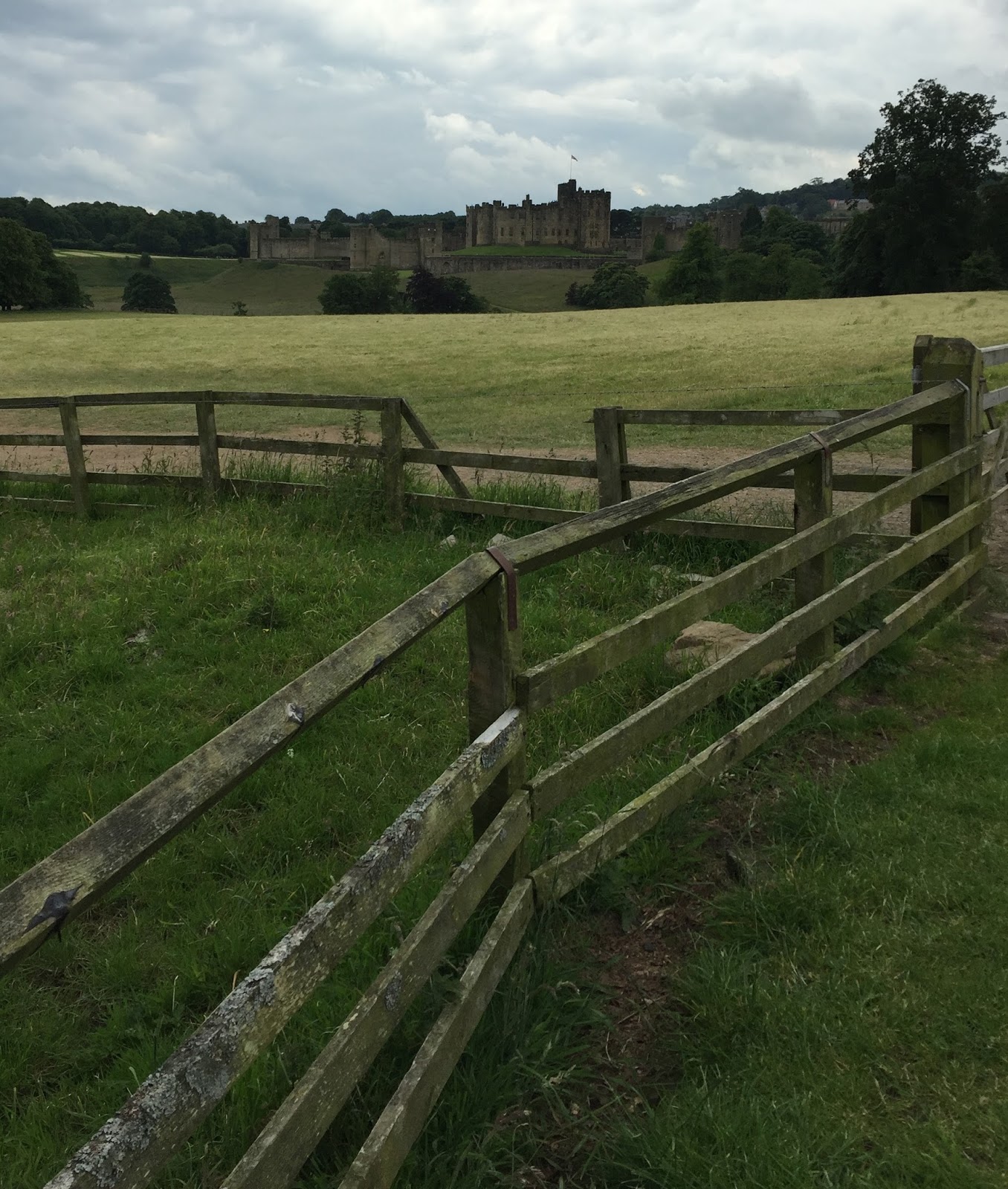
The difficulty with Alnwick is navigating the hordes who come to visit Hogwarts or the rooms at Downtown Abbey. But, like Ferniehirst, the Alnwick of Marie Stuart’s reign and that of the early Stuart kings of England was also a fortress. In my novel In the Shadow of the Gallows, my protagonists approach it from the direction depicted in this photograph, which shows how strategically it was placed.
 It was a mere 25 miles from Flodden, and 32 miles from the Tweed at Coldstream. Unlike the Alnwick in my novel, the actual castle was largely uninhabited from 1572 until the 18th century. Except for the more than one-hundred-year hiatus, it has been a residence for the Percys from 1309 to the present. Its basic structure has not changed significantly since the12th Century, but the castle has been embellished and renovated many times. It retained a significant military flavor until the Borders were actually pacified. During the Civil War, Cromwell used it to stable horses and as a Prisoner-of-War camp. The Earl of Northumberland, Algernon Percy, served as guardian of ill-fated Charles I’s children, who lived with the Percys at Warkworth and later, at Syon House in Metropolitan London. The present castle’s interior has largely been redesigned in a palatial style credited to Anthony Salvin, who in 1852 began a large-scale restoration of Alnwick, removing the Strawberry Hill Gothic interior created a hundred years earlier by Robert Adam, replacing one of the towers, and creating the present exquisite interior.
 During Victoria’s reign, interior rooms opened to the public were given an Italianate flair by architect Luigi Canina. Thus, unlike Ferniehirst, the present Alnwick may structurally resemble the original border castle to one who has studied it, but it lacks the austerity of a military structure such as Ferniehirst.
There is a seductive link between Ferniehirst and Alnwick tempting to any historical novelist captivated by the Border Lore that evolved during the days when steel-bonneted Reivers ruled the Marches, and later romanticized by Sir Walter Scott. ‘Every valley has its battle, and every stream its song,’ he wrote in a letter to a friend. Students of Border politics during the latter Sixteenth Century will recall the existence of a body of law unique to the Borders, and not especially centered on such concepts and nationalism and sovereignty. Thus, it is not surprising that the leaders of the ill-fated Northern Rebellion of 1569, the Earls of Northumberland and Westmoreland and their ladies, fled to the Borders just ahead of Elizabeth Tudor’s army. When the powerful Armstrong Border family considered betraying the fugitives to the English if the price was right, Sir Thomas Ker of Ferniehirst rescued both of the countesses and the Earl of Westmoreland. The entire affair went against the Reiver’s Creed, in which political fugitives entering the Borders were given sanctuary. Lord and Lady Ferniehirst gave them safe haven at Ferniehirst Castle, and eventually orchestrated their escape to the Low Countries.
The Earl of Northumberland, who was not as canny as the others and had more derring-do than his situation warranted, fell into the clutches of the Scottish Earl of Morton, an act which enraged most Borderers and ultimately contributed to Morton's fall. In 1572 when Morton was the Scottish Regent, he traded Northumberland to Elizabeth as part of a deal in which she sent her siege guns to dislodge forces loyal to the Queen of Scots from Edinburgh Castle. Tommy Ker of Ferniehirst was among the great castle’s defenders whose life was spared, but to punish him for aiding and abetting men whom Elizabeth considered traitors, he was forfeited and sent into exile, and Ferniehirst was leveled. After Sir Thomas died, his son Andrew Ker had barely restored it when it was reduced to ruin again in 1593, the third time in a century when Ferniehirst was reduced to a rock pile. And yet, the castle stands, a sentinel on the east bank of the Jed.
Across the Border to the South, the Percy stronghold of Alnwick ranks among the top English historical homes open to tourists. The 12th Duke of Northumberland, Lord Ralph Percy and his family live in a portion of the castle not open to the public.
Neither Ferniehirst nor Alnwick is a fairytale castle the likes of Mont San Michel on the French Coast or Neuschwanstein in Germany, but they have the unique distinction of not only remaining habitable but pridefully occupied by descendants of those who defended them nearly five hundred years ago.

For a deeper understanding of the evolution of the early keeps to the versatile British fortified houses and beyond,
see: Emery, Anthony (1996), Greater Medieval Houses of England and Wales, 1300–1500, Volume I: Northern England, Cambridge University Press, ISBN 978-0-521-49723-7
This is an Editor's Choice from the #EHFA Archives, originally published August 10, 2016.
~~~~~~~~~~
Linda Root is an author of historical novels set in Marie Stuart's Scotland or during the reign of her son James VI and I. She is a retired major crimes prosecutor living in the hi-desert above Palm Springs. She also writes fantasy fiction under the name of J.D. Root, of which The Green Woman, set at Ferniehirst, is her debut. Her historical novels can be found on Amazon.

Recently I circulated a photograph taken by my colleague Ron Morrison showing his wife Maryanne, our mutual friend Ian Lumsdaine, and me approaching Ferniehirst Caste, located on the east bank of the Jed Water near Jedburgh. My friends from the MarieStuartSociety gifted me with a visit there, knowing it was the number one destination on my Bucket List. One of my friends who saw the picture in an email replied, ‘You must have been sorely disappointed. It is so plain.’
I could not disagree with my friend’s assessment. Ferniehirst was designed not to attract visitors but to repel them. [1] In those days, Ferniehirst was strategically placed at the top of a steep ravine, on land so heavily forested that invading English forces often did not see it until pikes tossed from the battlements pierced their armor. Its defenders were known for their ruthlessness-- a trait celebrated in Laidlaw's poem, the Reprisal. The invaders were not always English. From time to time, the Kers of Ferniehirst squared off against their Cessford cousins. In spite of their service to the Scottish crown and relative success in policing the Borders, at heart, the Kers were among the most feared surnames among the Reivers. They had their share of enemies.
The castle is arguably the best preserved of the Border fortresses along the Middle Marches, and presently owned and occupied by indirect descendants of the Kers of Ferniehirst, who built it on what may have been a Roman ruin. It exists much as it appeared after its reconstruction by Sir Andrew Ker of Ferniehirst in 1598, five years before James VI of Scotland became James I of England and declared the Borders ‘pacified.' It was James who had leveled it a few years prior when Sir Andrew Ker of Feriehirst aligned himself with the king’s rebellious cousin Lord Francis Stewart, 5th Earl of Bothwell. In the transpiring four hundred years, the woodlands above the Jed have been deforested, and a modern visitor sees Ferniehirst as a castle built on fertile farmland, not as the 16th Century fortress from whence a mighty band of reivers rode.
 |
| 'Queen Mary's House - Jedburgh |
As it stands, Ferniehirst remains much as it was at the time of the Union of the Crowns in 1603. And yes, it lacks the elaborate façade and mullion windows of a northern palace like Linlithgow or Sterling. It was a formidable Border Tower, not a palace. One of the beauties of Ferniehirst is the castle’s integrity with its past. Thus, my answer to my friend is, ‘No. I am not the least disappointed in Ferniehirst, and I thank the later generations of Kers for resisting any urge to embellish it with the trapping of a palace. [2]
Hogwarts/Alnwick?


Unlike Ferniehirst, Alnwick Castle (pronounced ah-nick) in Northumberland is very much a tourist destination. For an armchair historian to enjoy it, one must squint and imagine it as it was. For tourists unaccustomed to turnabouts and vehicles with right-hand steering and the roads to match, the easiest way to access the ancestral seat of the mighty Northern Earls of Northumberland is by tour bus. My point of embarkation was a coffee house in Old Town Edinburgh, and the tour was ideal. For the price of a ticket to the gardens and the castle, one could wander about at will for three hours. For someone already familiar with the castle’s history, this is indeed ideal.
The difficulty with Alnwick is navigating the hordes who come to visit Hogwarts or the rooms at Downtown Abbey. But, like Ferniehirst, the Alnwick of Marie Stuart’s reign and that of the early Stuart kings of England was also a fortress. In my novel In the Shadow of the Gallows, my protagonists approach it from the direction depicted in this photograph, which shows how strategically it was placed.

There is a seductive link between Ferniehirst and Alnwick tempting to any historical novelist captivated by the Border Lore that evolved during the days when steel-bonneted Reivers ruled the Marches, and later romanticized by Sir Walter Scott. ‘Every valley has its battle, and every stream its song,’ he wrote in a letter to a friend. Students of Border politics during the latter Sixteenth Century will recall the existence of a body of law unique to the Borders, and not especially centered on such concepts and nationalism and sovereignty. Thus, it is not surprising that the leaders of the ill-fated Northern Rebellion of 1569, the Earls of Northumberland and Westmoreland and their ladies, fled to the Borders just ahead of Elizabeth Tudor’s army. When the powerful Armstrong Border family considered betraying the fugitives to the English if the price was right, Sir Thomas Ker of Ferniehirst rescued both of the countesses and the Earl of Westmoreland. The entire affair went against the Reiver’s Creed, in which political fugitives entering the Borders were given sanctuary. Lord and Lady Ferniehirst gave them safe haven at Ferniehirst Castle, and eventually orchestrated their escape to the Low Countries.
The Earl of Northumberland, who was not as canny as the others and had more derring-do than his situation warranted, fell into the clutches of the Scottish Earl of Morton, an act which enraged most Borderers and ultimately contributed to Morton's fall. In 1572 when Morton was the Scottish Regent, he traded Northumberland to Elizabeth as part of a deal in which she sent her siege guns to dislodge forces loyal to the Queen of Scots from Edinburgh Castle. Tommy Ker of Ferniehirst was among the great castle’s defenders whose life was spared, but to punish him for aiding and abetting men whom Elizabeth considered traitors, he was forfeited and sent into exile, and Ferniehirst was leveled. After Sir Thomas died, his son Andrew Ker had barely restored it when it was reduced to ruin again in 1593, the third time in a century when Ferniehirst was reduced to a rock pile. And yet, the castle stands, a sentinel on the east bank of the Jed.
Across the Border to the South, the Percy stronghold of Alnwick ranks among the top English historical homes open to tourists. The 12th Duke of Northumberland, Lord Ralph Percy and his family live in a portion of the castle not open to the public.
Neither Ferniehirst nor Alnwick is a fairytale castle the likes of Mont San Michel on the French Coast or Neuschwanstein in Germany, but they have the unique distinction of not only remaining habitable but pridefully occupied by descendants of those who defended them nearly five hundred years ago.

Notes:
[1] Ferniehirst is not a tourist destination in the wider sense. It is a private residence of Lord Ralph Kerr,(the modern spelling of the name), heir presumptive to the Marquisate of Lothian, (a title held by the Ancrum Kerrs) whom I had the pleasure of meeting. Its cultural significance is in the able hands of its curator, Bob Lawson. The site is open for tours Tuesday through Sunday during the month of July, and are hosted by the curator. His stage presence and knowledge of the topic make it well worth the price of the 5GBP ticket.
[2] Two excellent sources on Ferniehirst and Kers include 1) Lawson, Bob, The Kerrs of Ferniehirst 1205-1692, a limited edition publication available from the author, and 2) Kerr, Anthony, Ferniehirst Castle, Scotlands Frontier Stronghold, Kelso, 1985, currently out of print. Thankfully, I have two copies
For a deeper understanding of the evolution of the early keeps to the versatile British fortified houses and beyond,
see: Emery, Anthony (1996), Greater Medieval Houses of England and Wales, 1300–1500, Volume I: Northern England, Cambridge University Press, ISBN 978-0-521-49723-7
This is an Editor's Choice from the #EHFA Archives, originally published August 10, 2016.
~~~~~~~~~~


