Showing posts with label Sarah Siddons. Show all posts

Tuesday, June 14, 2016

Playing the Provinces: 18th Century Actors on the Move, Part 2 (York, Bristol & Bath)

by Margaret Porter
 
This is the second part of Playing the Provinces. Follow this link to Part 1, featuring the provincial theatres of Liverpool & Manchester.


York


Tate Wilkinson
This city's Theatre Royal (patented in 1759) was managed by Tate Wilkinson, who left behind verbose and entertaining memoirs of his theatrical career and the personalities he encountered. He was an actor, but as mentor he nurtured the talents of many of the era's greatest players--and never failed to take credit for it. He was proprietor not of a single theatre, but of an entire circuit that included lesser Yorkshire theatres: Leeds, Hull, Wakefield, Doncaster, and Pontefract. He had an interest in the Edinburgh theatre as well, and his company also performed in Halifax, Beverley, Sheffield, and Newcastle. His 'theatrical army' as he termed it, in the 1770s and '80s included Sarah Siddons, John Philip Kemble, Stephen Kemble, Frances Kemble, Elizabeth Kemble, Dorothy Jordan, Elizabeth Inchbald, Dicky Suett, and Mrs Baddeley. Eventually he surrendered them to the Theatres Royal in London, but occasionally they returned for special engagements.

The York circuit followed the racing calendar, performing during the race week in its various towns. Wilkinson prided himself on his ability to offer actors year-round employment, rather than only for a summer season as at other provincial theatres, e.g. Liverpool. Among the London acts he lured to York 1785 was Signior Scaglioni, who, 'with his dancing dogs from Sadlers Wells, performed seven or eight nights at York theatre, and were really followed, and brought full houses...I can with truth say they entertained me, and I laughed immoderately at almost the whole of their performances: Indeed I received double entertainment to any other spectator, for I not only was pleased with the dogs in the theatre, but had my bow for the money they occasioned into my pocket before supper.'

Kemble rejoined the York company for a week in the summer of 1791, for which he received
£150, in today's currency about £8700 or $12,600. He re-visited York in 1799.
 

Bath/Bristol


Bath's theatre was located in Orchard Street, dating from 1750. It lacked dressing rooms for the actors until expansion in 1767, and the following year its proprietor obtained the third royal licence in existence, after Drury Lane and Covent Garden, and the very first issued to a provincial theatre. Further enlargement took place in 1774. 


Orchard Street Theatre, Bath
 
In 1783 a performer connected to Bath declared that its theatre 'boasted the Best company out of London....The Bath audience had long maintained being the most elegant and judicious in the kingdom.' Some of that audience would have been local, but Bath's reputation as a fashionable watering place, especially in winter months, ensured that many theatre attendees were the same aristocratic and wealthy patrons of London's Drury Lane and Covent Garden.


A performance in the Orchard Street Theatre

During the 18th century, Bristol's hot wells made it a popular resort, and the Jacob's Well Theatre opened in 1729. In 1766 the King Street theatre opened, and in 1778 received its royal licence. John Palmer, the Bath proprietor, negotiated a lease of the Bristol theatre in 1779, and the relationship between the two sites continued until 1817. The design of the Bristol theatre copied London's Drury Lane.

The popular Hotwells social season was in summer, which complemented Bath's winter one. Also advantageous, these two theatres were geographically close and could be yoked. In September and October the company played in Bristol for three nights, and in Bath on Saturdays, and Mondays in Bristol. According to Tate Wilkinson, 'The Bath company perform at Bristol every Monday evening, from November till the end of May.'  Palmer, instrumental in developing the Royal Mail system, devised a lengthy 'caterpillar' coach that could carry twelve persons and their luggage, and these conveyed the players back and forth. Regular members of the company received a salary and a benefit night in each location if desired.
 

Sarah Siddons as The Grecian Daughter
In autumn of 1778, after her Liverpool, Manchester, and York years, and her recovery from her humbling Drury Lane failure, Sarah Siddons was engaged at the Orchard Street Theatre. She became a sensation--attendance at Thursday night balls suffered as fashionable society was drawn instead to the theatre to see the remarkable young actress. She performed at Bath and Bristol for a further three seasons, playing over 100 characters. It was there she encountered the budding artist Thomas Lawrence. At that time he worked in pastels, and in later years he often painted her portrait, and her brother's--and caused two of her daughters much romantic strife.


Sarah's ghost is said to haunt the theatre in Bristol, where she first appeared in March of 1779.

As at other provincial theatres, London actors performed in Bath and Bristol with regularity. In the summer of 1777, many members of the Drury Lane company performed at Bath. Other celebrated visitors included Signora Anna-Selina (Nancy) Storace, known as 'Mozart's Muse'; and George Frederick Cooke. John Philip Kemble, who appeared in Bath in 1799 and 1807, gave a farewell performance in Bristol in January 1817, prior to his retirement from the stage in June of that year.

With the construction of Bath's new (and current) Theatre Royal in Beaufort Square in 1805, the Orchard Street venue was abandoned; it served as a Roman Catholic chapel and lately as a Masonic Hall and museum.


Orchard Street Theatre today


Original columns and sole remaining box

Bristol's Theatre Royal is the longest continually running theatre in Britain, and houses the Bristol Old Vic company. In 1972 the theatre incorporated the adjacent Cooper's Hall, now serving as the iconic entrance to the refurbished 18th century space.

The Bristol Old Vic


Conclusion


Certainly there were other provincial theatres and circuits, but here I have presented the primary ones. Benefits to a player of performing outside of London were several. First and foremost, smaller theatres provided income at times of year when Drury Lane and Covent Garden were closed. Additionally, these places were already familiar to those who began careers in the provinces, who had previously established a relationship with the local audiences.

The theatres were more compact, the spectators closer to the stage, allowing greater intimacy. In London the major theatres had expanded to truly massive proportions, accommodating grand spectacles and visual effects but inhibiting their actors. Of necessity the performing style grew broader, resulting in the loss of nuance in voice and gesture. It must have been a relief to act in smaller venues, although of course the dressing rooms and green room spaces were cramped.

Another consideration: at a distance from the metropolis there were far fewer newspapers and critics, of which London had so many. Interest in theatrical matters--on stage and off--was high in all parts of Britain. Surely when performing at the lesser theatres the players appreciated the absence of the journalists who carped at any deficiencies in production!

For these reasons, and more, former provincial players who achieved a lasting reputation in London returned frequently to the places where they gained crucial experience as neophytes.

~~~~~~~~~~~~~~

Margaret Porter is the award-winning and bestselling author of twelve period novels, whose other publication credits include nonfiction and poetry. A Pledge of Better Times, her highly acclaimed novel of 17th century courtiers Lady Diana de Vere and Charles Beauclerk, 1st Duke of St. Albans, is her latest release, available in trade paperback and ebook. Margaret studied British history in the UK and the US. As historian, her areas of speciality are social, theatrical, and garden history of the 17th and 18th centuries, royal courts, and portraiture. A former actress, she gave up the stage and screen to devote herself to fiction writing, travel, and her rose gardens.


Tuesday, June 7, 2016

Playing the Provinces: 18th Century Actors on the Move, Part 1 (Liverpool & Manchester)


by Margaret Porter

During the Georgian era, the performance season at Drury Lane and Covent Garden, London's two Theatres Royal, concluded in June. Actors and actresses therefore sought employment elsewhere, resulting in mass migration of theatrical personnel towards provincial theatres. During the summer months, England's most celebrated players augmented their income in the distant cities in which they had first honed their talents. From afar they also negotiated their terms for the next London season, commencing in September.

Liverpool


Ned Shuter
From the 1750s, Liverpool's Drury Lane Theatre offered summer entertainment to prosperous visitors flocking there for the bathing season. As no playbills are extant, little is known about its company or the performances. In 1756 the newspaper alerted the public to the arrival of 'Comedians from the Theatres Royal in London at the Theatre in Liverpool. During the months of June, July, and August next, will be perform'd variety of the best plays. N.B. The days of acting will be Mondays, Wednesdays, and Fridays.' On 4th June the season opened with The Constant Couple, or a Trip to the Jubilee, followed by the farce The Virgin Unmask'd. Seats in the pit cost two shillings and the gallery one shilling. At that time there were no boxes, although they were added during a subsequent renovation, with seats offered at three shillings. For many years the theatre attracted London players, including famous comic actor Ned Shuter as well as John Palmer, Thomas King, and Miss Pope.

The fortunes of the Liverpool theatre improved in 1771 when, by Act of Parliament, a licence was granted. In the Letters Patent, the location of the Theatre Royal would be Williamson Square.


Williamson Square, Liverpool

Facade of the Theatre Royal
  
After the opening 5th June, 1772,  the summer season proceeded  with a company populated primarily by London performers. In 1775 Charles Macklin appeared as Shylock, his most famous character. Prior to his retirement from the stage the great David Garrick also trod the boards in Every Man in His Humour by Ben Jonson. The Georgian theatre repertory relied heavily on plays from prior centuries.
 
Macklin as Shylock, The Merchant of Venice
 
During late 1770s, Sarah Kemble Siddons was a mainstay of the theatre. The daughter of provincial players, she had disappointed them by becoming an actress
and compounded her error by wedding an actor. She began her career in provincial theatres and eventually David Garrick of Drury Lane hired her. After her inauspicious debut and departure after a single London season, she accepted employment in Liverpool, where her brother John Philip Kemble joined her.

 
Sarah Siddons & John Philip Kemble in Macbeth


In 1782 her second attempt to establish herself in London was hugely successful. After her metropolitan triumph, on her way to a summer engagement in Dublin, she stopped to perform in Liverpool. She returned in 1785, 1789, 1797, and 1809.

The popular comedienne Mrs Jordan performed there in 1786. She delighted local audiences as Hippolyta in She Wou'd and She Wou'd Not, and in The Romp, one of her most popular roles. 

Mrs Jordan as Hippolyta

Kemble, who had risen to succeed Garrick as actor-manager at London's Drury Lane, spent the summer of 1786 in Liverpool. Three years later he became a co-lessee (with Francis Aickin) of the Theatre Royal. In his diary he records: 'This day [1st January] I agreed to take the Liverpool Theatre with Mr F. Aickin for several years. Our rent is to be 360 Pounds per ann. We are to use the Theatre for six months of the twelve and are to pay down twelve hundred pounds for the purchase of wardrobe, etc.' He was present on 15th June to open its summer season with an address, but due to his London responsibilities was an absent manager, leaving most responsibilities to Aickin. Their partnership failed, and after losing money Kemble gave it up.

Harriot Mellon
Another player of that period who achieved popularity in Liverpool was Harriot Mellon, who wrote, 'When I was a poor girl, working very hard for my thirty shillings a week, I went down to Liverpool during the holidays [from London's Drury Lane], where I was always kindly received.' Harriot later wed her devoted and elderly admirer, wealthy banker Thomas Coutts. After his death she chose the much younger, impoverished Duke of St Albans as her second husband.

By 1803 the Theatre Royal had been rebuilt and given a graceful curved facade, reopening in June of that year. Actor Charles Mathews left a rich description of the theatre and his experiences in the city:

The theatre is beautiful...the prices are now lowered, and we play to houses of £90 or £100, which is thought to be bad; the pit is usually well attended. They had little opinion of any actor who has not appeared in London...The town I like; the situation is beautiful. I have ridden seven miles on the sands; the sea on one side, the town and harbour on the other. The opposite Cheshire coast and distant Welsh mountains for altogether a most enchanting prospect. Prince William [of Gloucester] is here....He has bespoken plays three times.

The improved theatre continued to draw the most eminent players of the late Georgian and Regency periods: Edmund Kean, Charles Mayne Young, Robert Elliston, George Frederick Cooke, Master Betty ('The Young Roscius'), and Miss O'Neill.

In the waning days of his long career John Philip Kemble returned for a farewell performance as Corialanus. On 12 July, 1816, in his remarks at the conclusion of the performance, he expressed his appreciation of the Liverpool audiences, emotion overcoming him as he declared:

Ladies and gentlemen, I have tonight appeared before you for the last time, and cannot take my leave without expressing my high sense of the liberal support that I have always received from you....It was on this stage that I first adapted this play of Shakespeare's for representation, and the success which it met with in the fostering smile of your approbation encouraged me to persevere in my profession and determined me to pursue an industrious and methodical study of my art....Ladies and gentlemen, I wish you all a very good night, and every prosperity and happiness to this town.

There remains a theatre in Williamson Square in a slightly different location. The site of the 18th century one now looks like this:


Manchester


An early theatre located at King and Marsden Streets housed a repertory company and occasionally hosted concerts, oratorios, balls, and auctions. In the summer of 1762 it welcomed the first London actors, 'His Majesty's Servants from the Theatres Royal,' who performed three times a week from June to September, and every night during the August race meeting.

In 1764 the theatre was described by Thomas Wilks (sometimes Snagg) as 'plain and unadorned, having been newly built....the manager had a room to himself, the first male performer likewise a separate room; the useful plebians, of which I made one, a general apartment for habiting. The heroines and principal ladies had likewise an attiring room, and the underlings their cockloft....'  The following summer an actress relatively new to London's Drury Lane established herself in Manchester, Mrs Baddeley, whom Wilks admired as 'an extremely beautiful woman. She played the ladies in most comedies and operas, and I...was often allotted to be her lover before the curtain, which brought an intimacy, with many a cup of tea and private walk with her, where I have been charmed with her melodious voice...I'll venture to say she was the best and most beautiful Ophelia I ever saw.' Nearly a decade passed before London players returned to Manchester.

In 1775, Lord Lyttelton sponsored a bill for a licenced Theatre Royal in Manchester: 'to establish a Theatre in Manchester, to keep a company of comedians for His Majesty's service, and to act such Tragegies, Plays, Operas, and Entertainments only as had been or should be licenced by the Lord Chamberlain of His Majesty's Household.' The licence was granted to Joseph Younger and George Mattocks (managers of the Liverpool theatre), and subscriptions were raised to construct a brick building at the corner of York Street and Spring Gardens, with boxes, pit, and gallery. The season in Manchester was not intended to overlap the summer season in Liverpool. 


Manchester's Theatre Royal, York Street & Spring Gardens
 
The theatre opened June 5, 1775, with Othello--Younger playing the lead. Performance nights were Monday, Wednesday, and Friday. The regular season commenced the following October. Sarah Siddons and her brother John Kemble spent time at Manchester in the winter of 1776, as did Elizabeth Farren and Elizabeth Inchbald. All were destined to gain greater fame--and notoriety--in London. Farren left the Drury Lane stage to marry her lover, the Earl of Derby, and was transformed from actress to countess.

Elizabeth Farren

A German resident in the 1780s left a description of the theatre and its audiences:

The gallery is here, as everywhere in England, unbearably unashamed; they throw apples, pomegranates, nut-shells on the stage, in the pit and the boxes they cry out and make a lot of noise; I know people who refuse to sit in the front seat of the boxes. With ladies they are more polite. Many years ago a flask flew from the gallery into the pit, striking a man's skull. This shrieking and din and all this bad behaviour is difficult in the intervals...during the play itself the gallery is quieter than I have heard in any other place, and the applause and laughter in the middle of speeches does not last so long that one loses the thread or misses the climax...Of battles and murders they are especially fond.

The Liverpool company sometimes performed in Manchester during the summer, bringing with them luminaries from Drury Lane and Covent Garden. Those who turned up in Manchester included George Frederick Cooke and comedian Dicky Suett. John Philip Kemble returned in 1784 after achieving success in Dublin and prior to emulating his sister's fame in London. He reappeared periodically, whenever playing at Liverpool. In May 1785 his sister Sarah Siddons, by then London's leading actress, returned, prompting a sudden rise in prices for her two performances--to five, three, and two shillings for box, pit, and gallery respectively. 


Anna Maria Crouch
The Manchester theatre was rebuilt in 1790. The next year, playwright/librettist Charles Dibdin's son joined the company for its winter season. George Frederick Cooke was present, as he was in most years, for Race Week, and stayed on. In some years there was a brief September season. Kemble returned for Race Week in the summer of 1798. By this time, the theatre was often used in summer for special events--a one-off performance by a well-known player, or singers such as Charles Incledon, Michael Kelly, and Mrs Crouch, Mr and Mrs Charles Dibdin, and Madame Mara. 

Near the turn of the century John Ducrow 'The Flemish Hercules'--a clown who performed thrilling acrobatic feats--came to town. He posted a notice in the newspaper, informing the public of his intent in to display 'those wonderful leaps from the Trampoline in particular one over Eighteen Grenadiers, with shouldered firelocks and fixed bayonets; also through a hogshead of Real Fire, and will fly over a grand Pyramid of Light.'

A banking establishment was built on the site of Manchester's Theatre Royal, a building that has since become a restaurant.


Coming next: Part 2 of this article, featuring the theatres of York, Bristol and Bath, follows on 14 June 2016 and you can read it here.

~~~~~~~~~~~~~~

Margaret Porter is the award-winning and bestselling author of twelve period novels, whose other publication credits include nonfiction and poetry. A Pledge of Better Times, her highly acclaimed novel of 17th century courtiers Lady Diana de Vere and Charles Beauclerk, 1st Duke of St. Albans, is her latest release, available in trade paperback and ebook. Margaret studied British history in the UK and the US. As historian, her areas of speciality are social, theatrical, and garden history of the 17th and 18th centuries, royal courts, and portraiture. A former actress, she gave up the stage and screen to devote herself to fiction writing, travel, and her rose gardens.


Saturday, December 27, 2014

"Confound the Nose!": Thomas Gainsborough and Mrs Sarah Siddons

By Catherine Curzon

Thomas Gainsborough Self Portrait, 1758-9
After I published my previous post on Sir Joshua Reynolds's portrait of Sarah Siddons as the Tragic Muse, I received a message from a reader who asked if I would consider a similar piece on another portrait of the famed actress. Since both theatre and art are two passions of mine, it was a suggestion that I was certainly not going to ignore and so, today, I turn my attention to Thomas Gainsborough's 1785 work, Portrait of Mrs Sarah Siddons.

By the time Sarah Siddons sat for Gainsborough in 1784, both were at the pinnacle of their respective fields. Just three years from his death, Thomas Gainsborough had painted some of the most illustrious names in England and though he never officially held the title of Principal Painter in Ordinary to King George III, he remained a particularly well-loved artist at the English court. Siddons, meanwhile, was a theatrical phenomenon, commanding adoring sell-out crowds wherever she performed and moving in the highest social circles in the land. It was, therefore, inevitable that their paths should cross and when they did, the resultant portrait was not one that Gainsborough found easy.

If, in 1784, Reynolds painted Siddons as a figure of mythical grandeur, to Gainsborough she is a far less distant subject, and he has stripped her clean of the embellishments of mythology. Though still grand and dignified, he has very much rendered her as a human being, albeit one of fashion and success. Clad in the most up to the minute fashions, Gainsborough does not give the spectator a goddess like that depicted by Reynolds, but a glimpse into Georgian celebrity.

Rendered in Gainsborough's justly celebrated smooth, soft brushwork it is almost as though we could reach into the canvas and touch the rich fabrics Mrs Siddons wears, her artfully rumpled skirts falling just so about the chair on which she sits. Whereas she shared the canvas in Reynolds's iconic work, in this portrait there is nothing in the image to distract from the central figure of the actress. Looking off and away from the audience, we are in no doubt from her air of regal self-possession that this is a woman of no small importance. It is the 18th century equivalent of a celebrity publicity shot, constructed and directed to create an impression upon the viewer. Although this purports to be a portrait of Mrs Sarah Siddons, she is in character here just as much as she is on stage and, equally, just as she is when portraying the Tragic Muse for Reynolds.

In March 1785, Gainsborough completed the work and the painting was celebrated upon its unveiling at the National Gallery. Recent technological developments have offered us an insight into the methods Gainsborough employed and suggest that the painter did not find his painting of Mrs Siddons an easy one to produce.

X-rays on the painting have revealed pentimenti around the actress's right hand and nose, where Gainsborough has painted over the work several times in his search for perfection. Popular art legend has it that, frustrated and distracted by his inability to quite capture Mrs Siddons to his liking, Gainsborough threw down his brush and exclaimed, "Confound the nose, there’s no end to it!”.

Happily for all of us, the artist finally did lay down his brush on a completed painting, leaving us with another breathtaking depiction of the most celebrated lady to grace the Georgian stage.


Sources

Perry, Gill, Spectacular Flirtations: Viewing the Actress in British Art and Theatre 1768-1820, (Yale University Press, 2007)
Perry, Gill and Roach, Joseph, The First Actresses: Nell Gwynn to Sarah Siddons, (National Portait Gallery, 2011)
Postle, Martin, Joshua Reynolds: The Creation of Celebrity, (Tate Publishing, 2005)

~~~~~~~~~~~~~


Glorious Georgian ginbag, gossip and gadabout Catherine Curzon, aka Madame Gilflurt, is the author of A Covent Garden Gilflurt’s Guide to Life. When not setting quill to paper, she can usually be found gadding about the tea shops and gaming rooms of the capital or hosting intimate gatherings at her tottering abode. In addition to her blog and Facebook, Madame G is also quite the charmer on Twitter. Her first book, Life in the Georgian Court, is available now, and she is also working on An Evening with Jane Austen, starring Adrian Lukis and Caroline Langrishe.
SaveSave

Friday, August 29, 2014

Reynolds, Siddons and the Tragic Muse

by Catherine Curzon

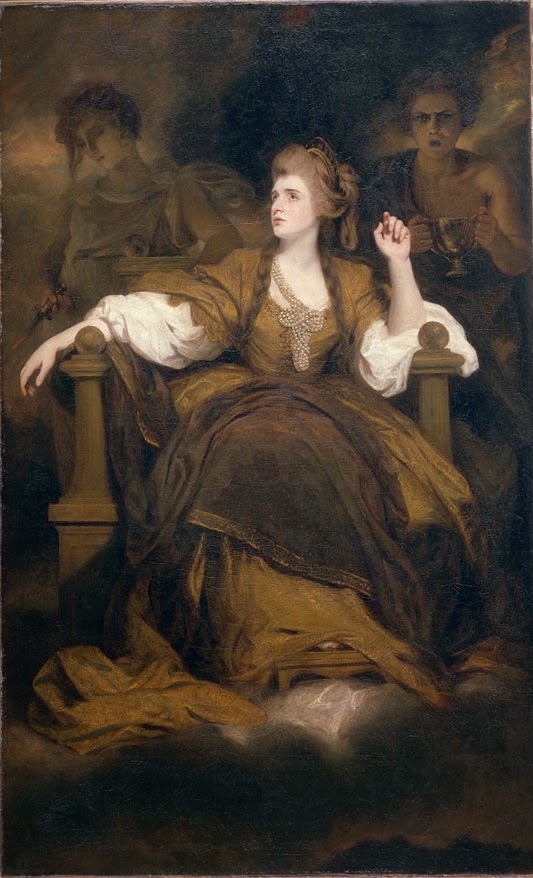
Last month, I wrote of the remarkable celebrity of Sarah Siddons, the first lady of the Georgian stage who was so celebrated for her portrayal of Lady Macbeth. Among her fans was Sir Joshua Reynolds, the near legendary Georgian artist, and he memorialised Mrs Siddons forever in his remarkable 1784 work, Mrs Siddons as the Tragic Muse.

This portrait has been an inspiration to me for many years and a print hangs in pride of place in my sitting room, where it often attracts compliments. When I look at this painting I see a remarkable piece of theatre, and one that rightly confirmed the actress's status as a superstar of the tragic stage, preserving Mrs Siddons forever as a figure of graceful authority, the living embodiment of Melpomene, the muse of tragedy.


Mrs Siddons as the Tragic Muse by Joshua Reynolds, 1784

When Mrs Siddons arrived to sit for the portrait, Reynolds told his adored subject, "Ascend upon your undisputed throne, and graciously bestow upon me some great idea of the Tragic Muse". Mrs Siddons accordingly draped herself in a somewhat monarchical fashion on her throne and in doing so appeared to assume the pose adopted by Isaiah on the Sistine Ceiling. However, she claimed that this was nothing but coincidence, having chosen this position when she found the initial pose requested by Reynolds to be too uncomfortable to hold. Whether this is true we cannot know but Mrs Siddons was well aware of the power of celebrity and perhaps was giving her own near-mythical reputation a helping hand!

Regardless of the thought behind it, the pose is unmistakably graceful and in her opulent gown and pearls, the actress's noble bearing is evident in every inch of the canvas. For all of the grace and nobility, though, her expression is troubled, and the painting is one that shows a woman in some conflict. Emerging from the shadows behind her throne are the figures of Aristotle's Pity and Fear. Recalling her role as Lady Macbeth they clutch a dagger and a chalice and Fear's features were modelled on Reynolds' own grimace, which he painted from reflection.

This painting is remarkable in its subtle use of light and shadow. The colours are subdued yet striking, and the arms and face of the sitter draw the eye with their vibrancy. Despite or perhaps because of the simple and muted palette, the painting draws and holds the attention; in fact, the dress was initially intended to be blue but Reynolds repainted it in the brown and gold we see today. This blends the primary figure of the actress into the background even as she is kept apart by the brightness of her features versus the misty figures that flank her, a luminous figure and one that demands attention.

The painting was an utter sensation when it was exhibited at the Royal Academy in 1784 and Reynolds placed a mind-boggling one thousand guinea price tag on the canvas. To this day it is regarded as one of the finest works of 18th century painting and has played a part in the enduring reputation of both actress and artist. It is perhaps fitting, then, that Reynolds signed the portrait across the bottom of Mrs Siddons's dress and told her, "I have resolved to go down to posterity on the hem of your garment." That signature is no longer visible but this magnificent painting remains, as remarkable now as it was then.


Sources

Perry, Gill, Spectacular Flirtations: Viewing the Actress in British Art and Theatre 1768-1820, (Yale University Press, 2007)
Perry, Gill and Roach, Joseph, The First Actresses: Nell Gwynn to Sarah Siddons, (National Portait Gallery, 2011)
Postle, Martin, Joshua Reynolds: The Creation of Celebrity, (Tate Publishing, 2005)

~~~~~~~~~~~~~


Glorious Georgian ginbag, gossip and gadabout Catherine Curzon, aka Madame Gilflurt, is the author of A Covent Garden Gilflurt’s Guide to Life. When not setting quill to paper, she can usually be found gadding about the tea shops and gaming rooms of the capital or hosting intimate gatherings at her tottering abode. In addition to her blog and Facebook, Madame G is also quite the charmer on Twitter. Her first book, Life in the Georgian Court, is available now, and she is also working on An Evening with Jane Austen, starring Adrian Lukis and Caroline Langrishe.

Wednesday, July 30, 2014

"Tragedy personified": Sarah Siddons as Lady Macbeth

By Catherine Curzon

The term "showbiz legend" is much bandied about these days when it comes to the world of entertainment, sometimes with less reason than others. Sarah Siddons, the first lady of the Georgian stage, was truly deserving of that lofty title. From humble beginnings she rose to the pinnacle of her craft, leaving her adoring fans gripped with Siddons fever as they flocked to her performances in droves. Famed as a tragedian, she will forever be associated with one particular role, that of Shakespeare's Lady Macbeth.


Sarah Siddons as Lady Macbeth by Henry George Harlow, 1814

When the celebrated Mrs Siddons played the lady of Dunsinane for the first time on 2nd February 1785, she was just 29 years old. With her tall, commanding figure and strikingly handsome looks Siddons made an instant and lasting impact; she would return to the role multiple times over the four decades that followed, making the part entirely her own. 

The majestic actress was known for the passion and fervour of her performances, bringing a deep understanding to each role as she practised the method of her day. Theatrical legend has it that, so intense was her portrayal and so blazing the look in her eyes, swooning ladies in the audience had to be carried from the theatre in order to recover their composure. The essayist, William Hazlitt, famously wrote that Siddons was "tragedy personified"[1], a sentiment with which her fans certainly agreed. 

In fact, away from the stage her life contained tragedy enough to inspire a thousand such performances. Her marriage to William Siddons ended in separation and five of their seven children predeceased their mother. She channelled her unhappiness into performances of startling intensity, focusing particularly on the famous hand washing scene. Siddons broke with tradition by setting down Lady Macbeth's candle to instead concentrate on repeated, hypnotising motions as she washed the blood from her hands again and again.


Sarah Siddons by Thomas Gainsborough, 1785

In her essay, Remarks on the Character of Lady Macbeth [2], Siddons shares her thoughts on the role and the reasoning behind her own stylistic choices. She displays a rich understanding of Lady Macbeth, whom she considers to be "made by ambition, but not by nature, a perfectly savage creature". The essay makes for fascinating reading, offering deep insight into this most remarkable actress and the way in which she approached her roles. 

Georgian theatre is occasionally depicted as an almost ridiculous place, with overblown performances and overheated thespians but in Remarks on the Character of Lady Macbeth we are privy to share what would appear to be a modern approach to the text, with Siddons examining dialogue, movement and psychology in her efforts to inhabit the role.

After a long and celebrated career, Sarah Siddons gave her farewell performance in the role that she had made her own at the Covent Garden Theatre on 29th June 1812. The reaction of the audience to the sleepwalking scene was so rapturous that they gave an ovation that seemed as though it might never end, forcing the curtain down. After a short delay in which the adoring applause continued, the curtains opened again to show Sarah sitting on stage in her own clothes, no longer in character. Once the crowds finally fell silent she gave a farewell speech of almost ten minutes in length, the actress as overcome with emotion as the audience who adored her.

References and Sources

[1]   Hazlitt, William, Selected Writings. (Oxford, 2009), p. 339
[2]   Siddons, Sarah, "Remarks on the character of Lady Macbeth" as quoted in  Campbell, Thomas, Life of Mrs. Siddons. (New York, 1834). 

Perry, Gill, Spectacular Flirtations: Viewing the Actress in British Art and Theatre 1768-1820, (Yale University Press, 2007)
Perry, Gill and Roach, Joseph, The First Actresses: Nell Gwynn to Sarah Siddons, (National Portait Gallery, 2011)


Glorious Georgian ginbag, gossip and gadabout Catherine Curzon, aka Madame Gilflurt, is the author of A Covent Garden Gilflurt’s Guide to Life. When not setting quill to paper, she can usually be found gadding about the tea shops and gaming rooms of the capital or hosting intimate gatherings at her tottering abode. In addition to her blog and Facebook, Madame G is also quite the charmer on Twitter. Her first book, Life in the Georgian Court, is available now, and she is also working on An Evening with Jane Austen, starring Adrian Lukis and Caroline Langrishe.
SaveSave