Showing posts with label Saint Patrick. Show all posts

Thursday, July 21, 2016

Bees and the Brehon Law in Early Medieval Ireland


By Kristin Gleeson

St Gobnait by Harry Clarke, Corning Museum

What would happen if bees from your hive swarmed and then settled in a neighbour’s tree, or if you were stung badly by one of your neighbour’s bees? If you were living in Ireland in the 6th century, the matter would be very clear. In the first case, your neighbour would be entitled to half the yield of honey, and in the second case, you would be entitled to a sufficient amount of honey that matched the severity of the sting.

Bees and the honey they produced were an important element in early Medieval Ireland and other parts of Europe. They were a significant source of nutrition for people who lived in a land that in many areas was often wet and difficult to farm. Honey also possessed an antiseptic quality that was important for internal healing, as well as external healing. And of course when fermented, it provided a drink that could make you forget how wet and difficult the land was to farm.

Medieval skep
In Britain and the rest of Europe the hives were made of straw, coiled into the familiar cone shape and stitched together with thin branches of brambles/blackberries stripped of their leaves and thorns, called a ‘skep’ from the Anglo-Saxon word ‘skeppa’ meaning ‘basket.’ In winter they would put straw tents over the skeps to keep out the elements, called ‘hackles,’ if they weren’t in little stone nooks, or ‘boles,’ like those of the monks of Lindisfarne. In Ireland, however, where cattle grazed outdoors all year and little straw was harvested, I was told by local historians sedgegrass was used instead, well up until the last century. The hives were then thatched against the rain that fell all year round and kept against the south wall of the ‘lios’ or wall of the home area.


Irish skep with thatch
Bees were kept not only on farms but also at religious communities in early Christian times. Monks (managh) and nuns (cailecha) tended the sick and injured among their community, as well people in the surrounding area. One such cailecha was Gobnait, a woman who settled in West Cork and established a convent, or community of women. She became so well known for her healing, with honey as her staple medicine, that her fame spread and eventually, after her death, she became the patron saint of bees.

With bees such a vital part of the daily lives of medieval Irish people, it is no surprise that they featured in the Brehon laws. “Brehon” is an ancient Irish term for judge. Over the centuries the judges accumulated a series of laws which they passed down orally from one generation of judges to the next. To qualify to become any one of the various levels of judges and lawyers - which in all likelihood were offshoots of the poets (filidh) - required that the person study at one of the named schools. It was a period of study that lasted a number of years in which they learned poetry as well as the laws.

Under the Brehon laws there were five paths to judgement: truth, duty, right, propriety and proper inquiries. These paths ensured that each case was considered carefully.  The choices were thrashed out beforehand by the respective lawyers in a process called airthacra, which was akin to the hearing of legal arguments in modern court cases.  Most disputes, however, were usually settled before they wound up in court.

During the early Christian period, from about the 5th century to the 8th century, the laws and law cases were recorded by Christian clerics and ‘adjusted’ if the laws didn’t fit the Christian outlook. Most of our knowledge of early Irish or Brehon law comes from these old Irish law texts, mainly composed in the 7th and 8th centuries. Some of these texts have survived in a complete form in later manuscripts (generally of the fourteenth to sixteenth centuries), but many are to be found only in fragments. The best preserved collection of early Irish law texts is that of the Senchás Mar, "great tradition," which is likely to have been organized as a unit about A.D. 800. The texts in this collection are all anonymous, and it is not known where or by whom they were put together. However, most of the place-names and personal names cited in the texts relate to the northern Midlands and southern Ulster, so it is probable that the material derived from this area. It may have been assembled in a monastic law school, such as that at Slane, County Meath.
Section of Irish law, Library Ireland

Much of the Brehon law is founded on the principle of restitution, rather than punishment, so often the judgements involved various types of compensation for any injury done. The cases and laws therefore encompassed much of what mattered in everyday life. The Senchás Mar originally consisted of 50 law texts broken up into three sections. There doesn’t seem to be a strict logic to the arrangements except that similar subjects are grouped together. For example, the law text relating to cats is followed by the law text relating to dogs.

In the first third of the work there is a general discussion of legal topics and a description of St Patrick’s role in its codification. This essay is followed by laws on the formal seizure of another’s property to enforce legal claims against him. There is also a discussion on the acts regarding hostages, laws regarding the “free fief” and fosterage fees, as well as free clientship and base clientship which were two different classes in the highly stratified society that was Ireland. There were also other texts dealing with the laws of marriage and divorce, the arrangement of customary behavior and the relationship of society to the Church.

The surviving final third, like the first third, is not complete by any means. It does have evidence that suggests it may have contained laws on carpenters, coppersmiths and blacksmiths, sick maintenance as well as trapping deer. It also has medical legal texts “Judgements of Blood-lying” and “Judgements of Dian Cecht” (a legendary physician).

Included in the middle section, the most complete section, are the judgements dealing with trespass by domestic animals, fencing obligations and other related topics. Here we can learn such interesting judgements like if an animal is killed in a jointly owned herd and the culprit cannot be identified then a lot is cast across the whole herd. The animal on which it falls is held to be responsible. Whether or not that animal is punished is a mystery. Other interesting aspects discussed in this section include rules for bringing water for a mill across a neighbor’s land. Conflict in a situation like this is easily imaginable. A final section, which understandably gets full discussion is  "Judgements Concerning Thefts."

It is in this middle section that the Bechbretha or “Bee Judgements” are found. They include a discussion of trespass by honey bees.  It’s there, for instance, we can learn that a person who is blinded by a bee gets a hive in recompense.  Or that there were penalties for a person who moves a hive not belonging to them. And most reasonably we can learn that if a person shakes or disturbs a hive and the bees should attack that person as a result, the owner was free from liability for any injuries that might result.

The Brehon laws stretched back centuries and through them we can understand the daily life of the ancient Irish. If the laws are anything to go by it shows a society that relied heavily on mediation and compensation, perhaps in attempt to avoid more violent acts of retribution, vengeance and punishment.

Kristin Gleeson holds a Ph.D. in history and a Masters in Library Science. Her novel, In Praise of the Bees, weaves in aspects of the Brehon Law. You can find out more about Kristin and her other books at her website.


Thursday, March 17, 2016

Shamrocks, Snakes, Maewyn Sucat and the Wearing of the Green: The Making of Saint Patrick


By Linda Root


The historic Saint Patrick can be hard to find:


Seeking insight into the historical figure we know as Saint Patrick, is more a lesson in historiography than biographical research. It can be a far more arduous endeavor than merely separating the man from the myth. It is every bit as much a quagmire as tracing the origin of the historical Arthur, and equally controversial. More than fifteen hundred years after his celebrated date of death, grown men and women of academic celebrity are duking it out over his origin in a style more common to the pubs of Dublin on Saint Patrick’s Day at closing time than the hallowed halls of Cambridge. One eminent historian, Cambridge Professor David Dumville, cites a remark of a colleague that ‘in Patrician studies scholars have left no stone unthrown.’[i],[ii]


When I elected to write my March post about Saint Patrick, I had no idea I had stepped into an academic brawl which still rages, in spite of Professor Dumville’s assertions to the contrary.  With that comment out of the way, there is one fact about Saint Patrick about which there is no controversy:  There is scant in common between the historical and the mythic Sanctus Patricius, or the holiday celebrating him.


Grandpa had it wrong: 


Henry C. Patterson and his granddaughter.
Every year of my early life in Cleveland, on March 17th my grandfather Henry Clay Patterson would don a top hat and march in the Saint Patrick’s Day Parade.   I wonder what he would say if he had known Saint Patrick was likely born a Scotsman. While there are several locations along the coast of the Irish Sea and the English Channel, which claim him, Western Scotland near Dumbarton is a current favorite, unless, of course, you are Welsh. Some modern scholars go so far as to suggest that Patrick was born in Brittany. 
A brief overview of the powerful symbolism surrounding the patron saint of Ireland uncovers more passion on the part of the various claimants to Saint Patrick’s past than those who write about his achievements.


There are some other surprising facts concerning Saint Patrick about which there is no quarrel. For example, his birth name was not Patrick. He was born Maewyn Sucat, and he was not Irish  He was more than likely British, although even that is subject to debate. There is controversy as to the proper definitions of the words  Brittania or Brittanii as they appear in early histories. At least one competent writer, Marcus Losack, makes a good argument that the saint’s ancestors fled Roman Scotland for Bretagne (Britany) when the Romans withdrew, which, of course, is on the northwest coast of France. Losack's hypothesis would explain but not resolve Maewyn Sucat’s familiarity with what linguists call Early Living Latin. There is good evidence the saint did not learn his  Latin in the Roman Catholic Church.[iii] While some historians conclude he had traveled to Gaul to prepare for his ministry, others speculate he may have been born there. Well-regarded Late Latinist scholar Christine Mohrmann finds 'There are in the language of Saint Patrick many elements of living Late Latin which cannot possibly be traced back to British Latin. Therefore, we must allow for a contact of Patrick with the Continent.’[iv] How and when that may have occurred is another topic for debate.


If not Irish, who was Maewyn Sucat?


There are as many factions struggling to construct a claim to the Irish saint as there are battling over the origin of  Arthur Pendragon. A survey of the literature suggests the Arthurians are more civilized than the Patricians. In his short biography[v], Daniel Colston says: 'The mythical Patrick was created because history was not yet discovered as a science in the 7th century and writers of history were more concerned with a good story.’ 
Even a brief survey of the literature reveals historians are not always civil when  they disagree. Although Professor Dumville declares the debate has died down with the death of the most aggressive of the combatants, he obviously has not read his colleague Barbeiri's acerbic review of Dumville's book on Amazon.

Daniel Colston, in his short biography, reminds us the traditional images of Saint Patrick, with shepherd’s cross and mitered hat, is a fiction of the Holy Roman Church. Saint Patrick lived in the 5th century, hundreds of years before Catholic bishops costumed themselves in that manner. While most historians agree Saint Patrick was a member of an early British Christian sect, he was not Catholic in the classical sense. Colston has him born on the southwestern coast of Roman Britain, to an aristocratic family. The language in his village would have been Latin. The Angles and the Saxons came much later. Other sources place his family home in Strathclyde, Scotland, and some favor Wales. Strathclyde seemed rather far north for a lad who spoke Latin.  But with evidence surfacing indicating the Romans had a garrison at or near Carlisle, the Scots are currently back in the game. Others argue in favor of Brittany. While Patrick’s own writings should be dispositive of questions concerning his vital statistics, they are not. In his Confession, he calls his birthplace Bannavem Tiburniae but does not place it geographically. His writing discusses his spiritual birth, not his mortal one.


How Maewyn Sucat got to Ireland: Blame it on the Pirates


Wherever it may have been, Maewyn Sucat’s homeland was the site of frequent raids by the Irish king ‘Niall of the Nine Hostages’. Marcus Losack, in his recent book Rediscovering Saint Patrick: A New Theory of Origins at Kindle Location 206,  is convinced the future saint lived in a family estate on the coast of Brittany and was captured when he was age sixteen by Niall’s raiders. Patrick’s writing confirms the kidnapping and his age at the time, but not the locale. A folk history of inhabitants at the location Losack pinpoints talks of a family of Scottish origin which had fled to Bretagne when Roman troops withdrew from Britain to protect Roman holdings in France. However, Losack’s explanation is only one of many that fits if you so desire. Other sources have adolescent Maewyn carried off from an area near Dumbarton, which supports a Scottish birth. One recent historian has suggested the controversy is caused by Saint Patrick’s parents hailing from Scotland but having a vacation home on the coast of France.  Except in the minds of certain partisan academics, the puzzle remains unsolved.


Wikimedea Commons-
Solway Firth north of Carlisle

Maewyn Sucat and Ireland:


All versions of Saint Patrick’s story including his own work, Confession, place his capture and abduction at or near the dawn of the fifth century, circa A.D. 400. Raids by Irish slavers were apparently common. While accounts are not specific, including the one written by Patrick himself, it seems he was sold to a sheep owner and was forced to tend flock in an inhospitable, remote location, possibly in County Mayo, which for those of you who do not know your Irish geography, is a long, long way from the spot where the Clyde flows into the Irish Sea.
At some point during the six years of his captivity, the future Saint Patrick experienced an epiphany. Not only did he abandon his name, but also his way of life. Perhaps due to the remoteness and the isolation from his friends and family, Maewyn Sucat became spiritualized. He also learned the language and some of the cultural traits of his captors. Authorities are mixed as to the nature and strength of his religion during the sixteen years before he was seized but agree he was not Catholic in the orthodox sense. This does not mean he had not been closely affiliated with a religious community in the land of his birth.  In his writings, he implies his father was a public official and perhaps a deacon in a nascent Christian church. While Maewyn Sucat may have been earmarked for the priesthood, nowhere in his early life is there evidence of the deep religious fervor that came later.

Little is known of Saint Patrick’s circumstances during his captivity. When he wrote about it later, he focused on his spiritual awakening.  He is not the first nor the last of his kind to have found his God in the wilderness and received divine revelations in the form of dreams. In one of them, voices told it was time for him to leave - a ship was waiting to take him home. According to his own account, although he was far from a seaport, he had enough confidence in the dream to walk for days. Says Saint Patrick: 
’It was not nearby, but a good two hundred miles away. I had never been to the place, nor did I know anyone there. So I ran away then, and left the man with whom I had been for six years. It was in the strength of God that I went - God who turned the direction of my life to good; I feared nothing while I was on the journey to that ship.’[Colston, Daniel, Ibid, (Kindle Locations 161-163).
When he arrived, he found a ship with a crew willing to give him passage home, wherever home may have been.  

Maewyn Sucat returns to his homeland: The Lost Years


Few facts are known of Saint Patrick’s history for the next several years. While Some writers infer his immediate family had been slain at the time of his kidnapping, Saint Patrick in  Confessions talks of his reunion with his parents, who urge him never to leave again. Apparently there were three significant religious characters named Patrick in the fifth-century timeframe. The account of the murder of his family may relate to another Patrick. In the mid-twentieth-century, there was significant support for a Two-Patricks Explanation. Nevertheless, from his own writing, the Patrick the subject of this review  was reabsorbed into the political and religious community from whence he came. Again, what we learn from the written words of our protagonist, albeit of suspect translation, has more to do with his faith than his surroundings. One fact is clear: His experience in captivity in Ireland had changed him.
  
In a popular rendition of Confessions, the man who became Saint Patrick speaks of joyous days with his parents. Other evidence suggests he may have traveled to Gaul to prepare for the spiritual life he had embarked upon in Ireland. He had become a Man of God and was expecting God to call him to a mission. Then came a time when his dreams came more specific.  He heard voices he identified as the collective voice of the Irish People.

‘“We beg you, holy boy, to come and walk again among us.” This touched my heart deeply, and I could not read any further; I woke up then. Thanks be to God, after many years the Lord granted them what they were calling for. Another night – I do not know, God knows, whether it was within me or beside me – I heard authoritative words which I could hear but not understand, until at the end of the speech it became clear: “The one who gave his life for you, he it is who speaks in you”; and I awoke full of joy.’[vi]
There is some evidence not all of the leaders in his early church were excited to send him back. Apparently one of his lifelong friends had betrayed a childhood secret which tarnished Patrick’s image. In his writings, Patrick admits to an unspecified sin committed in his youth. But when he made it clear he intended to return to Ireland with or without the blessings of the hierarchy of his church, they reluctantly endorsed his mission to Ireland. Mayhap they wanted to be rid of him. Substantial evidence exists in Papal archives indicating Pope Leo the Great had already sent an alternative Patrick to Ireland, known to history as Palladius, who may have been Patrick’s predecessor and might have been his alter-ego. During the middle Twentieth Century, a historian questioned if the discrepancies in Patrick's history emerged because there were actually two of them. A parallel  debate still rumbles if not rages as to the extent of the Christian presence before 431, or the degree of convergence of the stories of the two bishops. Perusal of the evidence suggests the existence of a somewhat limited Christian church presence in Ireland prior to either Palladius or Patrick, and concedes the possibility of confusion between their separate missions. Late developing evidence suggests Palladius was indeed a bishop sent by Rome, but due to the expansion of Anglo-Saxon power in Britain in the latter half of the fifth century, the Roman Church abandoned the Irish mission to the British church after Pallaadius died. Rome had troubles enough without concerning itself with the Irish.


Saint Patrick preaching to an Irish King atTara

Mitered Hat, Shamrocks and other Shams:


One of Saint Patrick’s biographers has stated that Patrick’s intimate association with Jesus and the Messianic Message was precisely what the wild Irish needed to hear. Like the Jews of ancient Palestine, they were a downtrodden people badly in need of a hero—a Deliverer. By revealing Jesus in a messianic role, Saint Patrick led thousands upon thousands of the Irish to embrace Christianity. Some of his converts were kings. Christian, including Catholic, doctrine was in flux. His own beliefs were not Catholic in the classical sense. They were early Christian, centered on the existence of Jesus, and not the glory of the nascent Catholic Church. Patrick was a strict Trinitarian, and his teachings stressed the separate natures of the Son, the Father, and the Holy Spirit. He understood and used scripture and symbolism in his ministry, which is likely where the Shamrock legend comes into the story. He may have drawn three circles in the dirt with his staff, and others might have thought it resembled a shamrock, but there is no evidence the saint used a shamrock in his teachings. The significance of the Shamrock is its exclusivity to Ireland, at least until modern times.


The origin of the legend of the snakes is evident in its simplicity. There are no snakes in Ireland: Why not give credit to Saint Patrick with eradicating them? And what about the paintings and sculptures and stained glass windows of the Irish saint? They represent an awe inspiring Catholic Saint, but certainly not Saint Patrick. Even Roman bishops did not adopt the mitre until the eleventh century. And yet, it is almost universal in depictions of Saint Patrick. Again, the answer is obvious. The Roman Church was claiming him as one of its own.


The Catholic Icon

Somehow in the midst of snakes and shamrocks and mitres, we have forgotten that Saint Patrick had learned their language during his captivity, and sustained an intense dialog with common Irishmen. He also stood toe to toe with kings. He spread the Christian doctrine as Jesus did, to the masses, not always from the pulpit.  He converted many kings and publicly chastised a British warlord king for his bloodlust and sinfulness. Yet, more is written of his origin than his acts.
Which brings us to the topic of Saint Patrick’s Day - a very secular holiday in its modern interpretation.


CONCLUSION:  Saint Patrick’s Day is a celebration of being Irish


Other than its name, Saint Patrick’s Day has little to do with the historic Saint Patrick but focuses upon our own real or feigned Irishness, which we demonstrate by wearing green or risk being pinched. We find our way to an Irish pub or a gathering of real or pseudo-Irish friends, fill up with corned beef and cabbage, after which we sing  "A Little Bit of Heaven” or “When Irish Eyes are Smiling,” while lifting a pint of green beer. And some of us shed a tear.
Photo by the author.

And to us, it doesn’t matter where Maewyn Sucat was born. He died Irish. The degree to which he changed the spiritual face and the destiny of a nation of people who in diaspora, have impacted the history of the modern world is left to the quibbling of historians. Methinks it would be a worthy endeavor for them to write more about Saint Patrick’s mission, and less about his origin.


For those who are interested in Saint Patrick’s beliefs as revealed in his words, no matter how suspicious the translation, Confession is available on Amazon at the link listed in the author’s notes.  It is noteworthy that the emphasis on Patrick as a missionary is most often depicted on the covers of children’s books. Perhaps that is a good start in separating the Saint from the stained glass image of the man in the mitered hat.


HAPPY SAINT PATRICK’S DAY, ONE AND ALL!


A PERSONAL RECOLLECTION FROM THE LIFE OF THE AUTHOR.

Recently, my own life took a turn not so different than that of the mythic Saint Patrick: There was never any question that Henry Clay Patterson considered himself true Irish, although many who share his surname are Ulster Irish, deported from the Highlands during the 17th Century. His family was established in Maryland before the American Revolution. They were avid Episcopalians. In any event, there is good reason to believe my Patterson ancestry was Scottish.
But that is not all. My paternal grandmother’s name was Amy Jameson. You don’t get much more Irish than that unless your name is Guinness. However, last year we discovered the spelling of her surname was changed in the 1920’s when her sister became a sports executive in Cleveland—a very Irish town in those days. The surname Jameson was a career move. Alas, just like Maewyn Sucat, my grandmother Amy was a Scot, the daughter of Alexander Jamieson, of the Clan Gunn. I wonder if he was born in Strathclyde. I realized as I concluded my post that March 18th, tomorrow, is the 55th anniversary of my grandfather’s death.  He did not march in a parade that year, but on the night he died, I was present when he did a jig. 

 AUTHOR’S NOTE:   


A Kindle edition of Confession is available on Amazon for 99cents. The trade paperback is 6.99. Like most published versions of the Confession, even the earliest, questions arise as to the accuracy of the translation. St.Patrick’s Latin was not the liturgical Latin spoken by priests of the Roman Catholic church. It was a language spoken in his home and his community. Irish was his second language. We do not know what variance may exist between the Latin taught in schools and the vernacular Latin spoken in Roman Britain of the fifth century. With that caveat, here is the LINK:


Photos not otherwise attributed are from Wikimedia.com through Creative Commons. Maps courtesy of Sansculotte - German Wikipedia, CC BY-SA 3.0, https://commons.wikimedia.org/w/index.php?curid=459238

ABOUT THE AUTHOR:  

Linda Root is the author of six historical novels set in Marie Stuart’s Scotland and the Early Jacobean years, including The First Marie and the Queen of Scots, The Last Knight and the Queen of Scots, and the four books of the Legacy of the Queen of Scots Series: 1) The Midwife’s Secret-The Mystery of the Hidden Princess; 2) The Other Daughter- Midwife’s Secret II; 3) 1603: The Queen’s Revenge and 4) In the Shadow of the Gallows. The fifth in the series, The Deliverance of the Lam in coming this autumn. Root is a former prosecutor and a veteran of more than a hundred twenty jury trials. She lives in the high desert community of Yucca Valley, on the edge of Joshua Tree National Park. In addition to being a regular contributor to EHFA, she is active at The Review blogspot and a Board Member of the M.m.Bennetts Award, an inactive member of the State Bar of Califoria, and a member of the Bar of the United States Supreme Court. Visit her author page on Amazon Author Page 


[i] Dumville, David, Saint Patrick A.D.493-1993, The Boydell Press, Suffolk, 1993, 1999, from the Forward contained in the front material.

[ii] It is interesting that Dumville claims the most vociferous of the combatants in the battle over Patrick’s origin to be dead at the time he published his book in 1993. His assertion is presumptuous. He should read the review his less than congenial colleague Italian historian and cartoonist F. Barbieri has posted on Amazon, calling Dumville an academic possessed of ‘an unconstructive attitude,’ who enjoys putting down the theories advanced by others.

[iii] Lossack, Marcus, Rediscovering Saint Patrick, A New Theory of Origin, Columba Press, Dublin, 2013.

[iv] Quoted from The Latin of Saint Patrick, p.50, by Dumville, op. cit. St.Patrick’s Missing Years, p 25.

[v] Colston, Daniel, SAINT PATRICK AND THE PRESENCE OF GOD: A Short Biography, North Garden Publishing Company, on Kindle

[vi] From Colston’s account and others.

Monday, June 15, 2015

The Rock of Cashel: Marvel from Medieval Ireland

by E. M. Powell

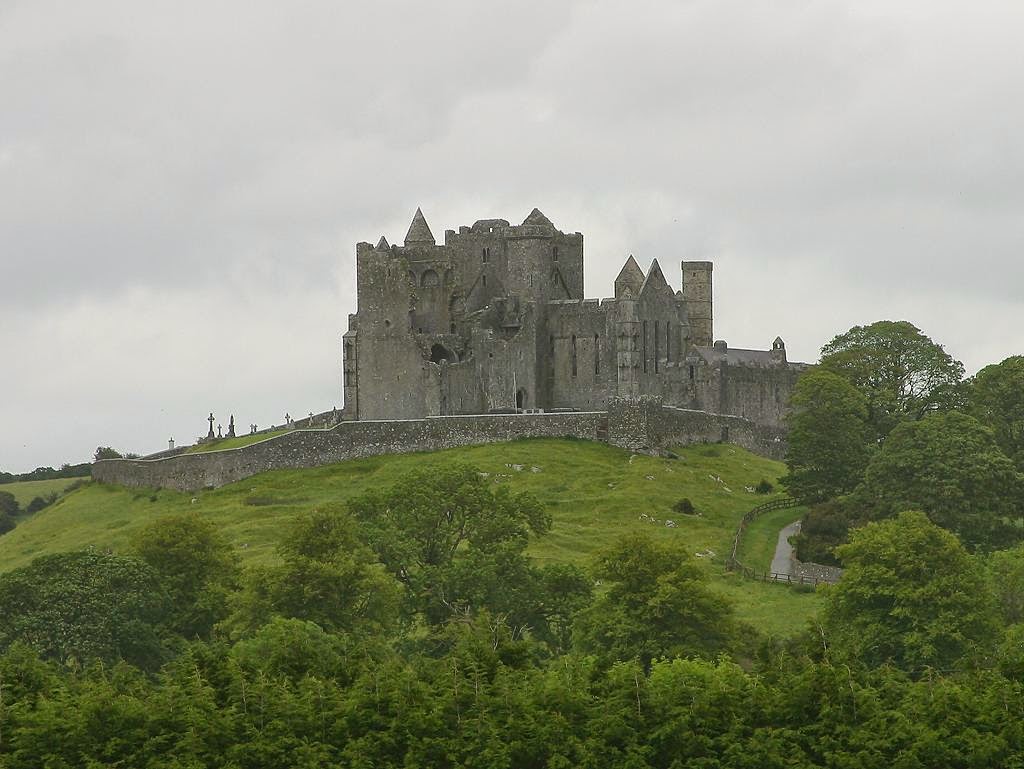
There are historical sites that are interesting. There are historical sites that are spectacular. And then there are historical sites that are an icon of the country in which they are located. It is in to the latter category that the Rock of Cashel in Co. Tipperary in the Republic of Ireland falls.

The Rock of Cashel

I visited on a recent research trip, which is when the photos in this post were taken. You might be surprised to see scaffolding on here. No, it isn't a medieval building project that has seriously overrun- I shall explain later.

The Rock of Cashel is also known as Saint Patrick's Rock.  The rock itself is an impressive prominent hill of karst limestone. This being Ireland, there is of course a far more imaginative description of what the rock is. Legend has it that the Devil took a bite out of the mountain opposite, and then dropped the rock from his jaws onto the plain. That's a lot more exciting then geology, but perhaps not quite as reliable.

Devil's Bit

Given the commanding position of the Rock, it is hardly surprising that the over-kings of Munster adopted it as their seat of power for hundreds of years. It is here that Saint Patrick is alleged to have converted the King of Munster, Aenghus, to Christianity in the 5th century AD. There is of course no proof of this. We do have a law tract from around 700 A.D. which refers to the King of Cashel controlling other Munster kings.

It was a king of Munster, Muirchertach Ua Briain, who gifted the Rock to the church in 1101. No buildings survive from the reign of the kings. The magnificent buildings that still stand are ecclesiastical and were constructed in the medieval period.

The Round Tower

The Round Tower is an architectural design that is unique to Ireland. The tower on the Rock is its oldest building. Originally a bell tower, it dates from around 1100.

Exterior of Cormac's Chapel

Next oldest is Cormac’s Chapel, built by a King of Desmond (part of Munster) and consecrated in 1134. It is the first example of Romanesque architecture in Ireland. It is Cormac's Chapel that is currently shrouded in scaffolding. Its stone roof has had to endure almost 900 years of Irish rain (and that's a lot of rain), and an urgent conservation project is under way. Basically, it's being dried out and I was told that's likely to be a seven year job in total.

Interior of Cormac's Chapel

Fortunately, you can still enter the Chapel with a guide. It is stunningly beautiful. Carved stone faces look down from the ceilings and the remains of brightly-painted frescoes which would have made the interior glow with colour can still be seen.

Ceiling of Cormac's Chapel

The twelfth century saw radical reform of the church in Ireland and the Synods (ecclesiastical councils) were held at Cashel. The first Synod in 1101 attempted to address marriage practices of the native Irish, which were deemed to be immoral. The second Synod of Cashel was held in 1171/72, under the auspices of Henry II and with the full backing of the Pope.

Carved Stone Sarcophagus

Henry had already added Ireland to his dominions. In 1171, he came in person (the first king of England to ever come to Ireland) and he stayed at Cashel for part of his visit. The Synod passed legislation to do with marriage, the payment of tithes, freed the church from lay control and introduced clerical privilege. In short, the Irish church was to operate in exactly the same way as the Church in England. The Irish Church, in existence for 700 years since the time of Saint Patrick, was ended on the very rock that bears his name.

The cathedral was built in the thirteenth century and added to over the centuries. Some sources claim that a cathedral was built here in 1169, and then replaced.

Exterior of Cathedral's South Transept

The Hall of the Vicars Choral was added by an archbishop in the fifteenth century. The Vicars Choral were a group of men appointed to sing during cathedral services and consisted of a mix of clergy and laity. Their quarters have been impressively restored.

The Hall of the Vicars Choral- Interior

The Rock of Cashel is of course deservedly one of the most visited sites on the Republic of Ireland, attracting around a quarter of a million visitors a year. One of those visitor's signatures is on display.

Elizabeth R

Yes, it's the signature of Queen Elizabeth II. Her State Visit to Ireland was the first made by a British monarch since the founding of the State in 1922. Her visit was a hugely important step in further reconciling the troubled history between the two countries. How apt that her visit included Cashel, the ancient seat of the Irish kings.

Celtic Cross at Cashel

References:
All photos are copyright E.M. Powell 2015.
Duffy, Seán, Ireland in the Middle Ages: Palgrave/Macmillan (1997)
Flanagan, Marie Therese, The Transformation of the Irish Church in the Twelfth Century, Boydell Press (2010)
Manning, Conleth, Rock of Cashel, OPW- The Office of Public Works/Oifig na nOibreacha
Ó Cróinín, Dáibhí, Early Medieval Ireland: 400-1200, Longman (1995)
O'Keefe, Tadhg, Medieval Ireland: An Archaeology, Tempus Publishing Ltd. (2000)

~~~~~~~~~~~~~~~

E.M. Powell’s medieval thrillers The Fifth Knight and The Blood of the Fifth Knight have been #1 Amazon bestsellers.
Born and raised in the Republic of Ireland into the family of Michael Collins (the legendary revolutionary and founder of the Irish Free State), she lives in northwest England with her husband, daughter and a Facebook-friendly dog. She blogs for EHFA, reviews for the Historical Novel Society and contributes to The Big Thrill.

The next novel in the series, The Lord of Ireland, in which Sir Benedict Palmer is sent on the Lord John's disastrous 1185 campaign in Ireland, will be published by Thomas & Mercer in 2016. Find out more at www.empowell.com.
Amazon
Barnes & Noble
Walmart


Monday, March 16, 2015

Medieval Ireland

by E.M. Powell

Lá Fhéile Pádraig sona daoibh- Happy Saint Patrick's Day to you all!

Saint Patrick

Yes, it's the day when much of the globe celebrates all things Irish by a) donning green and b) taking leave of their senses. Fair enough. As an Irish person, it's nice to see that the small island from which I hail is so widely/wildly celebrated, and I was very pleased that I could snag today's posting date to add to the acclaim.

Much has been written about Ireland's history, but not many people are aware of a history of Ireland that was written in the 12th century, Topographia Hiberniae, or The History and Topography of Ireland. It was written by Gerald of Wales, a cleric and chronicler at the court of England's Henry II. (In case anyone's disappointed, please be assured that there will be snakes.)

Topographia Hiberniae

Partly Anglo-Norman and partly Welsh and a member of the hugely powerful and successful fitzGerald family, Gerald wrote seventeen books and planned several others. He wrote the Topographia following two visits to Ireland in 1183 and 1185. It is a remarkable work, shedding light on many aspects of medieval Irish life and society. However, it is at all times Gerald's light, and Gerald was on the side of the conquerors. Bearing that in mind, let's look at the Ireland of 850 years ago from a man who was there.

The island of Ireland
NASA

Gerald divided his book into three parts. the first part he called The Position of Ireland. For the medievals, Ireland was the most westerly point in the world. Sorry, Americas, but there was simply nothing else. As Gerald so beautifully puts it: " Beyond these limits, there is no land, nor is there habitation either of men or beasts- but beyond the whole horizon only the ocean flows and is borne on in boundless space." He describes Ireland as about half the size of "greater Britain and ...more round."

Atlantic Ocean, Spanish Point Co. Clare, Ireland
© Copyright Angella Streluk http://www.geograph.ie/

Ireland's natural resources greatly impressed Gerald. He writes of rivers of magnificent size, with their "abundance of fish...beautiful lakes full of fish of magnificent size...a kind of speciality here." The fertile land and the mild temperatures, along with the ease with which grass could be grown also pleased Gerald: "The grass is green in the fields in winter, just the same as in summer." But like so many visitors to Ireland, Gerald quickly found out what made all that green in the first place: the Irish weather. (Or as we natives like to call it, the rain.) Gerald is not happy: "[The harvest] can scarcely be reaped...because of the unceasing rain. For this country more than any other suffers from storms of wind and rain... There is such a plentiful supply of rain, such an ever-present overhanging of clouds and fog, that you will scarcely see even in the summer three consecutive days of really fine weather." 

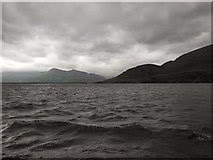
Lough Leane, Killarney, Co. Kerry
© Copyright Ian S  http://www.geograph.ie/

Gerald was cheerier about the plentiful supply of birds and the lack of mammals that would pose a threat to man. He even mentions snakes, (I did promise), or rather, lack of them. He assures us that "Ireland has no serpents or snakes, toads or frogs, tortoises or scorpions."  His readers will also have been relieved to know "It has no dragons." For those of you waiting to see if Gerald has the definitive answer on Saint Patrick and the snakes issue, Gerald provides one. But you may be disappointed: "Some indulge in the pleasant conjecture that Saint Patrick...purged the island of all harmful animals. But it is more probable that from the earliest times...the island was naturally without these as well as other things." 

Snake!

The first part of the Topographia is a wonderful read, in that so much of it is recognizable as the Ireland that still exists. The second part is also remarkable but in a way that is less based in reality. In it, Gerald relates The Wonders and Miracles of Ireland.

Under Wonders, we have reports of a small island where corpses don't rot. A bearded woman with a mane on her back at the court of the King of Limerick. A priest who conversed at length with a wolf. A whale that was found with three gold teeth. Wonders, indeed, but the lake that was formed in a flood because the people were addicted to bestiality is probably the show stopper.

Wolves from a Medieval Bestiary

Moving swiftly onto Miracles, Gerald includes (among many others), the fleas banished by Saint Nannan, a cross in Dublin that speaks the truth and the inextinguishable fire of Saint Brigid. My personal favourite is The Mill that Women Do Not Enter. The mill in question was carved by Saint Féchín, and women weren't allowed in. But an archer of Hugh de Lacy (de Lacy was Henry's man) dragged a woman in "and lustfully violated her there."  Happily, according to Gerald, the archer was "stricken in his member with hell-fire in sudden vengeance and immediately began to burn throughout his whole body. He died that same night." Good for Saint Féchín, I say. 

Ruins of the 7th C St Féchín's church, Omey Island Galway, Ireland
© Copyright Oxana Maher http://www.geograph.ie/

The third part of the Topographia is where Gerald gets up close and extremely personal with the Irish people. Its title is The Inhabitants of the Country. One gets a sense of what is to come when he begins it by restating the legitimate claim that the kings of Britain have over Ireland. Following a brief mention of "beautiful, upright bodies and handsome and well-complexioned faces", there are positives no more.

Firstly, the Irish are "barbarous..and cannot be said to have any culture. they are a wild and inhospitable people...they live on beasts only and live like beasts." Secondly, they are lazy, "think that the greatest pleasure is not to work and that the greatest wealth is to enjoy liberty." Gerald really gets into his stride with the third national trait, which is incest: "This is a filthy people, wallowing in vice." Fourth has us always treacherous, and he warns "You must be more afraid of their wile than their war." The fifth is the tendency to "always carry an axe as if  it were a staff...beyond being raised a little, it inflicts a mortal blow."  

Ancient Irish Warriors- as imagined in the 1920s

If only it were some nifty axe-work we were accused of. Gerald has more. He cites the example of a new and outlandish way of confirming kingship by the Irish in Ulster (where he never went). A white mare is brought before the ruler, who has intercourse with the animal, slaughters it, then boils up the meat and has a bath in the broth, "quaffs and drinks of it...in which he is bathed...just dipping his mouth into it round about him." The Irish Church isn't spared either. Gerald despairs that all the Irish saints are "confessors and there is no martyr...to cement the foundation of the church with his blood, not a single one." 

Gerald ends by countering his earlier statements about handsome Irish people. Yes, there might be some. But he has never seen so many suffering from defects and "turn out in a horrible way."  What can the Irish expect? They are a people "that is adulterous, incestuous, unlawfully conceived and born, outside the law, and shamefully abusing nature herself in spiteful and horrible practices."

So positives no more, except for an unexpected section in the third part of the Topographia where Gerald acknowledges and praises the Irish as highly skilled and talented musicians. Mind you, even this is qualified with a statement that the Scots have probably overtaken them.

Irish Harp

What to make of the Topographia, with its praise for a country but its condemnation of a people? Well, as I remarked at the start of this post, Gerald was on the side of the invaders. And if you make those you seek to conquer less than civilized, less than human, then you have the sword of justification in your hand. It's a very powerful weapon and has never been sheathed for very long in human history. The history of Ireland is no exception. The Topographia records some sadly prescient words to that effect, attributed by Gerald to Tatheus, Archbishop of Cashel in Ireland.

The Rock of Cashel, seat of the medieval Archbishopric
Public Domain Courtesy of John Sullivan http://pdphoto.org/

Gerald was bemoaning  to Tatheus the fact that the Irish had never produced a martyr. Tatheus replied: "But now a people has come to the kingdom which knows how, and is accustomed, to make martyrs. From now on, Ireland will have its martyrs, just as other countries."

Reading them with the hindsight of eight centuries of Irish history, these words are heartbreaking. And what did Gerald make of them? They were, according to him, "sly." 

References:
Cosgrove, Art, ed: A New History of Ireland Volume II, Medieval Ireland: Oxford University Press (2008)
Duffy, Seán: Ireland in the Middle Ages: Palgrave Macmillan (1997)
Gerald of Wales: The History and Topography of Ireland: Penguin Clasics (1982)
Otway-Ruthven, A.J.: A History of Medieval Ireland: Ernest Benn Limited (1968)

All images are public domain unless otherwise stated.

~~~~~~~~~~~~~


Born and raised in the Republic of Ireland into the family of Michael Collins (the legendary revolutionary and founder of the Irish Free State), E.M. Powell is the author of medieval thrillers The Fifth Knight and The Blood of the Fifth Knight which have been #1 Amazon bestsellers in the US, the UK and Australia. She is working on the next novel in the series, Lord of Ireland, based on the Lord John's disastrous 1185 campaign in Ireland.
Find out more at www.empowell.com
Amazon.com
Amazon.co.uk
Barnes & Noble
Walmart