by Linda Root
PART ONE:
The Road to Craigmillar (1561-1566)
February of the year 1567 was an intriguing month in the life of Marie Stuart, Queen of Scots in which one love story came to an end and another began, and both of them involved tragic marriages which taken together brought the Queen of Scots to ruin. The details are not just one of history's great romances but also, one of history’s greatest unsolved murder mysteries. Whether it was a true love triangle or a political enterprise set in motion by the queen’s enemies is open to debate, but the outcome indubitably set the queen on the road to Fotheringhay. Part One sets the stage.
 |
| James Hepburn, BOTHWELL |
 |
| Henry Stuart DARLEY |
 |
| Marie Stuart, Queen of Scots |
The Beginning of the End
The distinguished historian John Guy makes a solid argument in his comprehensive biography My Heart is My Own/ The True Life of Marie Stuart, Queen of Scots, that the queen’s demise was the result of her disastrous second marriage. While the seeds were already planted and the queen was already in a power struggle with her royal cousin Elizabeth Tudor, it was the arrival of Henry Stuart in Scotland that brought the devil to the door of the queen’s bedchamber. He eroded what was best in Marie Stewart's character and exposed the worst of it. Guy is almost being benevolent when he describes Darnley as “a narcissist and a natural conspirator.” And insofar as those two labels fit, he came by it naturally. He inherited a goodly bit of his love for conspiracies and betrayals from both sides of his family. To understand exactly how he ended up on center stage in Marie’s Stuart's tragedy, it is necessary to understand exactly who he was and what claims he had to both the Scottish and the English throne.
Who Was Darnley?
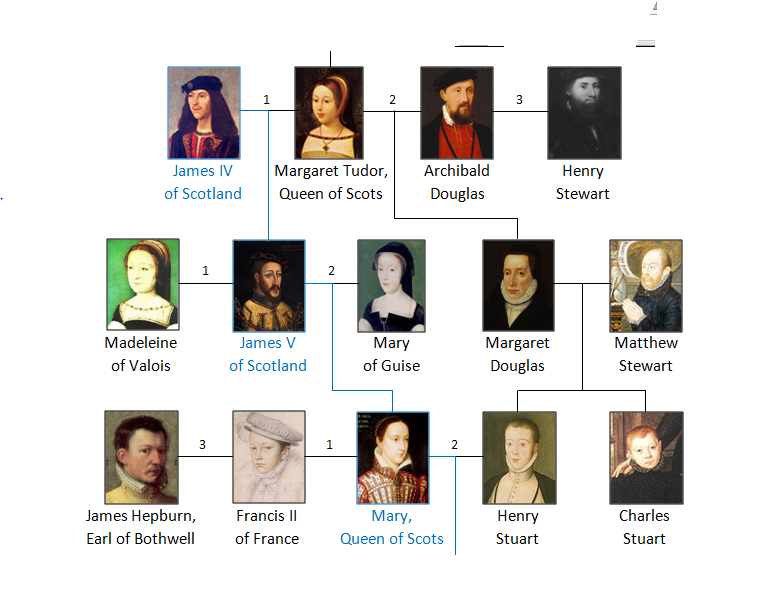 |
| Meet The Grandparents! |
The abbreviated family tree of the Tudors, above, begins with Henry VII’s older daughter Margaret who never married the King of Portugal as
The Tudors fans may believe, but did marry the King of Scots in 1503. Like most of the Scottish aristocracy, James IV was killed at Flodden Field in 1513, leaving the Queen Dowager Margaret as regent for her an infant son. But she did not remain a widow for long. She had become enthralled with one of the ambitious Douglases, and in 1514 secretly married Archibald Douglas, the new Earl of Angus.
In contracting the second marriage she not only infuriated the Scots, she outraged her brother who by then was England’s King Henry VIII. Under the terms of her marriage contract with James IV, a subsequent marriage ended her entitlement to the regency, which passed to the pro-French Duke of Albany, the dead king's brother.
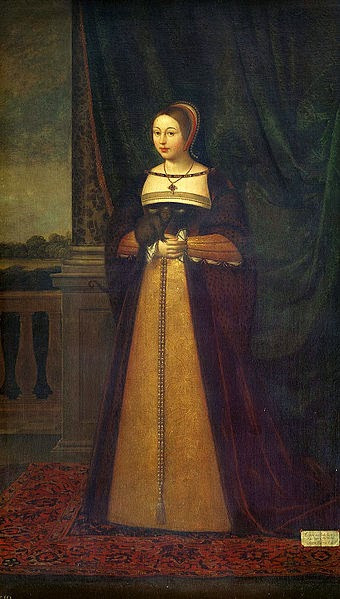
When Albany arrived from France, Margaret was forced to surrender her sons into his care and retired to Linlithgow, pregnant with Angus’s child. Eventually she followed her brother Harry’s advice and fled to England. Her daughter Margaret Douglas was born in Northumberland at Harbottle Castle which made Lady Margaret a natural born Englishwoman, a matter that became increasingly important after Henry VIII left a will disenfranchising foreigners from succeeding to the throne, and Parliament ratified it in the Act of Succession.
 |
| Margaret |
 |
| Angus |
Margaret’s marriage to Angus was not her last gambit in the marriage game but it certainly was the most tumultuous. He did not follow her into England but reconciled with Albany and stayed in Scotland, secretly taking up with a former lover Jane Stewart and living with his mistress on Queen Margaret Tudor’s money. While Margaret and her brother often argued, her daughter Lady Margaret Douglas was highly favored by King Henry and became a companion of his daughter Princess Mary.
In the meantime, Queen Margaret returned to Scotland and engaged political maneuverings that reconciled her with Angus until she discovered his infidelity and the fact that he had bilked her. When Albany who had been on a diplomatic mission to France returned, Margaret took up with Albany and Angus was on the outs. The exact nature of her relationship with Albany is one of history’s secrets. It was probably a platonic partnership but with Margaret, one never knew.
It did result in Angus being tried for treason and sent to exile. Thus it became Angus’s turn to receive aid and support from Henry Tudor, and when Margaret brought up the subject of divorce, her brother, who had not yet met Anne Boleyn, was morally outraged. When Angus marched north to seek custody of James, his wife greeted him with canon fire from Holyrood Palace and Edinburgh Castle. Angus retreated to rethink his game plan.
 |
| Edinburgh Castle |
But that did not end it. Ultimately Angus seized control of young King James, an event which left James V with anti-English political sentiments and a deep hatred of his step-father.
By then Margaret had successfully obtained her divorce. She engineered a coup that ousted Albany, and soon thereafter the twelve year old king escaped Angus and assumed personal rule of Scotland with his mother as his principal adviser. She married a third time to Henry Stewart, whom she found every bit the spendthrift and philanderer that Angus had been.
She was at court in Scotland when her son brought home his second French consort, Marie of Guise, after the death of his first wife, Princess Madeleine de Valois. Apparently the two formidable woman had a good relationship. The Dowager Queen Margaret Tudor died in Perthshire in 1541, the year before the birth of her granddaughter Marie Stuart, who became Queen of Scots when less than a week old.
Queen Margaret’s daughter Lady Margaret Douglas remained in England during her mother's Scottish adventures. She proved to be as difficult to control as her mother had been. However, she was a pretty girl, Henry Tudor’s favorite niece, and easy to forgive.
Darnley’s paternal grandfather John Stewart, Earl of Lennox, was also a character of merit. He had a remote claim to the Scottish throne as a descendant of King James II that made him a natural rival of the Hamilton earls of Arran who held a slightly superior claim.
He was murdered in 1526 after having been taken captive in the Battle of Linlithgow in which he lead a force seeking to free young King James V from domination by his stepfather Angus. While in custody he was murdered by James Hamilton of Finnart, the Earl of Arran's illegitimate brother. Stewart's widow was a daughter of the powerful Catholic Earl of Atholl. He left two sons, Matthew Stewart, who inherited the Lennox earldom, and John, a naturalized French citizen. John Stuart, Signeur d’Aubigny, was a noted captain in the French Garde Ecosse and a friend of Henri II. Little is know of Darnley's paternal grandmother, even whether she was Atholl's daughter Elizabeth or his daughter Anne.
Meet The Parents!
As stated, Darnley’s parents were Matthew Stewart (Stuart) and Lady Margaret Douglas, Earl and Countess of Lennox, both with royal blood. The preceding material has outlined Margaret’s Douglas’s lineage. Through her mother she was the granddaughter of Henry VII and Elizabeth of York and the half-sister of King James V of Scotland.
It is also noteworthy that she was English born and bred, which made her high in the English succession. As an adolescent she served in the household of Princess Mary, but when Henry married Anne Boleyn, Lady Margaret became one of her ladies in waiting.
However, after Henry had put Anne to death, he was outraged to discover that his favorite niece had become engaged to Anne Boleyn’s uncle Sir Thomas Howard without his permission. He sent them to the Tower where Howard died.
Not long after Howard’s death and her release due to illness, she began an affair with Sir Charles Howard, adolescent Queen Catherine Howard’s brother. Again Henry was furious, but her indiscretion with Charles was less critical now that Henry had an heir in Prince Edward. At the time of her affair with Thomas the king had bastardized his daughters which left Lady Margaret high in the succession. By the time of her liaison with Charles, such was no longer the case. It more an embarrassment than a threat.
Henry VIII was therefore delighted when Margaret married Mathew Stewart, Earl of Lennox in 1544, a satisfactory match. She was said to be very beautiful in her youth, a fact unfortunately not documented in any confirmed portrait although the one shown below at the right is believed to be either Lady Douglas or Queen Mary I. In spite of the fact that her union with Matthew Stewart was a political marriage, it evolved into a love match.
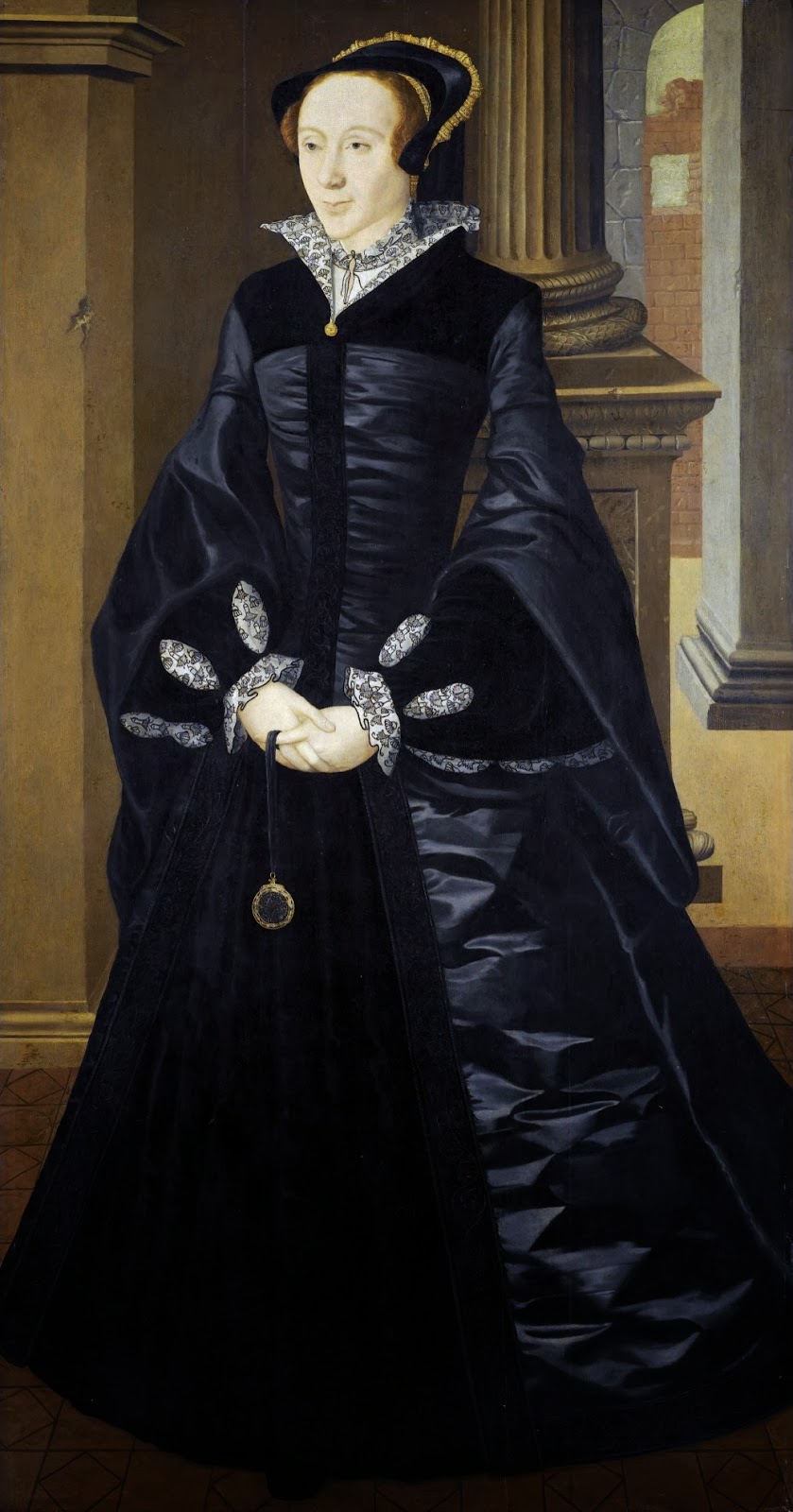 |
| John Scots, Possibly Margaret Douglas |
The bridegroom Matthew Stewart was the great-great grandson of James II of Scotland through the female line. His rival James Hamilton, Earl of Arran, was likewise descended from James II but from the male line. At the birth of the Queen of Scots, Hamilton (Arran) stood second behind her and Lennox-Stewart, a close third.
When James V died of despair after the Scottish defeat at Pinkie in which Stewart had performed credibly in a diversionary action, he asserted his claim to be second behind the infant queen, but in spite of Hamilton’s unpopularity and ineptitude, the Hamilton Earl of Arran prevailed. One of his advantages was the fact that Stewart was not yet married at the time of James V’s death and Arran had sons, important in asserting a potential dynastic claim.
Not long after Stewart’s return from exile and the king’s death in 1542, Stewart sought the hand of the Dowager Marie of Guise, Marie Stuart’s mother, and was a strong champion of the alliance with France. It was after it became apparent that Arran was favored by both the Scots and the French that Matthew Stewart changed his allegiance back to the English, returned south, and married Lady Margaret Douglas.
For supporting Henry VIII and later the Lord Protector Edward Seymour in the wars known as The Rough Wooing, Stewart’s Scottish lands and titles were forfeited. Later, when Marie of Guise was dying, he petitioned Elizabeth to allow him to travel to Scotland to reassert his claim and was ultimately successful.
He left Countess Margaret and their two sons Henry and Charles in England, probably at the insistence of Elizabeth, who liked having insurance. His older son Henry Stuart was known as Lord Darnley, a title historically used by heirs to the earldom, and he is generally known to history by that name. It seems that by this phase, the Lennox-Stuarts had adopted the French spelling of their surname. Darnley was handsome and athletic, a common face at Elizabeth Tudor’s court. And Henry was indisputably English, important due to the terms of the Act of Succession, which disqualified foreigners. Perhaps most important of all, he was inordinately tall. The Queen of Scots stood between 5’11 and 6 feet and had spent her youth looking down on the heads of others. And thus, the ill-fated romance begins.

Margaret Douglas was a very ambitious woman and acutely aware that her son Henry was well placed in the English succession as the great-grandson of the first Tudor king, Henry VII. And recall that through his father, he was also a descendant of James II, with claims to the Scottish crown. His position became more important after the death of Edward VI and Mary I in 1558.
The English queen Elizabeth Tudor was a self-styled maiden, what we would call a spinster, and there were signs that she wished to remain one. She had watched the disaster of her sister’s marriage to a foreign consort who was in the game merely for the crown. While the heirs of Queen Margaret’s younger sister Mary, Duchess of Suffolk were favored in Henry VIII's will and in the Act of Succession , Elizabeth disliked the Grey sisters intensely.
Thus, while Lennox was in Scotland reestablishing himself as a power player there, Lady Douglas was occupied positioning her son. She sent him to France the year of Henri II’s death to pressure the king to urge the Scottish regent to lift the forfeiture, and again in 1560 when Queen Marie's sickly husband King Francois II died. Although the countess had been writing letters to her niece the Queen of Scots highlighting Darnley’s virtues, there is no indication that the young widow was particularly impressed. She had another suitor in mind.
At the time, the Queen of Scots was hoping to wed Don Carlos of Spain. Apparently she was so anxious to secure an advantageous second marriage commensurate with the one that had briefly made her Queen of France that she was willing to marry a suspected homicidal maniac. Although neither of them intended to benefit Marie Stuart by their actions, Philip II of Spain and Marie Stuart’s mother-in-law Catherine de Medici did her an unanticipated favor when they sabotaged her marriage plan.
With no better alternative in sight, the Queen of Scots returned to Scotland to begin personal rule of the country she had not seen in thirteen years. Neither she, the Scots nor the English expected her to do it alone. Her choice of second husband became an important issue, because it was tacitly understood that once married, her husband would no doubt receive the Crown Matrimonial and be the one who actually ruled the nation. Mary I of England had already demonstrated that the choice of husbands by a regnant queen could have widespread consequences and unforeseen results.
 |
| Darnley |
 |
| Don Carlos |
Meet The Candidates
 |
| Robert Dudley, Baron Denbigh |
When she first arrived in Scotland in 1561, the queen had not given up on the idea of Don Carlos. She sent her foreign secretary the inimitable William Maitland of Lethington traipsing around the English and European courts seeking to broker it. He no doubt found it difficult to broach the topic with a straight face. Even Marie’s French relatives the Guises were opposed to it and without the queen’s consent were making overtures to the Austrian archduke.
The Queen of Scots was despaired to learn that her cousin Elizabeth Tudor felt she had the power to veto her sister queen’s marriage choice, but the English queen had lived through her older sister’s unpopular and heartbreaking marriage to a Spaniard. She had no plan to tolerate another Spanish consort on a British throne.
At the time that Marie Stuart began shopping for a husband, Elizabeth had only occupied her throne for five years and Elizabeth lived in constant fear of a Spanish invasion to purge England of Protestantism. She surely did not want to see a Spanish fleet in the Firth of Forth so close to the Borders at Berwick and the significantly Catholic English North country. She dangled the English succession under her Scottish cousin’s nose and proposed a candidate of her own.
Elizabeth, for reasons that historians find perplexing, advanced her own favorite Robin Dudley as her candidate. It was well known that Dudley and the queen were too close for comfort, especially for the comfort of Elizabeth’s minister Cecil, who may have been the one to press the nomination in hopes of being rid of Dudley, who by then was Lord Denbigh, and soon to be made Earl of Leicester. While there is no evidence that Dudley had carnal knowledge of the queen, their intimacy and preference for one another was close to scandalous.
After Dudley’s first wife Amy’s suspicious death, Elizabeth was canny enough to see that marrying him herself was impossibility. There is evidence that she planned that the three of them, Marie, Robin and Elizabeth – would share a residence at least a portion of each year. The problem with the English plan was that there were two people who strongly opposed it –Robin Dudley and the Queen of Scots—the prospective bride and bridegroom. When Elizabeth’s proposal was revealed to the Queen of Scots by the wary English Ambassador, instead of raging, she laughed until her side hurt, but only until she realized it was not a joke. Dudley himself wrote to her disclaiming any part in the plan.
By then, with a little help from her aunt Margaret, the Scottish queen had come upon an alternative of her own, the young Englishman Lord Henry Darnley, whom the Queen of England referred to as ‘yon long lad’. Nearly all of Marie Stuart’s Scottish advisers and most historians would agree that she would have been better off to have married Dudley. But even as a child, Marie Stuart always got her way.
Meet The Real Lord Darnley
The best that can be said for Darnley is that he was tall. Marie Stuart stood close to six feet, and Darnley was the taller. He was also handsome in a somewhat effeminate sort of way, and an excellent dancer. He was polished and spoke several languages. He could be charming when it mattered. It mattered when he wanted something.
There is still a good deal of controversy as to how exactly he ended up in Scotland and whether Elizabeth might have had the gift of Second Sight in allowing him to go. She pretended to be outraged when he left England without permission, but there is good argument that she knew Darnley well enough to guess that he would soon have Scotland in an uproar. And so he did.
He arrived in February of 1565 and when he fell ill in the late spring, the queen was at his bedside spoon feeding him and writing letters to Elizabeth informing her that she had no right of ‘nay-say’ as to who her Scottish cousin married. They were soon inseparable. Marie had always been attracted by the wounded and the needy. She did not know that what she thought to be measles was probably syphilis.
 |
Darnley's Sycamore, where the queen nursed Darley after he fell ill
shortly after he arrived in Scotland, no doubt to woo her. |
In a few months after his arrival, Darnley had succeeded in alienating practically everyone at court, complaining about the queen’s generosity to her brothers James, Earl of Moray; John, Prior of Coldingham; and Robert and her Four Maries who had attended her since they all were five years old and headed for France. Soon there was a faction ready to go to war if Marie married him.
But Marie Stuart had a healthy dose of Stewart stubbornness. She did marry Darney and her brothers and their allies prepared for war. The resulting comedy was called the Chase About Raid. Sometimes the rebels under the command of her brother James, Earl of Moray, did the chasing, but often it was the bride and bridegroom chasing after the dissidents. They finally succeeded in forcing most of the queen’s most stalwart supporters including Kirkcaldy of Grange and the Earl of Moray into England. She had allowed her husband's antics to chase away her support group.
With Moray out of country and Maitland out of favor, outward appearances were that the queen and Darnley were partners in the enterprise of government, but appearances were deceiving. With the queen’s brother and her most effective advisers in exile, Darnley let his mask slip and began to show his true nature. He was too busy entertaining himself to bother.
The queen soon realized that he was happiest when spending his evenings in alehouses and brothels, and he was not the least discrete about it. If she complained, he pouted or became verbally abusive. Her ladies and those old friends who had remained heard her ask for a knife. When she did not rush to ask Parliament to confer the crown matrimonial upon him, Darnley threw a tantrum and spieled threats that reduced the queen to tears. And she put up with it for he same reason women have endured such treatment throughout human history: the Queen of Scots was pregnant.
But then, in March of 1566, Darnley conspired with the powerful Douglas faction lead by James Douglas, Earl of Morton, to murder her private secretary and confidante David Rizzio in a brutal slaying orchestrated so as to occur in her presence at a private dinner party in her supper room. Darnley had not been on the guest list. Darnley, who was by then showing signs of tertiary syphilis, was manipulated by the queen’s enemies into believing that he had been cuckolded and that the diminutive artistic Rizzio was likely the father of her unborn child. The manner in which the death was carried out suggested that Darnley and the Douglases were hoping for a miscarriage and perhaps the death of the queen. There is some evidence that Darnley was bisexual and jealous not of David, but of the queen.

When Darnley showed up uninvited, the queen was polite but confused, but when intruders entered from the private stairs that linked her chambers to the king's and called out for Davie, their intent was clear. One of the assassins, one of the Kers of Faldonside, put a firearm to the queen’s pregnant belly and also threatened to shoot the Earl of Mar when he looked to be mounting a defense.
During most of the fracas, Darnley held Marie by the waist, restrain her from giving aid to Rizzio. The small man never had a chance. Although Darnley did not strike the fatal blow, by some accounts the consort's dagger was left in Rizzio's corpse.
The next day, Moray and the Scots who had been exiled in England returned, and they and the assailants celebrated the slaughter with a dinner at the Earl of Morton's house. Marie took advantage of their absence to convinced Darnley that he would be their next target. She used all of her feminine wiles to coerce him into escaping with her, and with assistance from the earls of Bothwell and Huntly, she was soon back at Holyrood and reconciled with her brother Moray. Morton and the Douglases fled the country, and the queen did nothing to diffuse their feeling that Darnley had betrayed them.
When matters settled, Darnley was out of favor but tolerated because of her pregnancy. The queen moved into a fortified room in Edinburgh Castle where she could spend her laying in without interference from her wayward treacherous husband. She had moved her brother and Moray into the castle and when Scotland's bad boy Bothwell promised to behave himself, she allowed him and his cohort Huntly to join the group living in the castle, awaiting the birth of an heir.
By the time the queen withdrew into her birthing chamber, Darnley was in secret negotiations with Philip of Spain and corresponding with the Vatican, accusing his wife of being a false Catholic. He sent charts of the shoals off the Orkneys and Shetlands to Philip and encouraged an invasion that would put Darnley on the Scottish throne. His activities were no secret to the queen, who had more credit with the European Catholic powers than Darnley had. But no move was made against him.
In June when the queen delivered a healthy son whom she named Charles James Stuart but who was later Christened as James Charles Stuart in appeasement of the Scots, she allowed her husband into the fortified chamber just long enough to get him to admit before witnesses that the child was clearly his. Then she and Darnley traded barbs and he stomped off. She no longer cared where he went or what he did.
Following the birth of her son, the queen remained for the most part estranged from her husband, who again was catering to her in hopes of being granted the Crown Matrimonial. Secretly, or so he thought, he continued conspiring against her. There were brief periods in which the queen and Darnley appeared to be reconciled and rumors that they were sharing a bed.
However, as soon as she was strong enough to travel, she went to Alloa to recover her health and good spirits, and Darnley did not accompany her. He showed up later and made a scene when he saw her dancing. They went stag hunting together at the Border fortress Traquair House where Darnley was so insulting to the queen that both the laird John Stewart of Traquair and the queen left the dinner table. When they left Traquair, they were no longer speaking.
The queen visited Jedburgh for the Border Assizes, and after the close of the Assizes, she made a controversial side trip to the Hermitage where James Hepburn, Earl of Bothwell lay wounded. It was a rigorous one day's trip of sixty miles, and when she returned to Jedburgh, she fell ill and almost died. Poison was suspected but the likely cause was exhaustion and a bleeding ulcer. News that she had actually died spread about the country.
Darnley arrived after she was on the road to recovery, insulted most of the others present, and promptly left. Although he was titular king, no one paid him much attention. The feeling among her companions was that the queen was exercising restraint because of the prince, whose Christening was forthcoming.
By the time the queen settled at Craigmillar Castle outside Edinburgh to recuperate and finish the plans for her son’s christening the following month, she was suffering more from hatred and despair of Darnley than from any disease or ulcer. Some who knew her well including James Melville, who had been her close friend since they were adolescents in France, feared that she was suicidal. She sent her ladies ahead to Stirling to decorate for the ceremonies, but even the affair that had meant so much to her did not cheer her.
At least, at Craigmillar Castle she was in the company of men she trusted --Maitland of Lethington, her brother James, the earls of Argyll, Huntley and Bothwell. The latter and his father had served her mother with unprecedented loyalty when the others had deserted and left her to die. Although he could be exasperating and disobedient, he was fast becoming her obvious favorite.
During Marie Stuart's short stay at Craigmillar, her trusted little band of advisers conferred on how to rid Scotland of the pestilence called Darnley, and they presented their proposals to the queen. They left Craigmillar committed to solve the queen's marriage problem. Whether they and the queen arrived at a mutual understanding as to the means remains the mystery. There was no mystery that by the time the queen left Craigmillar, Lord James Hepburn, the notorious Earl of Bothwell had become a principal player in the game.
 |
| The ruins of Craigmillar © Kim Traynor via Creative Commons,Wikimedia |
End of Part I
Part II –From Craigmillar to Carberry, coming February 28, 2014 (The Craigmillar Bond, the Whittinghame Bond, the Queen's strange trip to Glasgow—the events at Kirk o’Field, the Kidnapping at Foulsmouth Bridge on the Almond and the Road to Carberry Hill)
~~~~~~~~~~~~~
Linda Root is the author of the four books in the Queen of Scots Suite at Amazon and Amazon Kindle. The fifth book, 1603: The Queen's Revenge is forthcoming later this spring. She is also the author under the name Linda Fetterly of the Kindle paranormal time slip fantasy, The Green Woman, also coming soon. Explore
The Queen of Scots Suite by Linda Root.


 Annie Whitehead is an author and historian, and a member of the Royal Historical Society. Her first two novels are set in tenth-century Mercia, chronicling the lives of Æthelflæd, Lady of the Mercians, who ruled a country in all but name, and Earl Alvar who served King Edgar and his son Æthelred the Unready who were both embroiled in murderous scandals. Her third novel, also set in Mercia, tells the story of seventh-century King Penda and his feud with the Northumbrian kings. She is currently working on a history of Mercia for Amberley Publishing, to be released in 2018.


