
by Lauren Gilbert
While on his Grand Tour in Europe in 1761, John fell in love with Christiana Sophia Albertina (her first name was also spelled Christiane, or Christina), the oldest daughter of Charles Louis Frederick, Duke of Mecklenburg- Strelitz. His love was requited and the couple became betrothed. This was an imminently suitable match in every respect, equals in rank and intelligence. Unfortunately, not long afterwards, Christiana’s younger sister Charlotte became betrothed and then married to King George III of England. Because protocol did not allow an elder sister to marry a man of lower rank than a younger sister’s spouse (Christiana would have become Charlotte’s subject), the couple had to separate. Neither ever married.
John found another grand passion, in his family’s library. The first and second Dukes had acquired various volumes, including some of great value. In his turn, John became a passionate collector of books. His collection included the 1st edition of Boccaccio’s Decameron, known as the Valdarfers edition. This was a legendary volume, which many had believed did not actually exist. It seems that that John’s father Robert Ker (the second Duke) found it in Italy and purchased it for 100 guineas, then brought it home and showed it to his friends at dinner for great acclaim. This dinner included Lord Oxford and the Earl of Sunderland, and young John was present. This event supposedly precipitated John’s urge to collect. However the Valdarfers edition was acquired, this volume became a centrepiece of John’s collection. He went on to become a dedicated bibliophile who collected ancient and unusual incunabula and books, and who was especially fascinated with Shakespeare. He was assisted in his purchases by a man named George Nicol (bookseller and publisher), who also assisted George III with his library acquisitions. Roxburghe’s library collection included numerous editions of Shakespeare’s works and books that mentioned Shakespeare as well as volumes printed by Caxton and other rare books. It also included pamphlets and broadside sheets of ballads. The collection was bound in green leather.
John died March 19, 1804. Because he had outlived his younger brother (who died March 20, 1781) and had never married or had children, the dukedom was inherited by his 2nd cousin twice removed William Bellenden, who became known at William Bellenden-Ker. The other titles John had inherited or acquired became extinct. At the time of his death, he reputedly had 10,000 items in his collection. Sadly, William, the 4th duke, died childless in October of 1805. The titles went dormant until Sir James Innes, baronet, a descendant of the 1st Earl of Roxburghe and one of multiple contenders, established his claim, changed his name to Innes-Ker, and became the 5th Duke of Roxburghe. Subsequently, in 1812, it was decided to put the collection up for sale. 9353 items were listed in the catalogue which was written by George Nicol HERE. George Nicol also organized the auction, which was conducted by him and Robert Harding Evans, also a bookseller. The sale began May 18, 1812, lasted over a month and was extremely successful, thanks to the competitive efforts of the Duke of Devonshire, Lord Morpeth, Lord Spencer and other wealthy collectors. The Valdarfers Decameron was sold on June 17, 1812 for 2260 pounds to the Marquess of Blandford. (The entire sale generated 23,341 pounds, breaking all records.) Reverend Thomas Frognall Dibdin, a bibliographer associated with Lord Spencer, had invited a group of fellow book enthusiasts to dine at the St. Alban’s Tavern on the evening of the sale of the Decameron. This dinner was the beginning of the Roxburghe Club.
A club for bibliophiles, its membership was made up of nobility, academics and professionals, who were united in their passion for books. They met every year on the same date as the original dinner to commemorate the sale of the Valdarfars edition of the Decameron. The club still exists, and its members (membership limited to 40) still dine together on the date of (or a date near the date of) June 17. The club has been known for producing facsimiles of rare books which the members gave to each other, as well as for publishing previously-unknown medieval texts. Their books were published in a particular, elegant style which became known as the Roxburghe style. The club continues to publish a diverse selection of works, and one can contact the club if one desires to purchase a club book. The history, list of members since its founding in 1812, and more about their books can be found at their website HERE. Although the 3rd Duke’s library was sold, it was one of the great libraries of the Georgian eras. That library and John himself are remembered still today.
In doing some research regarding gentlemen’s clubs, I ran across a reference to the Roxburghe Club, a club for bibliophiles established at the time of the sale of the Duke of Roxburghe’s library. Who were the Dukes of Roxburghe? The Dukedom was a Scottish title awarded to John Ker, 5th Earl of Roxburghe who became a Secretary of State of Scotland in 1704 and helped bring about the union with England. This dukedom was the last creation in the Scottish peerage. John remained loyal to George I during the Jacobite rebellion. The first Duke of Roxburghe’s only son, Robert also was created Earl Ker of Wakefield, York and Baron Ker of Wakefield in York. John Ker was born April 23, 1740 to Robert Ker, the 2nd Duke of Roxburghe, and his wife Essex Mostyn in Hanover Square, London. He was the oldest of four children (he had 2 sisters and a younger brother). John was educated at Eton College. He succeeded to his father’s and grandfather’s titles August 20, 1755.
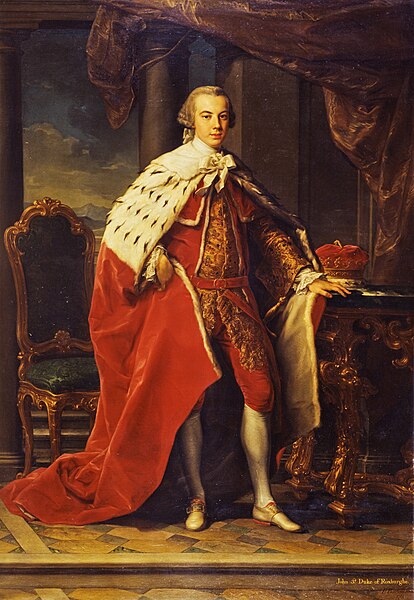 |
| John Ker, 3rd Duke of Roxburghe, by Pompeo Batoni 1761 |
While on his Grand Tour in Europe in 1761, John fell in love with Christiana Sophia Albertina (her first name was also spelled Christiane, or Christina), the oldest daughter of Charles Louis Frederick, Duke of Mecklenburg- Strelitz. His love was requited and the couple became betrothed. This was an imminently suitable match in every respect, equals in rank and intelligence. Unfortunately, not long afterwards, Christiana’s younger sister Charlotte became betrothed and then married to King George III of England. Because protocol did not allow an elder sister to marry a man of lower rank than a younger sister’s spouse (Christiana would have become Charlotte’s subject), the couple had to separate. Neither ever married.
 |
| Princess Christina of Mecklenburg-Strelitz, German School c 1766 |
John found another grand passion, in his family’s library. The first and second Dukes had acquired various volumes, including some of great value. In his turn, John became a passionate collector of books. His collection included the 1st edition of Boccaccio’s Decameron, known as the Valdarfers edition. This was a legendary volume, which many had believed did not actually exist. It seems that that John’s father Robert Ker (the second Duke) found it in Italy and purchased it for 100 guineas, then brought it home and showed it to his friends at dinner for great acclaim. This dinner included Lord Oxford and the Earl of Sunderland, and young John was present. This event supposedly precipitated John’s urge to collect. However the Valdarfers edition was acquired, this volume became a centrepiece of John’s collection. He went on to become a dedicated bibliophile who collected ancient and unusual incunabula and books, and who was especially fascinated with Shakespeare. He was assisted in his purchases by a man named George Nicol (bookseller and publisher), who also assisted George III with his library acquisitions. Roxburghe’s library collection included numerous editions of Shakespeare’s works and books that mentioned Shakespeare as well as volumes printed by Caxton and other rare books. It also included pamphlets and broadside sheets of ballads. The collection was bound in green leather.
 |
Itinerario di Ludouicode BarthemaBolognese nello Egypto from John Ker,3rd Duke of Roxburghe's collection |
John died March 19, 1804. Because he had outlived his younger brother (who died March 20, 1781) and had never married or had children, the dukedom was inherited by his 2nd cousin twice removed William Bellenden, who became known at William Bellenden-Ker. The other titles John had inherited or acquired became extinct. At the time of his death, he reputedly had 10,000 items in his collection. Sadly, William, the 4th duke, died childless in October of 1805. The titles went dormant until Sir James Innes, baronet, a descendant of the 1st Earl of Roxburghe and one of multiple contenders, established his claim, changed his name to Innes-Ker, and became the 5th Duke of Roxburghe. Subsequently, in 1812, it was decided to put the collection up for sale. 9353 items were listed in the catalogue which was written by George Nicol HERE. George Nicol also organized the auction, which was conducted by him and Robert Harding Evans, also a bookseller. The sale began May 18, 1812, lasted over a month and was extremely successful, thanks to the competitive efforts of the Duke of Devonshire, Lord Morpeth, Lord Spencer and other wealthy collectors. The Valdarfers Decameron was sold on June 17, 1812 for 2260 pounds to the Marquess of Blandford. (The entire sale generated 23,341 pounds, breaking all records.) Reverend Thomas Frognall Dibdin, a bibliographer associated with Lord Spencer, had invited a group of fellow book enthusiasts to dine at the St. Alban’s Tavern on the evening of the sale of the Decameron. This dinner was the beginning of the Roxburghe Club.
Sources include:
Google Books. DeRicci, Seymour. English Collectors of Books and Manuscripts and Their Marks of Ownership (1530-1930.) Cambridge: Cambridge University Press, 1930. HERE;
Roberts, William. The Book Hunter in London, Historical and Other Studies of Collectors and Collecting. London: Elliot Stock, 1895. HERE
The Encyclopedia Brittanica. A Dictionary of Arts, Sciences, Literature and General Information, 11th edition, Volume 23. New York: Enclyclopedia Brittanica Co, 1911. HERE
The Peerage.com. Person Page 40279. John Ker, 3rd Duke of Roxburghe. (last edited 15 May, 2017) HERE
All images from Wikimedia Commons (public domain)
~~~~~~~~~
~~~~~~~~~
Lauren Gilbert, a member of the Jane Austen Society of North America, has a bachelor's degree in English, and is a long-time resident of Florida. Her first published book, Heyerwood A Novel was released in 2011; her second novel, A Rational Attachment, is in process. Please visit her website for more information HERE.


