Showing posts with label History of Women. Show all posts

Thursday, March 23, 2023

British Women in the Women's Voluntary Services of WWII

by Helena Schrader

Britain was slow to wake up to the danger of war and pacifist sentiment was strong right up until the Munich Crisis. Yet as early as January 1937, the government charged local authorities with organizing air raid protection. This was formalized in the Air Raid Protection Act of 1938 and from the start, women formed a vital part of plans and execution.


The main tasks envisaged for civil defence organizations were air raid wardens to ensure compliance with air raid precautions, first aid and ambulance services, and anti-gas units. In addition, a demand for nurses was anticipated, but nurses were organized as before in existing organizations such as the British Red Cross Society, the Order of St. John of Jerusalem, the First Aid Nursing Yeomanry and Voluntary Aid Detachments (VADs). The various organizations took responsibility for both recruitment and training. Other aspects of civil defence, however, were handled separately as voluntary war work. In these tasks, the pay was only for the actual hours worked, uniforms were initially only an armband and a tin hat. Members had no ranks or command structure, but they did receive training. From the very beginning, women volunteered in greater numbers than men.  


In addition to the above, volunteers were sought to augment the capacity of the fire brigade and the police. They were organized in the Auxiliary Fire Brigade and Women's Auxiliary Police Corps respectively. Some ten thousand women were employed as auxiliary police, while 70,000 women served in the Fire Brigade. Women were not, however, employed fighting fires directly, certainly not in the midst of bombing raids. Primarily, they worked in control centres and fire stations handling switchboards and clerical work. They did fire watching in shifts and sometimes drove fire trucks. 


Yet some visionary women recognized that much more was going to be needed than the government had planned and so the Women's Voluntary Services (WVS) was born. The WVS did not have a clear mandate. Instead, it was designed to respond to needs as they came up, but organized regionally to be available anywhere in the country.


It started by offering training courses such as driving in the black-out, first aid, fire-fighting etc. During the war scare associated with the Munich Crisis and at the start of the war a year later, the WVS organized the evacuation of over a million children, pregnant women and young mothers out of urban areas. That is it organized both the registration and mustering of those seeking evacuation and the billeting of evacuees on arrival at the other end. Not all went well in either September 1938 or 1939, but each time "lessons learned" led to improvements that facilitated things the next time evacuation became necessary. 


While the evacuation of Dunkirk took nine days, the Blitz of London lasted nine months. At the start, London endured 57 straight nights of bombing.  At the end, 43.500 civilians had been killed, 159,000 injured and 2.25 million made homeless. And through it all the WVS was in action. It established and ran rest centers where those bombed out could get food and a bed until new housing was organized. It provided clothing and blankets to those who had lost everything. It created and manned Incident Inquiry Points in areas near the destruction to help relatives find one another. It operated mobile canteens to bring tea and sandwiches to firemen, first-aid workers and to the air raid shelters. In some cases, where local supplies could not cope after a massive raid, it organized convoys of food, blankets and clothing from areas of the country not affected by the bombing. These convoys often brought food and clothing donated by the United States or the Commonwealth. On arrival, a in the bombed out area, a distribution point would be set up, which remained sometimes for several days feeding and clothing thousands. 

Meanwhile, the WVS had been tasked with carrying out a billeting survey, something soon put to use when Hitler's armies rolled over Poland, Denmark, Norway, Holland, Belgium and France, sending tens of thousands of refugees to England. The "refugee crisis" came to a crescendo with the emergency evacuation of 340,000 troops off the beaches at Dunkirk. Much has been written about the "little boats" that contributed to the astonishing success of Operation "Dynamo," but less has been written about the women who met those troops with tea and sandwiches, warm, dry clothing, baths and clean socks, and help in contacting families. Across southern England, troop trains were taking the evacuated soldiers out of the landing ports to military bases across the country. At the height of the evacuation, trains arrived at some of the stations every twenty minutes for an eight-minute "food stop." It was the WVS that made and served thousands of sandwiches each day, working 24/7.
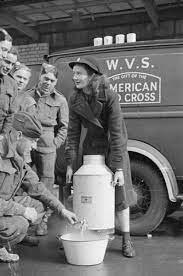


When the Blitz tapered off, the WVS took over less dramatic but nevertheless vital tasks such as organizing collection drives for scrap metal, waste paper, wool, books for service libraries, and even garbage for pig swill. They organized the distribution of ration books and conducted fundraising. Throughout the war, they provided mobile canteens to help harvest workers and when the Americans joined the war, they established "welcome clubs" for American servicemen. During the Allied landings in Normandy, the WVS returned to the train stations of southern England to again provide tea and sandwiches for troops -- now going on the offensive rather than withdrawing from a defeat. And of course, when the V1s and V2s struck, they again set up rest and information facilities for those who had lost their homes or relatives.


Roughly one million British women served in the WVS. Most of them were older women. Women whose children were already out of the house -- often in the armed services or at sea. The founder of the WVS, Lady Reading, claimed: "We know we look shabby and we know our members are not young but we are proud of the fact that we are trusted by ordinary people." [Quoted in Carol Harris. Women at War 1939-1945. Sutton Publishing, 2000. 47] 


In the wartime film The Heart of Britain, the following sentiments were put in the mouth of a character representing a member of the WVS. "You know, you feel such fools, standing there in the crater, holding up mugs of tea while the men bring up bodies. You feel so useless until you know that there is someone in that bombed house who you can actually give the tea to." The evidence of hundreds of memoirs suggests that many hundreds of thousands sincerely welcomed that cup of tea, the sandwich and the warm clothes too.


~~~~~

Award-winning novelist Helena P. Schrader is the author of three books set in Britain during WWII: Where Eagles Never Flew, Grounded Eagles and Moral Fibre.  You can find out more about them, their awards and read excerpts at: https://CrossSeasPress.com. 


Monday, January 27, 2020

Something about Mary

by Judith Arnopp

Anthonis Mor, Museo del Prado, Madrid, 1554 - Public Domain

Mary was the eldest of Henry VIII’s children. In her infancy she was lauded as a princess, the king referred to her as his ‘pearl’ and she was afforded every honour due to a Henrygirl in her position. Her mother, Catherine of Aragon, after suffering numerous miscarriages and still births was growing old. and her fertile years were at an end. As her fertility died, so did Henry’s love for her.

Anne Boleyn was everything the queen was not; young, fertile, witty and entrancing and Henry was unable to resist. In the years that followed, Mary and her mother’s status was brought into question, the marriage declared illegal and Mary was branded illegitimate. Teenage years are often difficult. Our emotions are in turmoil as we struggle to come to terms with the adult world. Imagine the thirteen year old Mary, isolated from those she loved, separated from her mother and compelled to deny the validity of her parent’s marriage and condemn herself as illegitimate.

Anne Boleyn National Portrait Gallery - Public Domain

In 1533 Henry and the now pregnant Anne Boleyn were married – seventeen-year-old Mary was heartbroken, the hurt intensified when she was sent as a servant to the household of her new sister, Elizabeth.

I would imagine there are difficulties for anyone accustomed to being the apple of their father’s eye when suddenly supplanted by the arrival of a new sibling but Mary was not just replaced in her father’s affection but in every aspect of her former life. Her titles were stripped, her property removed and her status demolished along with any hope of ever becoming queen. Her father’s love must have seemed like some distant dream, and since her nebulous status made her all but unmarriageable her future looked bleak.

Yet, she seems to have borne no ill-will toward Elizabeth. The same cannot be said for Anne however, whom Mary refused to acknowledge as queen and declared she knew no queen of England other than her mother. The Spanish ambassador, Chapuys, began a rumour that Anne was plotting to poison Mary, a rumour (if it were a rumour) that undermined Mary’s security even further.

During my studies of Mary, I discovered an isolated figure, never more so than during this traumatic period. She was not allowed to see her mother again and was inconsolable when Catherine died in January 1536, just four months before Anne Boleyn herself went to the scaffold. With Anne’s demise one might have imagined Mary’s trials were at an end but although her new step-mother, Jane Seymour, went out of her way to reunite Mary and Henry and persuaded the king to bring her back to court, Mary’s humiliation was not over. Henry insisted she accept him as head of the church in England, renounce papal authority and acknowledge Henry and Catherine’s marriage was invalid and she herself illegitimate. One would imagine that this was a very high price to pay for paternal love that should have been her due.

Henry VIII Holbein - Public Domain

Even after Mary returned to court and her household was reinstated and she was reunited with her lifelong friend, Susan Clarencieux her life continued to be difficult. As the dissolution of the monasteries intensified, Mary saw the church she saw as the ‘true church’ all but demolished. She had to sit quietly while monks and nuns were punished. Henry was no longer the golden king of Mary’s infancy but became increasingly ruthless, a trait that grew worse after Queen Jane died shortly after childbirth, providing Henry with Edward, the son he’d longed for.

After the execution of her fifth step-mother, Katherine Howard, Mary was invited to act as hostess at court until the king married his final wife, Katheryn Parr. For a short time the royal family were reunited and almost ‘normal’ or at least as normal as the Tudors ever managed. Encouraged by Parr, Henry welcomed all three of his children back into the fold and, although they remained illegitimate both Mary and Elizabeth were reinstated in the line of succession, after Edward. It was only a brief respite for Mary, who under her brother’s strictly Protestant rule, was to suffer further subjection and torment.

All things considered, there is little wonder that Mary grew into a troubled adult, and ultimately became as harsh a ruler as her father. Of all the women I have studied and written about in my novels, Mary strikes me as the most pitiful. She wasn’t friendless; the people loved Mary from her cradle to her deathbed but for much of the time were afraid to show it.

Edward VI Attributed William Scrots - Public Domain

From infancy she suffered trauma that would have broken most people. But Mary stood firm for as long as she could under constant pressure from her father and his councillors, her brother and his protectors and never ceased to champion her religion. Isolated and terrified, she stood for what she believed was right and, once the crown was finally within her grasp, she did not hesitate to step up to the mark and fight for it.

In a premeditated act, the Duke of Northumberland persuaded Edward to name his cousin, Lady Jane Grey, as his heir in Mary’s place. Having previously married Jane to his son, Guildford Dudley, Northumberland clearly planned to manipulate her and rule in her stead. But Mary was having none of it and rallied an army at Framlingham Castle where support for Northumberland quickly crumbled.

Mary’s reign has been largely regarded as a failure and from our perspective it is easy to see how she earned the title Bloody Mary. As queen, Mary married against the will of the people. She failed to understand the desire of the populace to worship in the manner of their choosing. She failed to provide an heir, suffering phantom pregnancies and dying before her innovative plans for England came to fruition. Yet some of those plans were promising.

She began many policies that have since been laid at Elizabeth's door: reforms to the economy, naval expansion and colonial exploration and had her reign been longer, she may have been remembered very differently. Her success is always measured against Elizabeth's yet Mary had just five years against Elizabeth's forty-four. As with her father, Mary is remembered for her very worst acts yet there was much more to her than religious persecution and brutality. I do not seek to whitewash her actions but to consider the events of her life as she saw them, and it cannot be denied that Mary flew the Tudor banner bravely. She was stalwart, stubborn and loyal. She was sometimes unwise, she was overly passionate and she could be harsh but despite everything, she was loved by her people.

Mary Tudor by Hans Eworth. National Portrait gallery - public domain

~~~~~~~~~~
Judith Arnopp is the author of twelve historical fiction novels, her latest being in The Heretic Wind: the life of Mary Tudor, Queen of England available on Kindle, in Paperback and soon on audible.

To find out more please visit her website www.judithmarnopp.com