Showing posts with label Gladstone. Show all posts

Monday, January 6, 2020

The Pantechnicon Fire of 1874

By Karen Odden

In the early decades of the nineteenth century, the developer Seth Smith helped to transform a swampy mire into the elegant West End of London.

Seth Smith

One of his buildings, the Pantechnicon, occupied nearly two acres in Motcomb Street, smack in the middle of Belgravia. It stood five storeys tall and had an elegant Greek-style portico, with a façade of pale marble Doric pillars, suggesting the majestic durability of ancient buildings and similar in style to museums such as the National Gallery in Trafalgar Square (built in the same decade). The name “Pantechnicon” meant “all” (pan) “art” (techne), and the building was originally conceived as a bazaar with stalls where all types of art could be sold—the work of jewelers, blacksmiths, painters, carpenters, and so on. The bazaar business failed, and eventually the building was re-purposed as both a storage facility for carriages and a warehouse where wealthy Londoners could store their valuable belongings when they closed up their city houses during the off-Season, when parliament was not in session. The Spectator commented with some asperity:
“It had become a habit of Belgravia and Tyburnia when the rich inhabitants … went out of town, to pack valuables and furniture in crates and send them to the Pantechnicon, and habits pursued for forty years by the rich and indolent can seldom be interrupted.” 
Deposited valuables included furnishings, paintings, pianos, jewels, silver, libraries, family heirlooms, and objets d’arts; some London bankers even rented rooms there for the deposit of deeds and plate.

This new storage business was enabled by the new Pantechnicon van, with a movable ramp at the back, that made it convenient for removers to fetch items from people’s homes and then deliver them back upon request. (Now the word “Pantechnicon” refers to the large moving vans themselves.) The general manager of the building was George Radermacher who also—an interesting tidbit for literary fans—was responsible for cataloging George Eliot’s  library.

The Pantechnicon was advertised as “the largest, the safest, and the most fireproof warehouse in the metropolis.” According to an 1874 issue of The Saturday review of Politics, Literature, Science and Art,
“the ceilings were lathed with iron rods and covered with a composition which, as was hoped, would resist the fiercest fire, and would not crack or fall down if water was thrown upon it while hot. The boarded floors were covered with iron plates laid upon patent felt to preserve the under side of the iron from rust and to deaden the sound. The rooms were separated from each other by brick walls and wrought-iron doors, and the stairs were all of stone. All the chimney flues were lined with cast iron, and there was not a piece of wood exposed … [because] a belief prevailed forty years ago in iron as a protection against fire … a belief that has probably perished in the ruin of the Pantechnicon.” 
Four different iron walls stretched east to west, “the idea being that the doors could be shut, the progress of the fire stopped, and the damage confined.” Not a gaslight was allowed on the premises except in the offices at the entrance. The only lamps used were safety lamps.

Despite these precautions, beginning at approximately 4:30 pm on Friday, February 13, 1874, the Pantechnicon went up in flames, shooting crimson and orange spears high into the sky and spreading smoke for miles.


Nearly all the firetrucks in London were called upon; men from the Metropolitan Fire Brigade, troopers of the Life Guards, Foot Guards from the Chelsea barracks, and members of the Salvage Corps cooperated to bring the fire under control and prevent nearby houses and stables from being damaged. At 7 pm, the roof fell in with a great crash; still, it took three days for the fire to be fully extinguished. Some personal property including approximately 100 carriages was saved, but between the fire and the streams of water, the event was perhaps the single largest episode of destruction of art and furnishings in the Victorian era—and it could have been worse. The Spectator noted, “the landlord of the House of Commons is much more indebted to the [change in] wind [direction] than to Captain Shaw [superintendent of the Metropolitan Fire Brigade].”

The timing of the fire was also remarkably unfortunate. Usually, Parliament would be in session in February—and the MPs, having returned to town, would have retrieved their items out of the Pantechnicon. But by the end of 1873, it was clear that Gladstone would call a General Election, beginning February 1 and lasting two weeks, so Parliament was not in session as usual on February 13. One journalist made the dark jest that the MPs could lay the bill for lost items at Mr. Gladstone’s door.

It is difficult to assess the value of the objects lost. Because people had such faith in the Pantechnicon, they under-insured their valuables—or found ways to avoid insuring them altogether. For example, one family hid their jewels in their furniture. The cost of insuring a headboard was significantly less than insuring jewels—but jewels hidden inside were (ostensibly) safe all the same. (Tricky!) However, it is known for certain that the fire destroyed the MP Sir Richard Wallace’s painting collection, worth £150,000; and the MP Sir Seymour Fitzgerald’s art collection, worth £200,000, which included many portraits by Sir Joshua Reynolds and paintings by other masters including J.M.W. Turner. Contemporary accounts estimated the total value upon the destroyed items at £2,000,000 (approximately £220,000,000 or $280,000,000 today).

The Pantechnicon fire wasn’t the first major fire of the Victorian era, of course. Earlier fires occurred notably at the Houses of Parliament (1834), Tower of London (1841) and in Tooley Street (1861). The London Fire Engine Establishment (LFEE) was founded in 1833, a conglomeration of fire insurance company brigades, and the “firemen” were intent on saving insured property (as opposed to uninsured property or lives). A concern for saving lives led to the establishment in 1836 of the Royal Society for the Protection of Life from Fire, which was recognized by Queen Victoria. It offered rewards to “escapemen” for saving lives and placed scaleable ladders throughout the city, to facilitate rescues.


Somewhat like the physicians, surgeons, and apothecaries who squabbled for authority over patients after the Medical Act of 1854, conflicts arose between the firemen and escapemen over objectives and methods. Eventually, the LFEE handed over their equipment and responsibility to the government, and the Metropolitan Fire Brigade, assigned the task of protecting both lives and property, was founded in 1866. It had been in place for eight years under the supervision of Captain Eyre Massey Shaw when the Pantechnicon fire broke out.

The mystery of how the fire started was never solved, but the Pantechnicon fire focused public attention upon urban fires and how to prevent and contain them. Fireproofing was not the science it is now; it was generally thought that iron and stone were more fireproof than wood, although by the 1870s Edwin Chadwick, a Victorian social reformer, pronounced that the most important factor was decreasing response time and having “hydrants and a ready water supply,” whereas a writer for The Saturday Review claimed that what mattered were the building materials, as “it is acknowledged now that good stout timber is more trustworthy than iron for supports, because timber will stand till nearly burnt through, whereas iron will bend or yield under heat, and throw down that which rests upon it.” Conversely, a writer for the Spectator declared with equal confidence,
“It is [in] brick, brick solidly built, brick in thick masses, that we repose our confidence, which increases with every reduction in the height of the building at stake. Sparks fly upwards here as well as in Judea, and the lighter the roof the less in the danger of that ‘tumbling in’ which usually destroys all hope. We cannot see why wood, or iron, or stone should be used at all.” 
It would be some time before science caught up with the behavior of fires.

The original façade of the Pantechnicon survived the fire, and eventually the building was rebuilt. It has recently been developed into a public space with shops and eateries, and people can visit it in London.


~~~~~~~~~~

Karen Odden earned her PhD in English literature from New York University, where she wrote her dissertation on representations of railway disasters in Victorian medical, legal, and popular literature, tracing our current ideas about “trauma” back to a time before the shell-shock of WWI to the railway disasters of the 1850s-1880s. She has taught at the University of Wisconsin-Milwaukee; her critical essays on Victorian literature have appeared in numerous books and journals; and for nearly a decade, she served as an assistant editor for the academic journal Victorian Literature and Culture. Her first Victorian mystery, A LADY IN THE SMOKE, was a USA Today bestseller, and her second novel, A DANGEROUS DUET, won for best Historical Fiction at the New Mexico/Arizona Book Awards. Her third, A TRACE OF DECEIT, was published in December 2019 by William Morrow. She lives in Arizona with her family and her beagle-muse, Rosy.

twitter: @Karen_odden
Instagram: @karen_m_odden
Facebook: KarenOddenAuthor

Thursday, July 18, 2013

Isandhlwana... The Disasters Keep Coming in the Scramble For Africa

by David William Wilkin


Such times that heroism is made of. Many are familiar with the exploits of the British during the Zulu War for the classic movie ZULU! 


starring Michael Caine. It portrays the defense and victory of Rorke's Drift.


Many, however, do not know that earlier that day, on January 22nd 1879, there was a horrible disaster at Isandhlwana. Another movie, ZULU Dawn starring Peter O'Toole, depicted this tragedy. And here I shall relay the details of it. Those who remember the opening of ZULU!  may recall Richard Burton as the narrator making mention of it.

Southern Africa was considered a gem, perhaps not as lucrative for the empire as India, but one that needed care and attention to become so. Sir Henry Bartle Frere had thought that he would one day reach the height of Colonial service as Governor of India, but that did not happen. In London, after he had been Governor of Bombay, he was convinced that he could turn his posting to Southern Africa into a Governorship of Africa.


So in Africa, expanding the Empire's control was something he was clearly concerned with. When a dispute was created between the European colonists and the Zulus, Bartle and his administration pushed the Zulus into war. He could not fathom how a power with 40,000 soldiers (many of whom could not take a wife and have a family until they had been blooded in war) had no designs on the British holdings.

War thus came. (There were months of positioning but ultimately the British powers pushed for this, neglecting to tell the government back in England that they were angling for war.)

Possibly one of the blunders that occurred and the reason for the disaster was that the commander in chief, Lord Chelmsford, did not respect the enemy, nor was he capable of conducting such a war. He micromanaged his subordinates on campaign to the extent that he acted more as the commander of a company or battalion, rather than a general. He would accompany his units and directly order the troops rather than let their commanders give them those orders. 

The incursion into the lands of the Zulu (the Zulu ensured that in this war they did not leave their lands for those claimed by the British or other territories) showed that Chelmsford had no regard for the capabilities of the natives. He set up camp with out defensive perimeters and this would result in the near total destruction of the British camp at Isandhlwana on the 22nd.


Without proper defenses, scouting, or orders, the main camp was left by Chelmsford and a reinforced patrol larger than the force left to the camp. To his credit he did order up reinforcements for the camp. However, there was a great deal of resentment between his own subordinates, made worse by this disaster, so that now, after the battle, blame has caused their animosity to grow. The two officers (Colonel Crealock and Major Francis Clery) who wrote out the orders for the camp commander, Lieutenant Colonel Pulleine, and the commander of the reinforcing column, Colonel Durnford, did so with a vagueness that caused problems once the Zulus attacked.

The British patrols missed the fact and did not send out pickets to see that there were 20,000 warriors close by.


Even so, once the Zulu attacked, the British still had a chance. They were in good order and their skill with modern weapons kept the Zulus at bay. Gun fire held off the natives with their Assegai. Then the next and most likely fatal foolishness of the British came into play.

The Quartermasters. The conundrum of ordering of the camp had the ammunition supplies for the various regiments very far from the fighting. Then Quartermaster Bloomfield of the 2/24th would not give out his ammunition to those from other battalions. Lieutenant Smith-Dorrien came upon this foolishness and took what he needed for his men, asking the quartermaster when he protested if he wished for a requisition.

Yet even an officer who had some common sense was not enough, for the British, worried that ammunition was too easily pilfered perhaps, had altered the security from a simple clasp to open the chests of bullets, to a more permanent solution. Not nails which could have at least been pried up but screws, and in the midst of the battle, finding a screwdriver was very hard to do.

The bullets that the men at the front a few hundred yards away so desperately needed were encased in boxes that the soldiers had fatal difficulty getting into.


Once the British ran out of ammunition, that was the end. Prior to that moment, the Zulus were even beginning to draw away, but they sensed their chance when the gunshots diminished.

That was all they needed. Soon 1700 of the British troops were dead. The only ones to survive were those who had access to horses or were dressed in anything but the famous red coats.

It was a disaster that could have been avoided for several reasons: better scouting by General Chelmsford, better orders from Chelmsford to Pulleine or Durnford (the orders written by Colonel Crealock were never found), and then the fiasco with the Quartermasters.

Research
Thomas Pakenham The Scramble For Africa, 1991
Bryan Perrett Last Stand!, 1991

~~~~~~~~~~~


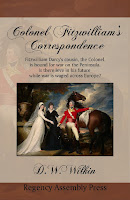
Mr. Wilkin writes Regency Historicals and Romances, Ruritanian (A great sub-genre that is fun to explore) and Edwardian Romances, Science Fiction and Fantasy works. He is the author of the very successful Pride & Prejudice continuation; Colonel Fitzwilliam’s Correspondence. He has several other novels set in Regency England including The End of the World and The Shattered Mirror. 


His most recent work is the humorous spoof; Jane Austen and Ghosts, a story of what would happen were we to make any of these Monsters and Austen stories into a movie.


And Two Peas in a Pod, a madcap tale of identical twin brothers in Regency London who find they must impersonate each other to pursue their loves.
He is published by Regency Assembly Press


The links for all locations selling Mr. Wilkin's work can be found at the webpage and will point you to your favorite internet bookstore: David’s Books, and at various Internet and realworld bookstores including the iBookstore, Amazon, Barnes and Noble, Smashwords.


And he maintains his own blog called The Things That Catch My Eye where the entire Regency Lexicon has been hosted these last months as well as the current work in progress of the full Regency Timeline is being presented.

You also may follow Mr. Wilkin on Twitter at @DWWilkin
Mr. Wilkin maintains a Pinterest page with pictures and links to all the Regency Research he uncovers at Pinterest Regency-Era