Showing posts with label Edward de Vere. Show all posts

Friday, March 3, 2017

The 17th Earl of Oxford: An Elizabethan Psychopath

by Anna Castle

Edward de Vere (12 April 1550 – 24 June 1604) was the 17th Earl of Oxford and not, by contemporary accounts, a very nice man. Charles Arundel, once one of the earl’s closest friends, attributed these qualities to him:
1. atheism
2. pathological lying
3. subornation
4. murder by hire
5. sedition
6. sexual perversion including pederasty
7. chronic inebriation
8. nursing of private grudges (especially against members of the Howard family)
9. lèse majesté. (treason committed against a sovereign power.)

Edward de Vere, 17th Earl of Oxford (Wikipedia)

For comparison, an article at Psychology Today list the major characteristics of a psychopath: 
1. cold-heartedness: being callous and showing a lack of empathy.
2. lack of 'social emotions', like shame, guilt, remorse.
3. irresponsibility and blaming others for events that are actually their fault.
4. insincere speech, ranging from glibness to pathological lying.
5. a grandiose sense of self worth; boastfulness.
6. pathologic egocentricity: selfishness.
7. inability to plan for the future, lack of realistic long-term goals.
8. violence; a low tolerance for frustration.

If you read Alan Nelson’s well-grounded biography (see reference below), you’ll probably recognize the earl in that psychology article.

A wilful child
Little Edward was a chip off the old block. His father was a violent, wilful, and inconsequential man who never sat on the Privy Council or earned the Order of the Garter. His son likewise failed to achieve any honors from his queen or his peers over the course of his fifty-four years.

When the 16th earl died in 1562, twelve-year-old Edward became a ward of Lord Burghley, the Queen’s Lord Treasurer and also Master of the Court of Wards. (Also Francis Bacon's uncle.) Burghley ran a sort of School for Orphaned Earls in his spacious house on the Strand. Others in his care were Robert Devereux, Earl of Essex, Henry Wriothesley, Earl of Southampton, and Roger Manners, Earl of Rutland. A selective group!

Biographer Nelson suggests that the rebelliousness of Burghley’s wards stemmed from their frustration with the stodgy and pious atmosphere of Burghley House, where the boys were kept to a strict schedule with plenty of prayers. Essex and Southampton went so far as to rebel against the Queen herself in 1603. 

From Sutton's Old Swordplay

But Oxford was more than merely rebellious. His first recorded act of violence was the killing of an undercook in 1567. Oxford was seventeen. He and a friend had been practicing with rapiers, the new weapon from the Continent. The exciting new weapon allowed the fighter to thrust and stab, rather than artlessly hacking away.

When the undercook chanced to walk across the yard, Oxford, wanting to test his new toy, drove the steel through the man's thigh. The poor fellow died a few hours later. Burghley hastened to repress the scandal, managing the process so that the coroner's official report stated that the undercook had been drunk and ran himself upon his lordship's rapier while Oxford was merely holding it in his hand, thus committing suicide. A masterpiece of spin!

Spare the rod and spoil the earl
Oxford received little punishment for the many acts of violence that punctuated his life. Nelson's book examines several murders committed by Oxford's men, presumably at his behest: "a massed attack on the residence of a personal enemy was, as we shall learn, Oxford's modus operandi".

Queen Elizabeth ignored that sort of thing among those of noble blood. But she tossed the earl into the Tower in 1581 for impregnating Anne Vavasour, a Maid of Honor. Anne was Towered as well, after delivering Oxford's bastard son. Oxford never contributed anything toward the support or education of the boy.

Anne Vavsour (Wikipedia)
This is hardly surprising, since he contributed next to nothing to the care of his three legitimate daughters, fruit of his union with Anne Cecil, Burghley's daughter. Burghley brokered that match himself, eager to ally his upstart family with the ancient nobility. Alas, Oxford was no catch. Somehow he got it into his head during Anne's first pregnancy that the child could not be his. True, he was in Italy during much of the relevant period, but not long enough to justify his accusations -- seen as wicked and bizarre at the time. Oxford refused to see his wife or even live with her for five years. In spite of this callous behavior, Lord Burghley continued to defend him and supply him with funds on demand.

The wages of sin
Oxford ran through money like a socialite on a spree. His estate was worth £12,000 in 1575. When he died in 1604, he left more debts than assets. He spent money on clothes, weapons, books, travel (especially to Italy, which he loved), retainers (a gang of violent men), and lush living.

He liked to host grand dinner parties, at which he would regale his friends with boasts and scandalous talk about his rivals and his intimate relations with the queen. He bragged that he had been offered £1,000 a year by the Pope, presumably for aiding the cause of returning England to the Catholic fold. He claimed the beauteous Countess of Mirandola had traveled 50 miles to share his bed.

He formed lifelong grudges against any man who rose in the queen's esteem, like Sir Philip Sydney, Sir Walter Ralegh, and the Earl of Leicester. He sent an armed man to assault Sir Walter in a narrow lane behind the tennis courts at Whitehall. Unsuccessfully, needless to say. Sir Walter was no easy target.

The vampire earl
In 1584, the earl accused his best friends of treason -- conspiring with Rome. History doesn’t tell us why; a rash whim or bitter humour, one supposes. The erstwhile friends rushed to testify against him to save their own skins. Charles Arundel is the one who called him "my monstrus adversarye Oxford, who wold drinke my blud rather than wine, as well as he loves it."

Oxford believed in satanic magics and weird prophesies. He flirted with Catholicism, doubtless attracted by the pomp and mystery, as well as the sheer danger of dancing with the enemy. He claimed to have had visions, some holy, others profane.

Signature of Edward de Vere (Wikipedia)

All in all, he was a truly appalling example of humanity, although Nelson manages to identify one positive trait. "[H]e was of course a fine calligrapher." Lovely handwriting; perhaps the saddest of all epitaphs.


References
Hutton, Alfred. 1892. Old Swordplay: A glance at the systems of fence in vogue during the XVIth, XVIIth, and XVIIIth centuries, with lessons arranged from the works of various ancient masters for the practical study of the use of the picturesque arms borne of forefathers.

Nelson, Alan. 2003. Monstrous Adversary: The life of Edward de Vere, 17th Earl of Oxford. Liverpool University Press. [Amazon link.]

~~~~~~~~~~

Anna Castle writes two historical series: Francis Bacon mysteries and the Professor & Mrs. Moriarty mysteries. She’s earned a series of degrees -- BA Classics, MS Computer Science, and PhD Linguistics -- and has had a corresponding series of careers -- waitressing, software engineering, assistant professor, and archivist. Writing fiction combines her lifelong love of stories and learning. Find out more at www.annacastle.com or visit her at
Her most recent book is from the Victorian Professor & Mrs. Moriarty series, Moriarty Takes His Medicine.

Sunday, January 25, 2015

The De Vere Family in the 17th Century

by Margaret Porter

The blood of the English de Veres, which still flows through the veins of Britain’s noble families—and some members of the present royal family—can be traced backwards in time to a Frenchman, Alberic de Vere. He accompanied William the Conqueror to England and in 1066 fought at the Battle of Hastings. Not long afterwards he was granted lands in Essex, the county most closely associated with his descendants. His grandson Aubrey, Count of Guines, was further ennobled as First Earl of Oxford by Empress Matilda when she was Queen of England. And down the centuries, through every reign, the de Veres were prominent as royal chamberlains, courtiers, and favourites.

Edward de Vere, 17th Earl of Oxford
The passage of five hundred years brings us to the 17th century and the waning days of the Seventeenth Earl—by far the most famous and illustrious member of his family. Edward de Vere was a shimmering star in Queen Elizabeth’s court, who referred to himself in his signature variously as "Oxford" or "Oxenford". For those who doubt that the genuine author of Shakespeare’s plays and poetry was a common glover’s son from Stratford, de Vere is most frequently proposed as their probable creator. He was a warrior-poet, in addition to being well-travelled, a gifted dancer, and a court officer. And, in the opinion of his wife Anne Cecil and her powerful father Lord Burghley, a terrible husband! It was his second wife, Elizabeth Trentham, who in 1593 provided an heir to his earldom.

Ten years later, at the death of his beloved Queen, Lord Oxford wrote to his brother-in-law of his grief, saying, “In this common shipwreck, mine is above all the rest.” On the accession of King James I, he asserted his hereditary claim as Lord Great Chamberlain and received from the King’s Wardrobe “forty yards of crimson velvet for the Earl’s own robes” to wear at the coronation on 25 July, 1603. Among his many duties on that date: delivering the uncrowned monarch's shirt, stockings, and underclothing to his bedchamber and dressing him for the coronation. As a perquisite, the Earl received “the bed on which the King had slept the night before the coronation and all his bedding, the coverlet, curtains, pillows, and hangings of the whole room, with the King’s nightgown.” During the coronation banquet, he presented the King's food. Oxford had but a year to enjoy his new possessions, for he died on 24 June, 1604.

Henry de Vere, 18th Earl of Oxford
His son and successor Henry was only eleven years old, the inheritor of a wasted estate. The boy's mother struggled to reclaim Hedingham, the de Veres’ ancestral castle in Essex, and other property in East Anglia. On attaining his majority he departed on a grand tour and spent five years in the Low Countries, France, and Italy. He later became Vice-Admiral of the Fleet, perhaps in order to keep him away from Parliament, where he was reportedly “one of the free-est speakers . . . .” He didn’t last long as a naval commander: disputes with the all-powerful Duke of Buckingham landed him in the Tower more than once. Like his father, he married a Cecil, but she bore him no children. He died at The Hague from a battle wound in 1625, two months after King James I, and was buried in Westminster Abbey.

Robert de Vere, 19th Earl of Oxford
As preparations began for Charles I’s coronation, Henry’s cousin Robert’s right of succession was disputed by another lord, preventing the presumptive Nineteenth Earl from taking part in the ceremony. Nearly a year later the House of Lords affirmed Robert’s status, and he took his seat in April 1626. In February of the following year his countess, Beatrice van Hemmema of Friesland, delivered their son Aubrey.

History repeated—like Edward and Henry de Vere before him, Aubrey became an earl when very young after his father fell at the Siege of Maastricht. Inheriting his title at the age of five, the Twentieth Earl of Oxford spent his childhood and early adolescence in Friesland with his mother’s family.

Aubrey de Vere, 20th Earl of Oxford
By the time Aubrey returned to England at age fourteen with his mother and sister, the de Vere properties were nearly all lost. He attended university at Oxford and began his long and rather distinguished career as a soldier—he loved a good fight on and off the battlefield and was a notorious duelist. In 1647 he took as his bride the ten-year-old heiress Anne Bayning, who brought him much-needed funds and a life interest in her Essex estates. A bright and promising future was dimmed by the execution of Charles I. Aubrey, a devoted royalist, fled to the Netherlands to join the court in exile. His estate was sequestered in 1651. Three years later he returned to England and landed in the Tower after being accused of plotting against Cromwell. This did not deter him--after his release, under the code name "Mr Waller" he participated in further royalist conspiracies and in 1659 was again imprisoned. His wife voluntarily joined him in the Tower, sickened, and died there. He was released a fortnight afterwards.

With the fall of the Commonwealth, the widower Aubrey, premiere earl of the realm, was among the six peers who invited Charles II to return to England. His good friend, the king he’d supported in exile, made him a Knight of the Garter, Lord Lieutenant of Essex, and gave him command of the regiment that was known as the “Oxford Blues.” He became a Privy Councillor and a Gentleman of the Bedchamber.

Aubrey, “the first of his Dignity in the Realm tho’ low in fortune,” was a gallant and courtly man, a gambler, and as lusty as Charles II’s other cronies—in other words, a very typical nobleman of the Restoration court. He arranged a false marriage to an actress who stirred his lust, employing one of His Majesty’s trumpeters to serve as “priest”. Despite the deception, the lady remained with him and in 1664 bore him a son. The mother referred to the boy Lord Bolbec, the courtesy title granted to an Earl of Oxford’s heir apparent, although he was the product of an unlawful marriage. Not surprisingly, the liaison didn’t last.

Aubrey proved himself a friend of the theatre in another way, by loaning out his coronation robes for a production of Shakespeare's Henry IV!

Diana Kirke by Peter Lely
His next mistress of note was the beautiful and immoral Diana Kirke, daughter of Whitehall Palace’s keeper and granddaughter of Aurelian Townsend, who composed court masques for King Charles I and Queen Henrietta Maria. When Di fell pregnant, the King offered the couple an annual pension of £2000 if they married. And so they did, in April 1673. Their first child, Charlotte, arrived not many months later.  She and her brother Charles, the true Lord Bolbec, died very young. Of the Oxfords' three surviving daughters, only one had an unblemished reputation—Lady Diana, the future First Duchess of St. Albans, who married Charles II’s son by Nell Gwyn. Lady Mary and Lady Henrietta, who were very possibly sired by Di's paramours, were as scandalous as their mother but did not succeed in marrying any of their lovers.

At James II’s accession in 1685, Aubrey was appointed Privy Councillor. At the coronation on 23 April his responsibilities were the same as when Charles II was crowned, and his wife took precedence over the other countesses. The Lord Chamberlain's instructions for the coronation clearly outline their positions: In procession of Countesses, four abreast, excepting Diana Countess of Oxford, alone….In procession of His Majesties regalia: The Sword of State in the Scabbard, born by Aubrey de Vere Earl of Oxford, Premier Earl of England, in his Robes of Estate, and Collar of the Order. 

Aubrey and James eventually fell out—the Earl refused to submit to the new King’s pro-Catholic policies and his stubborn intention to abolish the Test Act. Aubrey and his regiment supported the Protestant cause embodied in Prince William of Orange, and he welcomed the Dutch invader to England. After the accession of William and Mary, Aubrey participated in their coronation (his daughter Diana was one of the Queen’s train-bearers), and his former offices and honours were restored to him. He and the Oxford Blues fought against James II’s forces in Ireland, most notably at the Battle of the Boyne. In 1700 and and the following year he was commissioned as Speaker of the House of Lords, serving until William III revoked his privilege in September 1701.

Queen Anne was the last of the many monarchs Aubrey helped to crown. He succumbed to a serious illness in the winter of 1703 and died at his house in Downing Street, aged seventy-six. He was buried with his first wife Anne and many of his ancestors in Westminster Abbey's Chapel of St. John the Evangelist. The historic earldom of Oxford (first creation) died with him, as he had no legitimate son.

His daughter Diana, Duchess of St Albans, was a renowned beauty. Not long after her father's death, a member of the Kit-Kat club (a Whig drinking and discussion society) paid tribute to her and the de Veres' martial exploits by engraving these verses on a toasting glass:

1st Duchess of St Albans, 1694
Author's Collection
The line of Vere, so long renown’d in arms,
Concludes with luster in St. Albans’s charms;
Her conquering eyes have made their race complete,
It rose in valor, and in beauty set. 

Through Diana, the de Vere bloodline extended through her numerous offspring (eight of her nine sons survived) to the present day. Although the Beauclerks are more often described as direct descendants of King Charles II, they are equally connected to Aubrey the great 17th century courtier and his forbears. Murray de Vere Beauclerk, the current and Fourteenth Duke of St Albans, bears the name that Alberic brought to England in the 11th century, as does his eldest son, an author--and biographer of their ancestress Nell Gwyn.

Members of the royal family who carry de Vere DNA are William, Duke of Cambridge (through his mother Diana, Princess of Wales) and his son Prince George.

Sources:

The de Veres of Castle Hedingham, Verily Anderson
Manuscript letters written by Aubrey de Vere, 20th Earl of Oxford, held by the British Library
Beauclerk family papers held by the London Metropolitan Archive
A Genealogical History of the Dormant, Abeyant, Forfeited, and Extinct Peerages of the British Empire, Sir Bernard Burke
The Diary of Samuel Pepys
The Fighting Veres, Sir Clements Robert Markham
Monstrous Adversary: The Life of Edward de Vere, 17th Earl of Oxford, Alan H. Nelson
Dictionary of National Biography

~~~~~~~~~~~~~

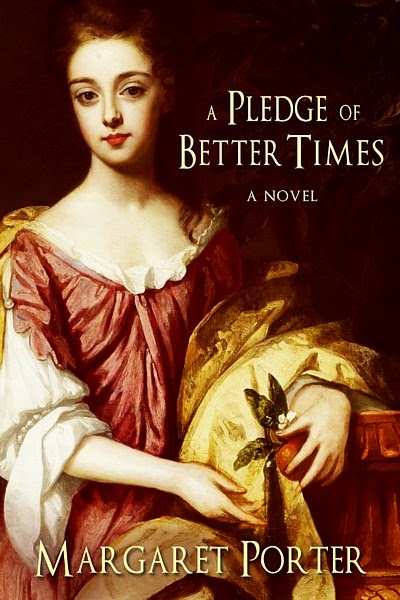
Margaret Porter, who can claim a few tiny drops of de Vere blood, is the award-winning and bestselling author of several historical fiction genres, and is also published in nonfiction and poetry. A Pledge of Better Times, the story of courtiers Lady Diana de Vere and Charles Beauclerk, 1st Duke of St. Albans, and of Diana's father Aubrey de Vere, will be available in April 2015. Margaret studied British history in the UK and the US. As historian, her areas of speciality are social, theatrical, and garden history of the 17th and 18th centuries, royal courts, and portraiture. A former actress, she gave up the stage and screen to devote herself to fiction writing, travel, and her rose gardens.